
A 100-unit community in Florida found its roof reserves were $400,000 short, the same month state law required a full structural inspection. The board had no management company to blame and no cash to fix it. So homeowners each got hit with a $4,000 special assessment. That is the double edge of running a self-managed homeowners association. You keep the money an HOA management company would have charged, but you also inherit every deadline, reserve gap, and compliance risk. This article walks through what self-management requires, how to transition into it, and where volunteer boards get burned.
Key Takeaways
- A self-managed homeowners association is governed entirely by its volunteer board, which absorbs the finances, maintenance, and rule enforcement a management company would normally handle.
- Cutting a management company can save a 100-unit community $12,000 to $36,000 a year, but part of that should be reinvested in software and reserve planning.
- Board members almost always serve unpaid, which makes burnout and turnover the leading threats to a self-managed community's stability.
- Reserve funding shortfalls and tightening state laws in places like Florida and California are the compliance risks that expose self-managed boards to special assessments and liability.
- The right software and D&O insurance are what let volunteer boards stay self-managed responsibly rather than defaulting back to a management company.

What a self-managed HOA is and how it differs from professional management
A self-managed HOA runs without a third-party HOA management company. The volunteer board handles the accounting, vendor contracts, dues collection, and rule enforcement directly. Most boards use software rather than paid staff. Under professional management, an outside firm does that work and charges a monthly fee per unit, plus extras like violation letters and reserve study coordination.
The practical difference is control and cost. Most boards assume a management company handles the hard decisions. In reality, the board still votes on budgets, approves special assessments, and carries the legal responsibility no matter who processes the paperwork. HOA self-management just removes the middle layer. That works best for small to mid-sized communities where the volume of requests stays manageable, and residents are willing to serve. Nationwide, American Housing Survey data shows just how many households now live in community associations, which underscores why getting self-management right matters.
Rules on what boards can and cannot do vary heavily by state. The Community Associations Institute's Best Practices reports lay out governance standards that apply whether or not you use a management company. Read your governing documents alongside them before deciding your community is ready for HOA self-management, and if you're comparing tools, review the best HOA management software for self-managed boards before committing.
Core responsibilities a self-managed board must handle (finances, maintenance, dues, vendors, compliance)
Once you drop the management company, five jobs land squarely on the board. First, financial management: budgeting and reporting, tracking every dollar, and keeping operating funds separate from reserves. Second, maintenance tracking and planning, from routine landscaping to the deferred maintenance that turns into emergencies. Third, dues collection, including late notices and, occasionally, liens. Fourth, vendor management: soliciting bids, vetting insurance, and holding contractors accountable. Fifth, legal compliance and record keeping that satisfies state laws.
Here's the hard truth: these board responsibilities do not shrink because you're a volunteer. A treasurer with a full-time job still owes the same fiduciary duty as a paid manager. The root cause of most self-managed failures is not laziness; it's disorganization. When dues, vendor bids, and maintenance requests live in email threads and shoeboxes, nothing gets tracked, and financial transparency evaporates. Smaller communities in particular benefit from solid bookkeeping tips for small HOAs to keep those records clean from the start.
State attorneys general and consumer protection offices publish guidance on homeowners association obligations. The Federal Trade Commission's consumer resources cover the debt collection rules that apply when you pursue unpaid dues, and the Consumer Financial Protection Bureau's consumer financial protection resources offer additional guidance boards can point residents to. Many volunteer board members never realize those rules govern their own community.

Step-by-step action path to start or transition to self-management
A clean transition to self-management follows a defined order. Rushing it is how communities lose records and miss filing deadlines.
1. Review your governing documents and state statutes to confirm the board has authority to self-manage and to identify any required disclosures.
2. Give your current management company written termination notice per your contract, noting the exact date all records and funds transfer.
3. Collect every record: financial statements, bank access, vendor contracts, insurance policies, the reserve study, and homeowner files.
4. Open or take control of the association's bank accounts, keeping operating and reserve funds strictly separate.
5. Order or update a professional reserve study so your reserve planning reflects current replacement costs.
6. Choose self-managed HOA software to run dues collection, budgeting and reporting, violation tracking, and resident communication in one place.
7. Set up a member portal so homeowners can pay dues, submit requests, and see financial transparency without calling a board member.
8. Assign clear board responsibilities: treasurer owns finances, another director owns maintenance tracking, another owns compliance.
9. Notify all residents in writing of the transition to self-management and the new payment and contact process.
Move through these in sequence and the transition to self-management takes weeks, not months. If your first budget cycle feels daunting, a step-by-step HOA budget template can give the treasurer a reliable starting framework.
Benefits of self-management: cost savings, control, and transparency
The cost savings are the headline. An HOA management company charging $20 per unit on a 100-home community pulls roughly $24,000 a year, before add-on fees. Redirect even half of that into a reserve study and self-managed HOA software. You strengthen stability while spending less than the old fees.
Control is the quieter benefit. A self-managed homeowners association sets its own priorities instead of waiting on a manager who juggles thirty other associations. When a fence blows down, the board approves the repair the same week rather than sitting in a queue. Handling your own books also means you'll want to understand tax filing obligations, such as the IRS Form 1120-H instructions for homeowners associations, which many boards previously left entirely to their management company.
Then there's financial transparency. Most boards assume homeowners trust them. In reality, trust collapses the moment residents can't see where their dues go. Self-management, run through software, puts budgeting and reporting in front of every member. That visibility is what prevents the whisper campaigns that tear communities apart.

Common self-management pitfalls and how to overcome them (objection handling)
The most common objection is confidence: "We're just volunteers, we can't do what a management company does." What many communities don't realize is that the management company was mostly running software and sending letters. The right self-managed HOA software does the same work. Self-management is less about expertise and more about having practical tools.
The second objection sounds reasonable: "Our management company already handles all this." That's exactly the reason to reconsider. If a company charges thousands a year to process dues and mail violation notices, that money could fund your reserves instead. Before you renew any contract, it's worth learning the HOA management company red flags that signal you're overpaying for underwhelming service.
The real pitfalls are internal. Board burnout tops the list, because a handful of unpaid people cannot manually track violations, chase dues, and coordinate vendors forever. Picture a five-member board where the treasurer moves away mid-year and no one has access to the bank records or the vendor list. Dues stop getting deposited on time, a landscaping contract lapses, and the community spends three months untangling accounts it could have automated. The fix is automation. Let software handle repetitive dues collection and violation tracking so volunteers spend hours on decisions, not data entry. The other pitfall is poor record keeping, which turns a routine ownership dispute into a legal mess. Both problems disappear when the whole operation lives in one system instead of scattered inboxes.
Legal compliance and fiduciary duty for volunteer boards
Every director on a self-managed board carries a fiduciary duty: the legal obligation to act in the association's best interest, not their own. That duty does not weaken because the role is unpaid. Courts have held volunteer board members to the same standard of care as paid managers. That is why legal compliance cannot be an afterthought.
The reason this matters is exposure. When a board skips a required reserve study, ignores an insurance renewal, or enforces rules inconsistently, individual directors can face personal claims. Directors & Officers insurance shields good-faith decisions, but it does not cover fraud or gross negligence.
HOA laws vary significantly by state. Compliance-heavy states like Florida, California, Nevada, and Colorado have added stricter reserve and inspection requirements in recent years. Boards in California, for instance, should read the California Davis-Stirling Common Interest Development Act closely, since it governs nearly every aspect of association operations. Reference your state's HOA or condominium statute directly, and read your governing documents alongside it. Boards should consult their attorney for legal interpretation rather than relying on a neighbor's memory of the rules. A condo association in particular should confirm its structural inspection obligations, because those deadlines carry real penalties.

Reserve planning and avoiding special assessments in a self-managed HOA
Special assessments are almost always a symptom of failed reserve planning. When a roof, elevator, or parking lot reaches end of life, and the reserve fund is empty, the board has one option left: bill every homeowner at once. The 2021 Surfside condo association collapse near Miami killed 98 people. It put a national spotlight on how deferred maintenance and underfunded reserves endanger lives, not just budgets.
A reserve study is the tool that prevents this. It projects when major components will need replacement and how much to set aside each month. What actually happens in underfunded communities is a slow drift. Boards keep dues artificially low to stay popular, reserves fall behind inflation, and one bad year triggers a five-figure assessment per unit. Because obligations differ so widely, it pays to check the reserve study requirements by state that apply to your community.
Run the reserve study, then fund it. Automated reserve study tools tied to your HOA management software help boards see funding gaps early and adjust dues gradually instead of dropping a special assessment on residents. Solume builds reserve study tracking directly into its platform, which most HOA management software leaves out entirely. You can learn more about the process through our reserve study guide.
Using an AI assistant for 24/7 compliance and governing-document support
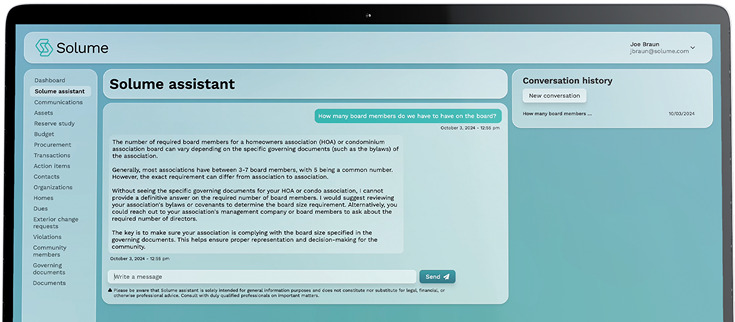
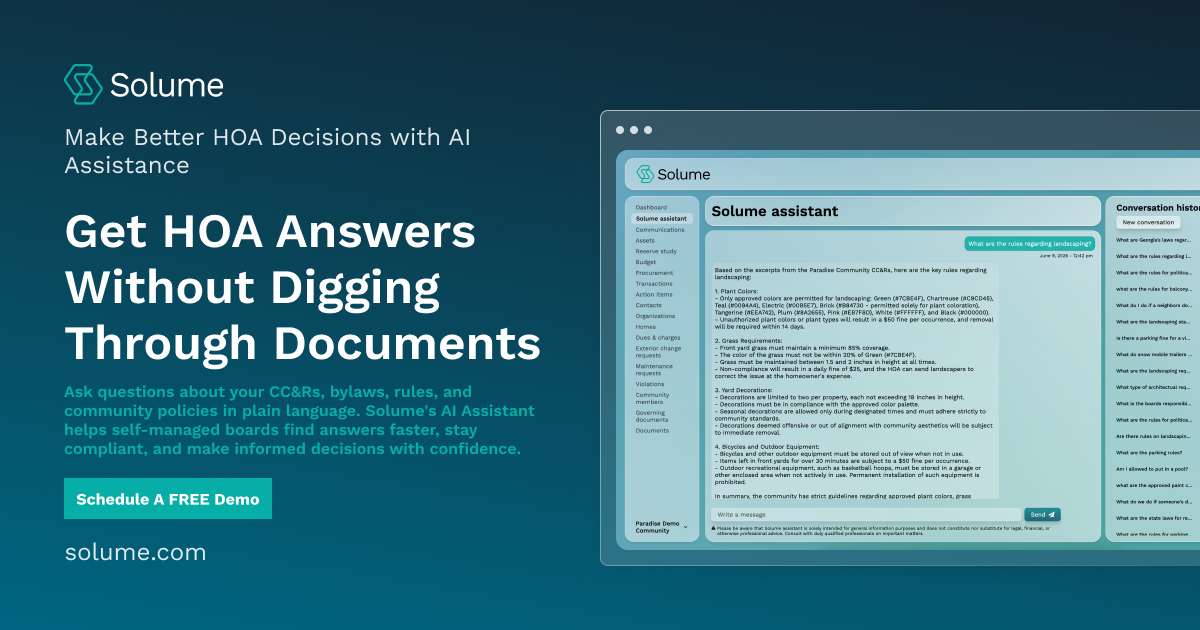
Volunteer board members rarely have a lawyer on speed dial, and legal questions do not wait for the next board meeting. A resident disputes a fine at 9 p.m. A director needs to know whether the architectural review committee can reject a fence color. An AI assistant trained on your governing documents and state laws helps surface those answers instantly, at any hour.
This is where HOA self-management stops feeling overwhelming. Instead of digging through a 60-page declaration to confirm a rule, a board member asks the AI assistant and gets a plain-language summary with the relevant section cited. Solume's AI Assistant provides that kind of 24/7 support for compliance questions and governing-document lookups, so boards act faster and with more confidence.
To be clear, an AI assistant supports decisions. It does not replace your attorney for formal legal interpretation. Used well, it closes the knowledge gap that pushes many communities back toward a management company they didn't actually need. Running a self-managed homeowners association well comes down to keeping records clean, reserves funded, and compliance current, and the right tools make that manageable for a volunteer board.
If your board wants a clearer way to handle financial management, reserve planning, and compliance without a management company, you can see whether Solume fits your community on a short 15-minute call. There's also a free 30-day trial if you'd rather test the software first, especially useful for small to mid-sized communities weighing the switch.
Frequently Asked Questions
How much can a community really save by dropping its management company?
Management fees typically run $10 to $30 per unit per month, so a 100-unit community pays roughly $12,000 to $36,000 a year. Self-managing eliminates that fee, though boards usually reinvest $50 to $250 per month in management software to keep operations organized.
Do board members in a self-managed HOA get paid for the work?
No. In the vast majority of cases, including five-person boards in Florida, directors serve as unpaid volunteers who dedicate personal time to the community. Their compensation is limited to running the association they live in, not a salary.
What's the biggest downside of self-managing that boards underestimate?
The most overlooked risk is compliance and financial exposure: reserve funding shortfalls, missed state filing requirements, and deferred maintenance that leads to special assessments. States like Florida and California have tightened reserve laws, so a volunteer board without accounting or legal expertise can create liability faster than it saves money.
Can an HOA president be held personally liable if something goes wrong?
A president can be sued personally, though most claims are shielded when directors act in good faith within their fiduciary duty and the association carries Directors & Officers (D&O) insurance. Personal exposure rises when boards act with negligence, fraud, or outside their governing authority.
What tools do self-managed boards use instead of a management company?
Boards typically rely on HOA management software to handle dues, financial reporting, reserve tracking, and resident communication in one place. Platforms like Solume, built for volunteer boards, focus on fund separation, compliance tracking, and reserve planning rather than tools designed for professional property managers.
What happens if our volunteer board can't keep up with the workload?
Board burnout is one of the most common reasons self-managed communities struggle, often leading to missed maintenance, disorganized finances, and eventual hiring of a management company. Automating repetitive tasks like dues collection, reserve tracking, and homeowner requests is the practical way boards stay self-managed without exhausting their volunteers.