KEY TAKEAWAYS
- Check your state laws before anything else. Thirteen states require reserve studies by statute for condo associations, and several mandate that the study be conducted by a licensed professional. What was optional two years ago may be legally required today.
- Start with a complete asset and element inventory. An asset is the broad category -- a community pool. An element is every sub-component within it -- the pump, filtration system, chlorination equipment, pool deck, and fencing. The more granular your list, the more accurate your funding projections.
- Three numbers drive the financial analysis: useful life, remaining useful life, and estimated replacement cost today. Get current figures from contractors who specialize in each asset category rather than relying on national averages.
- There is a real case for both DIY and professional approaches. DIY is cheaper and builds board knowledge. A professional brings current cost data, trained condition assessment, and speed -- and is required by law in several states.
- Solume strongly recommends hiring a professional for any community with structural assets including parking garages, balconies, decks, or retention ponds. The liability exposure from an inaccurate structural assessment is not a risk worth taking.
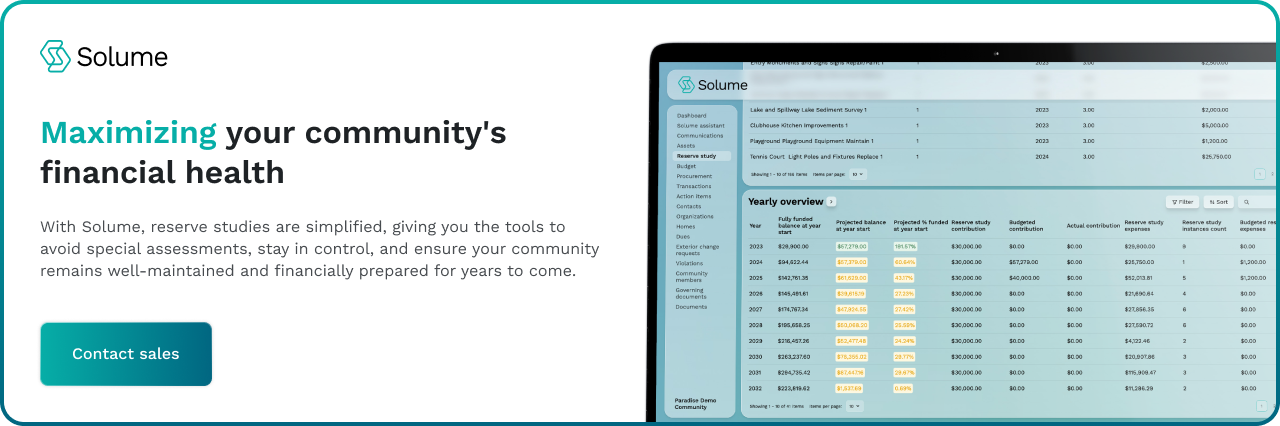
- A reserve study delivered as a PDF is not a management tool. It is a document. Most boards file it and forget it. Solume takes that static data and turns it into a live financial dashboard connected to your budget, vendor procurement, and homeowner reporting.
- Solume is the only all-in-one HOA platform with built-in reserve study management. We do not conduct reserve studies ourselves, but we partner with credentialed professionals and can connect your community with the right expert -- then make sure the results actually get used.
Most HOA boards know they need a reserve study. Fewer actually have one that is current, accurate, and connected to anything they use day to day.
That gap is where communities get into trouble. A reserve study sitting in a PDF on someone's desktop is not a financial plan. It's a document. There's a difference.
This guide walks through how a reserve study actually gets done, what the process looks like whether you hire a professional or take a guided DIY approach, and why what happens after the study matters just as much as the study itself.
IMPORTANT DISCLAIMER
Before you begin: Reserve study requirements vary by state. In many states, a professional reserve study must be conducted by a licensed engineer, certified reserve specialist, or other credentialed professional. Check your state statutes and governing documents before attempting any DIY approach.
Additionally, Solume strongly recommends hiring an outside professional for any community with assets that could pose a safety risk if improperly assessed, including parking garages, retention ponds, balconies, decks, and any structural elements. The cost of getting this wrong is not worth the savings.
Step One: Check Your State Laws Before Anything Else
This is not a formality. It's the first real decision your board needs to make.
Thirteen states currently require reserve studies by statute for condominium associations, including California, Florida, Nevada, New Jersey, Washington, Hawaii, Colorado, Delaware, Maryland, Oregon, Tennessee, Utah, and Virginia. Several others require reserve funding without mandating a formal study. The requirements in each state differ on who can conduct the study, how often it must be updated, what it needs to include, and whether a licensed professional or structural engineer must be involved.
Florida now requires a Structural Integrity Reserve Study for condominium buildings three stories or higher, and that study must be conducted by a licensed engineer or architect. California requires a visual inspection every three years and has added balcony and deck inspection requirements under SB 326. New Jersey's 2024 legislation requires studies be conducted by a CAI-accredited Reserve Specialist, a licensed engineer, or a licensed architect.
The takeaway is simple: before your board decides how to proceed, look up your state's current requirements. Laws in this space have been changing quickly since the 2021 Surfside collapse, and what was optional two years ago may now be mandatory. When in doubt, consult your HOA attorney.
Step Two: Inventory Every Asset Your Community Owns and Maintains
A reserve study is only as good as the asset list it's built on. If you don't know what you own, you can't plan for it.
Here's how to think about it. Start big, then break it down. We use two terms in this context: assets and elements. An asset is the broad category—the community pool, the clubhouse, the parking lot. An element is everything that makes up that asset. The pool as an asset contains elements: the pump system, the filtration system, the chlorination equipment, the pool deck surface, the fencing, the lighting. Each element has its own useful life and its own replacement cost.
Go through every shared or common area your association is responsible for maintaining. That typically includes:
- Roofing systems on common area buildings
- Exterior building surfaces, siding, windows, and paint
- Parking lots, driveways, and roadways
- Pool and spa equipment
- HVAC systems serving common areas
- Elevators and mechanical systems
- Fencing, gates, and security systems
- Lighting infrastructure
- Landscaping features and irrigation systems
- Playground equipment and recreational amenities
- Clubhouse interiors, including flooring, appliances, and fixtures
- Retention ponds, drainage systems, and any structural elements
The more granular you get, the more accurate your study will be. A board that lists pool as a single line item will get a very different (and less useful) funding projection than one that breaks it down into every component with its own lifespan and cost estimate. Yes, the longer list takes more time. It also produces numbers you can actually rely on.
Step Three: Get the Financial Data Right
An asset list tells you what you own. The financial analysis tells you what to do about it.
For each asset and element on your list, you need three pieces of information:
- Useful life -- How long should this item last under normal conditions? A commercial roof might have a 20-year useful life. A pool pump might be 10 to 12 years. Asphalt parking lots typically run 20 to 25 years before resurfacing.
- Remaining useful life -- Where is this specific item in its lifespan right now? A roof installed eight years ago on a 20-year system has roughly 12 years of remaining useful life. This is where condition assessment matters most.
- Estimated replacement cost today -- What would it cost to replace or fully repair this item at current labor and material prices? Not what it cost when it was installed. Not a rough estimate. An actual current figure based on your market.
Getting accurate numbers on replacement costs is where a lot of DIY reserve studies fall short. Construction costs vary significantly by region and fluctuate with material prices and labor markets. The best approach is to bring in contractors who specialize in each category -- a roofing contractor for roof systems, a pool company for pool equipment, a paving contractor for parking surfaces -- and have them provide written assessments. This gives you defensible, current numbers rather than figures pulled from a national database that may not reflect your local market.
Once you have useful life, remaining useful life, and current replacement cost for each element, the math to build a funding plan becomes straightforward. You're essentially calculating how much money needs to be set aside each year so the funds are available when each item comes due.
DIY vs. Hiring a Professional: Weighing the Options
There's a real case to be made for both approaches, and the right answer depends on your community's size, complexity, state requirements, and risk tolerance.
The Case for Doing It Yourself
For smaller communities with straightforward assets and no statutory requirement for professional involvement, a board-managed reserve study can work. Here are the honest advantages:
- Lower cost. A professional reserve study typically runs between 00 and ,000 depending on community size and complexity. For a small association on a tight budget, that's a real consideration.
- Go at your own pace. You can build the inventory and gather contractor quotes over several months rather than on a firm project timeline.
- Deep community knowledge. Board members who walk through the process themselves often come away with a much clearer picture of what condition things are actually in. That understanding tends to produce better financial decisions over time, rather than staring at a spreadsheet trying to figure out what it all means.
The Case for Hiring a Professional
For most communities, and especially any community with significant shared infrastructure, a credentialed reserve specialist is worth every dollar. Here is why:
- Professional condition assessment. A trained reserve specialist knows what to look for in ways a board member simply does not. They can identify deferred maintenance, catch early signs of deterioration, and flag components that are aging faster than their theoretical lifespan suggests.
- Current cost data. Professional reserve analysts use regularly updated construction cost databases that reflect real regional pricing. That's significantly more reliable than getting a few contractor quotes and averaging them.
- Speed. A professional can complete a study in weeks that might take a board weeks to assemble on their own. And honestly, one of the biggest risks with DIY reserve studies is that they never actually get finished.
- State compliance. In states where a licensed professional is required, there is no DIY option. Don't put your board in a position of thinking you're covered when you're not.
Solume's recommendation is straightforward: if your community has any assets that require structural assessment -- parking garages, balconies, decks, retention ponds, older building systems -- hire a professional. The liability exposure from an inaccurate assessment of a structural element is not a risk worth taking to save a few hundred dollars.
Why a PDF Is Not a Reserve Plan -- And What to Do Instead
Here is a problem almost every HOA board runs into, whether they conduct a study themselves or hire a professional: the reserve study gets delivered as a PDF, it goes into a folder or a filing cabinet, and six months later nobody is looking at it.
This is not a criticism of reserve study professionals -- the studies themselves are thorough and well-constructed. The problem is the format. A static document is not a management tool. And managing a multi-million dollar community's financial future from a PDF is, bluntly, a bad idea.
This is exactly the problem Solume was built to solve.
Solume is the only all-in-one HOA management platform that includes built-in reserve study management. When your reserve study data lives inside Solume, it stops being a document and becomes a living part of how your community operates. Your reserve projections connect directly to your annual budget. Your component timelines are visible alongside your vendor management and procurement. Your board reports pull from the same data your financial planning is built on. Everything talks to each other.
That integration matters more than it might sound. Most boards today manage their reserve study in one place, their operating budget in another, and their vendor relationships in a third. When those systems don't talk to each other, gaps develop. A roof replacement that's two years out doesn't show up in next year's budget conversation because nobody connected those two pieces of information. With Solume, that connection is built in.
Beyond the financial planning tools, Solume gives homeowners portal access to reserve status and financial reports. Transparent communication about reserve health is one of the most effective ways to build trust between the board and the community -- and to make the case for contribution increases when they're needed. When homeowners can see the data, the conversation changes completely.
If you've got a reserve study sitting in a PDF somewhere that nobody looks at, that's the starting point. Getting that data into a platform that actually connects it to how you manage your community is what turns a document into a plan.
Solume doesn't replace the reserve specialist. It makes sure the work the specialist did actually gets used. If you want to see how that works in practice, a 15-minute call is enough to know whether it fits what your community is trying to do.
Frequently Asked Questions: How to Conduct a Reserve Study
1. Can an HOA board conduct its own reserve study?
In many states, yes -- there is no legal requirement that a professional conduct the study. But in states like Florida, New Jersey, and California, a licensed engineer or credentialed specialist is required for at least part of the process. Even where it's not required, boards should think carefully before self-conducting studies for communities with structural assets like parking garages, balconies, or elevated walkways. Getting those assessments wrong carries real liability risk.
2. What is the difference between an asset and an element in a reserve study?
An asset is the broad category -- the community pool, the clubhouse, the parking lot. An element is a component within that asset. The pool as an asset contains elements like the pump, the chlorination system, the pool deck, the fencing, and the lighting. Each element gets its own useful life, remaining useful life, and replacement cost estimate. The more granular your element breakdown, the more accurate your funding projections will be.
3. How do we determine replacement costs for our reserve study?
The most reliable approach is to bring in contractors who specialize in each asset category and get written estimates. A roofing contractor for your roof systems, a paving contractor for your parking surfaces, a pool company for your pool equipment. Professional reserve analysts use updated construction cost databases that reflect regional pricing -- which is one of the key advantages of hiring a professional over doing it yourself.
4. How often should a reserve study be updated?
At minimum, every three to five years with a full site inspection. Many states with mandatory reserve study laws require updates on a specific cycle -- California every three years, Nevada every five. Annual internal reviews are strongly recommended regardless of state requirements. Associations that review annually are far less likely to be caught off guard by a major repair that wasn't adequately funded.
5. What happens if we skip the reserve study?
In states where it's legally required, the board faces compliance exposure and potential personal liability. Even where it's not required, the consequences of an underfunded reserve are predictable: deferred maintenance, deteriorating property values, and eventually a special assessment that nobody saw coming -- or should have, if someone had been doing the math. Lenders also check reserve adequacy when approving mortgages in your community. An underfunded or unstudied association can make units harder to sell.
6. Does Solume provide reserve studies?
Solume does not conduct professional reserve studies. What Solume does is help your board manage the process, stay organized through it, and actually use the results once the study is complete. We partner with credentialed reserve study professionals and can connect your community with the right expert. Once you have a study in hand, Solume turns that static data into a live financial dashboard connected to your budget, vendor management, and homeowner communications.