
Key Takeaways
- Colorado law requires every HOA and Condo Association to adopt a formal reserve policy, but it doesn’t require a reserve study outright.
- Boards must show how they plan to maintain fund reserves and ensure the long-term financial stability of their communities.
- Conducting a professional reserve study is still considered best practice and can prevent surprise special assessments and underfunded reserves.
- Modern platforms like Solume help automate reserve tracking, integrate it into financial planning tools, and ensure transparency for both boards and homeowners.

What Are Colorado HOA Reserve Study Requirements?
I lived in Colorado for several years, in one of the largest master-planned communities—Highlands Ranch. I know firsthand how residents love the beauty and organization of Colorado communities, but also how quickly conversations about HOA budgets can turn into debates about fairness, planning, and priorities.
Under Colorado’s Common Interest Ownership Act (CCIOA), associations are required to adopt a written reserve policy (C.R.S. § 38-33.3-209.5). This means the board must define how reserve funds will be maintained, reviewed, and potentially replenished. While a full reserve study isn’t legally mandated, failing to have a reserve policy—or not following one—can lead to questions about legal compliance and fiduciary duty.
Defining an HOA Reserve Study
A reserve study is a structured evaluation of the physical assets your association maintains. Items such as roofs, pavement, clubhouses, electrical systems, and other common area components are frequently included. It projects when these major repairs will occur, their estimated remaining useful life, and their estimated replacement cost.
Traditional reserve studies typically include:
- A site inspection and visual inspection of major systems and structural components.
- A financial reserve analysis outlining the cost and timeline of each reserve item.
- A funding plan that projects contributions and expenditures over the next fiscal year and beyond.
A Reserve Specialist or licensed engineer typically conducts the study, ensuring accurate cost estimates and a clear maintenance plan for future repairs.
Legal Requirements Under Colorado Statutes
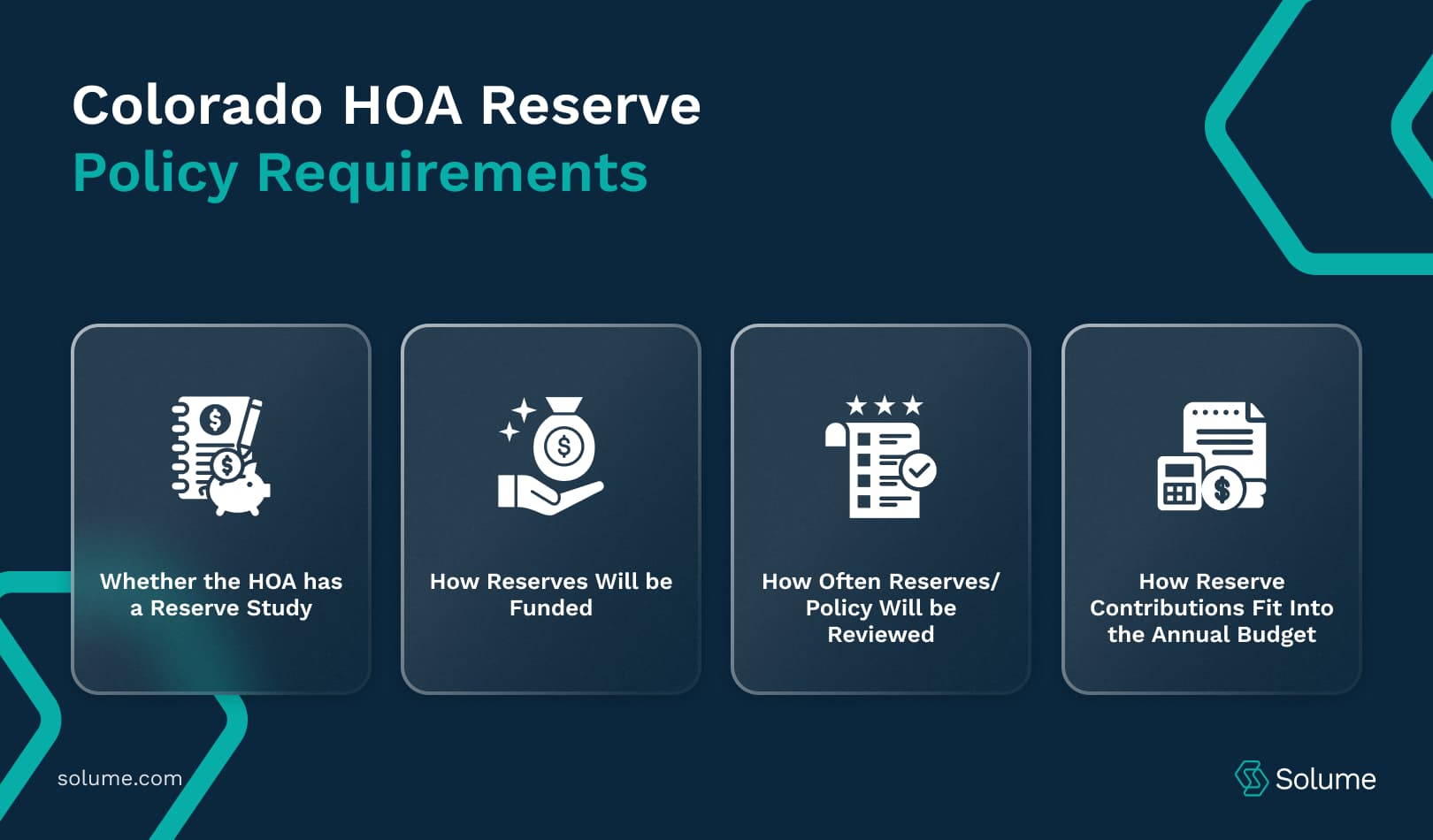
While the Colorado Statutes do not explicitly require a reserve study, they do require every board of directors to adopt and disclose a reserve policy. The policy must outline:
- Whether the association has a current reserve study.
- How the association plans to fund reserves.
- How often will the policy be reviewed or updated
Even though CCIOA stops short of mandating a formal study, most experts, including reserve study companies and legal advisors, recommend performing one every three to five years. It helps boards make informed decisions and maintain financial health across multiple budget cycles.
Why Reserve Studies Are Crucial for Colorado HOAs
Protecting Property Values and Structural Integrity
If you're reading this, I suspect you either live in or are looking to move to Colorado. If you're looking to move (or invest there), one thing you need to understand is how unpredictable the weather is. Snow in April, hail in July, fire risks, and sun that can age building paint faster than expected. In areas like Ken Caryl southwest of Denver, the land itself presents challenges, with shifting soils and compressed ground that can strain building foundations over time. These land issues make regular assessments and a thorough Reserve Study essential (even if they're not legally required) for catching early signs of structural movement before they become major repairs. Without a reserve study or at least a detailed reserve policy, it’s easy to overlook wear and tear on key structural components.
A reserve study acts as a financial planning tool, protecting property values by ensuring timely repairs to:
- Roofs and load-bearing walls
- Electrical systems and fire protection systems
- Pavement, parking lots, and pavement resurfacing
- Clubhouses, pools, and other community amenities
- Shifting terrain and soil compression can cause foundation cracks and drainage issues. Including these land and foundation factors in your reserve study ensures accurate budgeting for potential structural repairs and long-term stability.
Deferred maintenance doesn’t just impact appearances—it erodes financial stability. A well-documented structural integrity reserve study allows the board to plan ahead, instead of reacting in crisis.
Financial Health and Avoiding Special Assessments
Reserve funds aren’t just a savings account—they’re your community’s safety net. When boards underfund reserves, the result is predictable: special assessments, tension at board meetings, and a loss of trust.
By maintaining adequate reserves, boards can fund capital expenditures and deferred maintenance expenses without shocking homeowners with sudden fees. Every board should aim for a long-term funding plan that ensures balance between dues, expenses, and future repairs.
Key Elements of a Colorado HOA Reserve Study
Inspections and Reserve Analysis
Even though not mandated by state law, an on-site reserve analysis is the most reliable way to identify issues before they become financial emergencies.
A professional inspection typically includes:
- Site inspection and visual inspection of roofs, drainage, and foundation.
- Identifying major components requiring major repairs or replacement.
- Estimating remaining useful life, estimated replacement cost, and reserve contribution needs.
- Creating a long-term reserve funding plan aligned with the annual budget.
Regular reserve study updates help track changes over time and align spending with actual conditions.
Important Reserve Items and Common Elements
For Colorado’s diverse terrain and climate, these costs can quickly add up. Wildfires along the Front Range, shifting soils in the foothills, and those freeze-thaw cycles up in the mountains all pile on extra maintenance headaches. Communities have to think ahead. Cracked foundations, drainage issues, and land movement can sneak up fast in Colorado’s unpredictable conditions. Planning for this stuff early saves money and prevents a lot of stress later. The biggest expense categories for homeowners associations in Colorado often include:
- Roof replacement and exterior painting
- Pavement resurfacing and drainage maintenance
- Electrical systems and fire protection systems
- Clubhouse repairs, playgrounds, and common area components
A clear maintenance plan prevents deferred work from becoming urgent—and costly.
Best Practices for HOA Reserve Planning in Colorado
Working with Professionals
For most communities, hiring a reserve study company or licensed engineer is worth it. They know how to look at the parts of your property that matter most—balconies, parking decks, foundations—the things that, if they fail, can actually put people in danger. When you bring in the right professional, you’re not just getting cost estimates. You’re getting someone who helps you see risk clearly and plan before something serious happens.
Even if your association opts to self-manage, it’s wise to review your reserve policy with a CPA or attorney specializing in Colorado Statutes and community association law to ensure legal compliance.
While Solume doesn’t provide reserve studies directly, we partner with professional providers to conduct these studies. Solume’s software enables you to manage your reserve study—or create your own if you choose—keeping everything organized, transparent, and easy to update.
Engaging HOA Boards and Members
A good policy only works when the **board members, including the board of directors are aligned. That means:
- Reviewing reserve study results at least once per fiscal year.
- Making majority vote decisions about updates or reallocations.
- Communicating transparently with homeowners to build trust.
Modern tools like Solume make this easier by combining financial reporting, reserve planning, and legal compliance into one secure dashboard.
Ensuring Long-Term Success for HOAs in Colorado and Beyond
A reserve policy isn’t just beurocracy or paperwork, it’s how you stay ahead of the collapse of your community. Colorado doesn’t require a reserve study, but any community that wants to stay healthy financially and structurally needs to know what’s coming and plan for it. In places like Ken Caryl, shifting soil and subtle foundation movement can quietly sneak up to become serious repair costs if left unchecked. That’s why taking the time for regular reserve planning and structural checkups isn’t just about following a rule—it’s smart stewardship of the property and everyone’s investment. Even though Colorado law doesn’t require a traditional reserve study, it does expect homeowners associations to plan responsibly.
When boards invest in professional reserve studies, they’re not just following best practices—they’re protecting their communities from underfunded reserves, special assessments, and costly surprises.
That’s where Solume comes in. It’s the only HOA management software built for modern communities—integrating reserve tracking, financial planning tools, and reserve study updates into one intuitive platform.
Colorado’s approach gives boards freedom, but with that freedom comes responsibility. A strong reserve policy, built on solid data and the right tools, helps keep the community’s finances steady and compliant and lets everyone breathe a little easier knowing the numbers make sense.
Expert Takeaway
A well-run association isn’t about perfection—it’s about foresight. Whether your community is in Denver, Boulder, or a mountain town like Durango, one truth remains: a plan today prevents panic tomorrow.
Boards that treat reserve planning as an ongoing conversation—not a one-time task—protect their structural integrity and their homeowners’ investment.
Solume was built for that mindset. It connects your reserve analysis, financial management, and community engagement in one place. It might sound cliche, but a well-informed board doesn’t just react; it leads.
1. Are Reserve Studies required for Colorado HOAs and Condos?
Colorado law doesn’t require a formal or professional reserve study, but it does require every association to adopt a written reserve policy under CCIOA. You don’t have to commission a study, but skipping one is risky. States that started out optional — like Florida and California — eventually made them mandatory after years of deferred maintenance disasters.
2. What’s the difference between a Reserve Study and a Reserve Policy?
A reserve policy is the plan. A reserve study is the map that shows what’s actually on the road ahead. The policy explains how you’ll maintain your reserves. The study tells you what you’ll be paying for and when. Without both, the board is flying blind.
3. How often should a Colorado HOA or Condo update its Reserve Study?
Most reserve study companies recommend updating every three to five years, but Colorado’s unique conditions can make that timeline shorter. Freeze-thaw cycles, shifting soil, and hail damage can age things faster than anticipated. If your study predates the pandemic or any Colorado-specific event, it might be a good idea to have it updated.
4. What are the biggest risks of not doing a Reserve Study in Colorado?
Skipping a reserve study is how you end up with emergency assessments, financial tension, and declining property values. When boards don’t plan, they react — and that usually means charging homeowners more. It also risks missing structural issues that could’ve been caught early, like cracks in balconies or parking decks.
5. How does Colorado’s climate impact Reserve Studies?
Colorado can throw all four seasons at you in a single week. Snow, hail, wildfire risk, and soil movement make consistent maintenance nearly impossible without a plan. You can’t control the weather, but you can control whether your community is ready for it.
6. Who should perform a Reserve Study for our Condo or HOA?
Always hire a licensed engineer or a qualified Reserve Specialist. A reserve study is not something you crowdsource or delegate to a volunteer. While Solume doesn’t perform the studies directly, our platform helps you manage them, track updates, and actually use them as part of your financial planning.
7. What qualifies as “significant assets” under Colorado’s HOA laws?
“Significant assets” generally include any common elements that impact the safety, value, or use of the community — things like roofs, roads, retaining walls, and building systems. A simple rule of thumb: if it’s expensive to replace and everyone depends on it, it’s significant.
8. How can small HOAs or Condos afford a Reserve Study?
Start simple. You don’t have to do everything at once. Even a basic reserve analysis gives you a foundation to build on. Smaller communities can stretch funds by phasing the study or using tools like Solume to manage the data and track progress internally.
9. How does a Reserve Study affect home sales and property values?
Lenders and buyers look closely at an association’s financials now. Weak reserves or outdated studies can slow down closings or lower property values. A current reserve study signals financial health and responsibility — it’s a selling point, not just a spreadsheet.
10. What’s the best way to get started with a Reserve Study in Colorado?
Start with what you already have. Gather your maintenance records, current budgets, and a list of major assets. From there, get a professional study or build a reserve plan using Solume’s tools to keep everything documented and up to date. The sooner you start, the easier it becomes to stay ahead of the curve.