
Key Takeaways
- In Nevada, reserve studies are required for many common‑interest communities under NRS Chapter 116.
- Nevada law applies to both HOAs and Condo Associations, with some rule differences that boards need to understand once, then manage consistently.
- Climate, rapid development, and board turnover make reserve planning especially important across Nevada communities.
- Reserve studies are not static reports. Nevada law expects ongoing review, budgeting, and disclosure.
- Solume helps Nevada boards and managers stay compliant by combining reserve study software, budgeting, disclosures, and long‑term tracking in one system.
Nevada HOA reserve study requirements catch many board members off guard, especially those who step into the role expecting it to be mostly about approving landscapers and responding to homeowner complaints.
Here is the clear starting point.
In Nevada, reserve studies are required for many common‑interest communities. That requirement lives inside NRS Chapter 116, which governs how HOAs and Condo Associations plan, fund, and disclose long‑term repair obligations.
When I first spent time in Nevada, I thought of it the way a lot of people do. Vegas. Open desert. Incredible hiking. What did not register at first was just how many HOA and condo communities stretch across the state. Once you start driving outside the Strip or Reno proper, it feels like seas of planned communities, master‑planned developments, and multi‑phase condo projects. With that density comes responsibility, and Nevada law indicates that reality.
This guide explains what Nevada requires, how those requirements apply to both HOAs and Condo Associations, and why reserve planning matters even more in a fast‑growing, high‑turnover state.
What Are Nevada HOA Reserve Study Requirements?
Nevada’s reserve study framework is governed by Nevada Revised Statutes (NRS) Chapter 116, which applies to common‑interest communities. This includes both HOAs and Condo Associations, with specific provisions addressing reserve studies, budgets, and disclosures.
Defining an HOA Reserve Study
An HOA Reserve Study is a long‑term planning tool intended to identify major community components, estimate their remaining useful life, determine the cost of repair or replacement, and calculate how much money must be set aside over time. To put it clearly, it’s a financial and practical necessity.
A Traditional Reserve Study typically includes a site inspection, reserve analysis, and a reserve funding plan that spans multiple fiscal years. While a reserve study specialist may not catch everything, it should be comprehensive enough to plan confidently for the future. The goal is predictability.
A Reserve Specialist or reserve study company evaluates three broad categories that shape long‑term risk.
Structural components include items that affect the physical safety and stability of buildings, such as foundations, load‑bearing walls, roofs, and balconies. Common elements include shared assets like pools, parking areas, clubhouses, elevators, and shared utilities. Major systems include electrical systems, fire protection systems, mechanical equipment, and pavement.
Together, these elements create a roadmap for reserve planning and capital expenditures rather than a static checklist.
Legal Requirements Under Nevada Revised Statutes
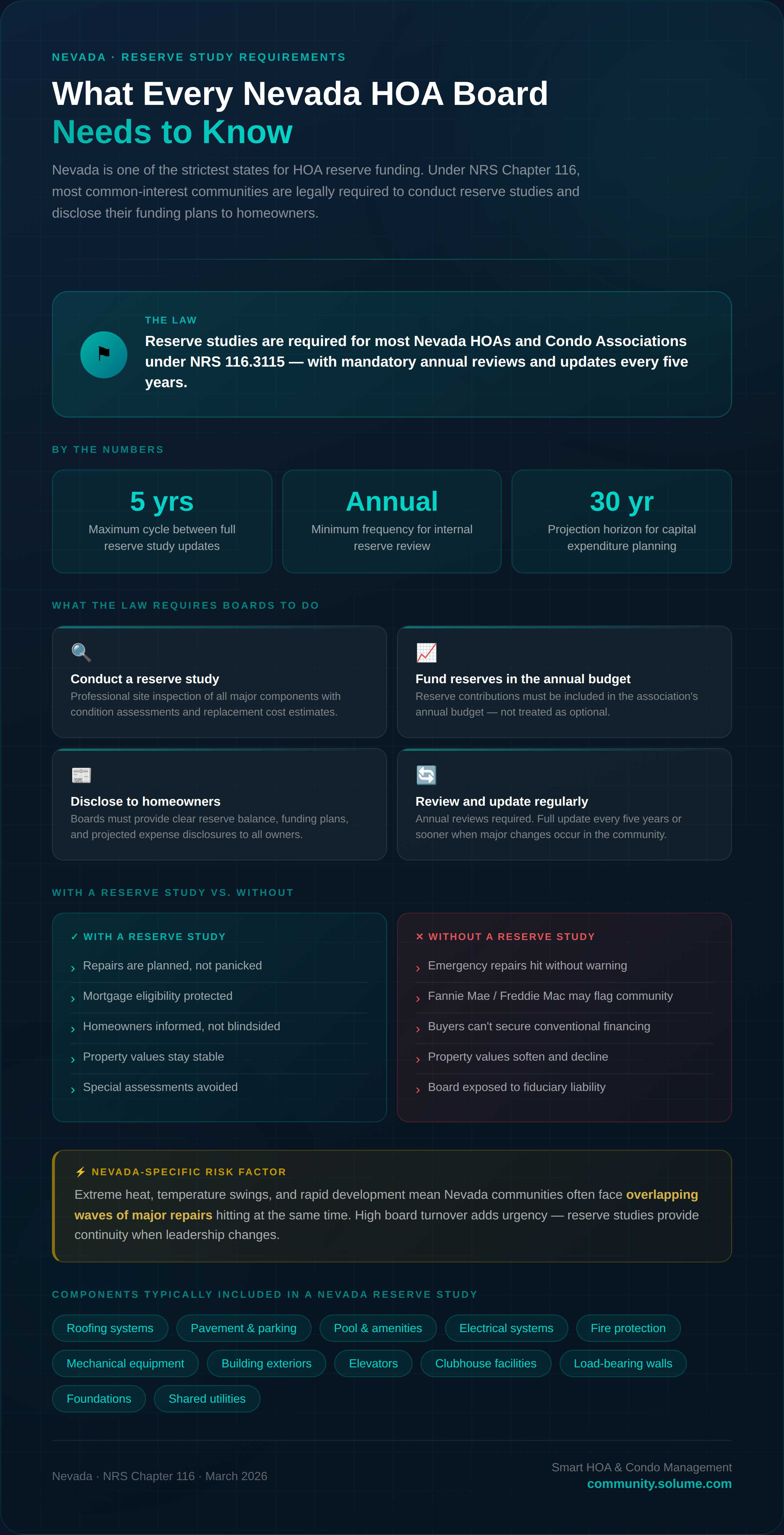
Under NRS 116.3115, many Nevada communities are required to conduct a reserve study and include reserve funding as part of the association’s budget. Boards are expected to review reserves annually and update reserve studies on a regular cycle.
The statute applies broadly to common‑interest communities, but some details vary based on whether the association is a Condo Association or a planned community HOA. That distinction matters, but it does not eliminate the underlying obligation to plan responsibly.
Nevada law also places emphasis on budget and reserve disclosures. Associations must provide homeowners with clear information about reserve balances, funding plans, and projected expenses. This is where many boards struggle, not because they are unwilling, but because they lack the right tools.
Solume helps boards meet these disclosure requirements by tying budgets, reserve studies, and ongoing reserve tracking together in one system. As reserve study software, Solume allows boards and managers to maintain compliance without juggling spreadsheets, PDFs, and disconnected accounting tools.
Why Reserve Studies Are Crucial for Nevada HOAs
Nevada communities face a mixture of environmental and organizational challenges that make reserve studies especially important.
Extreme heat, temperature swings, and intense sun exposure accelerate wear and tear on roofs, pavement, and mechanical systems. At the same time, Nevada’s rapid development boom means many communities were built in the same era and are now aging together, creating overlapping waves of major repairs that boards must plan for.
Just as important is board turnover. In fast‑growing Nevada communities, volunteers often step into board roles without deep experience in HOA governance or state law. Reserve studies provide structure and continuity when leadership changes.
Protecting Property Values and Structural Integrity
Structural integrity depends on proactive planning. Roof replacement, pavement resurfacing, and system upgrades do not wait for boards to feel ready.
A structural integrity reserve study helps boards anticipate major repairs before they become emergencies. Deferred maintenance expense grows quietly until costs spike, and when that happens, property values are often the first casualty.
As maintenance is delayed, communities begin to look and feel neglected. Buyers notice. Appraisers notice. Lender's notice. In extreme cases, poorly managed or underfunded associations can find themselves flagged by Fannie Mae or Freddie Mac, making units in the community ineligible for conventional financing. When buyers cannot obtain mortgages, demand drops, prices soften, and the financial impact spreads far beyond the original repair that was postponed.
Financial Health and Avoiding Special Assessments
Special assessments are often the result of underfunded reserves, not bad intentions.
Strong reserve planning supports financial health by aligning reserve contributions with the annual budget and spreading costs across each fiscal year. This approach reduces financial shocks and improves long‑term stability for homeowners.
Key Elements of a Nevada HOA Reserve Study
Inspections and Reserve Analysis
A professional reserve study begins with a site inspection and visual inspection of common area components. The Reserve Specialist evaluates condition, remaining useful life, and estimated replacement cost.
Reserve analysis then translates those findings into a reserve funding plan that supports capital expenditures over time. This turns the reserve study into an active financial planning tool instead of a document that gathers dust.
Important Reserve Items and Common Elements
In Nevada, reserve items often include pavement resurfacing, roofing systems, pools, fire protection systems, and building exteriors. Electrical systems and mechanical equipment are also major components, especially in larger or multi‑phase communities.
These obligations require disciplined reserve planning and consistent reserve study updates.
Best Practices for HOA Reserve Planning in Nevada
Working With Professionals
Hiring a licensed engineer or professional reserve study company improves accuracy and credibility. Property managers rely on reserve studies to coordinate maintenance plans, manage major repairs, and support Association Reserves responsibly.
Regular reserve study updates allow boards to adjust for rising costs, climate impacts, and completed projects while upholding legal compliance.
Engaging HOA Boards and Members
Board members carry fiduciary responsibility, whether they serve a Condo Association or an HOA. Candid communication helps homeowners understand why reserve contributions matter.
Some reserve decisions may require a majority vote under governing documents. Boards should seek legal advice when needed, but strong systems reduce uncertainty.
Reserve Study Software, Data Ownership, and Long‑Term Compliance
Many Nevada communities are professionally managed, but that does not mean boards want their data locked away. Communities increasingly expect access to the same information their property managers see.
This is where all-in-one management and reserve study software plays a critical role. Solume allows boards and managers to work from the same system, creating transparency instead of dependence. Reserve data stays with the community, even if management companies change.
Solume also supports complex structures like master associations, multi‑phase developments, and communities transitioning from developer control. Builders increasingly use Solume to document assets, completion dates, and maintenance history so that when the declarant exits, the community inherits a stable, well‑documented HOA or Condo Association.
Ensuring Long‑Term Success for HOAs in Nevada and Beyond
While Nevada’s reserve study requirements are clear under NRS Chapter 116, it is worth noting that reserve study laws vary widely across the country. States like California, Colorado, Florida, and Washington have adopted more prescriptive rules, while others rely more heavily on disclosure standards and fiduciary expectations. Boards that manage or compare communities across state lines often find that understanding how Nevada fits into the broader national landscape helps clarify why reserve planning has become a baseline expectation, not an optional best practice. We maintain a separate guide that outlines reserve study requirements by state for boards that want a clearer national view.
Nevada law makes reserve planning a clear expectation. Climate, growth, and board turnover make it a practical necessity.
Solume was built to help boards and property managers meet these challenges. It is the only all‑in‑one platform that combines reserve study management, ongoing reserve tracking, AI‑driven compliance guidance, and vendor coordination.
If your board is already responsible for protecting the community’s future, is it unreasonable to spend 15 minutes seeing whether a platform could reduce risk, eliminate guesswork, and simplify compliance?
Solume helps Nevada communities move from static reserve studies to living financial plans that evolve with the community.
1. Are reserve studies required for HOAs and condo associations in Nevada?
Short answer. Yes, Nevada requires reserve studies for many common-interest communities under NRS Chapter 116, which applies to both Condo Associations and HOAs.
Longer answer. The law expects associations to understand their long-term obligations, plan for them, and disclose that information clearly to homeowners.
Where boards get tripped up is thinking “required” means “someone is going to knock on our door tomorrow.” That is not how it works. Instead, the requirement shows up when you least want it to. During resale disclosures. During financing issues. During a major repair when the reserves are light and homeowners start asking questions.
Nevada made reserve studies part of the framework because too many communities were drifting into financial trouble without realizing it. The law is there to force clarity before the crisis, not after.
2. How often must a reserve study be updated under Nevada law?
Nevada expects reserve studies to be reviewed annually and updated on a regular cycle, typically every five years or when major changes occur.
Here is the practical reality. Construction costs do not wait five years. Labor does not wait five years. Climate does not wait five years. If your reserve study only gets dusted off once every half-decade, it is already behind.
The best-run Nevada communities treat the professional update as the anchor and then adjust annually for real-world changes. That approach keeps the numbers honest and avoids the “how did we miss this” moment.
3. Does Nevada treat condo associations and HOAs differently when it comes to reserve studies?
Yes, but not in the way most people think.
Nevada law distinguishes Condo Associations and HOAs in certain operational details, but both are expected to plan for long-term maintenance, funding, and disclosure. Condo Associations often face stricter scrutiny because of shared structural components, but HOAs are not off the hook just because they do not share walls.
The mistake boards make is over-focusing on the distinction instead of the responsibility. The law expects both to protect the community’s long-term financial stability. Once you understand that, the differences matter less.
Clarify it once. Then manage forward.
4. What happens if a Nevada HOA does not complete or update a required reserve study?
Usually, nothing happens. Until everything happens at once.
There is rarely a single penalty notice. Instead, problems stack quietly. Incomplete disclosures. Budget confusion. Underfunded reserves. Frustrated homeowners. Then a major repair lands, and suddenly everyone is looking at the board.
At that point, the question is no longer “were we required to do this” but “why didn’t we see this coming?”
Boards are fiduciaries. That responsibility does not disappear because a study was skipped or outdated. Reserve studies exist to protect boards as much as communities.
5. How do reserve studies affect property values and resale in Nevada communities?
This is where things get real.
Deferred maintenance does not just make a community look tired. It affects financing. Fannie Mae and Freddie Mac maintain eligibility standards, and communities with poor reserves, weak financials, or deferred maintenance issues can find themselves effectively blacklisted.
When that happens, buyers cannot get conventional loans. Sales fall through. Prices soften. Homeowners get angry.
Reserve studies are not about perfection. They are about credibility. Lenders, buyers, and real estate professionals want to see that a community understands its obligations and has a plan. No plan means risk. Risk means fewer buyers.
6. What components are typically included in a Nevada HOA reserve study?
A proper Nevada reserve study looks at the things that actually fail, not the things that look good on paper.
Structural components like roofs, load-bearing walls, and foundations.Common elements like pools, clubhouses, parking areas, and shared amenities.Major systems such as electrical systems, fire protection systems, mechanical equipment, and pavement.
Each component is evaluated for condition, estimated remaining useful life, and estimated cost of repair or replacement. Those estimates are not guesses. They are the backbone of the funding plan.
This is where boards move from reactive to intentional.
7. How much should a Nevada HOA be contributing to reserves each year?
If someone gives you a single number, stop listening.
Reserve contributions depend on the community’s assets, age, condition, and projected capital expenditures. What matters is alignment. Your annual budget should support the reserve funding plan, not contradict it.
Underfunded reserves are rarely accidental. They usually come from short-term thinking. Strong boards choose predictable contributions over unpredictable special assessments every time.
8. Can a reserve study help a Nevada HOA avoid special assessments?
It cannot eliminate risk. It can eliminate surprise.
Most special assessments are not caused by sudden failures. They come from known issues that were not planned for. A reserve study gives boards time. Time to adjust contributions. Time to communicate. Time to phase projects instead of panicking.
Homeowners may not love paying more, but they hate being blindsided. Reserve studies shift the conversation from crisis to planning.
9. Who is qualified to perform a reserve study in Nevada?
A qualified reserve study is typically performed by a Reserve Specialist, licensed engineer, or professional reserve study company with experience in Nevada communities.
Credentials matter, but context matters more. The right professional understands climate impact, regional construction costs, and the realities of HOA governance. A good study explains risk clearly and defensibly, not just technically.
Boards should feel informed after a study, not overwhelmed.
10. How can boards and property managers track reserve studies and stay compliant over time?
This is where most communities struggle.
PDFs get outdated. Spreadsheets get lost. Boards turn over. Management companies change. Suddenly, no one knows which numbers are current.
That is why reserve study software matters.
Solume allows boards and property managers to treat reserve studies as living financial tools. Reserve data stays with the community. Updates reflect real projects. Disclosures stay current. Compliance stops being a guessing game.
The goal is not more work. There are fewer late nights asking, “Where is that document?”
Final Thought From the Field
Nevada did not require reserve studies to make boards miserable. The requirement exists because the cost of not planning is always higher.
If you are already volunteering your time to protect the community, is it really unreasonable to expect tools that make that responsibility easier to carry?
That is the real question every board should be asking.