
A cracked parking lot, a failing roof, an elevator that finally quits, and no money set aside to fix any of it. That's the moment a board learns the hard way what happens when nobody plans ahead. If you're a treasurer or board member asking how much should an HOA have in reserves, the honest answer isn't a single number. It's a percentage tied to what your community owns and how worn out those things already are. This article breaks down the benchmarks, the math, and the planning that keeps your association out of that cracked-parking-lot scenario.
Key Takeaways
- The best way to measure how much an HOA should have in reserves is by percent funded: 70% or higher is strong, 30-70% is fair with special-assessment risk, and under 30% is weak.
- A reserve study produces your Fully Funded Balance by cataloging each major component's useful life, remaining life, and replacement cost.
- Fannie Mae and FHA generally expect at least 10% of the annual budget in reserve contributions, while well-funded HOAs often allocate 15-40% of assessment revenue.
- Underfunded reserves push boards toward special assessments, dues spikes, and deferred maintenance that lowers property values.
- Reaching a healthy reserve level is a multi-year funding plan, not a one-time deposit, and consistent annual contributions steadily raise your percent funded.
What Is an HOA Reserve Fund?
An HOA reserve fund is a dedicated savings account for major repairs and replacements of shared property. It stays separate from the operating fund that pays day-to-day bills like landscaping, utilities, and insurance. Think of it this way: the operating fund covers this month, the reserve fund covers the next twenty years.
Why the two stay apart matters. Operating money gets spent as it comes in. The reserve fund is meant to grow, untouched, until a big-ticket component reaches the end of its useful life. Blurring the line between the two is a common mistake in self-managed communities, and solid bookkeeping practices for small HOAs go a long way toward preventing it from quietly eroding your financial responsibility.
Federal lenders take reserves seriously because they affect whether a buyer can get a mortgage in your community. Fannie Mae's Condo Project Manager and eligibility standards require associations to budget at least 10% of annual revenue toward reserve contributions. If you fall below that, units can become harder to finance. The mechanism is straightforward: when a loan can't be sold to Fannie Mae, fewer lenders will write mortgages in your community, which shrinks your buyer pool and drags down property values. A healthy reserve fund isn't just prudent. It affects whether people can buy and sell homes at all.
What Reserve Funds Are Used For (Common Repair & Replacement Items)
Reserve funds pay for the expensive, predictable failures every property eventually faces. These aren't emergencies in the true sense. Roofs, roads, and pool equipment all wear out on a schedule you can forecast years ahead.
Typical reserve components include roofing, exterior painting, asphalt paving and sealcoating, elevators, pool resurfacing and pumps, fencing, clubhouse HVAC systems, retaining walls, and shared plumbing or electrical infrastructure. In a condo, add hallway flooring, lighting, and structural waterproofing. The exact list depends on what your community owns in its common areas and shared amenities.
Here's the distinction that trips up boards. A leaky faucet in the clubhouse is an operating expense, but replacing the clubhouse roof is a reserve expense. The dividing line is scale and frequency. Anything recurring often and costing little belongs in the HOA budget. Anything that happens rarely and costs a lot belongs in reserves. If you're not sure where to draw the line, a step-by-step HOA budget template can help you sort operating costs from reserve items cleanly.
The Community Associations Institute maintains national reserve standards through its reserve study resources, which most professional reserve specialists follow when classifying components. Their broader Community Associations Institute guidance on reserve funds is worth reviewing, and using a consistent standard keeps your reserve study defensible and your board out of arguments about what counts.
Why Reserves Matter for Community Stability
Reserves are the difference between a community that ages gracefully and one that limps from crisis to crisis. When the money is there, a failing roof gets replaced on schedule. Without it, the board scrambles, homeowners get hit with a surprise bill, and trust breaks down.
The 2021 Surfside condo collapse in Florida killed 98 people. It put a national spotlight on what deferred maintenance and underfunded reserves can lead to at the extreme. It pushed several states, Florida among them, to mandate structural reserve studies and restrict a board's ability to waive reserve funding. The state's rules under Florida Statute 718.112 on condominium reserves now tie community stability and structural safety together more firmly than ever.
Beyond safety, reserves protect the thing homeowners care about most: value. Buyers and their lenders look at reserve health before closing. A community with underfunded reserves signals future assessments, and that scares off buyers. The reason is simple: a buyer weighing two similar units will avoid the one that comes with a looming special assessment attached. What many communities don't realize is that a healthy reserve fund is a quiet selling point that keeps their property values competitive with newer developments down the road.

How Much Should an HOA Have in Reserves? (The Rule of Thumb)
The clearest way to answer how much should an HOA have in reserves is with one metric: percent funded. It compares your current reserve balance to your Fully Funded Balance, the ideal amount you'd have saved if every component were funded in proportion to how worn it is.
The widely accepted rule of thumb breaks down like this. Above 70% funded is strong. Between 30% and 70% is fair, but you carry real risk of special assessments if a big component fails early. Below 30% is weak, and boards there are usually one failure away from an emergency bill.
Many boards assume a fixed dollar amount, like "$100,000 should be plenty." In reality, $100,000 might be excellent for a small community and dangerously low for a large one. That's why aiming for 70 to 100 percent funded beats a flat number. The percent funded figure adjusts to the size, age, and complexity of what you maintain, which is why professionals prefer it over a raw balance.
Percentage of Dues/Budget That Should Go to Reserves
Once you know your target, the next question is how much of each month's dues should feed the reserve account. Fannie Mae and FHA generally require at least 10% of the annual budget to go toward reserve contributions. That 10% is a floor, not a goal.
In practice, well-funded associations often direct 15% to 40% of assessment revenue into reserve funds. It depends on how old their buildings are and what's coming due. A brand-new community with a fresh roof and pavement can sit near the low end. A 30-year-old community facing multiple replacements at once needs the high end, or it will fall behind fast.
The percentage varies so widely because of timing. Reserve contributions have to match the pace at which components consume their useful life. If your roof has 8 years left and will cost $200,000, you need to set aside roughly $25,000 a year for that item alone. Set the percentage of HOA dues too low, and the shortfall compounds silently until the bill arrives at once. Treat that percentage of HOA dues as a fixed obligation, not a leftover.
Picture a self-managed community that trimmed its reserve contribution to 8% for three straight years to keep dues flat and avoid pushback at annual meetings. When the asphalt hit the end of its life, the board found itself $180,000 short with no runway to catch up, and every owner absorbed the gap through a special assessment they never saw coming. The savings were an illusion. The cost simply waited, and it grew.
The Role of the Reserve Study in Setting Reserve Levels
A reserve study turns guesswork into a plan. A qualified reserve specialist inspects your property, catalogs every reserve component, and records each one's useful life, remaining life, and replacement cost. From that inventory, the study calculates your Fully Funded Balance and your current percent funded.
The study also produces a reserve funding plan, a multi-year schedule of contributions designed to keep you at a healthy level as components age. Some plans use threshold funding, which keeps reserves above a set minimum rather than fully funded. On how often to do a reserve study, most guidance recommends a full study every three to five years, with lighter updates in between so your numbers track inflation and wear.
As for reserve study cost, expect a few hundred to a few thousand dollars depending on community size and whether an on-site inspection is included. That's the cheapest insurance a board can buy. Skipping it doesn't save money. It just moves the cost to a future special assessment, usually larger and always less popular. Reserve study rules vary by state, so check the HOA reserve study requirements by state or ask your association attorney before waiving anything.

Factors That Affect How Much Reserves You Need (Age, Amenities, Climate, Risk)
No two communities need the same reserve level, and four factors explain most of the difference. Age comes first. An older community has more components nearing the end of their life, so it needs a higher balance to stay at the same percent funded as a newer one.
Amenities are the second driver. Pools, elevators, gyms, tennis courts, and gated entries are shared amenities that carry heavy replacement costs and constant wear. A community with a pool and elevator needs far larger reserves than a townhome development with nothing but pavement and roofs. The reason is mechanical: each amenity adds another component with its own useful life and replacement cost to the Fully Funded Balance, so more amenities simply mean more dollars owed to the reserve schedule.
Climate is the third. Freeze-thaw cycles destroy asphalt. Coastal salt air corrodes metal and shortens roof life. Intense sun bakes paint and sealants. The same roof lasts longer in a mild climate than a harsh one, which changes your replacement schedule.
Risk is the fourth, and the one boards underestimate. Aging plumbing, structural concerns, or a history of deferred maintenance all raise the odds of an early, expensive failure. Learning to spot the red flags in HOA management helps here. When these factors run high, the board of directors has to push reserve targets toward the top of the 70 to 100 percent funded range rather than the bottom.
What Happens When Reserves Are Underfunded (Special Assessments)
Here's the hard truth about underfunded reserves: the bill never disappears. It just waits, grows, and lands on homeowners all at once. When a major component fails and the reserve account can't cover it, the board has three unpleasant options, and none of them are painless.
The first is a special assessment, a one-time charge split among every owner. Picture a 60-unit condo facing a $600,000 roof replacement with only $150,000 in reserves. That's a $7,500 special assessment per unit, due on a short deadline, and some owners simply won't be able to pay. The second option is emergency fee increases that spike monthly dues. The third is deferred maintenance, where the board delays major repairs and replacements and lets the eventual cost get worse.
All three damage community stability. Special assessments trigger conflict, delinquencies, and sometimes disputes. Deferred maintenance lowers property values and can breach state safety rules. A funded reserve account replaces these crises with a predictable line item, and disciplined capital planning is the whole point of getting ahead in your homeowners association finances.
How Self-Managed Boards Can Track Reserves and Compliance with Software
Volunteer boards rarely have an accountant on hand, and spreadsheets have a way of falling out of date the moment the treasurer's term ends. That's where the real risk lives for self-managed communities. The numbers exist somewhere, but nobody can produce a clean picture of percent funded on demand, and the board loses track of exactly how much it should have in reserves against the Fully Funded Balance.
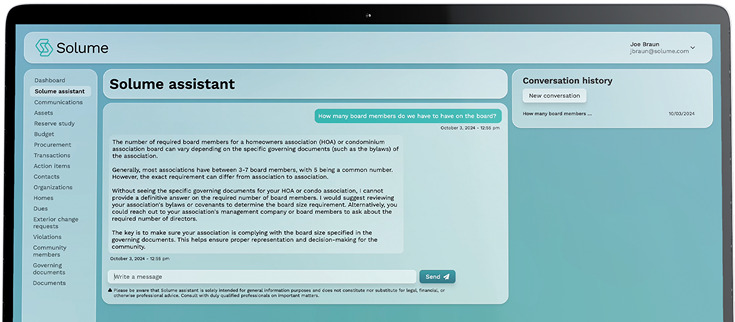
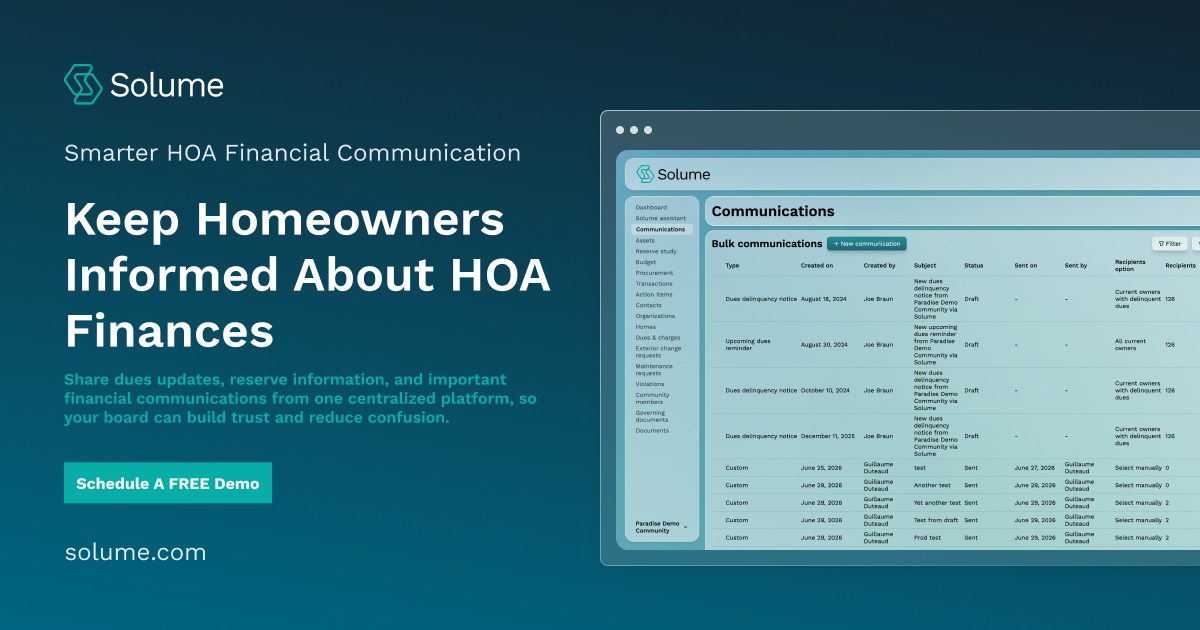
That specific gap, knowing your numbers but never being able to see them clearly, is what software solves. Solume's financial management tool for boards and automated reserve study tool let the board of directors track reserve contributions, monitor percent funded against the Fully Funded Balance, and keep operating and reserve accounts cleanly separated in one place. For boards in states with strict reserve laws, its compliance tracking helps flag what your state reserve requirements expect without hiring a management company.
The transparency payoff matters just as much. When homeowners can see where the reserve fund sits and why contributions are set where they are, the trust that special assessments usually destroy stays intact. Managing your homeowners association finances well isn't only about the math. It's about making the math visible to the people paying for it.

If your board wants a clearer way to manage reserve planning, compliance, and financial transparency without leaning on a management company, you can book a 15-minute call to see if Solume fits your community. It's a low-pressure way to see whether the right tools can ease the load on volunteers and strengthen your long-term planning.
Frequently Asked Questions
How much should an HOA have in reserves?
There's no single dollar figure: the right amount depends on your community's age, amenities, climate, and upcoming replacement costs. The clearest way to measure adequacy is the percent funded metric, with 70% or higher considered strong and anything below 30% considered weak.
How do you calculate the amount an HOA should have in reserves?
Start with a reserve study that lists every shared component (roofs, pavement, pool equipment, elevators) along with its useful life, remaining life, and replacement cost. Then calculate the Fully Funded Balance by multiplying each component's replacement cost by the fraction of its life already used up and summing the totals, that number is what you should ideally have saved today.
What does a 70% funded reserve actually mean?
Percent funded equals your current reserve balance divided by the Fully Funded Balance, so 70% funded means you have 70% of the ideal amount set aside based on wear and tear across all major components. That level is widely treated as a strong benchmark, while the 30-70% range is considered fair but carries elevated risk of surprise special assessments.
What percentage of an HOA budget should go toward reserves?
Fannie Mae and FHA guidelines generally require at least 10% of the annual budget to be allocated to reserves, which is the floor for meeting lender requirements. Well-funded associations often contribute 15-40% of assessment revenue depending on the age of their infrastructure and upcoming projects.
What happens if our HOA's reserves are too low?
Underfunded reserves usually force boards into special assessments or steep dues increases to cover major repairs like roofing or paving. Low reserves also lead to deferred maintenance and can hurt property values and lending eligibility for owners trying to sell or refinance.
Is a reserve study really worth the cost for a small self-managed HOA?
A reserve study is the only way to know your Fully Funded Balance and percent funded, so without one you're essentially guessing at future liabilities. For volunteer boards, the study cost is minor compared to a surprise five-figure special assessment that could have been planned for years in advance.
What if we can't afford to reach 70% funded right now?
Most communities don't hit 70% overnight: the goal is a funding plan that steadily raises your percent funded over time rather than a single lump sum. A reserve study will map out the annual contributions needed to close the gap while avoiding sudden dues shocks.
Is there a simple rule of thumb for HOA reserves?
The most common rule of thumb is to keep reserves at 70% or higher of the Fully Funded Balance and contribute at least 10% of the annual budget. Rules of thumb are useful for a quick gut check, but they can't replace a component-by-component reserve study tailored to your specific property.