
A $200,000 roof replacement hits the board agenda with no warning. The reserve fund holds $30,000. The board's only option: levy a special assessment that fractures community stability and tanks property values. This scenario plays out across Michigan every year because boards confuse the absence of a legal mandate with the absence of financial liability.
Michigan HOA Reserve Study Requirements in Michigan create a confusing regulatory environment. Condominium associations must fund reserves by law. HOAs don't. But both face the same physical reality: roofs fail, parking lots crack, and siding deteriorates whether you planned for it or not.
The Michigan Condominium Act (MCL 559.205) and Administrative Rule R 559.511 create clear reserve fund requirements for condos. They mandate a 10 percent minimum annual contribution and restrict reserve funds to major repairs and replacement only. HOAs have no such statutory requirement.
Deferred maintenance doesn't disappear; it compounds. When a major repair comes due without adequate reserves, the board's only option is a special assessment that can fracture community stability and tank property values.
HB 5019, the pending legislation known as the reserve study bill, may change everything. If passed, it will require Michigan condominium associations to commission professional reserve studies and follow stricter reserve funding protocols. The bill targets 2026 compliance, giving boards a narrow window to prepare.
This guide walks through Michigan reserve study requirements as they exist today, explains the distinction between HOAs and condos under Michigan law, and outlines best practices for reserve planning regardless of your community type. Understanding reserve study requirements across all 50 states helps put Michigan's approach in context.
Key Takeaways
- Michigan HOA Reserve Study Requirements in Michigan differ sharply by community type: condominium associations must maintain a reserve fund under the Michigan Condominium Act (MCL 559.205), but Michigan HOAs face no statutory requirement for reserve studies.
- Administrative Rule R 559.511 requires Michigan condo associations to fund reserves at a 10 percent minimum of their annual budget.
- Most boards assume reserve planning is optional until a major repair forces a special assessment. In reality, proper reserve funding protects communities from financial emergencies.
- HB 5019, the reserve study bill currently under review, may mandate professional reserve studies for all Michigan condominium associations by 2026, tightening compliance standards statewide.
- Reserve funds may be used only for major repairs and the replacement of common elements, not for operating expenses or routine maintenance.
- Self-managed Michigan communities face unique reserve study challenges without professional management, often relying on volunteer boards with limited financial expertise.
- Automated reserve study tools help Michigan boards meet current and future requirements by simplifying reserve planning, tracking component deterioration, and ensuring compliance with the 10 percent minimum funding rule.
Michigan Condominium Act (MCL 559.205) Reserve Fund Requirements
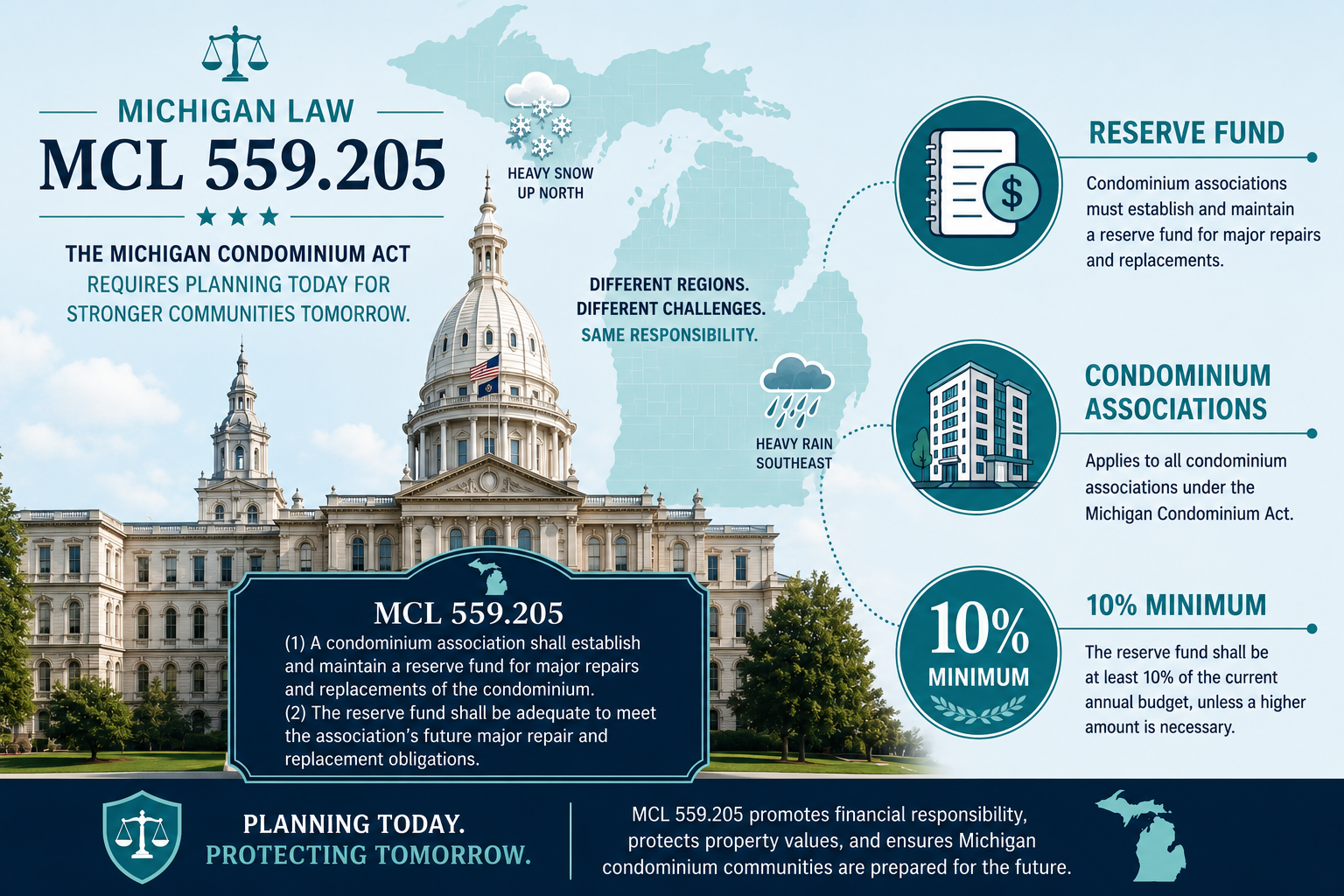
The Michigan Condominium Act establishes the baseline. MCL 559.205 requires every condominium association to maintain a reserve fund for major repairs and replacement of common elements. The law doesn't specify how much to fund or how often to update your reserve study. It simply mandates that a reserve fund must exist.
Administrative Rule R 559.511 fills some gaps. It sets the 10 percent minimum funding requirement and clarifies that reserve funds may be used only for major repairs and replacements, not for operating expenses. But even with this rule, many Michigan condo boards underfund reserves because the law doesn't require a professional reserve study to calculate actual needs.
The Michigan Condominium Act also requires boards to disclose reserve fund balances in the annual budget. This creates transparency, but transparency without adequate funding just means homeowners can see the problem coming. For boards trying to understand what a reserve study actually includes, the physical and financial components are essential to proper planning.
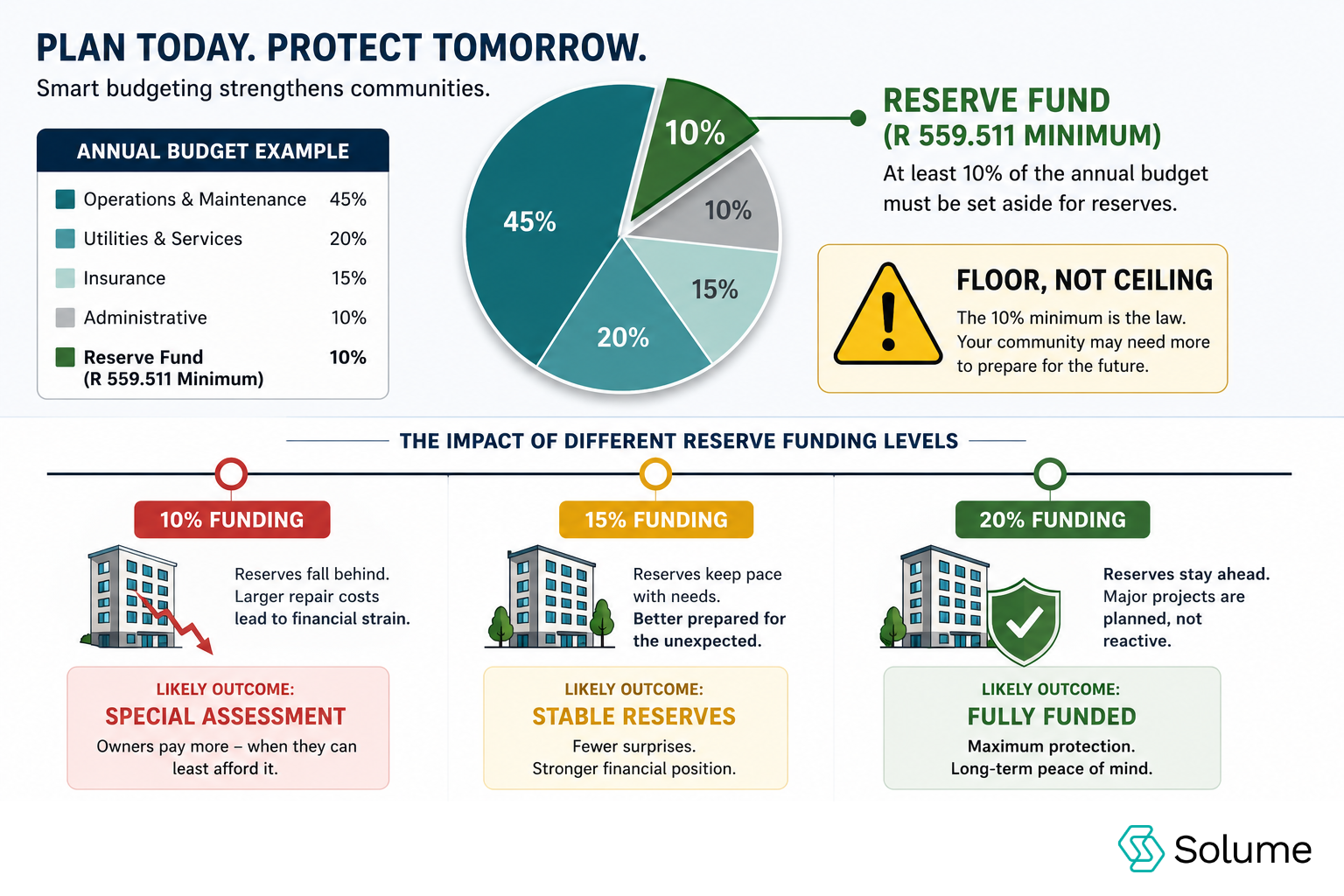
Most boards assume that meeting the 10 percent minimum satisfies their fiduciary duty. In reality, 10 percent is a floor, not a target. The rule sets a minimum contribution level but doesn't account for actual deterioration rates or replacement costs, which is why communities with aging infrastructure, lake-effect weather exposure, or deferred maintenance may need to fund reserves at 15 percent or 20 percent to avoid special assessments.
MCL 559.205 allows boards to borrow from the reserve fund for emergency repairs, provided they repay the funds within a reasonable timeframe. This flexibility helps in a crisis, but it also creates temptation. Boards under financial pressure sometimes raid reserves to cover operating shortfalls, violating the major repairs and replacement restriction.
Until HB 5019 passes, Michigan condominium associations must navigate MCL 559.205 and Administrative Rule R 559.511 with limited guidance. Boards that treat the 10 percent minimum as a checkbox instead of a starting point will face special assessments. Additional resources from the Michigan Legislature provide the full statutory text for boards seeking detailed legal guidance.
Administrative Rule R 559.511 and the 10 Percent Minimum Funding Requirement
Administrative Rule R 559.511 is where the Michigan Condominium Act gets teeth. This rule requires Michigan condo associations to contribute at least 10 percent of their annual budget to the reserve fund. It's not a suggestion. It's a regulatory floor.
The 10 percent minimum applies to all condominium associations governed by the Michigan Condominium Act. It doesn't apply to HOAs. If you manage a neighborhood of single-family homes, Administrative Rule R 559.511 doesn't bind you. If you manage a condo building, it does.
Here's what the 10 percent minimum means in practice. If your Michigan condo association has an annual budget of $200,000, you must deposit at least $20,000 into the reserve fund each year. That money can only be used for major repairs and the replacement of common elements such as roofs, elevators, parking lots, and exterior siding.
Most boards treat the 10 percent minimum as the target. That's a mistake. The rule sets a floor, not a ceiling. A community with a 30-year-old roof, crumbling asphalt, and original HVAC systems needs more than 10 percent to avoid special assessments.
The 10 percent rule doesn't account for component deterioration rates. Michigan communities face freeze-thaw cycles, lake-effect weather, and harsh winters that accelerate wear on common elements. Administrative Rule R 559.511 doesn't adjust for regional considerations.
Administrative Rule R 559.511 also doesn't require a professional reserve study to determine whether 10 percent is adequate. This creates a compliance gap. A board can meet the 10 percent minimum and still be catastrophically underfunded if they haven't conducted a physical analysis and financial analysis of their common elements. Following the step-by-step process for conducting a reserve study ensures boards calculate actual needs rather than relying on the statutory minimum.
The risk most boards overlook is that the 10 percent minimum becomes a ceiling in practice. Boards fund at exactly 10 percent year after year, assuming they've met their obligation. Then a major repair comes due, the reserve fund falls short, and the board levies a special assessment.
HB 5019, the reserve study bill, would address this gap by requiring professional reserve studies that calculate actual funding needs. Until that pending legislation passes, Administrative Rule R 559.511 remains the only binding standard. The Association of Professional Reserve Analysts provides industry standards that go beyond Michigan's minimum requirements.
Distinction Between HOAs and Condominiums Under Michigan Law
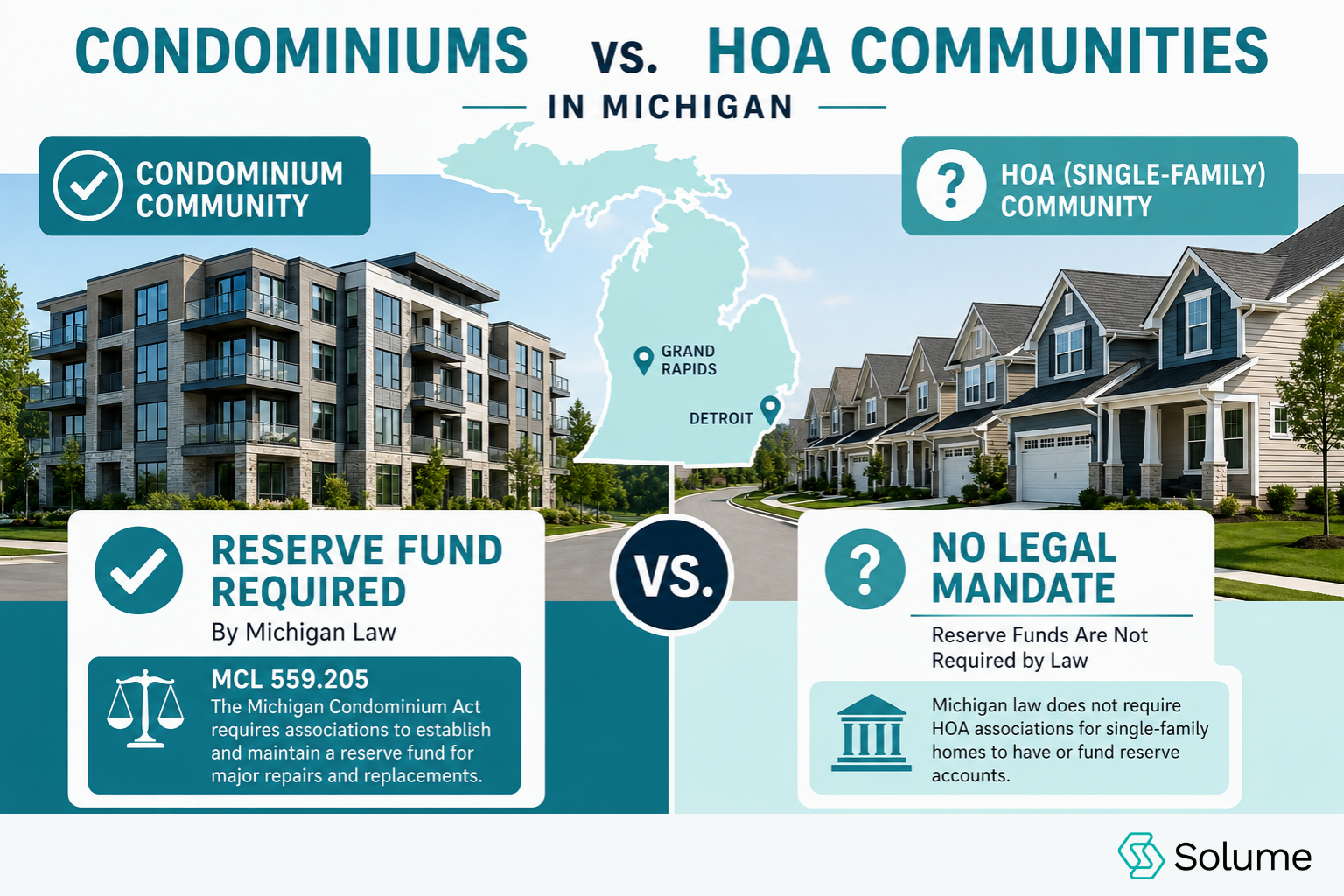
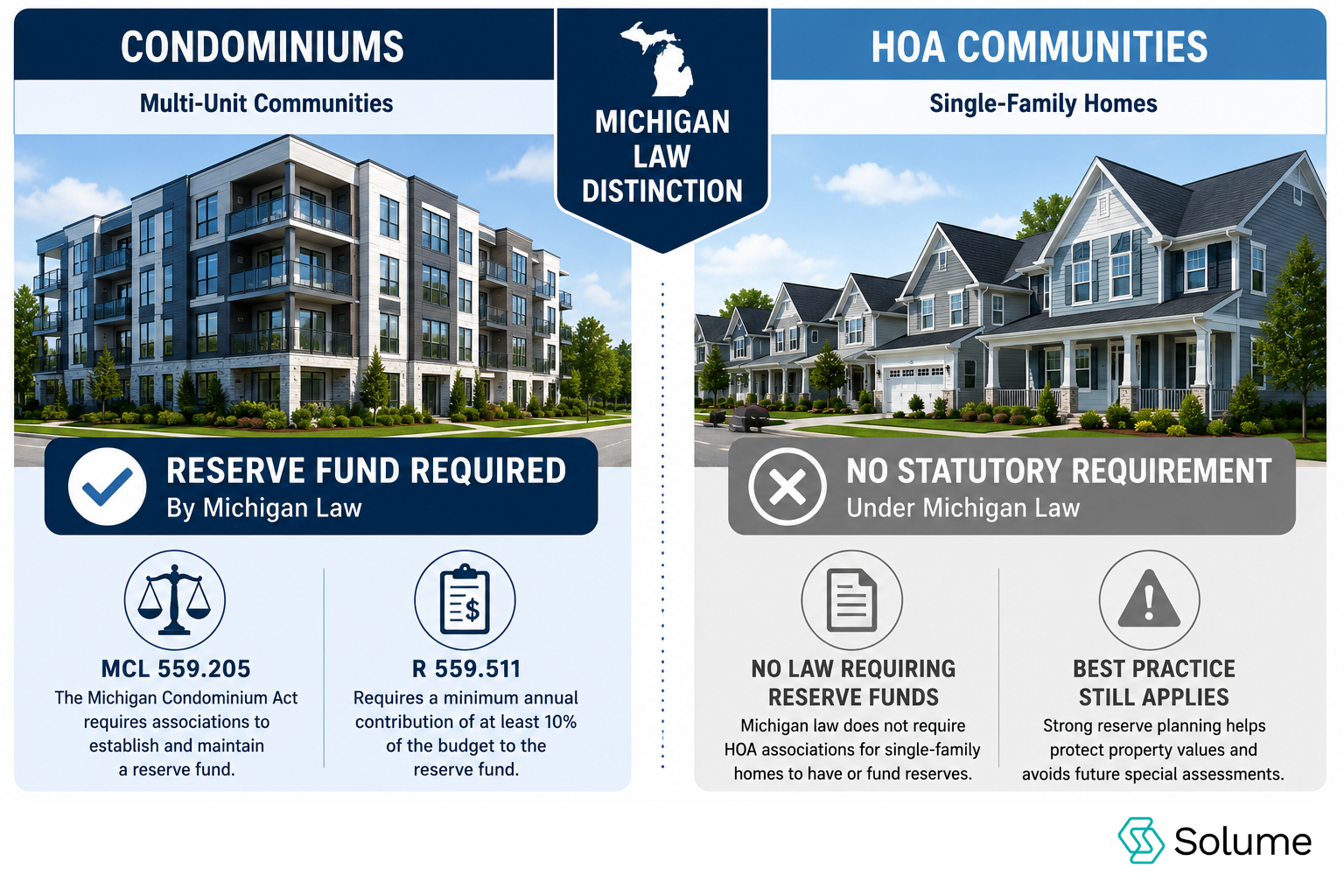
Michigan law treats HOAs and condominium associations as separate entities. The Michigan Condominium Act (MCL 559.205) and Administrative Rule R 559.511 apply only to condos. HOAs operate under different statutes and face no statutory requirement to maintain reserve funds or conduct reserve studies.
This distinction matters because many board members don't know which category their community falls into. If you manage a building where owners hold individual units and share common elements like hallways, roofs, and parking structures, you're a condominium association. If you manage a neighborhood of single-family homes with shared amenities, you're an HOA.
Condominium associations must comply with the 10 percent minimum funding rule under Administrative Rule R 559.511. HOAs don't. This doesn't mean HOAs should skip reserve planning. It just means Michigan law doesn't force them to do it.
The legal structure also affects how reserve funds can be used. Under the Michigan Condominium Act, reserve funds are restricted to major repairs and replacement of common elements. HOAs face no such restriction unless their governing documents impose one.
Many boards assume that because HOAs aren't required to fund reserves, they don't need reserve studies. In reality, the absence of a legal mandate just shifts the risk. An HOA with aging infrastructure faces the same financial liabilities as a condo. The roof will fail. The pavement will crack. The only difference is that the HOA board won't face regulatory penalties for failing to plan.
The distinction between HOAs and condos also affects lender requirements. FHA requirements and Fannie Mae both impose reserve study standards for condo financing. An underfunded Michigan condo may lose FHA approval, making units harder to sell. Understanding how proper reserve planning prevents special assessments is critical for both HOAs and condos, regardless of legal requirements.
HB 5019, the reserve study bill, would narrow the gap between HOAs and condos. The pending legislation focuses on condominium associations, but it sets a precedent. If Michigan mandates professional reserve studies for condos, HOAs will face pressure to adopt similar standards.
Here's the practical takeaway: Michigan law distinguishes between HOAs and condos, but physics doesn't. A roof on an HOA building deteriorates at the same rate as a roof on a condo building. The Michigan Condominium Act forces condo boards to plan for that deterioration. HOA boards have to choose to plan for it.
Best Practices for Reserve Studies Despite Lack of Legal Mandate
Michigan HOAs aren't required to conduct reserve studies. That doesn't mean they shouldn't. The best-run communities treat reserve planning as a fiduciary duty, not a compliance checkbox.
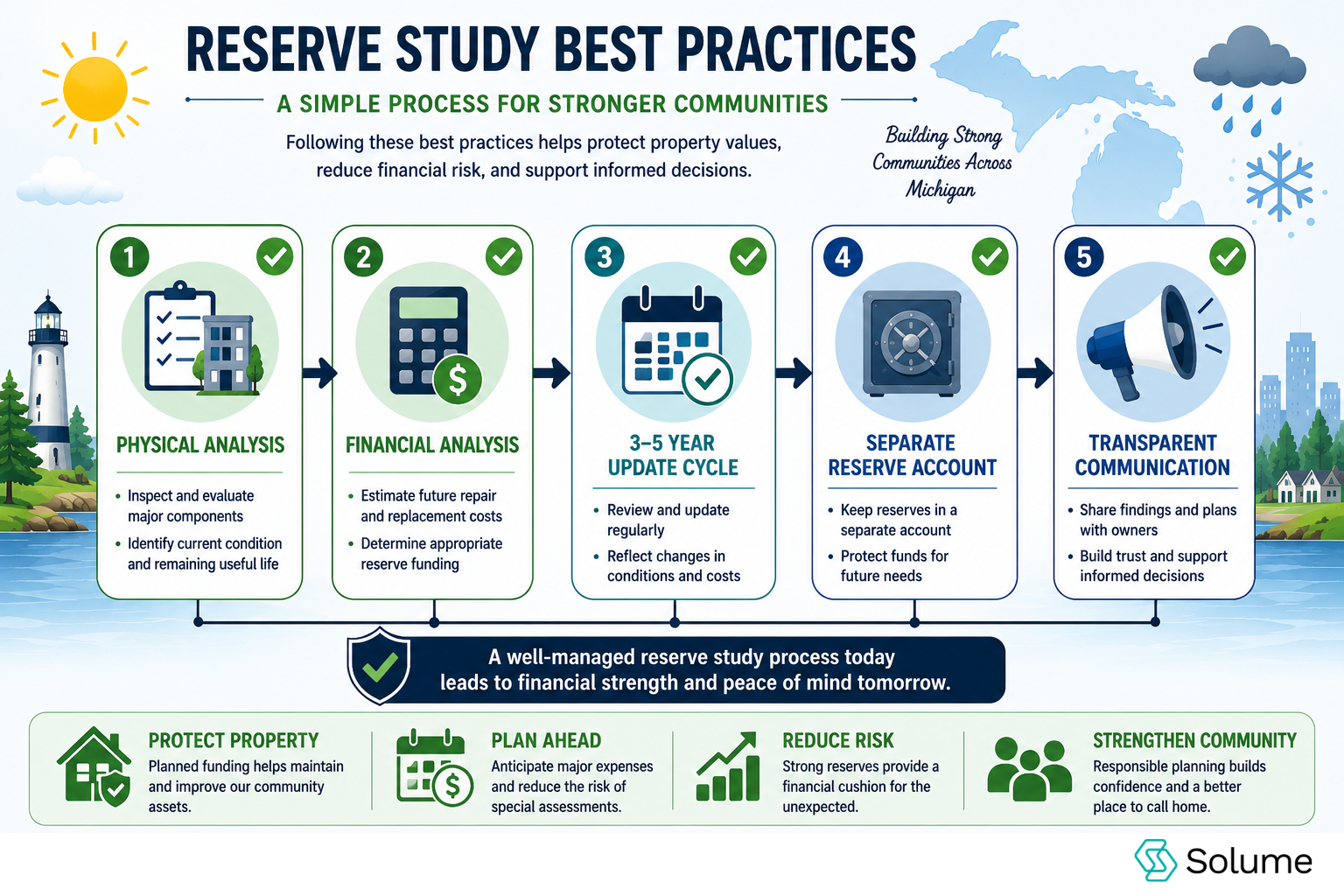
A professional reserve study includes two components: a physical analysis and a financial analysis. The physical analysis inventories all common elements, estimates their remaining useful life, and projects replacement costs. The financial analysis calculates how much the community needs to save each year to cover those costs without special assessments.
Best practices call for updating your reserve study every three to five years. Michigan communities should lean toward the three-year cycle because freeze-thaw cycles and lake-effect weather accelerate component deterioration. Boards committed to managing reserve funds effectively build regular updates into their long-term planning.
Self-managed Michigan communities face unique challenges. Without professional management, volunteer boards must handle reserve planning themselves. This is where automated reserve study tools come in handy. Platforms like Solume allow boards to input component data, track deterioration, and generate reserve funding plans without hiring a consultant for every update.
Best practices also include transparency. Boards should share reserve study results with homeowners, explain the funding plan, and update the community when reserve contributions increase. Most homeowners will support higher monthly dues if it means avoiding a $5,000 special assessment.
Another best practice: separate reserve funds from operating funds. Many Michigan HOAs commingle reserves and operating cash in a single account. This creates temptation and violates the major repairs and replacement restriction.
Reserve planning also requires boards to prioritize components. Not every element needs replacement at the same time. A reserve study helps you sequence projects so you're not funding a roof replacement and a parking lot overlay in the same year.
Finally, best practices include board education. Reserve planning isn't intuitive. Volunteer boards need training in reading a reserve study, interpreting funding plans, and explaining reserve contributions to homeowners. The State of Michigan's official resources offer additional guidance for community associations navigating these responsibilities.
Permitted Uses of Reserve Funds (Major Repairs and Replacement Only)
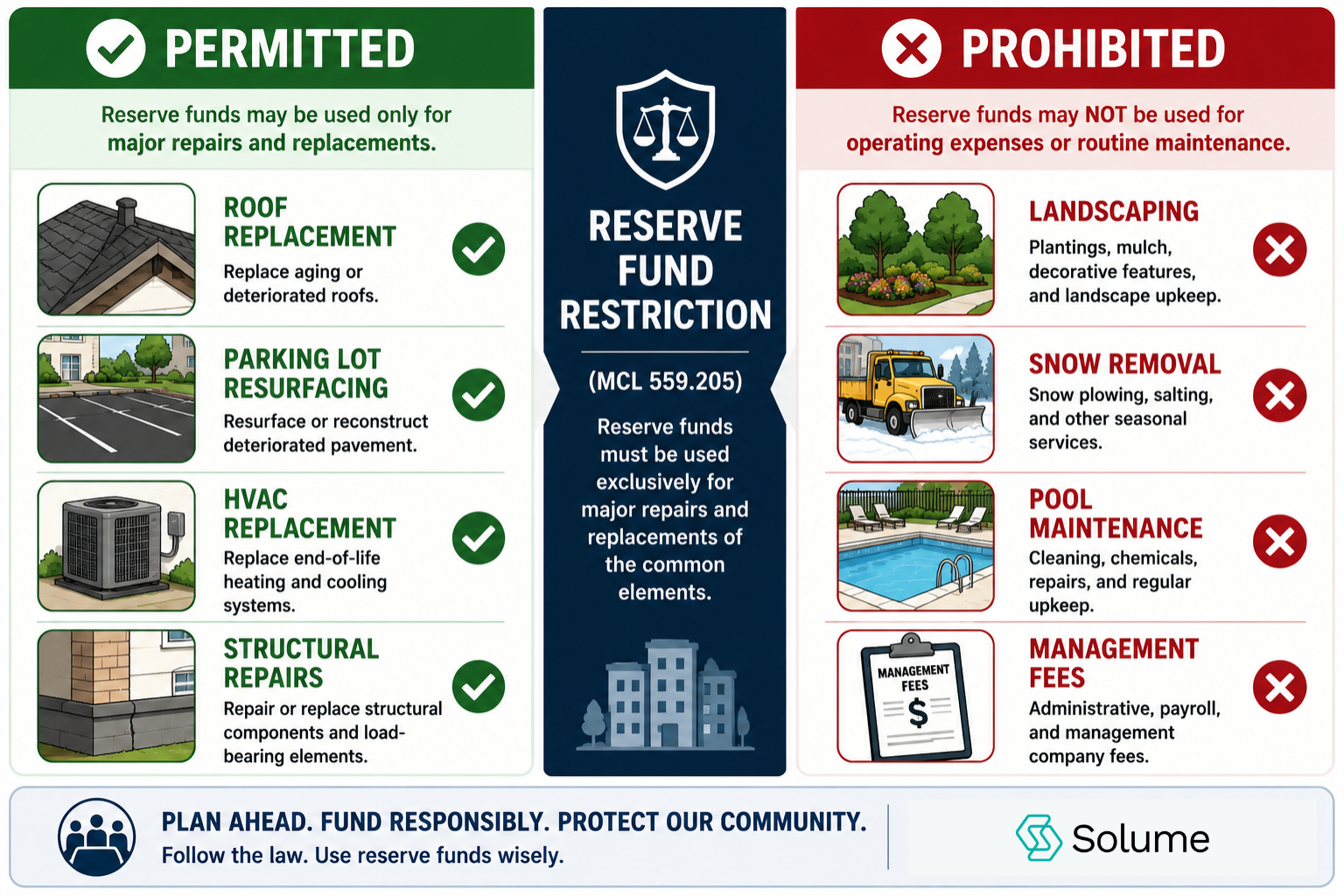
Reserve funds aren't a slush fund. Under the Michigan Condominium Act and Administrative Rule R 559.511, reserve funds may be used only for major repairs and the replacement of common elements. This restriction protects the long-term financial sustainability of the community.
What counts as major repairs and replacement? Roof replacement, parking lot resurfacing, exterior siding, HVAC systems, elevators, and structural repairs all qualify. Routine maintenance doesn't. You can't use reserve funds to pay for landscaping, snow removal, pool chemicals, or management fees.
The distinction trips up many boards. A roof repair that patches a few shingles is maintenance. A full roof replacement is a capital expense. Repainting a building's exterior is maintenance. Replacing rotted siding is a major repair.
Here's a practical test: if the expense extends the useful life of a common element or replaces it entirely, it's a capital expense. If it just keeps the element functioning until replacement, it's maintenance. Capital expenses come from reserves. Maintenance comes from the operating budget.
Administrative Rule R 559.511 also restricts the use of reserve funds to common elements. You can't use reserves to replace a water heater inside a privately owned unit, even if the association is responsible for it under the governing documents.
The major repairs and replacement restrictions also prevent boards from raiding reserves to cover operating shortfalls. The law says you can't borrow from reserves for operating expenses. But many boards do it anyway, planning to repay the funds later. That's a violation.
Michigan communities that follow best practices document every reserve fund expenditure and justify it in board meeting minutes. This creates a paper trail that protects the board if homeowners challenge a reserve fund expenditure.
The risk most boards overlook is that violating the major repairs and replacement restriction can trigger lawsuits from homeowners. If a board uses reserve funds for operating expenses, homeowners can sue for breach of fiduciary duty. The board may be required to repay the reserves personally.
Self-Managed Michigan Communities and Reserve Study Challenges Without Professional Management
Self-managed Michigan communities face a steeper climb. Without professional management, volunteer boards must handle reserve planning, financial analysis, and compliance tracking themselves. Most board members have full-time jobs and are doing this work at night and on weekends without training.
The biggest challenge is expertise. A professional property manager understands reserve planning and can guide the board through funding decisions. A volunteer board treasurer may have none of that background.
Self-managed communities also struggle with continuity. Board members turn over every few years. The treasurer who commissioned the reserve study in 2020 may be gone by 2023. Without professional management to maintain institutional knowledge, reserve planning falls apart.
Self-managed Michigan communities also lack access to reserve study software. Professional management companies use platforms that track component deterioration and update replacement costs. Volunteer boards often rely on spreadsheets.
This is where automated reserve study tools make the biggest difference. Solume is designed for self-managed communities. It walks boards through the reserve planning process, tracks common elements, calculates funding needs, and updates replacement costs based on inflation. These software tools, designed for self-managed communities, level the playing field for volunteer boards.
Self-managed communities also face compliance challenges. Administrative Rule R 559.511 requires Michigan condo associations to fund reserves at a minimum of 10 percent. A professional manager tracks compliance automatically. A volunteer board has to remember to do it.
Despite these challenges, many self-managed Michigan communities succeed at reserve planning. They succeed because they treat it as a priority, invest in tools that simplify the process, and educate themselves on best practices.
If your Michigan community is self-managed, you need three things: a reserve study, a funding plan, and a system to track both. You can hire a consultant to create the reserve study. You can use automated tools like Solume to maintain it. But you can't skip it.
Michigan Regional Considerations (Detroit Metro, Grand Rapids, Lakeshore Communities)
Michigan isn't one climate. Detroit Metro, Grand Rapids, and lakeshore communities face different weather patterns, which affect reserve planning. A reserve study that doesn't account for regional considerations will underestimate costs and leave your community underfunded.
Detroit Metro communities face urban density challenges. High-rise condos and multi-building complexes have more common elements to maintain: elevators, parking structures, and shared mechanical systems. These components cost more to replace and require specialized contractors.
Grand Rapids communities deal with freeze-thaw cycles that crack pavement and damage roofing materials. The city averages 170 freeze-thaw cycles per year. Each cycle expands and contracts asphalt, concrete, and roofing membranes, accelerating deterioration. A parking lot that lasts 25 years in southern Michigan may need replacement in 18 years in Grand Rapids.
Lakeshore communities face the harshest conditions. Lake-effect snow, high winds, and moisture exposure accelerate wear on roofs, siding, and structural components. A community in Holland or Traverse City should budget for replacement costs 15 to 20 percent higher than those of inland communities.
Regional considerations also affect contractor availability and pricing. Detroit Metro has more contractors and competitive pricing. Rural lakeshore communities may face higher costs because fewer contractors serve the area, and travel time increases project expenses.
Michigan HOA Reserve Study Requirements in Michigan must account for these regional differences. A reserve study template designed for Arizona won't work in Marquette. Boards need to work with consultants who understand Michigan weather patterns and regional cost variations.
Solume's platform allows boards to adjust replacement cost estimates based on regional data. This ensures your reserve study reflects actual Michigan conditions, not national averages.
Michigan boards face a narrow window to prepare for stricter reserve study requirements. Whether you manage a condominium association bound by MCL 559.205 or an HOA with no statutory mandate, proper reserve planning protects your community from special assessments and financial instability.
Understanding Michigan HOA Reserve Study Requirements in Michigan means recognizing the distinction between legal compliance and fiduciary responsibility. Condominium associations must meet the 10 percent minimum under Administrative Rule R 559.511. HOAs should adopt the same standards voluntarily.
If your board needs help navigating reserve planning, compliance tracking, or preparing for HB 5019, get in touch with us. Our platform simplifies reserve studies for self-managed Michigan communities, tracks component deterioration, and ensures compliance with current and future requirements.
Frequently Asked Questions
Does Michigan require HOAs to conduct reserve studies?
No, Michigan law does not require HOAs to conduct reserve studies or maintain reserve funds. Only condominium associations are subject to statutory reserve fund requirements under MCL 559.205 and Administrative Rule R 559.511.
What is the 10 percent minimum funding requirement for Michigan condos?
Administrative Rule R 559.511 requires Michigan condominium associations to contribute at least 10 percent of their annual budget to the reserve fund. This is a regulatory floor, not a recommended target.
Can reserve funds be used for routine maintenance?
No, reserve funds can only be used for major repairs and replacement of common elements. Routine maintenance expenses must come from the operating budget, not reserves.
How often should Michigan communities update their reserve study?
Best practices call for updating reserve studies every three to five years. Michigan communities should lean toward three-year updates because freeze-thaw cycles and lake-effect weather accelerate component deterioration.
What happens if a Michigan condo association doesn't meet the 10 percent minimum?
Failing to meet the 10 percent minimum violates Administrative Rule R 559.511 and exposes the board to regulatory penalties and potential lawsuits by homeowners for breach of fiduciary duty.
Are self-managed Michigan communities at a disadvantage for reserve planning?
Self-managed communities face challenges with expertise, continuity, and compliance tracking, but automated reserve study tools like Solume help level the playing field by simplifying reserve planning and tracking component deterioration.
Does HB 5019 apply to HOAs or just condominiums?
HB 5019, the pending reserve study bill, focuses on condominium associations and would require professional reserve studies for Michigan condos. It does not currently apply to HOAs, though it may set a precedent for future HOA requirements.