
Key Takeaways
- A static PDF reserve study starts drifting from reality the moment costs change, projects finish early, or scopes shift.
- Most associations should review their reserve study every year and get a professional update every 3 to 5 years.
- Several states now mandate reserve studies and update cycles, but even in non-mandated states, boards still carry fiduciary responsibility.
- Compliance is the floor. The real win is avoiding special assessments and protecting property values through disciplined long-term planning.
- The most common failure point is fragmentation: budgets in one place, reserves in another, maintenance in a third.
- Reserve Study Software helps boards and managers treat reserve planning like a living system, not a one-time document.
As a board member or association manager, you already know that a “set it and forget it” approach to financial planning is a recipe for disaster. A reserve study can look polished the day it’s delivered, but it starts losing accuracy the moment labor costs shift, material pricing changes, or a major project gets completed.
I’ve watched perfectly “compliant” communities get blindsided anyway. Not because the board didn’t care, but because the reserve study became a static PDF while the community kept moving.
Most HOA and condo boards should review their reserve study every year and commission a professional update every 3 to 5 years, even if your state laws don’t require it.
That is the simple rule of thumb. And it exists for one reason: the moment you stop revisiting the assumptions, the reserve study starts drifting away from reality.
A reserve study is not a trophy. It is a financial model.
At Solume, we believe transparency and proactive planning are the cornerstones of a thriving community. This guide is meant to be practical: state requirements at a glance, the best practices that actually prevent special assessments, and the modern approach boards are moving toward when they want to stop guessing.
Why a Reserve Study Needs Regular Updates
A reserve study is a long-term financial planning document that estimates:
- What common assets you are responsible for
- How long those assets are likely to last
- What they will cost to repair or replace
- How much you should set aside each year to avoid getting blindsided
So why does it need updates?
Because the real world does not sit still.
Costs move. Contractors change. Inflation hits. Projects get completed early. Sometimes you learn that a component is in better shape than expected. More often, you learn the opposite.
If your reserve study is five years old and has not been meaningfully reviewed, it might still look professional, but it is already starting to lie to you. Not maliciously, just mathematically.
State-by-State Reserve Study Requirements
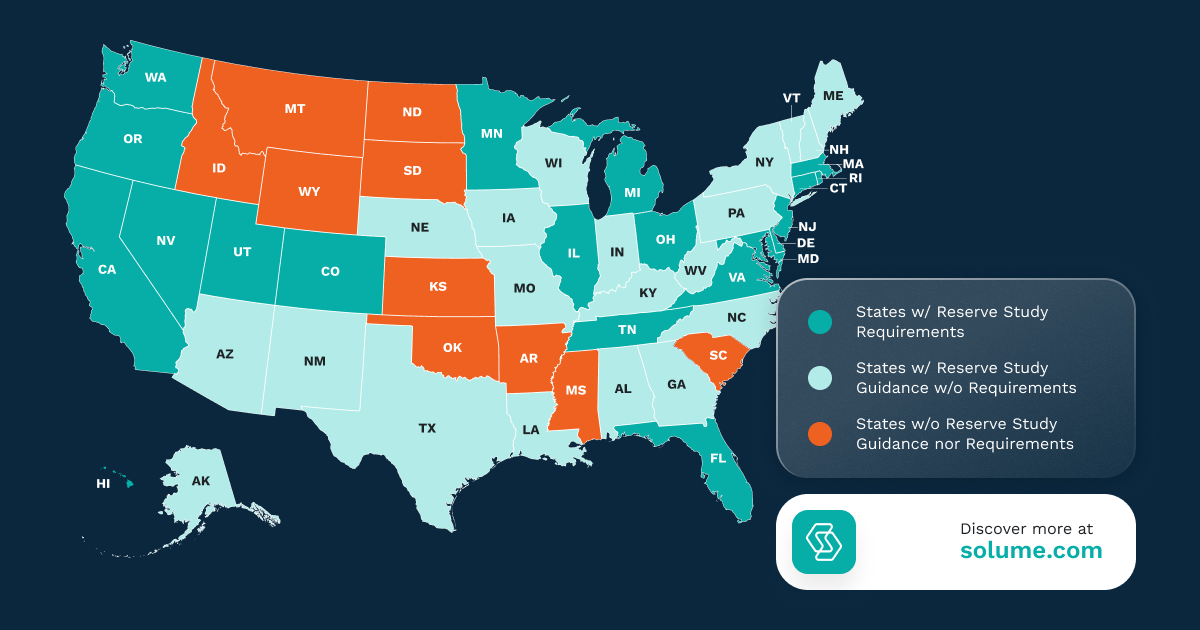
The legal landscape is evolving rapidly, with many states tightening rules to prevent special assessments and improve structural safety. Below are the states where reserve studies are currently mandatory for HOAs and/or Condo Associations:
California - Every 3 Years
Requires a diligent visual inspection of components and an annual review of the study by the board.
Read more about California's Reserve Study requirements here.
Colorado - Periodic
Mandates studies for portions of the community maintained by the association; specific frequency is often tied to funding plans.
Read more about Colorado's Reserve Study requirements here.
Delaware - Every 5 Years
Reserve studies must be updated every five years, and annual budgets must include adequate reserve contributions.
Florida - Every 10 Years
Specifically requires Structural Integrity Reserve Studies (SIRS) for buildings 3 stories or higher (S.B. 4-D).
Read more about Florida's Reserve Study requirements here.
Hawaii - Every 3 Years
Budgets must be based on a study using a 30-year replacement projection.
Maryland - Every 5 Years
Mandatory for all condos and co-ops, as well as HOAs with significant common elements ($10k+).
Nevada - Every 5 Years
Requires a professional study every five years with an annual internal review by the board.
New Jersey - Every 5 Years
Recent legislation (2024) requires associations to conduct and update studies to ensure adequate funding.
Read more about New Jersey's Reserve Study requirements here.
Oregon - Annually
Boards must conduct a reserve study or review/update an existing one every year.
Read more about Oregon's Reserve Study requirements here.
Tennessee - Every 5 Years
Required for associations that have conducted a study on or after Oct 1, 2018.
Utah - Every 6 Years
Requires a professional update every six years, with an internal review every three years.
Virginia - Every 5 Years
Must conduct a study every five years and review results annually to ensure sufficiency.
Washington - Every 3 Years
Mandates a professional update with a site visit every three years and an annual internal review.
Read more about Washington's Reserve Study requirements here.
Even if your state is not listed, your association’s governing documents (CC&Rs) or fiduciary duties likely require you to maintain adequate funding.
Here’s the part most boards miss. If your state does not mandate reserve studies, it’s easy to assume you have more “wiggle room.” In reality, you just have more ways to drift off course.
When something expensive breaks, nobody asks whether your state required a study. They ask why there wasn’t a plan.
Reserve Study Best Practices
Legal compliance is the floor, not the ceiling. If your goal is to protect property values and avoid the special assessment nightmare, these are the best practices that actually move the needle.
1) Don’t Wait for the Five-Year Mark
A five-year update cycle sounds reasonable until you live through a year where costs jump 10 to 20 percent. It happens. And it’s exactly why many boards do a lightweight annual update, even if it’s a “Level 3” update with no site visit.
The point is not to redo the study. The point is to keep the numbers anchored to reality.
2) Move Beyond the Static PDF
A 100-page PDF sitting in a drawer is not a management tool. It’s a snapshot. And snapshots go stale.
If you complete a project, change a component’s scope, or shift vendors, the reserve assumptions should update too. Otherwise the study becomes a historical document that quietly misleads you.
3) Sync Your Study with Your Budget
Reserve planning and budgeting must live together.
If the reserve study is in one spreadsheet, the annual budget is in another, and actual spending is tracked somewhere else, you will miss things. Not because you’re careless, but because the system is built for fragmentation.
4) Prioritize Transparency
Homeowners are much more likely to support dues increases when they can see the data. Show remaining useful life. Show projected replacement cost. Show the funding gap.
When people see the “why,” you get fewer emotional debates and more informed decisions.
At this point, most boards ask the same question:
“Okay… but how do we actually keep track of all this without dropping the ball?”
That question is the whole game.
The Practical Update Schedule Most Boards Should Follow
Annual review: every year
An annual review is a lightweight check-in. You are not recreating the study. You are asking:
- Did we complete any major projects that should update the component list?
- Did actual costs match the study assumptions?
- Have inflation and construction pricing changed the replacement costs?
- Did we change reserve contributions during the last budget cycle?
This can be done internally by the board and manager if you have solid records.
Professional update: every 3 to 5 years
A professional update is a deeper refresh that recalibrates costs, timing, and useful life assumptions.
For many communities, every 3 years is the sweet spot. For smaller or less complex associations, every 5 years can be sufficient if the board is doing a real annual review and tracking projects accurately.
When You Should Update More Often
Some communities should not wait 3 to 5 years.
Here are the common triggers that justify a faster schedule.
If you are a condo association
Condo associations usually have higher structural and systems exposure. Roofs, siding, balconies, elevators, plumbing, fire systems. When those fail, the costs are bigger and the risk is higher. A stale reserve study is a bigger problem in a condo than it is in a neighborhood with minimal shared infrastructure.
If you have large or expensive common assets
If your community has a pool, clubhouse, private roads, retaining walls, or significant drainage systems, you are dealing with real capital expenditures. That kind of community should be more aggressive about updates.
If your cost environment is changing quickly
If your contractor pricing has jumped, insurance has shifted, or your bids are coming in consistently above your reserve study numbers, you need to update sooner.
If you just completed a major project
Any time you complete a big project, you should update the reserve schedule and funding plan. Otherwise the study still assumes you have not done the work, and your projections get distorted.
Why Reserve Study Software Matters
A reserve study is only as useful as the system you use to manage it.
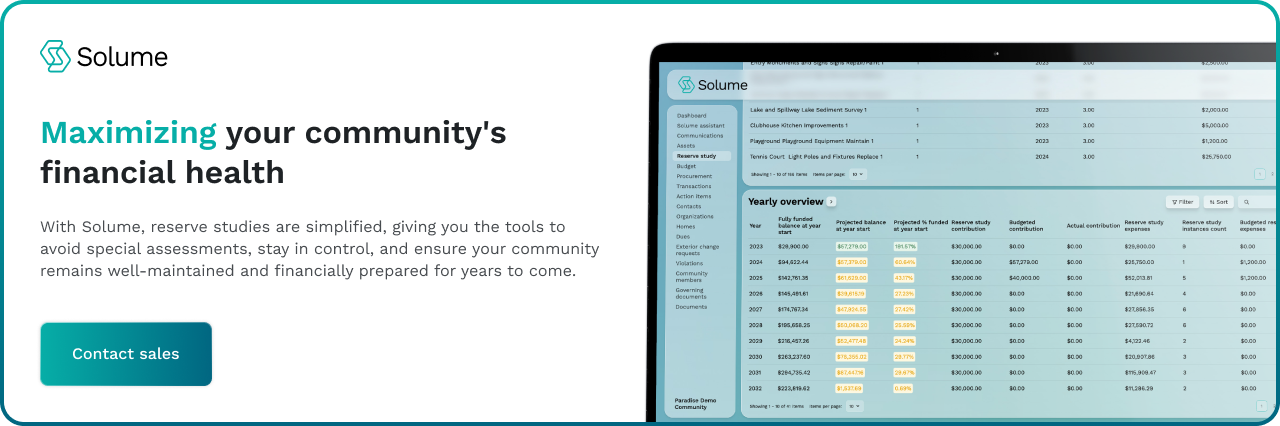
Reserve Study Software is what turns reserve planning into something operational. Instead of relying on disconnected PDFs, spreadsheets, and calendar reminders, boards can track long-term financial liability, component timing, and funding scenarios as a living system.
This is also where boards and managers can finally get on the same page. In the real world, reserve planning touches budgeting, work orders, vendor bids, and long-term maintenance. If those systems do not talk to each other, you get delay, human error, and surprises.
Solume was built for this exact problem. It’s an all-in-one HOA and Condo management system that includes integrated reserve study management, so your reserve data is not separate from your day-to-day reality.
- Living Data, Not Dead Documents: When costs change or projects are completed, you update the system and your long-term projection adjusts.
- Total Financial Integration: Your reserve planning and operating budget can live together, so contributions are driven by the plan, not by guesswork.
- Avoid Special Assessments: The earlier you see a funding gap, the easier it is to solve with small adjustments instead of emergency assessments.
- Vendor Management: When a component is nearing end-of-life, you should be able to move straight into bids and execution, without jumping across tools.
I’m not saying every community needs the most complicated platform on the market. Most boards don’t. What boards need is a system that is simple enough to actually use and complete enough to manage long-term risk.
Ready to Modernize Your Reserve Management?
If your reserve study is a PDF that only gets opened during budget season, you already know the problem. The question is whether you want to keep operating that way.
Is it really a crazy idea to spend 15 minutes seeing whether a platform could save your community thousands of dollars and years of friction?
If you want to modernize reserve planning and put it into a system your board and manager can actually use, click the button below to learn more or schedule a demo today.