
A pipe bursts in the clubhouse ceiling over a holiday weekend, floods the fitness room, and the repair bill lands at $42,000. Who pays? If your board can't answer that in one sentence, your community has an HOA insurance problem, not a plumbing problem. Most self-managed boards inherit a master policy they've never read, then find the gaps only after a claim gets denied. This guide walks through what HOA insurance is, what it covers, what it leaves out, what it costs, and where the responsibility lands when volunteers, not a management company, run the show.
Key Takeaways
- HOA insurance, known as the master policy, protects the shared structures, common areas, and liability risks the association owns rather than individual units.
- Homeowner dues fund master policy premiums, which typically range from $3,500-$7,500 a year for small condo associations to $8,000-$18,000 for mid-size communities with amenities.
- Whether coverage is bare-walls, single-entity, or all-in determines exactly where the master policy stops and where each owner's personal policy must begin.
- Condo and townhome owners still need their own HO-6 policy to cover interior finishes, belongings, and personal liability that the master policy excludes.
- Gaps or uncovered claims in an HOA policy shift costs onto reserves or a special assessment, so boards should review coverage limits alongside their reserve planning each year.

What HOA insurance is and how it works
HOA insurance is the master insurance policy an association buys to protect the property it collectively owns and the liability it carries. People also call it homeowners association insurance or the HOA master policy. The terms describe the same thing: one policy covering shared assets rather than any single home. So what is this policy protecting? Think roofs, exterior walls, hallways, elevators, and everything in the common areas that no individual owner controls.
Here's how it works in practice. The association is the named insured, the board manages the policy, and the operating budget funded by dues pays the premium. When something covered gets damaged, the association files the claim and pays the deductible. It then splits any remaining exposure across the community. The structure works this way because the association legally owns the shared property, so it carries the insurable interest that individual owners don't have in a shared roof or common hallway. The National Association of Insurance Commissioners consumer guide on condo and HOA coverage explains how these master policies interact with individual owner policies. Understanding that handoff is key.

What HOA insurance covers (property and liability)
What does HOA insurance cover? Two big buckets: property and liability. On the property side, the master policy pays to repair or rebuild shared structures after a covered event: fire, wind, vandalism, or that burst clubhouse pipe. That includes the building shells, roofs, shared plumbing and electrical systems, fences, pools, and landscaping in common areas.
The liability side is where boards get complacent. General liability insurance covers bodily injury and property damage claims when someone gets hurt on association property. A guest slips on an icy walkway. A child is injured at the pool. A delivery driver trips on a cracked sidewalk. This coverage pays legal defense costs and settlements up to the policy limit. The reason it matters: a single serious injury lawsuit can exceed a small association's entire reserve fund. The Insurance Information Institute's overview of condo insurance and master policies breaks down how coverage splits between the association and owners. For a deeper look at condo association insurance essentials, boards have to review both halves of homeowners association insurance, not just the property limits everyone remembers to check.
What HOA insurance does not cover
Here's the hard truth most boards learn during a claim: the master policy stops at the shared structures. It does not cover anything inside an individual unit. No personal belongings, no furniture, no interior finishes beyond whatever the policy type dictates. It does not cover an owner's personal liability if a guest is injured inside their condo.
The master policy also excludes several perils outright unless you buy them separately. Standard HOA insurance coverage does not include flood or earthquake damage. Both require dedicated flood and earthquake insurance, and communities in designated zones should review FEMA flood insurance requirements before assuming they're protected. It excludes wear and tear, deferred maintenance, and gradual damage. The reason is straightforward: insurers cover sudden, accidental events, not the slow decline a board should address through routine upkeep. That's why a slow leak that rots a subfloor over two years often gets denied. Many boards assume a full-looking policy covers every disaster. In reality, the exclusions page is where the risk lives. Mold, wrongful acts by board members, employee theft, and injuries to workers all fall outside a basic property and liability policy and need supplemental coverage.
Types of condo/HOA coverage: bare walls, single-entity, all-in
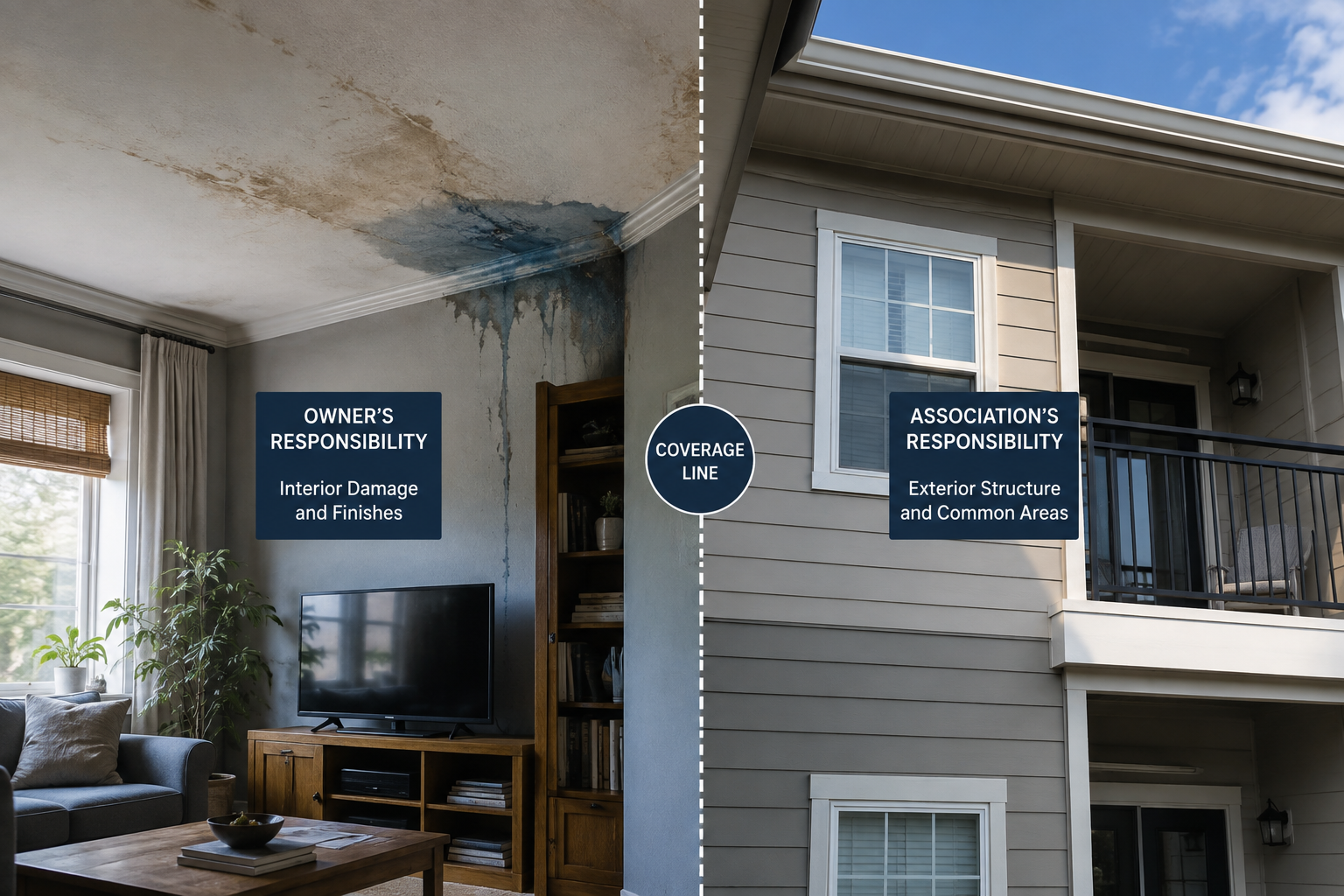
The single most important detail in any HOA master policy is which coverage type it uses. It decides where the association's responsibility ends, and the owner's begins.
Bare walls coverage is the narrowest. It insures the structure only up to the unfinished interior surfaces: the framing, drywall, and subfloor. It does not cover cabinets, fixtures, flooring, or appliances. Under this walls-in coverage arrangement, an owner is responsible for nearly everything they can touch inside the unit.
Single-entity coverage goes a step further. It includes the original fixtures and finishes installed when the unit was built, but not upgrades an owner added later. All-in coverage, sometimes called all-inclusive, is the broadest. It extends into condo interiors like built-in cabinets, flooring, and often improvements. That leaves owners responsible mainly for personal property and liability.
Picture a condo owner who renovates a kitchen with $30,000 in custom cabinets and quartz counters, assuming the master policy will rebuild them after a fire. If the association carries single-entity coverage, the policy only pays to restore the builder-grade fixtures that were there originally, and the owner eats the difference on the upgrades. Boards should read their governing documents to confirm which type applies, because owners buying their own policies need to know the exact gap. A community that thinks it has all-in coverage but actually carries bare walls leaves every homeowner underinsured without realizing it.
HOA insurance vs homeowners/condo insurance
The confusion in HOA insurance vs homeowners insurance comes from assuming one policy replaces the other. It does not. They cover different property and stack together.
A traditional homeowners policy covers a single-family house top to bottom: structure, contents, and liability, because one owner controls everything. Condo association insurance works differently. The master policy handles shared structures and common areas. Each unit owner carries a personal HO-6 policy for interior finishes, belongings, and personal liability. The HOA master policy and the HO-6 meet at a line defined by the coverage type above. The NAIC consumer guidance on homeowners and association coverage is a useful reference for owners sorting out which policy handles what.
So the honest framing of HOA insurance vs homeowners insurance is this: the master policy protects the community, and your HO-6 protects your unit. Owners who skip the HO-6 because "the HOA has insurance" are the ones stuck paying out of pocket when a covered loss damages their flooring, appliances, or belongings. Neither policy is optional if you want full protection.
Additional/supplemental coverages (D&O, crime, EPLI, flood)
A basic property and liability package leaves several exposures wide open, and this is where volunteer boards are most vulnerable. Directors and officers liability insurance protects board members personally when they're sued over decisions they made: denying an architectural request, enforcing a fine, mishandling a vote. Without this directors and officers liability insurance, a volunteer's personal assets can be on the line. That's one of the many challenges self-managed boards face that most don't realize they've accepted.
Crime insurance, also called fidelity coverage, protects the association if a board member, employee, or manager steals funds. That's a real concern when one treasurer controls the checkbook. Employment practices liability insurance covers claims of wrongful termination or discrimination if the association has staff. Workers' compensation insurance covers on-site employees injured on the job. Because standard policies exclude floods, communities in risk zones need separate flood and earthquake insurance. Larger associations often add umbrella coverage to raise liability limits above the base policy. The through-line is that each of these fills a specific hole a standard policy deliberately leaves open, so the right mix depends on whether your community has staff, amenities, or sits in a hazard zone.

Why HOA insurance matters and who pays for it
Who pays for HOA insurance? Every homeowner does, indirectly. The association buys the master insurance policy, and the premium is baked into the HOA fees each owner pays. That's the point: spreading the cost of insuring a shared roof or a common-area lawsuit across the whole community so no single owner absorbs a catastrophic bill alone. It also helps to understand how HOA fees and expenses are treated when you're accounting for the premium at year-end.
This matters because of fiduciary duty. Boards must protect association assets, and courts have consistently treated adequate insurance as part of that duty. Skipping or underinsuring the master policy exposes homeowners to special assessments they never budgeted for. Consider a 40-unit condo association where the board let liability limits stay at 1990s levels. One pool injury settlement exceeds the policy, and the remaining $200,000 gets split into a $5,000 assessment per unit. That's the scenario adequate homeowners association insurance exists to prevent. Community associations that treat the master policy as a line item to minimize, rather than a protection to maintain, gamble with every homeowner's finances.
State insurance requirements for HOAs
Insurance requirements for HOAs aren't uniform, and this constantly trips up self-managed boards. Requirements come from three places: state statute, your governing documents, and mortgage lenders. Governing documents usually spell out minimum coverage. Lenders often require proof of a master policy before they'll finance a unit because the loan is secured by property that shares walls, roofs, and systems with units the lender can't control.
State law adds another layer. California's Davis-Stirling Act, for example, addresses insurance disclosures and requires associations to notify members about coverage. Other states impose their own minimums on liability limits or fidelity bonds. Because insurance requirements for HOAs vary significantly by state, boards should confirm the specifics with their state's community association statute and have their attorney review the governing documents. Do not assume a policy that met requirements a decade ago still complies. Statutes change, and so do lender standards.
For a planned community of single-family homes, requirements often focus on common areas and liability rather than building structures. Condo association insurance rules tend to be stricter because the shared structures are so much larger, and the walls between owners create more overlap that someone has to insure.
How much HOA insurance costs
How much does HOA insurance cost? It depends on unit count, property type, location risk, claims history, and amenities, but real ranges help. A small condo association of around 20 units commonly pays $3,500 to $7,500 per year for a solid property and liability package. A mid-size community of 25 to 100 units with a pool, clubhouse, and elevators can run $8,000 to $18,000 annually once you add the supplemental coverages.
Location drives a lot of the variation. Coastal wind exposure, wildfire risk, and flood zones push premiums up fast. In high-risk areas, adding flood and earthquake insurance can rival the base policy cost. In underfunded communities, the squeeze is slow: boards shop for the cheapest policy, cut limits or drop D&O coverage, and end up exposed. A cheaper premium that strips out coverage isn't a saving; it's a deferred cost that reappears as a special assessment the first time a claim lands outside the policy. Folding the full premium into building your annual HOA budget, and revisiting it during reserve planning, keeps HOA fees stable instead of spiking after a surprise renewal.

Insurance responsibilities unique to self-managed boards
In a professionally managed community, a manager tracks renewals, files claims, and flags coverage gaps. In self-managed communities, that's entirely the board's responsibility, and it's easy to drop. Most boards assume the policy renews itself correctly year after year. In reality, coverage limits erode against inflation, exclusions get added quietly, and a lapsed fidelity bond can go unnoticed until money goes missing.
Here's the practical checklist for self-managed communities. Read the full policy, including exclusions. Confirm the coverage type matches your governing documents. Verify D&O coverage is active before every board term. Keep a certificate of insurance on file, and review limits during your annual budget cycle. This is also where compliance failures hide, because HOA insurance requirements connect directly to statute and lender demands. Coordinating insurance review with your reserve study matters too, since uncovered claims land on reserves. Handling all of this on spreadsheets and email is where board burnout starts, because the one document nobody can find is always the one an adjuster or lender asks for. Software that centralizes financial records, vendor documents, and reserve planning gives self-managed boards one place to track coverage instead of hunting through old files.
If your board wants a clearer way to manage finances, reserve planning, vendor oversight, and the documents tied to your insurance and compliance obligations, you can schedule a 15-minute call to see if Solume fits your community. No pressure, just a straight answer on whether it makes sense for how you operate.
Frequently Asked Questions
What does an HOA insurance policy actually cover?
An HOA master policy covers shared property the association owns or maintains: roofs, exterior walls, hallways, elevators, clubhouses, pools, landscaping, and parking lots: plus liability for accidents in common areas. Common building systems like shared plumbing, wiring, and HVAC may also be included depending on the policy.
How much should a board expect to pay for HOA insurance?
Cost varies by unit count, property type, location risk, and amenities. A small condo association of roughly 20 units often pays $3,500-$7,500 per year, while a mid-size community of 25-100 units with amenities can run $8,000-$18,000 annually for a full property, liability, and extras package.
Who actually pays for the HOA's master insurance policy?
The association buys the master policy, but it's funded collectively through the dues every homeowner pays. This spreads the cost of insuring shared structures and liability across the whole community rather than any single owner.
Does the master policy mean I don't need my own homeowners insurance?
No. The master policy stops at shared structures and common areas, so you still need a personal policy (an HO-6 for condos) to cover interior finishes, personal belongings, and your own liability. Where exactly that line falls depends on whether the master policy is bare-walls, single-entity, or all-in.
What's the difference between bare-walls, single-entity, and all-in coverage?
Bare-walls covers the structure only up to the unit's outer walls, single-entity adds original built-in fixtures, and all-in (all-inclusive) extends into interior elements and sometimes upgrades. Boards should check their governing documents to know which type applies, since it determines the gap each owner must fill.
Is a master insurance policy really worth the cost for a small self-managed HOA?
The alternative is exposing individual homeowners to repair bills for shared roofs, private streets, or a lawsuit from someone injured at the pool: costs no single owner should carry alone. For most communities, the master policy is a fiduciary requirement, not an optional expense, and governing documents or lenders often mandate it.
What happens if the HOA's insurance doesn't cover a claim?
Uncovered damage or shortfalls typically fall to the reserve fund or trigger a special assessment split among all homeowners. This is why boards should confirm coverage limits, review policy gaps annually, and coordinate insurance planning with their reserve study.
Do all HOAs carry their own insurance, or is it optional?
Most HOAs must carry a master policy under their governing documents, state law, or mortgage lender requirements. Condominium associations almost always maintain one, while planned communities of single-family homes may carry more limited coverage focused on common areas and liability.