
A single homeowner who stops paying dues can drain a small association faster than most boards expect. If a 40-unit community loses even two owners to prolonged delinquency, the shortfall lands on everyone else, often as a special assessment nobody voted for. HOA collections isn't a bureaucratic afterthought. It's the mechanism that keeps the lights on, the insurance paid, and the reserves funded, and it's central to any association's financial health. Many of the difficulties boards face here trace back to broader self-managed HOA collections challenges that come with running an association without professional management. This article walks through general considerations for building a collections policy that actually holds up when a delinquency escalates, though boards should always consult their own attorney before adopting or enforcing one.
Key Takeaways
- HOA collections is the formal process, grounded in CC&Rs and state law, that associations use to recover unpaid dues, fines, and assessments.
- Unresolved delinquencies typically escalate from late fees to attorney referral, a recorded lien, and in some states, foreclosure.
- Credit damage from HOA debt usually comes through a collections agency report or court judgment, not the lien filing itself.
- Settlement or payment plans are often negotiable before a lien is recorded, but options shrink once legal fees accumulate.
- A documented, consistently enforced collections policy reduces both delinquency rates and the board's legal exposure.

What an HOA collections policy is and why it matters
A collections policy is the written playbook that tells your community exactly what happens when someone falls behind on payments. It defines the grace period, late fees, the sequence of notices, and when an account moves to an attorney or collection agency. Without one, boards improvise. That's where trouble starts.
Here's the hard truth: inconsistent enforcement is a legal liability. If your board waives a late fee for one owner and pursues an HOA lien against another for the same delinquency, you've handed a defense attorney an argument. This matters because HOA dues collection rests on the principle of equal treatment: a court will scrutinize whether every owner faced the same rules, and selective enforcement is what gives a delinquent owner grounds to fight back. A written HOA collection policy protects the board of directors by applying the same rules to everyone, giving directors a defensible standard when a homeowner pushes back. It also gives the homeowners association a defensible record if a dispute reaches court, since consistency shows the board acted in good faith rather than singling anyone out. The Community Associations Institute publishes guidance for board members on operating within governing documents and state requirements. A clear policy also makes collection predictable rather than reactive.
Understanding HOA dues, assessments, and delinquency
Dues are the regular payments every owner makes to fund community operations. Assessments cover the same ground, but the term also includes one-time charges, like special assessments for a roof replacement or a lawsuit settlement. When a payment isn't made by the due date, the account becomes delinquent, and most governing documents require late fees and interest to accrue.
Here's why this matters: an HOA is a nonprofit that spends almost exactly what it collects. Unpaid HOA assessments don't just inconvenience the board; they threaten the community's financial health by reducing cash available for insurance, maintenance, and reserve funds. The Consumer Financial Protection Bureau explains that association assessments are a legal obligation tied to property ownership. Many owners assume unpaid dues are a private matter between them and the board. In reality, one owner's delinquency raises costs for every neighbor. Boards also need to understand how HOA fees are treated for tax purposes, since owners sometimes raise tax questions when disputing charges or negotiating a payment plan.
Key elements every collections policy should include
A strong policy covers the full path from the first missed payment to legal action. Leave out a step, and you create a gap an attorney can exploit.
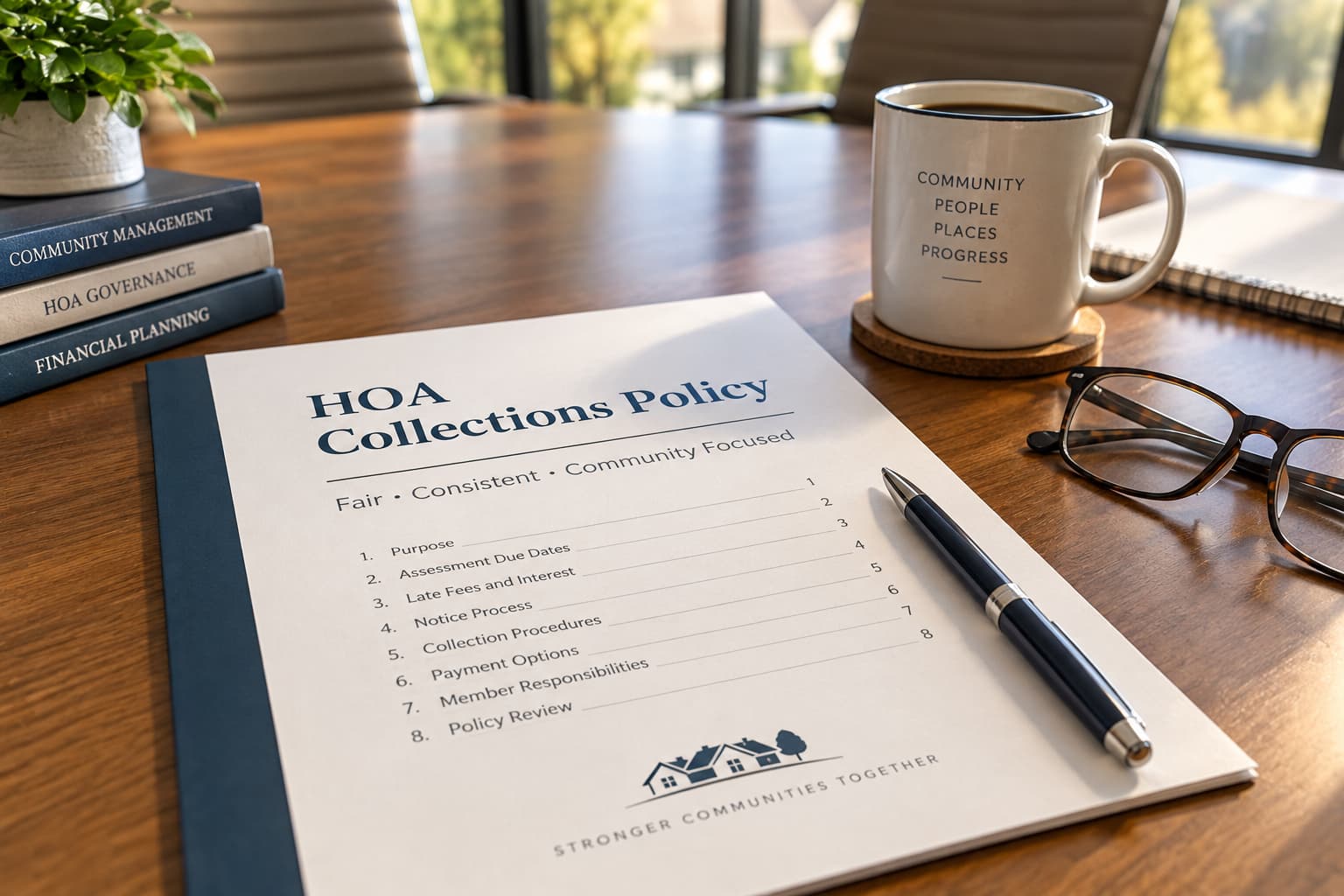
At minimum, your written policy should spell out:
1. The payment due date and the length of any grace period.
2. The late fee amount and how interest accrues on delinquent balances.
3. The exact sequence and timing of reminder notices sent to the owner.
4. The point at which an account is referred to an attorney or collection agency.
5. The conditions under which the association will record an HOA lien.
6. A formal dispute or hearing process the owner can use before escalation.
7. Whether payment plans, including online payments, are offered and on what terms.
Document, date, and have the board approve each of these elements, ideally with input from the association's attorney. Vague language like "the board may pursue collection at its discretion" invites uneven enforcement and the disputes that follow.
The step-by-step collections process from notice to lien
A defensible HOA dues collection process moves in predictable stages. Follow them in order.
1. Send a friendly reminder notice as soon as a payment is late, before any fee applies.
2. Apply the late fee once the grace period closes, and document the date.
3. Mail a formal HOA collection notice stating the balance, the fees, and the deadline to cure.
4. Offer a payment plan option in writing if the owner responds.
5. Send a final demand letter warning that the account will be referred for legal action.
6. Refer the account to an attorney or collection agency per your written policy.
7. Record an HOA lien against the property once the statutory notice requirements are met.
This order is about timing. Each step creates a documented record showing the owner was given notice and a chance to resolve the debt. This sequence matters because most state statutes make a valid lien conditional on prior notice: skip straight to a lien, and you may violate those notice requirements, which can invalidate the lien entirely. Boards should confirm these requirements with their attorney against the specific statute that governs their state and community type.
Late fees, interest, and payment plans
A late fee is meant to encourage prompt payment, not to punish. Most governing documents cap what an association can charge, and several states set statutory limits on both the fee and the interest rate. Charging more than your CC&Rs or state law allows is a common way boards create legal exposure, so confirm current limits with your attorney rather than relying on past practice.
Payment plans are one of the most useful tools in recovering delinquent assessments, and boards underuse them. A homeowner behind on delinquent HOA fees who agrees to a structured plan, especially one paid through online payments, is far cheaper to recover from than one you drag through lien foreclosure. When boards refuse to negotiate, legal costs balloon and the association recovers less. Offer plans consistently, put every term in writing, and treat a signed plan as the preferred outcome. Consistency keeps unpaid dues from turning into a total loss.
The HOA lien and foreclosure process
An HOA lien is a legal claim recorded against a delinquent property. Once filed, it attaches to the home and generally must be paid before the owner can sell or refinance. Recording it is a serious step, and most states require specific advance notice before the association can do it.
Lien foreclosure is the last resort, and it's exactly what it sounds like: the association forces a sale to recover unpaid assessments. The rules here vary sharply. Some states allow non-judicial foreclosure, others require a court process, and several impose a minimum debt threshold before foreclosure can begin. Condominium associations often operate under a separate statute from planned communities. Because these rules vary significantly by state, confirm your process against your state's HOA or common-interest community statute and have your attorney review it before proceeding. A misfiled lien can cost more than the debt it was meant to recover.
Staying compliant with state laws and the FDCPA
State laws govern almost every part of HOA fee collection: how much you can charge, how much notice you must give, and whether you can foreclose. Many communities don't realize that a policy legal in one state can be unenforceable in the next. Always confirm your state's current HOA statute with your attorney rather than relying on a template from another jurisdiction.
The federal Fair Debt Collection Practices Act adds another layer. When your association hires a third-party collection agency or attorney to pursue a debt, that agent is subject to the Fair Debt Collection Practices Act, which restricts how and when they can contact an owner. Violations can expose both the agency and the association to liability. The Fair Debt Collection Practices Act regulations published by the CFPB spell out exactly what communications are permitted and how disputes must be handled. Staying compliant means documenting every notice, honoring dispute requests, and staying inside the collection timelines your state sets. Boards should consult their attorney to interpret any statute before acting on it.
Proactive communication and consistent enforcement
Most boards assume collections is about pressure. In reality, associations with the lowest delinquency rates communicate early and often. A proactive collection policy leans on reminders, not threats.
Picture a self-managed community that mails no reminder notices and only reaches out after an account is 90 days past due. By then, the owner owes hundreds in late fees and interest, feels ambushed, and is far more likely to dispute the charges. Now picture a community that sends a courtesy reminder the week a payment is late. The owner pays, no fee accrues, and the relationship stays intact. Consistent enforcement matters just as much: apply the same collection timelines and the same escalation to every owner. Selective enforcement is the fastest way to lose a dispute and undermine board authority over community operations, and it's one of the clearest red flags in HOA financial management that owners and new board members alike should learn to spot.
Using software to automate dues collection and tracking
Manual tracking is where self-managed communities fall behind. A treasurer juggling a spreadsheet and a full-time job will miss due dates, forget to send reminder notices, and apply late fees inconsistently. Each gap weakens the collections policy and quietly erodes financial health as inconsistent enforcement creeps into your HOA collections.
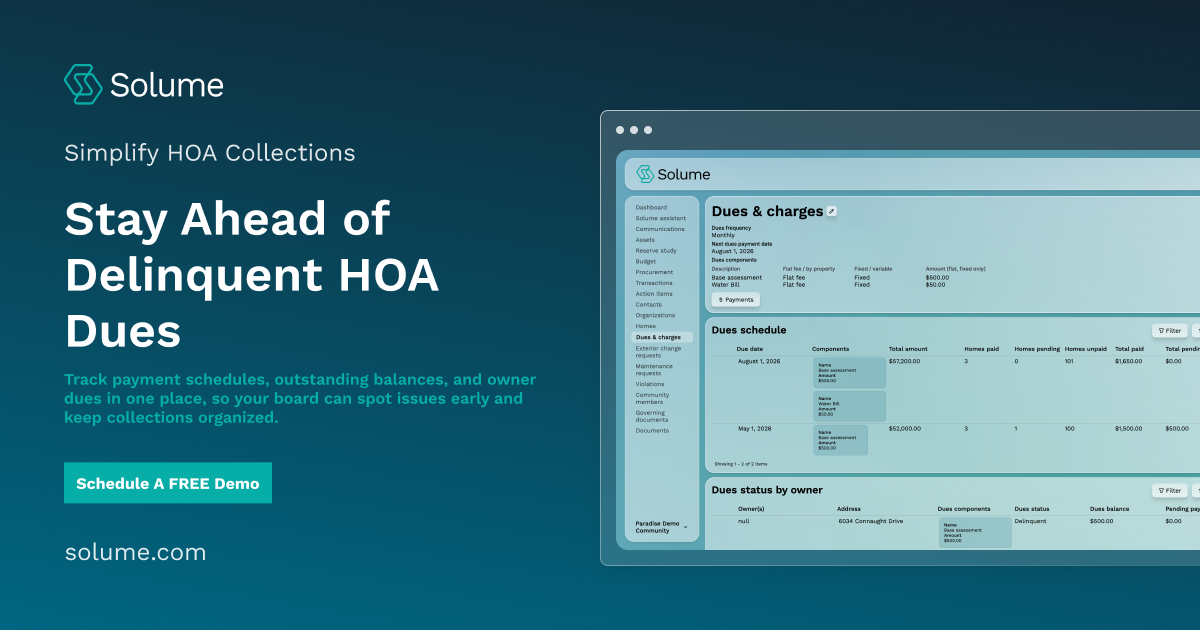
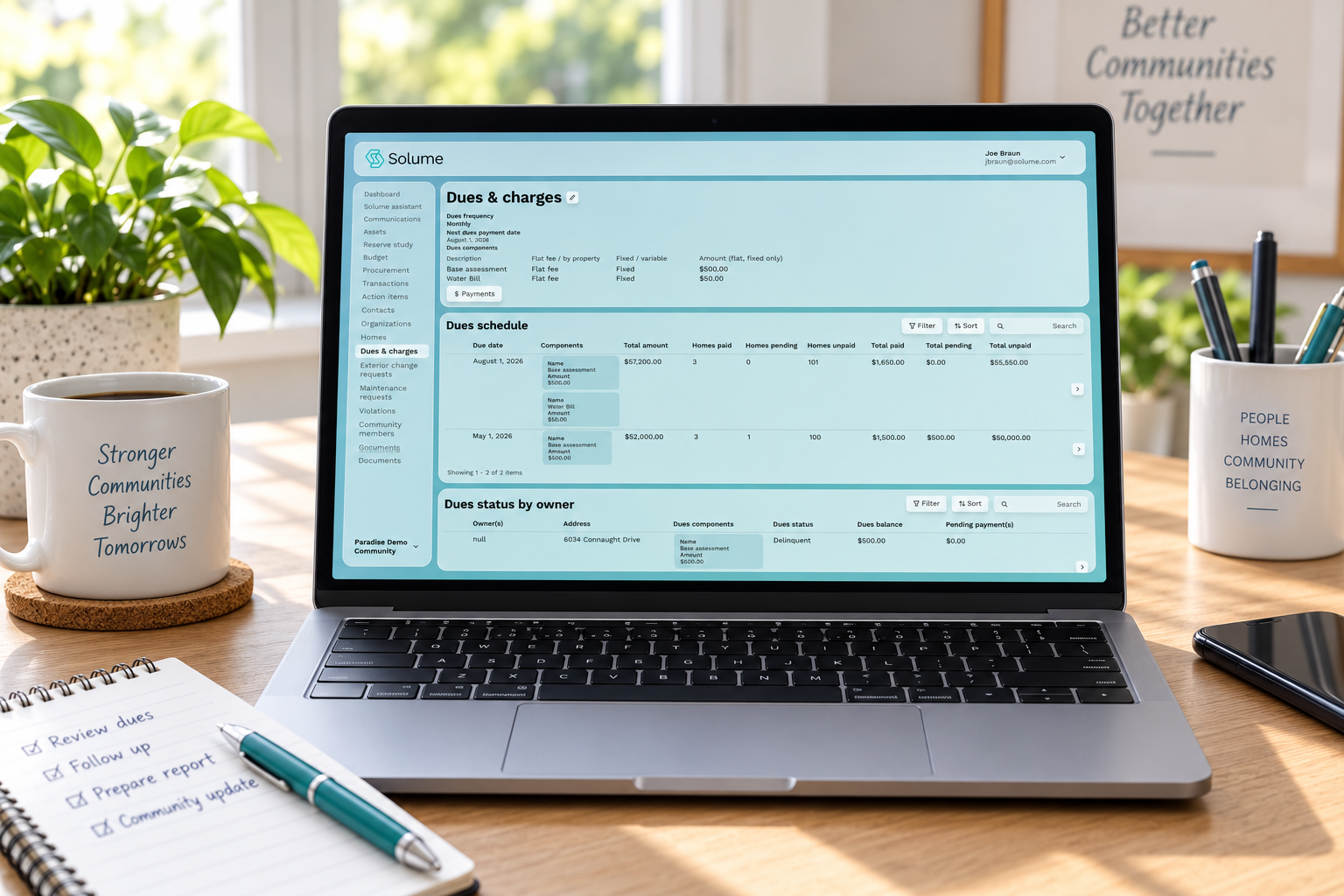
Automation closes them. Systems built around online payments make it easier for owners to pay on time, the cheapest form of assessment recovery there is. Solume automates HOA fee collection for self-managed boards, tracking each account, flagging delinquencies, and sending reminder notices on schedule so no delinquent account slips through unnoticed. Building this on top of accurate bookkeeping practices for tracking dues ensures every payment, fee, and adjustment is recorded correctly from the start. A running record of every notice sent creates the documentation you'll need if an account ever escalates to legal action or credit reporting.
Financial transparency in the collections process for self-managed boards
Transparency is what separates a trusted board from one homeowners suspect. When owners can see how revenue flows into reserve funds, maintenance, and insurance, they're more likely to accept enforcement as fair rather than punitive. Opaque accounting breeds the resentment that turns a routine delinquency into a contested one.
For self-managed communities, the fix is straightforward: report clearly. Publish delinquency totals in aggregate, show how recovered HOA assessments feed the budget, and keep the collections policy itself available to every member. This isn't just good ethics. It's a defense: a board that documents its collection timelines and shares them openly is far harder to accuse of unfair treatment. Transparency also strengthens community stability, because owners who trust the numbers are less likely to challenge special assessments or withhold payment out of frustration. Handled well, HOA collections become a routine, predictable process rather than a source of conflict.
If your board wants a clearer way to handle dues collection, reserve planning, and financial reporting without leaning on a management company, book a 15-minute call to see whether Solume fits your community and where it could close gaps in your current process.
Frequently Asked Questions
What actually happens if my HOA sends my account to collections?
Your unpaid balance gets handed to an attorney or third-party collections agency, which adds its own fees and interest on top of what you already owe. From there, the HOA can pursue a lien on your property, and in some states, foreclosure if the debt stays unresolved.
What happens long-term if I just never pay my HOA dues?
The debt compounds through late fees, interest, and collection costs, and most CC&Rs allow the HOA to suspend your access to shared amenities like pools or gyms. Left unaddressed, it typically escalates to a recorded lien and, depending on state law, foreclosure proceedings.
Does an HOA lien show up on my credit report?
The lien itself isn't automatically reported to credit bureaus, but once the debt is sent to a collections agency, that agency can report it and damage your credit score. A judgment resulting from an HOA lawsuit can also appear on your credit history and stay there for years.
Can you negotiate or settle a debt once it's in HOA collections?
Yes, many HOAs and their collections agencies will accept a payment plan or a reduced lump-sum settlement rather than pursue costly legal action. It's worth requesting this in writing before a lien is filed, since options narrow considerably once legal fees start accumulating.
What if a homeowner disputes the charges before the HOA escalates to collections?
A written collections policy should include a formal dispute or hearing process before referring the matter to an attorney or agency, since skipping this step can expose the HOA to legal challenges. Boards that document every notice and response typically avoid disputes turning into drawn-out litigation.
Why do HOAs send accounts to collections instead of just waiting for payment?
Unpaid assessments directly reduce the funds available for shared maintenance, insurance, and reserves, so delays create financial strain for the entire community, not just the board. Most governing documents obligate the board to pursue collection as a fiduciary duty, not an optional choice.
Are there best practices that reduce how often HOA accounts end up in collections?
Boards that adopt a written collections policy, distribute it annually, and send consistent notices during the grace period see fewer accounts escalate to formal collections. Automated dues tracking and early payment reminders catch delinquencies before late fees and legal costs stack up.