
A retired homeowner in Florida volunteers for the board, thinking the job means approving pool furniture and settling parking disputes. Two years later, the roof needs replacing. The reserve account holds a fraction of what it should, and every owner gets a $9,000 special assessment letter in the mail. That scenario plays out in communities every month. It happens because most volunteers underestimate what HOA board responsibilities actually involve. This guide walks through the legal, financial, and operational duties that come with the job, so your board can protect the community instead of scrambling after problems surface. Because these duties are set by state law and your own governing documents, the specifics vary by jurisdiction, and your state statutes and CC&Rs are always the governing authority.
Key Takeaways
- HOA board responsibilities center on three legal pillars: financial management (budgets and assessments), fiduciary duty (care, loyalty, obedience), and enforcement of the community's CC&Rs.
- No single board officer, including the president, holds unilateral power: binding decisions require a majority vote at a properly noticed meeting.
- The board sets policy and controls the money, while a property manager only executes the board's decisions and holds no governance authority.
- Underfunded reserves, secret decision-making, and selective rule enforcement are the clearest signs of a board failing its fiduciary obligations.
- Documented good-faith decisions and D&O insurance protect board members under the business judgment rule, making liability exposure largely avoidable.

What an HOA board of directors is and who serves on it
An HOA board of directors is the governing body of a community association. It is made up of elected volunteers who happen to own homes in the community they run. They are not professionals. They are retirees, working parents, and neighbors who agreed to take on a legal role most never trained for. That gap between the HOA board responsibilities and the experience is exactly where trouble starts.
The board holds legal authority to make binding decisions on behalf of every owner. That covers setting budgets, hiring vendors, and enforcing rules. What actually happens is that a corporation, usually a nonprofit under your state law, operates through this board. The board sets policy. Nobody else does. Community associations have become a significant part of American housing, as reflected in American Housing Survey data on community associations.
Most boards assume their power is informal. In reality, the board of directors duties are defined by your governing documents and state law, and courts treat those obligations seriously. Because those obligations flow from state statutes, they differ from one state to the next, so your state's HOA statute is the final word on what your board can and cannot do. The Community Associations Institute, a national trade group, publishes practical guidance on board member roles and governance that clarifies where a volunteer's authority begins and ends. Reading it early helps boards avoid decisions they had no right to make.
HOA board member positions (president, vice president, secretary, treasurer)
Most HOA board positions come with a title and a stack of assumptions that don't match the actual job. Here's the hard truth: no officer outranks the others in a vote. Each holds one vote.
The board president runs meetings, signs contracts once the board approves them, and acts as the public face of the association. That's coordination, not command. The vice president steps in when the president is unavailable and often manages committees or projects.
The board secretary keeps the books and records: meeting minutes, official notices, and the membership roster. This role gets treated as clerical, which is a mistake. Accurate minutes are your legal proof of what the board decided and why.
The board treasurer oversees financial management, from tracking dues to presenting the budget and monitoring reserves. In a self-managed HOA, this is often the most demanding of the HOA board member responsibilities, since one person carries the money. Purpose-built financial management tools for board treasurers can take much of the pressure off that single point of failure.
For a clear breakdown of how these HOA board positions function, the Nolo legal reference on HOA officer duties explains the standard division of labor. Whatever the titles say, remember: HOA board member duties always trace back to the full board acting together, not to one person acting alone.
Managing budgets, assessments, and HOA finances
Money is where boards get sued, and money is where communities die slow deaths. Handling budgets and assessments is not the treasurer's private hobby. It's a shared board responsibility, and getting it wrong triggers the special assessments homeowners hate most. If your board is starting from scratch, this step-by-step HOA budget guide walks through the numbers line by line.
The annual cycle looks like this: the board builds a budget, sets assessments to cover it, collects those dues, and funds two accounts. One is operating, for day-to-day costs. The other is reserves, for major future repairs. Even a very small association needs to track this carefully, and a review of bookkeeping basics for small HOAs can keep those two accounts cleanly separated.
Here's where most boards fail. They keep assessments artificially low to stay popular, which starves the reserve funds. The mechanism is simple: reserves fund large future repairs, so every dollar you skip today has to be made up later in one lump sum when a major component fails. A reserve study, ideally updated every few years, tells you exactly how much to set aside for the roof, the roads, and the pool decade by decade. Ignore it, and deferred maintenance compounds until the only fix is a five-figure special assessment. Assessments also weigh heavily on owners, which is why boards should understand consumer guidance on housing and homeownership costs before raising dues.
The 2021 Surfside condo collapse in Florida, which killed 98 people, has been tied in part to chronic underfunding of needed structural repairs. That tragedy pushed states like Florida to mandate reserve studies. The root cause was a board that deferred hard financial decisions for years. Associations also have federal tax obligations, and the IRS Form 1120-H instructions for homeowners associations explain how HOA income is treated at filing time. Reserve mandates and funding rules differ by state, so check what your own state requires before setting a funding target.
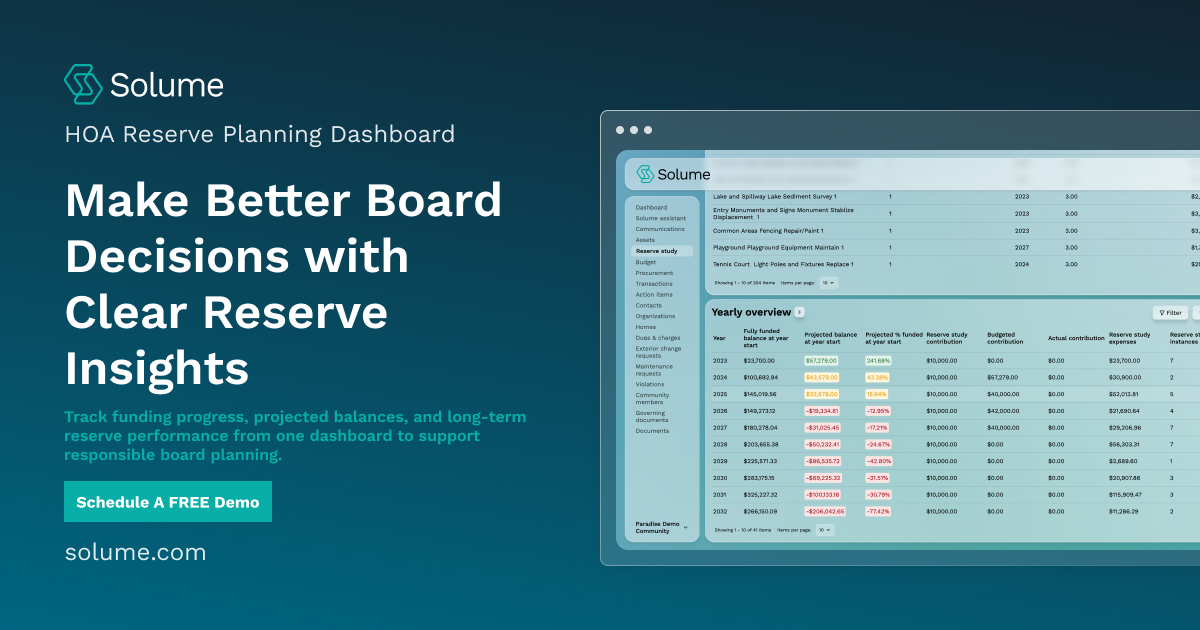
Reserve planning is one of the HOA board member responsibilities boards most often mishandle. That's why Solume builds automated reserve study and long-term capital planning tools into its financial management platform, so self-managed boards can see funding gaps before they become emergencies.

Maintaining common areas
The lawns, the private roads, the clubhouse, the elevators, the roofs on a condo building: these are common areas. Keeping them safe and functional is a core board duty. When a resident trips on a cracked sidewalk the board knew about, the liability lands on the association.
Maintaining common areas means more than mowing and pressure washing. It means long-term planning: knowing which components are aging, when they'll fail, and how you'll pay to replace them. This ties directly back to your reserve funds. Every common element you're responsible for eventually needs capital repair.
The risk most boards overlook is deferred maintenance disguised as savings. Skipping a $2,000 roof patch this year feels responsible until it becomes a $40,000 replacement three years later, plus interior water damage. What many communities don't realize is that deferred maintenance often costs more, not less, over the life of the asset, because water intrusion and structural damage can spread once a small problem goes unaddressed.
Your governing documents define exactly which areas the association maintains versus what individual owners handle. Get that boundary wrong and you'll either overspend on something you don't own or neglect something you do. Read the CC&Rs and bylaws before approving any maintenance budget, because the split varies from one community to the next.
Adoption and enforcement of rules and regulations
Rules only work if they're applied evenly, and rule enforcement is where boards most often expose the association to legal risk. Adopting rules is the easy part. Enforcing them fairly, every time, against every owner, is the hard part.
The board's authority to make and enforce rules comes from the CC&Rs and bylaws. Any rule the board adopts must stay consistent with those documents and with state law, keeping the board within legal compliance. A rule that contradicts your governing documents is generally unenforceable, no matter how many owners voted for it.
Many boards assume they can enforce a rule against one troublesome owner and quietly ignore it elsewhere. In reality, selective rule enforcement is one of the fastest ways to lose in court. If you cite one owner for a fence violation while three others go untouched, the cited owner may have a strong discrimination or arbitrary-enforcement defense.
Enforcement should follow a written, predictable process: notice, an opportunity to be heard, then a defined penalty. Document every step. Consistency protects the board far more than any single fine ever collects, and it keeps conflict resolution grounded in policy rather than personality. When a homeowner argues the board is picking on them, your records are the whole defense.
Communication with and representing homeowners
Boards forget who they work for. Every owner in the community elected them, and honoring that fiduciary duty through open homeowner communication is not a courtesy. Understanding the legal definition of fiduciary duty helps board members see why transparency is the difference between a board's owners' trust and a board owner's trying to recall.
Here's why it matters: HOA boards spend other people's money and enforce rules on other people's property. When decisions happen behind closed doors, owners assume the worst, and often they're right. Open the process, and most of the resentment disappears.
Practical transparency means publishing meeting agendas ahead of time, sharing financial reports, explaining why assessments change, and giving owners a real channel to ask questions. Owners commonly have a legal right to inspect the association's books and records under state law, and stonewalling those requests can invite litigation.
A common trap in a self-managed HOA is scattered homeowner communication: some owners hear things by email, others at the mailbox, others not at all. That inconsistency breeds distrust fast. Centralizing communication through a single hub, like the one Solume provides, keeps every owner working from the same information and cuts the he-said-she-said that fuels board burnout.

Vendor and contract management
Vendor management is where volunteer boards leak the most money without realizing it. A landscaping contract auto-renews at a 15% increase. A plumber overcharges because nobody compared bids. A handshake deal has no written scope. Multiply that across a year, and the losses are real.
Sound vendor coordination starts with the duty of care: collect multiple written bids for any significant job. Not because it's a formality, but because it's the documented evidence that the board made an informed decision. If an owner later challenges a contract, competing bids show the board acted reasonably.
Every vendor relationship needs a written contract with a defined scope, price, insurance requirements, and termination terms. Verbal agreements protect nobody. Confirm each vendor carries current liability insurance and any required licensing. If an uninsured contractor gets hurt on association property, the exposure can flow back to the HOA.
Track performance too. A vendor who did great work three years ago may be cutting corners now. Keeping a simple record of who you've hired, what you paid, and how the job went turns vendor management from a scramble into a repeatable process. Solume includes vendor management and a vendor reference program so boards can organize bids, contracts, and history in one place instead of a shoebox of paper invoices.
Meetings, meeting protocols, and record keeping
A decision made outside a properly noticed meeting isn't a decision. It's just a conversation, and it carries no legal weight. This is the single most common procedural mistake self-managed boards make.
Board meetings must follow the notice and quorum rules in your bylaws and state law. Most states require advance notice to owners, an agenda, and a minimum number of directors present to conduct business. California's Davis-Stirling Act, for example, sets detailed open-meeting and notice requirements that boards there ignore at their peril, while other states set their own rules, so confirm the requirements for your jurisdiction. That's part of the legal compliance every community association must meet.
Binding action requires a majority vote of the board at that meeting. No email chain, hallway agreement, or private text thread substitutes for it. The reason is the business judgment rule: courts will generally defer to board decisions made in good faith and through proper process, but that protection typically only applies when the process was actually followed.
Record keeping ties it all together. Accurate minutes, financial statements, contracts, and correspondence form the books and records that document what the board did and why. The same principles behind SEC guidance on financial oversight and reporting integrity apply on a smaller scale to any board handling other people's money. Owners can request these records, regulators may review them, and in a dispute they're your evidence. Sloppy records can erase the legal protection good decisions should have earned.
Traits and conduct of an effective board member
The best board members aren't the loudest ones. They're the ones who show up prepared, read the material, and vote based on what the community needs rather than what their friends want.
Effective conduct starts with respecting the difference between the board and the individual. You are one vote. Once the board decides something, you support the decision publicly even if you argued against it privately. Boards that air their infighting to owners lose credibility fast.
The duty of loyalty is one of the clearest HOA board member duties, and it demands honesty about conflicts. If a vote involves your cousin's roofing company, you disclose it, and you recuse yourself. Elected volunteers who blur that line hand ammunition to anyone looking to challenge the board.
Good members also manage their own capacity. Board burnout is real, and it usually comes from one or two people absorbing every task because the rest of the board checked out. Spreading the HOA board responsibilities across the HOA board of directors, using committees, and relying on practical tools keeps the workload survivable. Turnover destroys associations because institutional memory walks out the door. A steady, prepared, fair-minded board produces community stability over years, not just a single term.

How management software help volunteer boards meet their responsibilities
Volunteer boards fail on execution, not intent. Nobody sets out to underfund reserves or miss a deadline. They just don't have the time or systems to track everything a modern association demands, and that's where the right tools change the math.
Good HOA management software replaces the spreadsheets, filing cabinets, and email threads that cause boards to drop the ball. It automates dues collection so payments aren't chased by hand, centralizes books and records so nothing gets lost, and flags reserve funding gaps before they become special assessments. The best HOA management software also supports long-term planning so an HOA board of directors can forecast repairs years out. If you're weighing your options, this software buyer's guide for self-managed boards breaks down what to look for. For a self-managed HOA, that structure is the difference between staying organized and falling behind.
If your board wants a clearer way to manage finances, reserve planning, and vendor oversight without hiring a management company, you can see how Solume fits your community on a 15-minute call. It's an honest conversation about whether the platform solves the problems your board is actually facing, no pressure attached.
Frequently Asked Questions
What are the three core functions an HOA board is responsible for?
Every board must prepare an annual budget, set and collect assessments, and obtain adequate insurance for the association's common property. Some of these tasks can be delegated to committees, but final accountability stays with the board.
What do fiduciary duties actually require an HOA board member to do?
Fiduciary duty breaks into three parts: duty of care (make informed decisions, like collecting multiple bids before approving a repair), duty of loyalty (avoid conflicts of interest, such as steering contracts to family), and duty of obedience (follow the CC&Rs and state law). These are legal obligations, not suggestions, and a board can be held personally liable for ignoring them.
Does the HOA president have more authority than other board members?
No. The president typically runs meetings and signs documents, but holds one vote like everyone else and cannot make binding decisions alone. Real authority rests with the full board acting through a majority vote at an official meeting.
What are board members specifically not allowed to do?
Board members cannot make unilateral decisions outside of a properly noticed meeting, use their position for personal financial gain, or selectively enforce rules against certain homeowners. They also cannot vote on matters where they have a personal conflict of interest without disclosure.
Can a volunteer board really handle these responsibilities without a management company?
Yes, many small and mid-sized communities self-manage successfully when they use structured tools for budgeting, reserve planning, and record-keeping. The failure point is usually disorganization and missed compliance deadlines, not the absence of a professional manager.