A small 80-unit condo association in Colorado went three months without anyone answering resident emails. By the time the board caught up, two architectural review requests had defaulted into approval by silence. A leaking roof report sat buried in a volunteer's inbox the whole time. That gap is what a community manager is supposed to close. But the title means wildly different things depending on who you ask. This article breaks down what the role actually does, how it fits a volunteer board, and when software covers the job better than a full-time hire.
Key Takeaways
- In the HOA context, a community manager can be a paid liaison, a volunteer board member, or a software system that handles resident engagement.
- Remote and digital-first communication has replaced the need for an on-site presence in many self-managed associations.
- Senior-level oversight responsibilities, like tying engagement to outcomes, typically fall to board treasurers or presidents in volunteer-run communities.
- Hiring a full-time community manager is rarely cost-effective for small HOAs compared to automation tools that cover dues, ARC requests, and resident communication.
- Lack of consistent communication management directly contributes to resident distrust and compliance gaps in self-managed boards.

What a community manager is (definition in the HOA context)
Ask ten board members "what is a community manager," and you'll get ten answers. In corporate marketing, it means someone who runs online forums and social channels. In the HOA world, the term can mean a paid liaison from a management company, a volunteer board member handling resident communication, or, increasingly, a software system doing both.
Here's the hard truth: there is no single standard definition. The Community Associations Institute, the industry's main trade body, offers credentialing and guidance you can review through CAI's education and credentialing programs. Their framework also distinguishes between on-site managers, portfolio managers, and association staff. Most of those models assume a professional management company is involved.
For a self-managed community association, the practical definition is simpler, and it answers what a community manager is better than any corporate glossary: whoever owns resident communication, keeps records accessible, and makes sure requests don't vanish into a volunteer's personal inbox. That "whoever" can be a person or a platform. What matters is that the function exists and someone, or something, is accountable for it. This is especially true for boards that choose to self-manage instead of hiring a community manager, where the accountability gap is easiest to overlook. The gap stays hidden for structural reasons: no single volunteer is told the role is theirs, so everyone assumes someone else owns it, and the function quietly goes unperformed until a homeowner complains or a deadline passes.
Core duties and responsibilities of a community manager
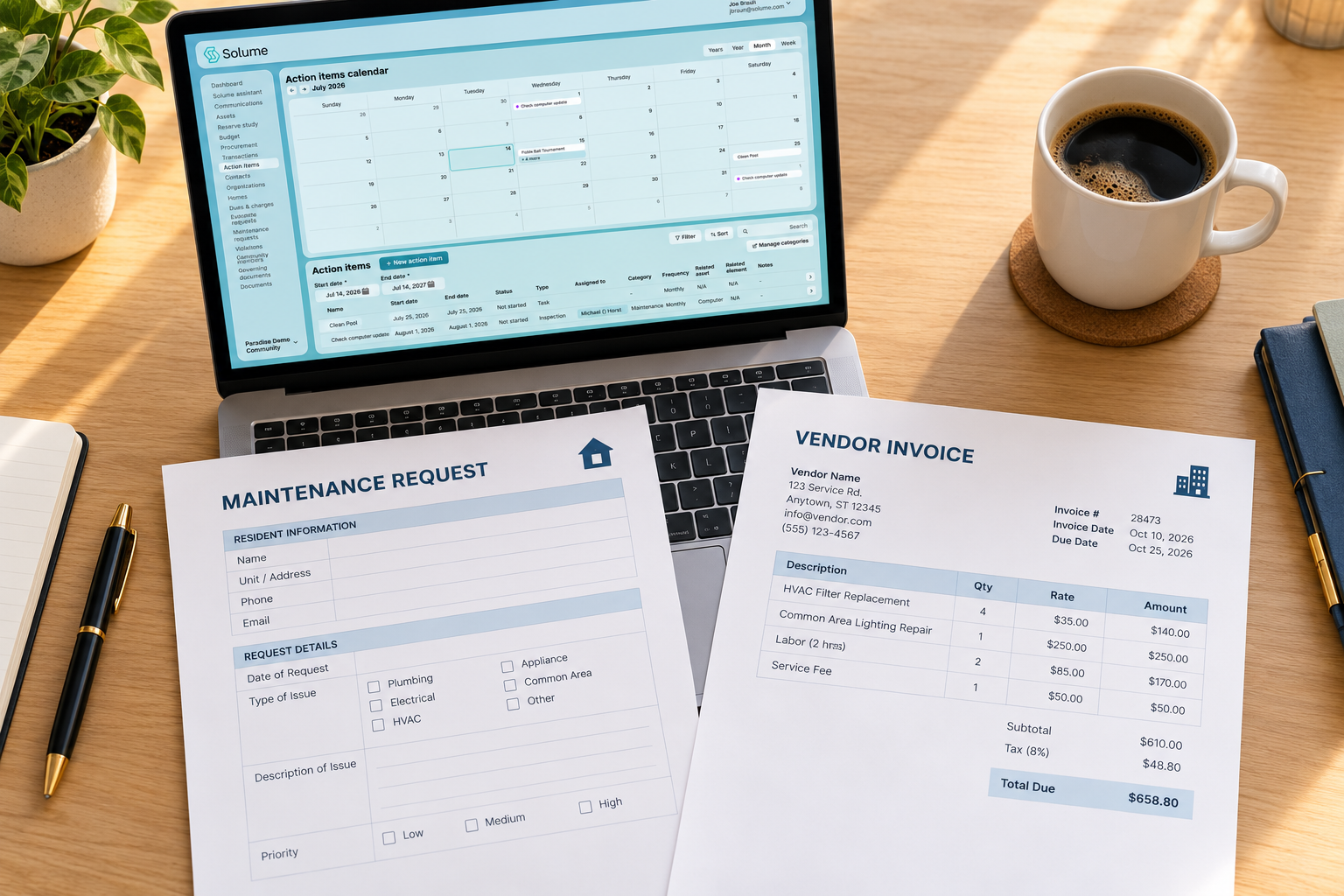
The community manager duties that matter most to an HOA board are less glamorous than the title suggests. At the center sits resident communication: answering questions, posting notices, and documenting what was said and when. Add ARC request intake, maintenance tracking, and serving as the hub between homeowners and the board.
Typical community manager responsibilities also include following up on dues, coordinating vendors, and keeping member records current. These tasks don't stop existing when no one is assigned to them. They pile up and surface later as compliance problems or angry homeowners. The duties cluster around documentation because an HOA's legal standing depends on a clear record: a notice sent, a vote logged, a request answered within the window your governing documents require.
Many boards assume community manager responsibilities are mostly about enforcing rules. In reality, enforcement is a small slice. Most of the job is documentation and follow-through, including the financial reporting duties a community manager typically handles. The Federal Trade Commission publishes guidance on debt collection practices that shapes how dues outreach should be handled, exactly the kind of duty that gets mishandled when no one owns the process.
Where the community manager fits within the board and organization
A community manager is not the board. That distinction gets blurred constantly, and it causes problems. The HOA board holds legal authority and fiduciary duty. The community manager executes decisions and handles day-to-day communication. In a professionally managed association, the manager reports to the board, and the board reports to the homeowners.
In a self-managed HOA, the lines collapse. The treasurer, president, and other volunteer board members take on the roles themselves. That can work in a small community, but it piles board responsibility onto people with full-time jobs.
Picture a typical setup: tasks fall through gaps between volunteers because one person assumes the other is handling vendor follow-up. Neither is. A pool pump fails in July, the repair quote sits unapproved for three weeks because no volunteer knew it was their call, and the community loses a full month of the swim season while homeowners fume. The root cause is almost never laziness. It's the absence of a clear owner for each function, and responsibility without a named owner defaults to no one. Whether the HOA board hires a management company, splits duties among volunteers, or leans on HOA management software, the organizational question stays the same: who is accountable, and can a homeowner find them?
Skills and training a community manager should have
The skills a community manager should have in an HOA setting look different from the corporate version. Social media polish barely registers. What matters is clear written communication, basic financial literacy, and comfort with digital record-keeping.
A community manager needs to write a notice a homeowner can understand in one read, reconcile a dues report without panicking, and keep governing documents organized so answers are easy to find. Professional managers often train through CAI credentials. Volunteer board members rarely get formal training, so these skills in a self-managed context lean heavily on tools that reduce the expertise required.
A board treasurer with no accounting background can still run clean financial management if the software enforces structure. Platforms like Solume automate dues collection and keep records in one place, so anyone in the role can avoid errors without being a bookkeeper. Judgment and consistency matter more than credentials here, but the right tools close the knowledge gap.
How board performance expectations and evaluation work
Boards rarely run a formal performance evaluation of a community manager, and that's a mistake. If you're paying a management company or an individual, you need measurable expectations, not vibes. Response time to inquiries, accuracy of financial reports, and timeliness of ARC decisions are all things you can track. Reviewing red flags when evaluating a management company before signing a contract can save a board years of frustration.
For a professional manager, a yearly evaluation should tie engagement to outcomes: Are delinquencies dropping? Are compliance deadlines being met? Is communication consistent? In a volunteer-run community, these senior-level questions fall to the treasurer or president instead of a dedicated staffer. Outcome metrics beat impressions for one reason: a manager can be friendly at every meeting and still miss the reserve contributions and filing deadlines that actually protect the association.
Most boards assume performance problems show up as complaints. In reality, the worst failures are silent. No one notices a missed reserve contribution until a special assessment lands. When evaluating anyone in the role, measure the quiet functions, record accuracy, deadline compliance, documentation, not just how pleasant they are at meetings. Good HOA management software makes this easier by producing a clear record of what got done and when.
Community manager vs. self-managed board responsibilities
Here's where most boards get stuck. They assume the choice is "hire full management" or "do everything ourselves." That framing hides a third option, and it costs communities money either way.
A paid community manager handles communication, vendor coordination, and administrative follow-through. In a self-managed HOA, volunteers divide those same board responsibilities, but they often lack the time, leading to burnout and inconsistent service.
But full-time community management is rarely cost-effective for a small condo association. A management company might charge thousands per month, much of which goes to tasks automation now handles: dues collection, maintenance tracking, resident communication. Many assume the company is irreplaceable because "they do all this." In reality, a large share of those board responsibilities can shift to software built for boards that want to handle these duties themselves, freeing the budget to reinvest in the community itself. The honest question isn't manager versus volunteers. It's which tasks genuinely need a human and which just need a reliable system.

How software supports or replaces community manager duties
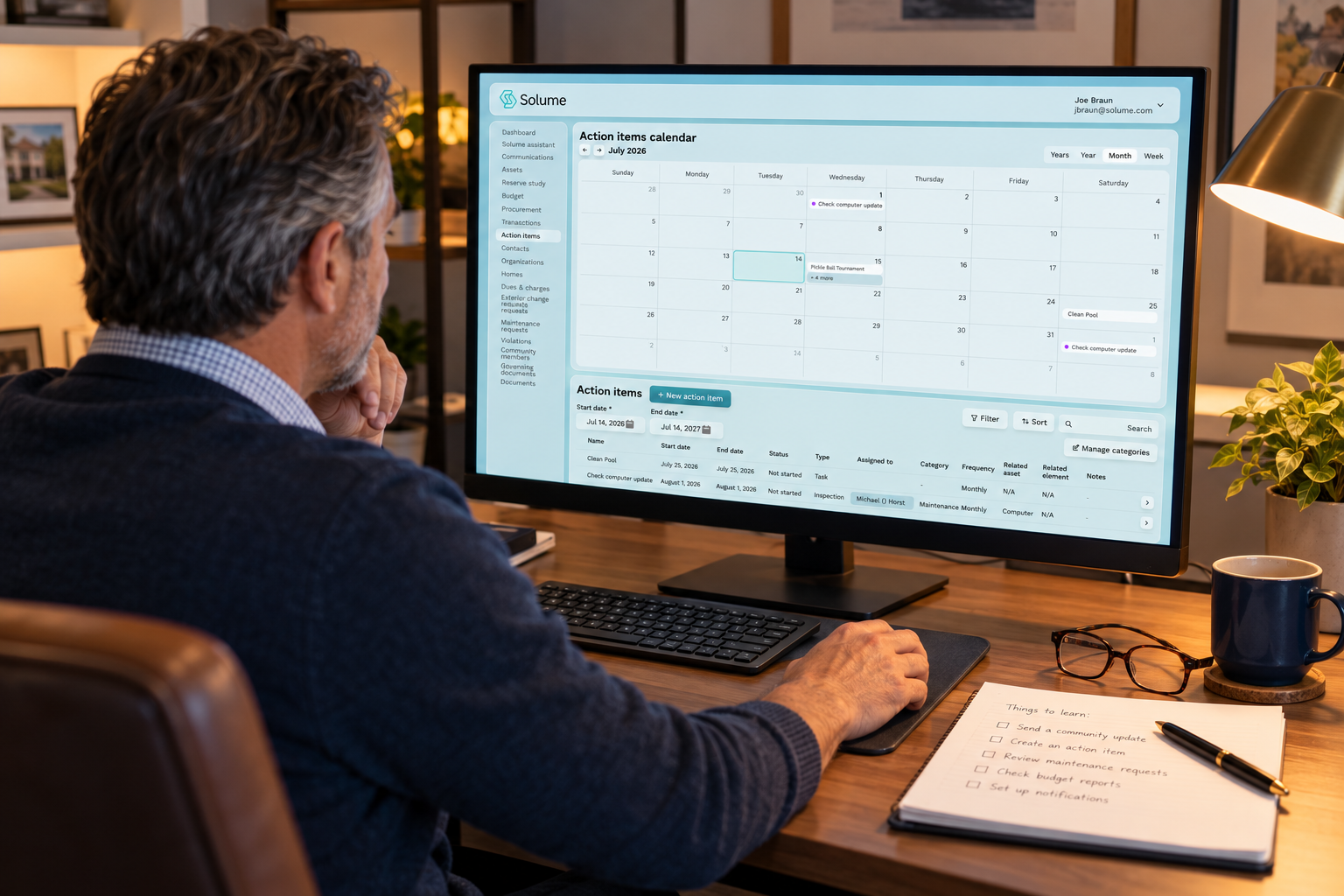
The tasks that overwhelm volunteer boards rarely require human judgment. They are the repetitive, rule-based ones: chasing dues, routing ARC requests, logging maintenance, and answering the same resident questions over and over. That is exactly the work software is built to absorb. A platform can run dues collection, ARC intake, maintenance tracking, and resident communication without a dedicated staffer.
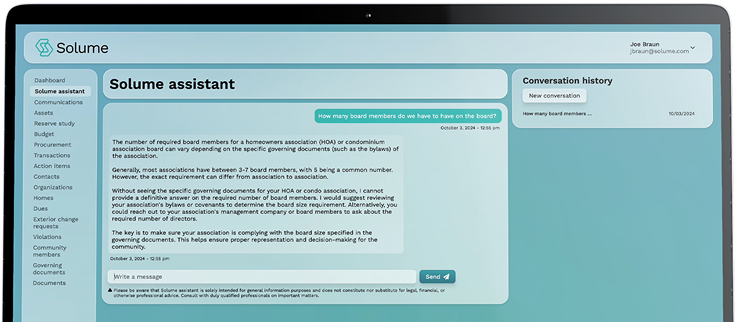
Most of what a community manager does daily is routing and documentation, not decision-making. A centralized communication hub replaces scattered emails and bulletin boards, so nothing defaults to silence like that Colorado condo association did. An AI assistant can answer common resident questions around the clock and point board members to the relevant governing documents or compliance requirements.
Because those routine duties are predictable and repeatable, self-managed boards should automate them before considering a hire. Solume was built to fill this gap, giving self-managed boards an all-in-one system for financial management, dues, ARC requests, vendor references, and communication, without a management company. The point isn't that software replaces every human function. Automating predictable duties lets the people filling the role focus on decisions that actually need them.
Financial and compliance duties boards should expect
The financial and compliance side is where the role carries the most risk, and where every HOA board should expect the most rigor. Core duties include budgeting, dues collection, accurate reporting, and reserve planning. Compliance covers meeting state notice requirements, maintaining records, and following your governing documents.
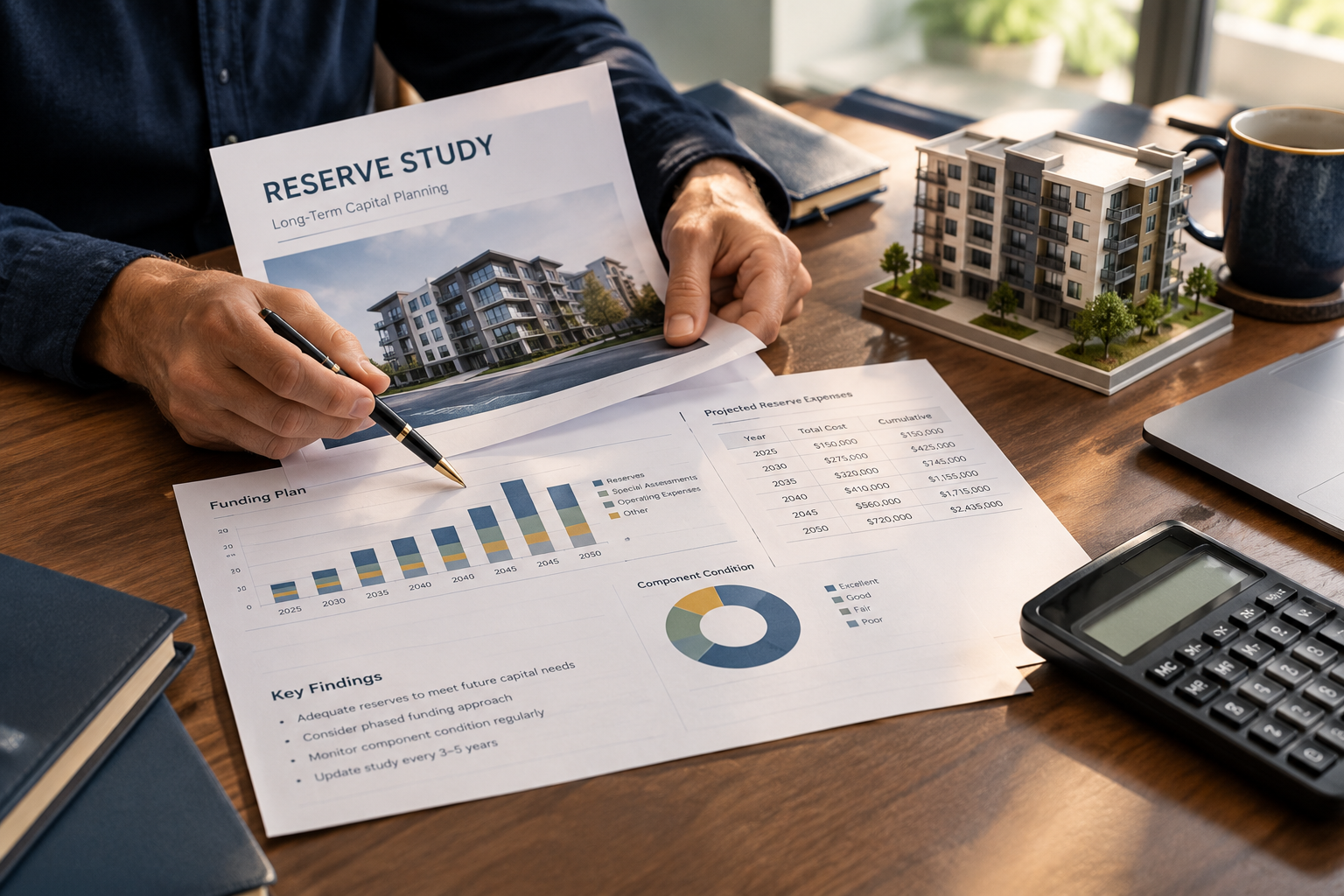
Reserve planning is the function boards neglect most. Deferred maintenance doesn't announce itself. It quietly accumulates until the roof, elevators, or parking structure demands a special assessment nobody budgeted for. This failure is so common because reserve shortfalls carry no immediate cost, so an underfunded reserve looks fine on a monthly budget until the repair bill arrives. The 2021 Surfside condo collapse in Florida, which killed 98 people, is the extreme consequence of years of ignored structural reserves and deferred maintenance. State reserve and disclosure requirements vary significantly, so boards should confirm their specific obligations by consulting their state's statutes directly and working with a licensed attorney in their jurisdiction rather than relying on general guidance.
Solume's automated reserve study tools help boards tie long-term planning to real numbers, reducing the risk of surprise special assessments. Strong financial management and transparency aren't just good practice. They're the foundation of community stability and the board's fiduciary duty, and they separate a stable community manager function from one that leaves the next board cleaning up a shortfall.
If your board wants a clearer way to handle finances, reserve planning, and resident communication without the overhead of a management company, you can see whether Solume fits your community in a 15-minute call. There's no pressure, just an honest look at whether the tools match what your association actually needs.
Frequently Asked Questions
Is a community manager the same as a property manager?
No. A community manager focuses on engagement, communication, and relationship-building with an audience or association members, while a property manager (or HOA management company) handles the physical and administrative operations of a community, like maintenance contracts and vendor coordination. In the HOA context, these roles sometimes overlap, but self-managed boards often split the two functions between volunteers and dedicated software tools.
What's the difference between a community manager and a social media manager?
A social media manager controls what a brand posts and tracks metrics like reach and conversions, while a community manager focuses on two-way engagement, responding to comments, moderating discussions, and gathering feedback. For HOA boards, this distinction matters less than having a clear point of contact for resident communication and documentation.
Can a community manager work remotely?
Yes, many community manager roles are remote or hybrid since the work centers on digital engagement, moderation, and reporting rather than physical presence. For HOA and condo boards, this is especially relevant when using centralized communication platforms instead of relying on an on-site manager.
What does a senior community manager do differently?
A senior community manager typically oversees strategy, mentors junior staff, and ties engagement data to business or organizational goals rather than handling day-to-day responses alone. In a board context, treasurers or presidents often replace this level of oversight, working alongside automated tools that flag compliance and financial issues.
What happens if a community has no one managing communication at all?
Without consistent communication, residents lose trust in the board, ARC requests and maintenance issues pile up, and financial transparency suffers. This is one of the core reasons self-managed boards adopt centralized platforms instead of relying on scattered emails or bulletin boards.
What skills matter most for managing an HOA community effectively?
The equivalent skills for a board-level 'community manager' role include clear written communication, basic financial literacy for reserve planning, and comfort using digital tools for dues collection and record-keeping. Unlike corporate community managers, board volunteers rarely need social media expertise but do need to understand state compliance requirements.
Does the HOA industry have a standard title for this role?
No single standard title exists; associations use terms like community manager, board liaison, or association manager, depending on whether a paid management company or a volunteer board member fills the role. Self-managed communities increasingly use software to absorb these responsibilities instead of hiring a dedicated person.