A treasurer in a 40-unit condo association once handed the next volunteer a shoebox of receipts, three spreadsheets that didn't reconcile, and a checkbook. Then he wished them luck. That handoff is where most self-managed communities lose money and trust. Accounting software for HOA exists to end that scramble. It replaces scattered files and manual math with a system that tracks every homeowner's dues, keeps operating and reserve money separate, and produces reports anyone on the board can read. This article walks through how the software works, where it saves time, how it cuts errors, and what to look for before you buy.
Key Takeaways
- Accounting software for HOA is purpose-built to manage unit-level dues, enforce separate operating and reserve funds, and automate billing in ways general business tools cannot.
- Enforced fund accounting is the single biggest reason dedicated HOA software beats generic tools, since it prevents commingling and keeps boards compliant.
- For volunteer boards without financial expertise, HOA software reduces manual errors and provides homeowners with greater transparency.
What HOA accounting software is and how it works
HOA accounting software is a financial system built around how community associations actually operate. Instead of treating your community as one big checking account, it tracks money at the unit level: what each home owes, what each home has paid, and what's outstanding. The core of it is fund accounting, which keeps your operating fund and reserve fund in separate ledgers so the two never mix. Modern HOA financial management tools are designed to handle exactly this kind of structure without the manual overhead.
That separation is not an optional bookkeeping style. Many states require associations to maintain reserve funds separately from operating cash, and commingling the two can raise concerns about a board's fiduciary duty. Reserve requirements vary by state, so boards should confirm the specifics with their state's condominium or HOA statute and consult their attorney for legal interpretation. The Community Associations Institute's guidance on reserve funds recommends that reserves be maintained and reported separately from operating budgets.
Here's the hard truth: general business tools weren't designed for this. Good HOA accounting software adds automated invoicing, dues collection, bank reconciliation, and financial reporting on top of that fund structure. A volunteer treasurer isn't rebuilding the wheel every month. What many communities don't realize is that the software's real job is enforcing the rules they already follow, whether they're a small homeowners association or a mid-size condo association. Solid bookkeeping practices for small HOAs become far easier to maintain when the system enforces them by default.
Automated dues and assessment collection
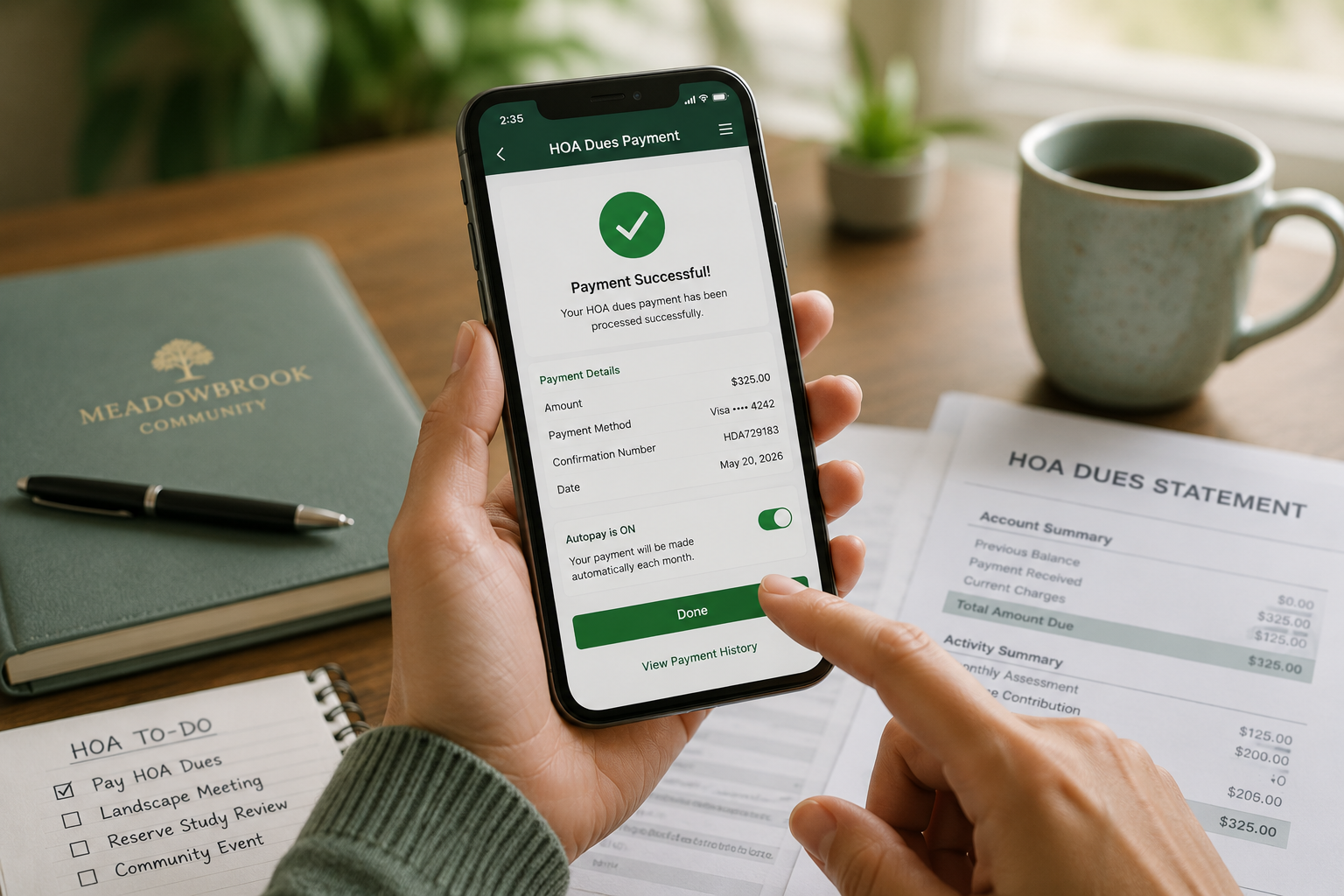
Chasing dues is the single most tedious job on any volunteer board. Manual dues collection means printing coupons, mailing reminders, and recording checks by hand. Then you argue about who paid. Accounting software for HOA automates the whole cycle. It generates automated invoicing on a schedule, applies late fees per your governing documents, and records online payments the moment they clear.
The reason this matters is behavioral. When homeowners can set up autopay or pay by card in two clicks, on-time payment rates often climb, and your accounts receivable shrinks. The Federal Trade Commission's guidance on consumer payments and billing practices is a useful reminder that consistent billing reduces disputes. That's exactly what automated assessment payments deliver.
Delinquency tracking is where the time savings compound. Instead of a spreadsheet that's out of date the day you build it, the system flags overdue accounts in real time, automatically escalates reminders, and maintains an audit trail for every notice. Solume's automated dues collection system offers flexible payment options for self-managed boards, so the treasurer isn't the collections department anymore. For special assessments, the same engine bills every unit its share and tracks assessment payments without a separate process.
Financial reporting and real-time visibility
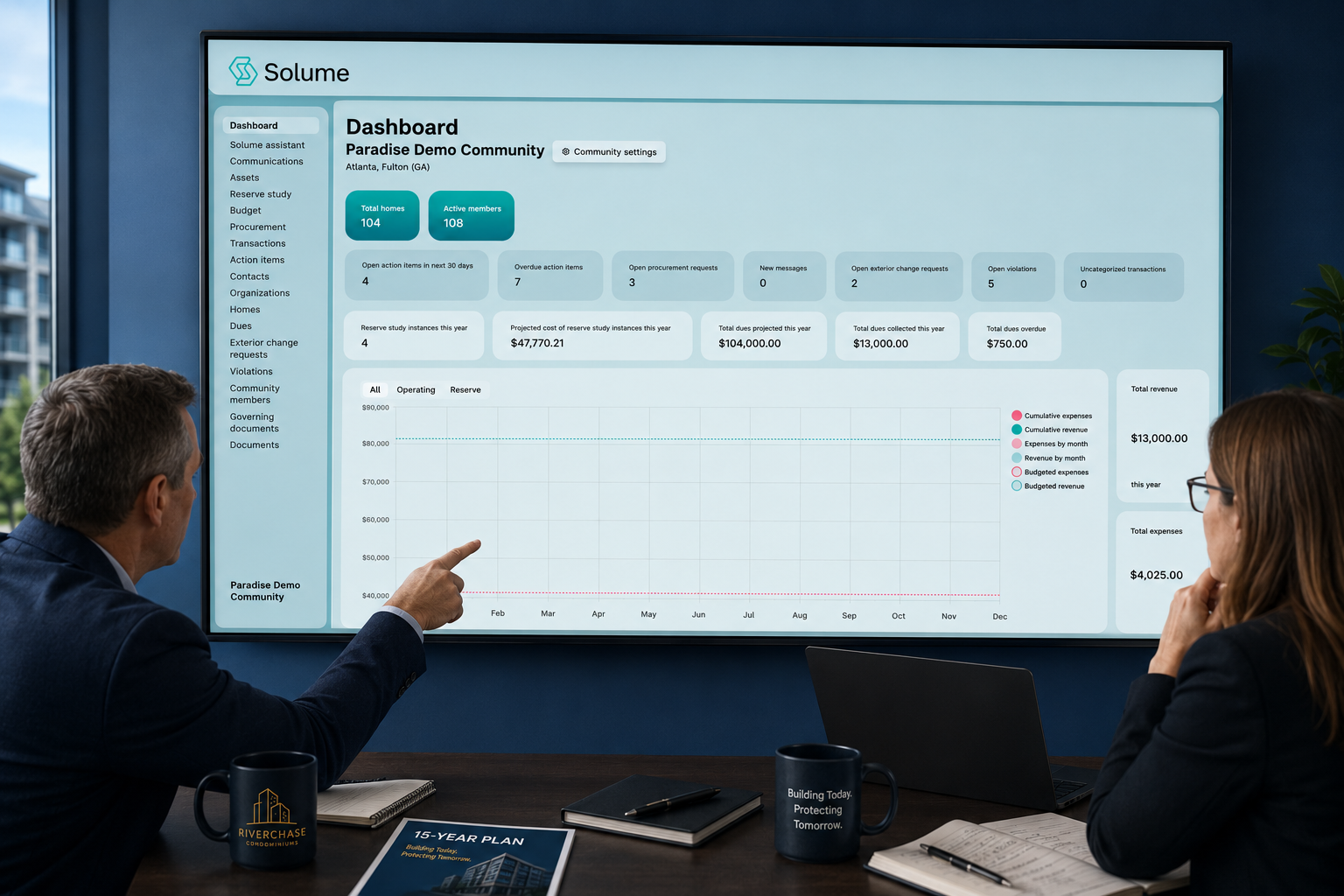
Most boards discover a financial problem months after it started. The reports arrive quarterly, and nobody understands them. Real-time accounting flips that. The moment a payment posts or a vendor bill is entered, the balance sheet, income statement, and budget-to-actual reports update. The board sees financial health as it happens, not in the rearview mirror.
That visibility changes how boards make decisions. When a treasurer can pull a current reserve balance and a delinquency report in thirty seconds before a meeting, the conversation shifts from "what do we have?" to "what do we do?" Good HOA accounting software gives every board member the same financial insights, not just the one who owns the spreadsheet. Building your annual plan around a step-by-step HOA budget template makes those real-time reports even more actionable.
The reports also serve a dual purpose for compliance. Many states require associations to distribute annual statements. A system that produces standardized reporting on demand means you're not reconstructing a year of transactions the week before the deadline. Boards that need to file taxes should also review the IRS Form 1120-H instructions for homeowners associations, since clean records make that filing straightforward. Without this, boards approve a budget based on stale numbers, only to be surprised by a shortfall. Real-time financial reporting removes the guesswork and keeps community association accounting honest between formal statements.
Error reduction and accuracy vs. manual/spreadsheet bookkeeping
Spreadsheets fail quietly. A dragged formula, a mistyped balance, a tab someone forgot to update, and suddenly the numbers presented to homeowners are wrong. Manual bookkeeping in a volunteer setting is not a matter of if errors creep in, but when. Dedicated HOA accounting software works to reduce errors by removing the manual steps where mistakes live.
Consider dues. In a spreadsheet, applying a late fee involves finding the right cell, calculating the amount, and updating the total manually. The software applies the rule automatically and posts it to the right unit ledger every time. That consistency is what reduces errors across hundreds of transactions.
Many boards assume QuickBooks solves this. In reality, QuickBooks wasn't built for fund accounting or unit-level dues. Treasurers bolt on workarounds that reintroduce the same errors they were trying to escape. Fund accounting inside purpose-built software prevents commingling automatically, keeps accounts receivable and accounts payable clean, and produces reconciliations that tie out. Accurate, consistent records also matter for any formal review, since AICPA audit and attest standards set the expectations auditors follow. The root cause of most HOA financial disputes is inconsistent record-keeping, and enforced automation helps address it. Fewer manual touches means fewer errors, and fewer errors means fewer angry homeowners at the annual meeting.
Key features to look for when choosing HOA accounting software
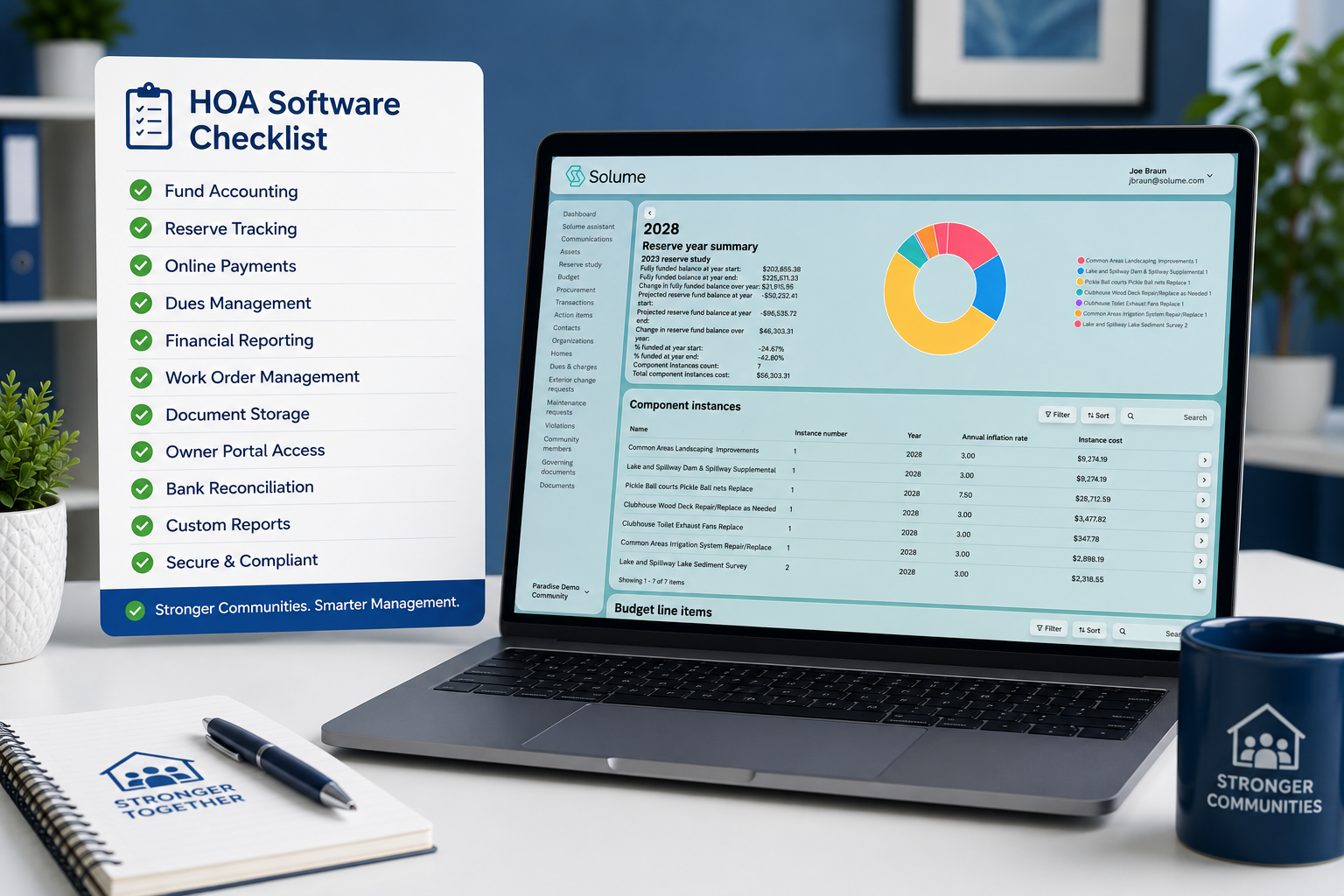
Not all platforms are built for self-managed communities. Many are designed for property managers juggling dozens of associations. Volunteer board members end up paying for complexity they don't need. Start with the non-negotiables: true fund accounting, automated invoicing, dues collection with online payments and autopay, and standardized financial reporting. If you're comparing options, our roundup of the best HOA software for self-managed boards is a good place to weigh the trade-offs.
Then look at what supports the whole board, not just the treasurer. Bank reconciliation, accounts payable and accounts receivable tracking, and a real-time dashboard everyone can see keep financial transparency intact. For a condo association in a stricter state, built-in compliance tracking and reserve fund tracking matter more than flashy extras.
Look beyond pure accounting too. The best HOA management software connects finances to operations: maintenance requests, architectural requests, vendor management, and a communication hub in one place. Solume is built specifically for self-managed and volunteer-run boards, integrating financial management, reserve study tools, and community operations into a single system. Ask whether the platform offers setup support and guided reserve planning, because software you can't configure won't help you meet your fiduciary duty. And confirm it handles special assessments cleanly, since that's when accurate records matter most.
Financial transparency and homeowner trust
The fastest way to lose a community's trust is opaque finances. When homeowners can't see where their dues go, rumors fill the gap, and every board decision gets questioned. Financial transparency is not a nice-to-have. It's how a board keeps its legitimacy between elections.
Shared, real-time reporting is the mechanism that rebuilds that trust. When the board and homeowners view the same numbers on the same dashboard, disputes shrink because there's nothing to hide or argue about. A homeowner who can log in and see the operating balance, reserve balance, and their own payment history stops assuming the worst.
The risk most boards overlook is that a lack of transparency can be read as a lack of financial responsibility, even when money is handled perfectly. Perception matters. Publishing financial insights to residents through real-time accounting shows good faith and reinforces community stability. Transparency also protects the board. For boards moving away from a management company, this openness is often what convinces skeptical owners that self-management can be more accountable, not less.
Reserve fund tracking and long-term capital planning
Underfunded reserves are the quiet crisis in community associations. The 2021 Surfside condo collapse in Florida, which killed 98 people, is the extreme reminder of what deferred maintenance and weak reserve planning can lead to. It's why states like Florida now require structural integrity reserve studies. Reserve laws vary significantly by state, so boards should confirm requirements with their state's condominium or HOA statute and consult their attorney for legal interpretation.
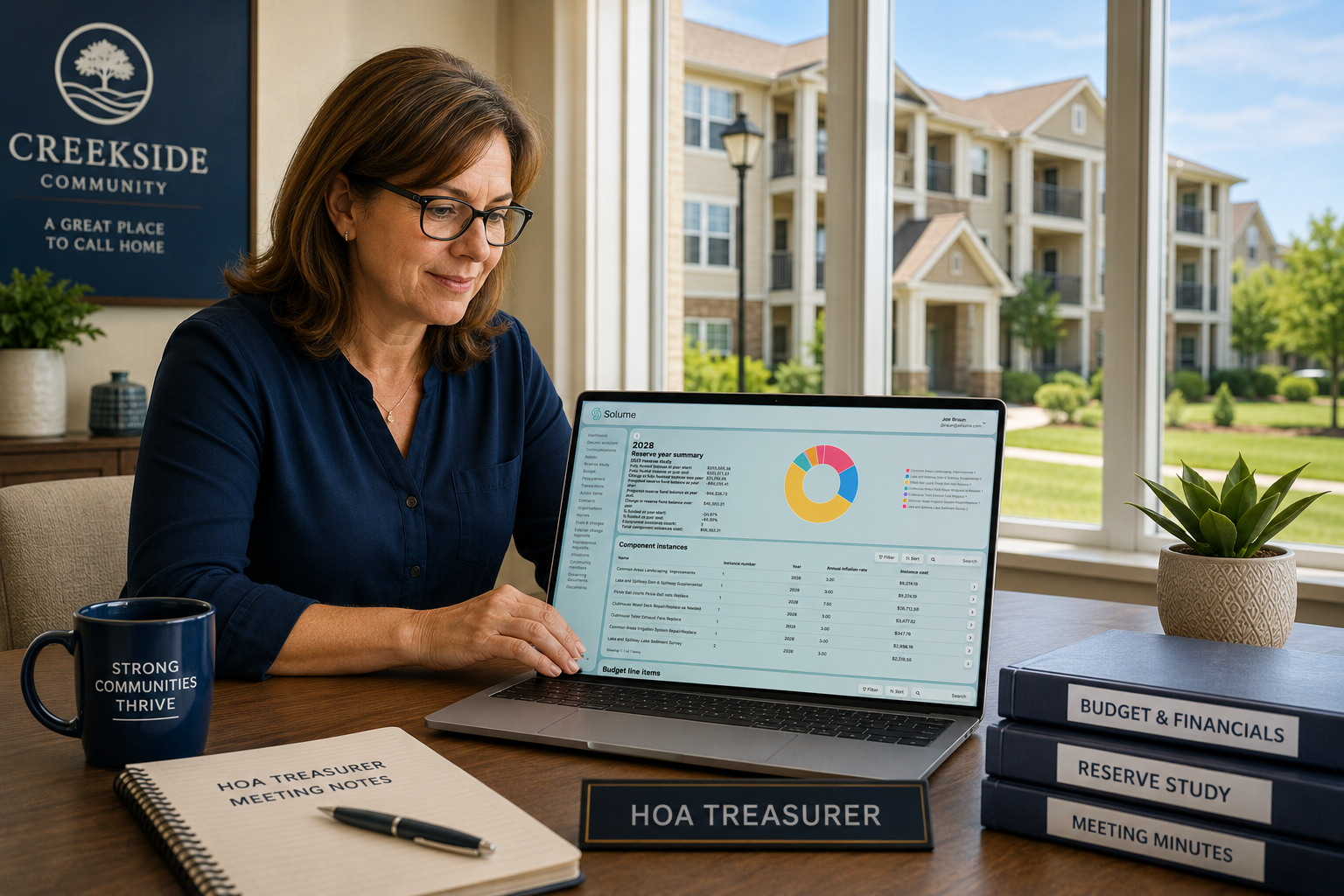
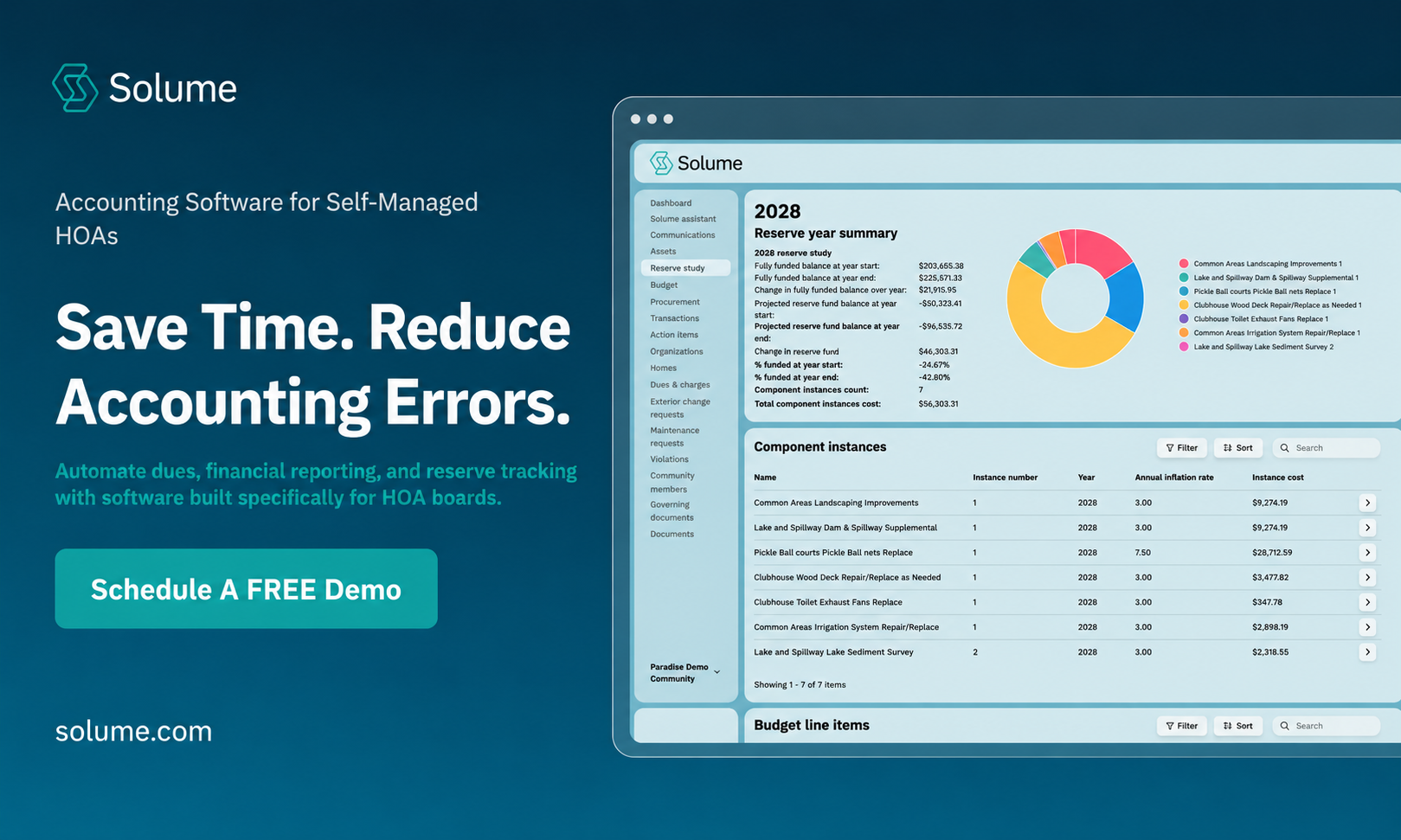
Most software treats reserves as an afterthought. It shouldn't. Reserve fund tracking connects your daily bookkeeping to a long-term capital plan: roofs, pavement, elevators, and every major component with a replacement cost and a timeline. When the reserve balance and the funding plan live in the same system as your operating accounts, the board can see whether contributions actually cover future liabilities and protect the association's financial health.
Here's what that prevents. A board that tracks reserves against a real study can gradually roll contributions into the budget instead of dropping a five-figure special assessment on homeowners overnight. Solume includes reserve study tools and compliance tracking built for self-managed communities, which ties reserve planning directly to the numbers boards already manage. Strong reserve planning is the clearest sign of volunteer board members taking their long-term responsibility seriously.
If your board wants a clearer way to manage dues collection, financial reporting, and reserve planning without a management company, you can book a 15-minute call to see if it fits your community. It's a short, honest conversation about whether Solume makes sense for how your board actually operates.
Frequently Asked Questions
What does HOA accounting software actually do?
It handles the financial tasks specific to community associations, including unit-level dues tracking, automated invoicing, and separate accounting for operating and reserve funds. Unlike general bookkeeping tools, it maintains individual payment histories and outstanding balances for every home in the community.
How is HOA accounting software different from regular business tools?
HOAs must keep operating and reserve funds separate to stay compliant and avoid commingling, and generic tools rarely enforce that separation. HOA-specific software is built around fund accounting, unit-level dues, and delinquency tracking that standard business software doesn't offer.
Is dedicated HOA software worth it for a small association?
For most small communities, yes: enforced fund accounting keeps you compliant, and automated dues collection reduces manual errors that volunteer treasurers often make. The trade-off is a monthly cost, with entry-level HOA-specific platforms often starting at $50- $60 per month for smaller unit counts.
What if our board is just a few volunteers with no accounting background?
That's exactly who dedicated software is built for, since it automates the calculations, scheduling, and record-keeping that trip up non-experts. Look for platforms aimed at self-managed boards rather than property managers, and check that they offer setup support and guided reserve planning.
Will switching from spreadsheets to software really improve transparency?
It usually does, because a shared system gives boards and homeowners a single, real-time view of dues, reserves, and spending, rather than scattered files. That single source of financial information is often what rebuilds trust in communities where residents doubt the numbers.