
In June 2021, the Champlain Towers South condo in Surfside, Florida collapsed and killed 98 people. One thread running through the aftermath was a reserve fund that never kept pace with the building's structural repairs. That's the extreme end. The ordinary version plays out every month: a roof fails, the reserves are half of what they should be, and owners get a $9,000 bill they never saw coming. So what is a reserve study meant to prevent, and why do so many volunteer boards treat it as paperwork instead of protection? This article walks through what an HOA reserve study is, what it covers, how it's built, what it costs, and what your state may legally require.
Key Takeaways
- A reserve study is a professional planning tool that inventories your association's major shared components and forecasts their repair and replacement costs over a 20-30 year horizon.
- The financial half of the study produces an annual funding plan and a 'percent funded' figure that measures how prepared your community actually is.
- Studies are usually refreshed every 3 to 5 years with annual updates, and states like Florida impose stricter rules for structural components.
- Skipping the study is the single biggest driver of surprise special assessments and deferred-maintenance failures that cost owners far more down the road.
What is a reserve study? (core definition and purpose)
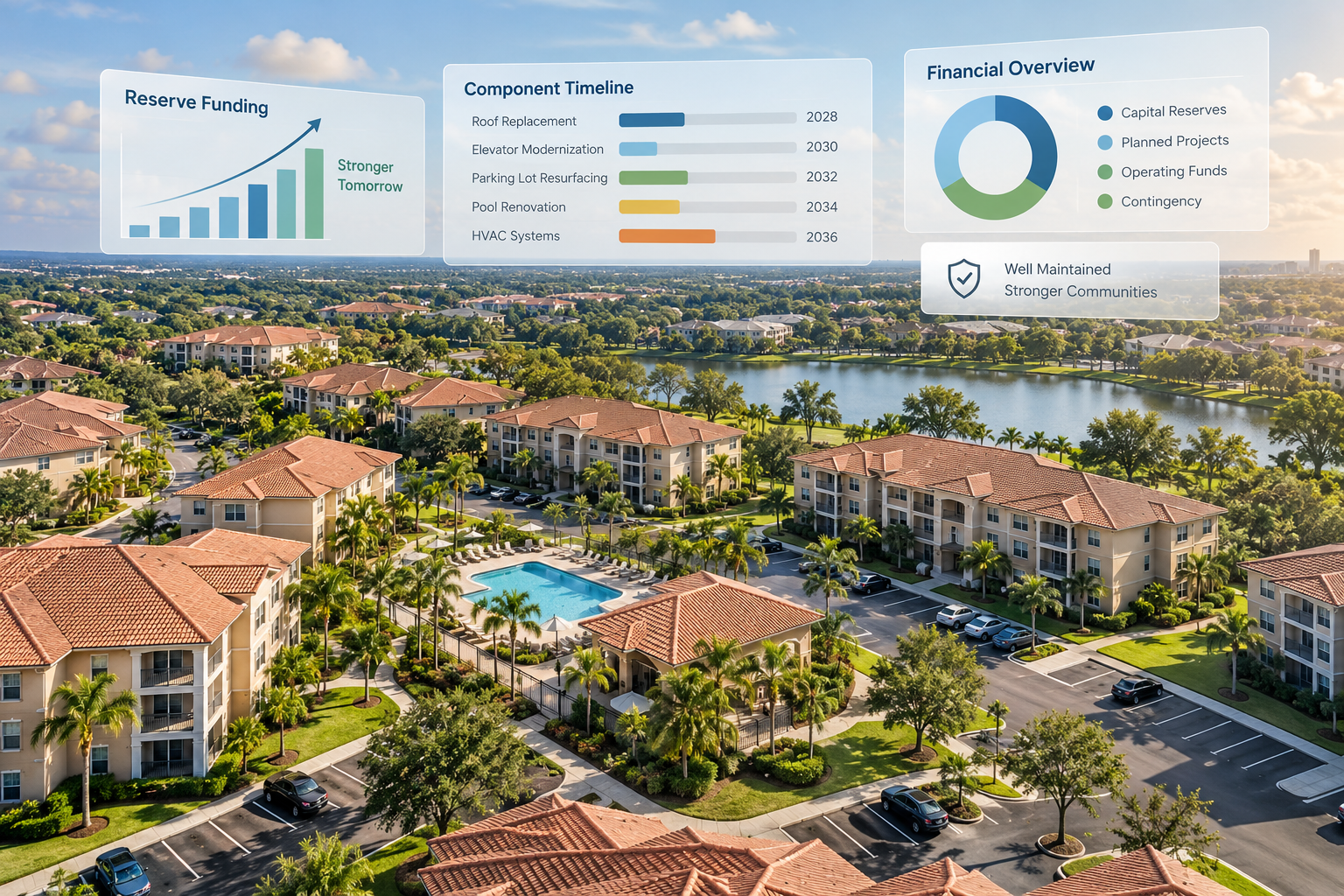
An HOA reserve study is a long-term capital planning tool that answers two questions. What major shared assets will your community eventually repair or replace, and does it have enough money set aside to pay for them? It's not a quick estimate. A credentialed professional inventories common-area components, estimates each one's remaining useful life and replacement cost, then builds a funding plan. That plan spreads those future expenditures across the years so no single project wrecks your annual budget. If you want a walkthrough of the mechanics, here's how to conduct a reserve study step by step.
So what is a reserve study really doing for the board? It converts vague worry about aging roofs and cracking asphalt into a dated, dollar-figured schedule. It works because it ties each component to a fixed useful-life clock and a funded contribution, removing the guesswork that lets costs pile up unseen. The Community Associations Institute is the largest trade body for community associations in the country. It publishes national reserve study standards that most credentialed analysts follow, and you can read their reserve study overview from the Community Associations Institute. The purpose is simple: give a community a clear-eyed picture of its financial responsibility for the next two to three decades. That way board members can fund gradually instead of panicking later.
The two parts of a reserve study: physical analysis and financial analysis
Every reserve study has two halves, and boards that read only one miss the point.
The physical analysis is the boots-on-the-ground portion. An analyst identifies each major shared component, measures or counts it, assesses its condition, and estimates its remaining useful life and replacement cost. Roofs, elevators, pool equipment, private roads, painting cycles: each gets its own line and its own timeline.
The financial analysis takes that inventory and turns it into money and math. It looks at your current reserve balance, projected interest, inflation, and future expenditures, then produces a funding plan and your percent funded figure. That percent funded number is your reserves divided by what they ideally should be. It's the single most useful health metric a board can track, and it helps to spend a little time learning how to read your reserve study report so the figure means something to you. The Federal Housing Finance Agency oversees mortgage backers like Fannie Mae and Freddie Mac. It has tightened lending scrutiny on condo reserves, and you can see the direction of travel in the FHFA's guidance on condo project standards. Lenders read the financial analysis to judge whether a community is a mortgage risk. Underfunded reserves can freeze sales.
What a reserve study covers (major shared components and useful life)
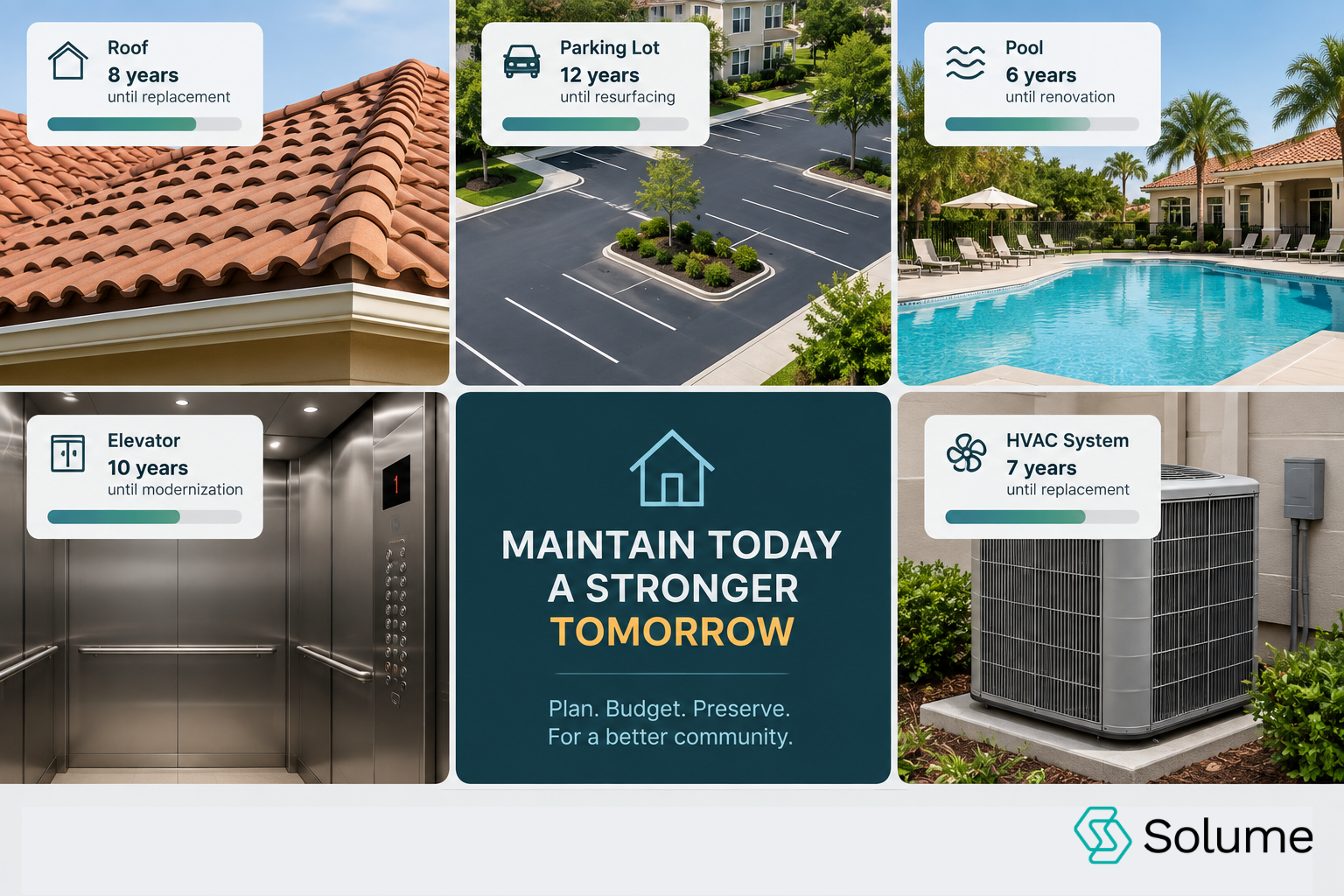
A reserve study covers the big, shared, wear-out-over-time items the association is responsible for, not day-to-day operating costs. Here's the standard test. A component belongs in the study if it's a common-area asset, has a predictable useful life, has a significant replacement cost, and the repair cost can be reasonably estimated.
Typical common area components include:
- Roofing and gutters
- Asphalt paving, sidewalks, and concrete
- Exterior painting and siding
- Pools, spas, and pool decking
- Elevators and mechanical systems
- HVAC serving common areas
- Fencing, gates, and lighting
- Clubhouse interiors and furnishings
Each gets a remaining useful life and a replacement cost. A parking lot resealed today might have a two-year life on the seal coat but a 25-year life on the underlying asphalt. Many boards assume the study covers everything, including individual unit repairs. In reality, it covers only the common-area components the governing documents make the association responsible for. So a component's ownership matters as much as its condition, because the association can only reserve for what its governing documents obligate it to maintain. These are the capital improvement projects that quietly build toward six-figure bills, which is exactly why they're tracked line by line.
Why a reserve study matters and its role in long-term capital planning
Here's the hard truth: most boards don't underfund reserves out of negligence. They keep dues low to protect homeowners, and the study shows them why that kindness backfires. An HOA reserve study matters because it forces long-term planning into a system that otherwise runs on 12-month budget cycles and short board terms. Community Associations Institute guidance on reserve funds makes the case that steady, planned funding keeps communities financially stable over time.
This matters because of timing. Major systems fail on 15-to-30-year clocks, but boards turn over every year or two. Without a written capital planning tool, each board inherits a blind spot, and the component that fails always seems to fail "suddenly." It wasn't sudden. It was scheduled, and nobody was reading the schedule.
A funded reserve study also protects property values. Buyers and their lenders increasingly ask for reserve figures, and a healthy percent funded signals a stable, well-run community association. Underfunded reserves do the opposite: they scare off buyers and shrink resale prices. For self-managed communities especially, where volunteer board members carry the load, the study is the one document that keeps financial responsibility from resetting to zero every election cycle.
How the reserve study process works (site inspection to funding plan)
The reserve study process moves in a predictable order. Knowing the steps helps a board judge whether they're getting a real study or a template with their name pasted on top.
First, document review: the analyst reads your governing documents, prior studies, maintenance records, and current reserve balance to define what the association owns. Second, the on-site inspection: the analyst walks the property, identifies each common-area component, assesses its condition, and records measurements. For a full study, this physical analysis is thorough; for updates, it may be lighter.
Third, the financial analysis: the analyst assigns remaining useful life and replacement cost to every component, then models inflation, interest, and your starting balance across a 20-to-30-year projection. Fourth, the plan: the study recommends annual contributions using one of several funding methods and reports your percent funded. Finally, delivery: you get a written report with the component inventory, the funding plan, and year-by-year projections.
A good analyst will walk the board through the assumptions, not just hand over a PDF. The numbers are only as trustworthy as the useful-life estimates behind them, since a single optimistic lifespan for a roof or boiler can understate funding needs by tens of thousands of dollars.
Levels of reserve study and qualifications of the preparer
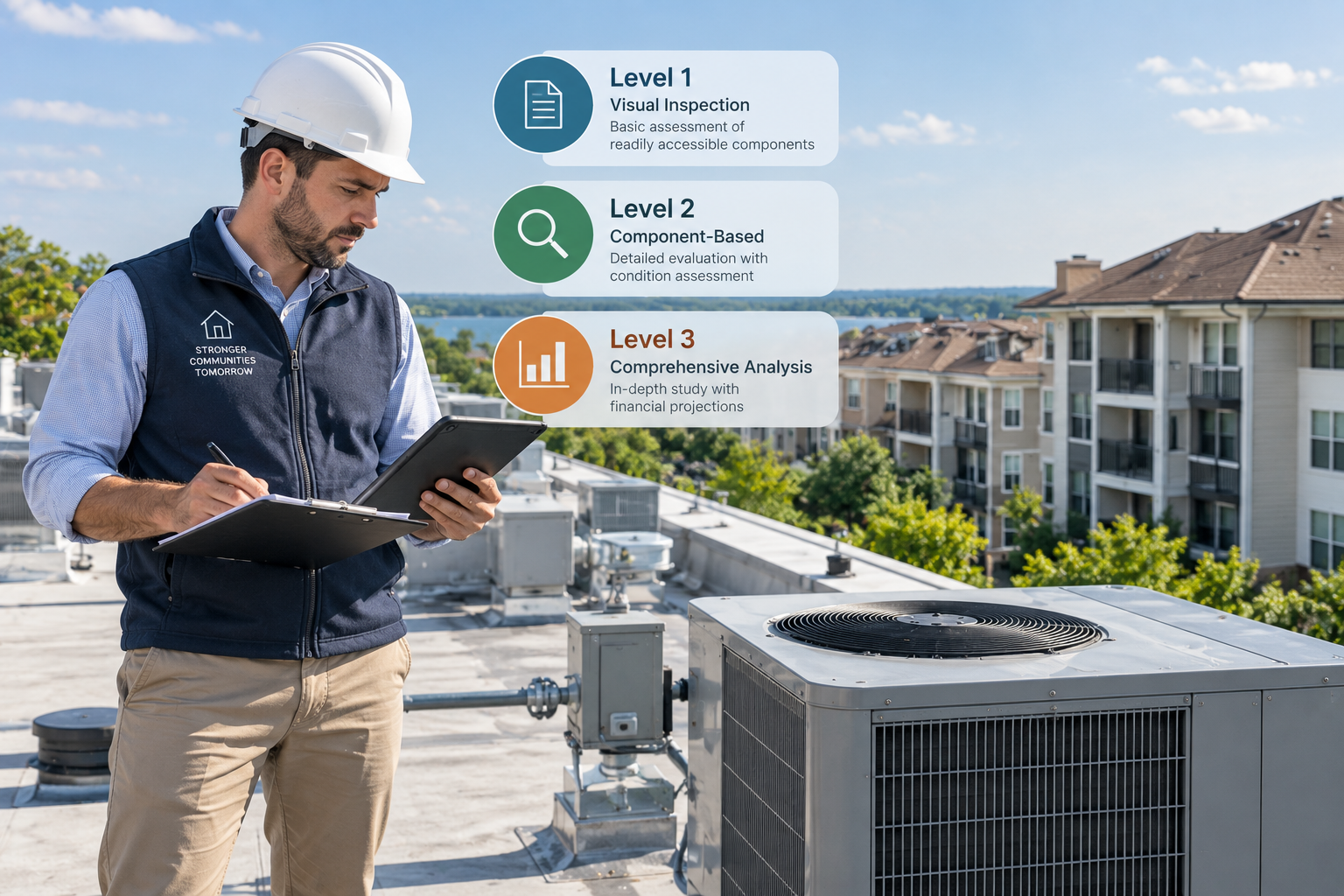
Three reserve study levels are recognized, and choosing the wrong one wastes money or leaves gaps.
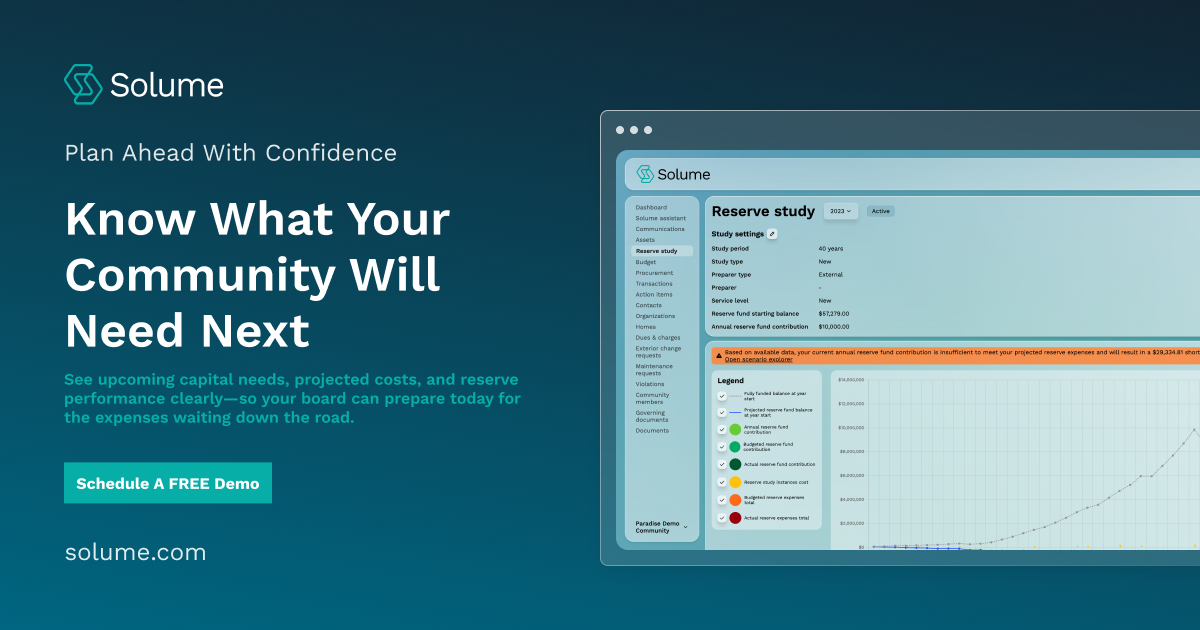
A Level 1 (Full) study starts from scratch: the analyst inventories every component, measures it onsite, and builds the financial analysis from scratch. A Level 2 (Update with site visit) revisits an existing study with a new onsite inspection to re-check conditions. A Level 3 (Update without site visit) refreshes the financial numbers from the desk, with no site walk, relying on the prior inventory. Most communities do a Level 1, then alternate Level 2 and Level 3 updates. Between engagements, Solume's automated reserve study tool can help a board keep the inventory and financial figures current without starting over each time.
Qualifications matter as much as the level. Credentialed preparers include the Reserve Specialist (RS) designation from the Community Associations Institute and the Professional Reserve Analyst (PRA) from the Association of Professional Reserve Analysts. Many assume any handyman or board member can produce a fundable study. In reality, lenders, insurers, and several states may expect a credentialed analyst, and structural inspections often require a licensed engineer or architect. The credential is what makes the report defensible, because a lender or state agency needs an independent, qualified signature before it will treat the numbers as reliable.
How often a reserve study should be done and updated
The general standard: a full condo association reserve study every three to five years, with a reserve study update in the years between. Conditions change, prices climb, and a plan that's five years stale can badly misstate your funding need. Annual updates keep the funding plan aligned with reality so the board isn't budgeting off old numbers.
State reserve study requirements often override the general rule, so check your state's requirements. Several states mandate specific intervals, and a few tie the requirement to structural safety. Florida's Structural Integrity Reserve Study (SIRS) law, for example, requires condo and cooperative buildings three stories or taller to complete a SIRS on a set schedule. Certain components are no longer eligible for waived funding. California, Nevada, Washington, and others each set their own timing and content rules.
A practical pattern for most boards: commission a Level 1 study, then run a lighter reserve study update every year and a with-site-visit update every three to five. Between formal studies, keep tracking component conditions and spending, because a study only reflects the day it was done. This variance by state is exactly why boards should confirm the rule with their own state's requirements or association attorney rather than assume.
Consequences of neglecting a reserve study (special assessments and deferred maintenance)
Skip the study, and the bill doesn't disappear. It just arrives all at once, usually as a special assessment nobody budgeted for. Many households have thin savings buffers, as the Federal Reserve's Survey of Consumer Finances household savings data shows, so a surprise four-figure levy can be genuinely destabilizing for owners.
Consider a 60-unit condo association reserve study that lapsed while dues stayed flat for a decade. The flat roof reaches end of life, the reserve fund holds $80,000, and the replacement quote comes in at $340,000. The board's only options are an emergency special assessment of roughly $4,300 per owner, a loan with interest that raises dues anyway, or letting the roof leak. That last choice turns deferred maintenance into water damage, mold, and structural repairs that multiply the cost.
The risk most boards overlook is compounding. Deferred maintenance rarely stays contained: a neglected roof damages framing, a cracked drain undermines paving. Underfunded reserves also chase away buyers because lenders flag communities with weak reserves and low percent-funded figures. What starts as "let's keep dues low" ends as forced special assessments, depressed property values, and owners who trusted the board to see it coming. The study helps a board see it coming.
The board's fiduciary responsibility and state legal requirements
Board members hold a fiduciary responsibility to the community. That's a legal duty to act in the association's financial interest, not just a moral one. Chronically underfunding reserves or ignoring a required reserve study can put board members personally in the crosshairs when a preventable failure hits. That's the part volunteer board members rarely sign up expecting.
State legal requirements have gotten sharper. Florida now mandates structural integrity reserve studies for taller condo buildings and restricts reserve waivers. California requires reserve studies and specific disclosures to owners. Nevada, Colorado, Washington, Hawaii, and others each impose their own reserve study requirements, disclosure rules, or funding standards. Because HOA law varies significantly from state to state, boards should consult their own governing documents and a qualified association attorney for legal interpretation rather than relying on a general article.
The board's responsibility here isn't to become experts in reserve engineering. It's to commission qualified work, fund the plan reasonably, and document the decisions. Pairing a credentialed study with Solume's financial management and reserve planning tool makes it easier to fund the plan consistently and keep the paper trail intact. Meeting that duty and showing it, through minutes, studies, and funding history, is how boards protect both the community and themselves.

Using software to keep reserve planning current between formal studies
A formal reserve study is a snapshot. The day after it's delivered, it starts aging. A lot happens in the three years before the next update: components get repaired, projects get deferred, prices shift, and reserve balances move. Boards that only revisit reserves when the next study lands are steering by a photo taken years ago.
This is where compliance tracking between studies earns its keep. Keeping running records of component conditions, spending against the funding plan, and upcoming capital projects means each annual budget reflects reality, not a stale document. It also makes the next reserve study update faster and cheaper, because the analyst inherits clean records instead of reconstructing history.
Picture a self-managed board where the treasurer keeps the reserve numbers in a personal spreadsheet, then rotates off after two years. The new treasurer inherits a file with no context, guesses at what was already spent, and the next study starts half-blind. That gap is exactly the kind of thing that quietly pushes a community toward an underfunded plan and a surprise assessment. Solume's automated tools and compliance tracking let self-managed communities keep their reserve planning current, tie it to the annual budget, and monitor state requirements without a management company doing it for them. For volunteer board members juggling this alongside full-time jobs, the point isn't fancy software: it's not losing the thread between formal studies. Long-term planning only works when someone is watching it year-round, and that's hard to do on a spreadsheet passed between rotating treasurers.
If your board wants a clearer way to handle reserve planning, financial transparency, and compliance without leaning on a management company, you can book a 15-minute call to see if Solume fits your community. No pressure, just a straight answer on whether it makes sense for how your community runs.
Frequently Asked Questions
What does a reserve study actually tell you?
It tells you which common-area components (roofs, paving, pools, elevators, HVAC) your association must eventually repair or replace, when, and what each will cost. It also reports your 'percent funded' metric, showing how your current reserve balance compares to what it should be.
What's the difference between a reserve study and a reserve fund?
A reserve study is the planning document that forecasts future repairs and recommends annual contributions, while the reserve fund is the actual pool of money set aside to pay for them. In short, the study is the roadmap and the fund is the bank account.
How often does an HOA need to do a reserve study?
Industry standard is a full study every 3 to 5 years with annual updates in between, though many states set their own intervals. When structural components are involved, states like Florida require a physical inspection on a stricter timeline.
How much does a reserve study cost in Florida and other states?
A small HOA or condo under 50 units typically pays around $1,500-$6,000, and mid-size communities of 50-150 units run roughly $5,000-$12,000. Florida high-rise Structural Integrity Reserve Studies (SIRS) cost more because they require licensed engineering inspections.
Is a reserve study really worth the cost?
For most communities, yes: the study typically costs a fraction of a single roof or paving replacement, and it prevents surprise special assessments that hit owners when reserves fall short. Boards that skip it usually pay far more later through emergency levies or deferred maintenance damage.
Can a board just do its own reserve study to save money?
You can produce internal estimates, but funding and lending decisions usually require a study from a credentialed professional, such as a Reserve Specialist (RS) through CAI or a Professional Reserve Analyst (PRA) through APRA. Many states also require structural inspections to be performed by a licensed engineer or architect.
What's the point of a reserve study if we already budget every year?
Annual operating budgets cover routine costs like landscaping and utilities, not the large replacements that hit once every 15 to 30 years. The reserve study handles that long-term capital planning so a single expensive project doesn't blow up your yearly budget.
What happens if our community never does one?
Underfunded associations are far more likely to impose large one-time special assessments or take on debt when major systems fail. In compliance states like Florida and California, skipping a required study can also expose the board to legal and fiduciary liability.