
A board in a 20-year-old condo building finds out the roof needs replacing. The quote comes in at $400,000. The reserve account holds $90,000. That gap doesn't disappear. It lands on homeowners as a special assessment averaging over $6,000 per unit, due in 60 days. This is what happens when reserve funding becomes an afterthought instead of a plan. This guide walks you through how to set reserve funding goals that hold up, from reading your reserve study to choosing a funding approach and keeping the account healthy year after year.
Key Takeaways
- Reserve funding is money set aside exclusively for major repairs and replacements, kept separate from the operating budget that covers routine expenses.
- A current reserve study, not board estimates, should determine how much reserve funding a community actually needs.
- Consistently contributing below the recommended level shifts costs onto homeowners later through special assessments or loans.
- State laws increasingly require boards to document and justify reserve funding decisions, particularly in states like Florida and California.
- Reserve accounts must legally stay separate from operating funds, and misusing them can expose board members to personal liability.

What is a reserve fund and why it matters for your community
A reserve fund is the savings account your community association builds to pay for the big-ticket items that wear out over time: roofs, elevators, asphalt, pool resurfacing, siding. These costs are predictable and expensive, and they're years away. That's exactly why boards tend to put off planning for them. Before setting any funding target, it helps to understand what a reserve study actually measures, since that document becomes the basis for every decision the board makes afterward.
Here's the hard truth. A healthy reserve fund keeps a community stable and supports long-term stability as property values hold steady. It reduces the odds of a surprise special assessment and signals to buyers and lenders that the board runs tight finances. The signal carries weight because reserves directly show whether a board can fund future obligations without emergency borrowing. The 2021 Surfside condo collapse in Florida, which killed 98 people, was tied in part to delayed structural repairs and inadequate reserves. The Community Associations Institute has published extensive research on reserve funding adequacy across US associations. For volunteer board members, this is the difference between a community that plans ahead and one that scrambles.
What reserve funds can and cannot be used for
Reserve funds are restricted money. They pay for major repairs and replacements of common-area components identified in your reserve study, nothing else. A new roof? Yes. Repaving the parking lot? Yes. Replacing worn clubhouse HVAC units? Yes.
What they cannot cover is routine operations. Landscaping contracts, utility bills, insurance premiums, and management fees all belong in the operating budget. Dipping into HOA reserve funds to patch an operating shortfall is one of the fastest ways a board gets into legal trouble. Understanding what reserve funds can and can't be used for is a core board responsibility, and preventing misuse starts with that clarity.
This matters because of fiduciary duty. Board members must manage association money responsibly. Most governing documents, plus state statutes, require reserve funds to stay in a separate reserve account. The CFPB's explanation of reserve fund purposes lays out this distinction clearly for homeowners, and the IRS guidance on homeowners associations also treats reserve contributions differently from operating income for tax purposes, another reason the two pools cannot be blended.
Operating budget vs. reserve budget explained
Think of your community's finances as two buckets. The operating budget handles everything that recurs: utilities, insurance, landscaping, pest control, trash, repairs under a certain threshold. Money flows in through monthly dues and flows right back out within the year.
The reserve budget works on a longer clock. It collects reserve contributions now for expenses that hit years from now. A roof installed today might not need replacing for 25 years, so the reserve budget spreads that future cost across every homeowner who benefits from the roof during its life. That spreading is the whole point: without it, whichever owners happen to live there the year the roof fails absorb the entire bill.
Many boards assume a leftover operating surplus counts as savings. In reality, that surplus is not reserve funding unless it's deliberately transferred into the reserve account and earmarked for capital planning. Learning how HOA reserve funds should be structured makes clear why keeping the two budgets separate is often a compliance requirement, and it's the foundation of real financial transparency.

The reserve study as the foundation for funding goals
You cannot set a reserve funding goal from gut feeling. The number has to come from a reserve study, a professional assessment of every major component the association is responsible for: what it is, how long it lasts, what it costs to replace, and where it sits in its asset lifecycle.
A reserve study does two jobs. The physical analysis inventories components and estimates remaining useful life. The financial analysis calculates how much the community should be contributing now to meet future costs, and reports your percent funded, meaning how close your current balance is to fully funded reserves.
Reserve study cost varies by community size and complexity, but for most small to mid-size associations it runs a few thousand dollars. That's cheap compared to a six-figure special assessment. A current reserve study is the single most useful document a board can have when setting reserve funding goals.
How to determine an adequate reserve funding goal
An adequate reserve fund can pay for major repairs and replacements as they come due, without forcing a special assessment or a loan. Your reserve study gives you the recommended annual contribution to reach that point, often expressed as an annual budget percentage tied to dues. That recommendation is your starting target.
From there, three things shape the final number. First, your current percent funded: a community at 30% funded needs to catch up faster than one at 70%. Second, the timing of upcoming projects, since a roof due in three years changes the math entirely. Third, your state's reserve laws, which may set a minimum funding floor. Florida boards in particular should review Florida's statutory reserve funding requirements, which have grown stricter since the Surfside collapse and now limit how much a board can waive or reduce contributions; boards should confirm current requirements with their association's attorney.
In underfunded communities, the process is a slow drift. Boards adopt a comfortable contribution rate to keep monthly dues low, inflation outpaces the reserve account, and the gap widens quietly until a major system fails. Set your reserve funding goals against the study, not against what feels painless.
Choosing a funding approach: baseline, threshold, or full funding
Your reserve study usually presents several funding plans, and the board picks one. There are three common approaches.
Baseline funding keeps the reserve account above zero at all times but lets the balance ride low. It's the cheapest monthly, and the riskiest. One cost overrun, and you're into special assessments.
Threshold funding sets a minimum reserve balance the board commits to staying above, somewhere between baseline and full. It balances affordability with a cushion.
Full funding targets 100% funded, where reserves match the depreciated value of all components. Fully funded reserves give the strongest financial safety net and the lowest special assessment risk. Many condo association boards aim for a fully funded balance but operate in the 70% range instead.
There's no universally correct choice. Older communities with aging components should lean toward full funding, because the closer a component sits to the end of its useful life, the less time the board has to spread the cost before the bill arrives. The key is that the board makes the decision deliberately and documents why, since that record matters for both compliance and financial transparency.

The cost of underfunding: special assessments and deferred maintenance
Underfunded reserves don't save anyone money. They defer it, with interest. When the reserve account can't cover a necessary project, the board has three bad options: levy a special assessment, take out a loan, or delay the work and let deferred maintenance pile up.
Deferred maintenance is the trap. A small roof leak ignored becomes structural damage. A cracked parking lot left alone becomes a full repave plus subsurface repair. The longer major repairs and replacements wait, the more they cost.
Picture a 40-unit condo association that froze reserve contributions for a decade to hold monthly dues flat. When the elevators finally failed inspection, the repair cost $300,000, and reserves couldn't cover it. Each owner got a $7,500 special assessment, due in 90 days. Several owners couldn't pay, liens followed, and property values dipped across the whole building. That's the real price of underfunded reserves, and it always lands on homeowners.
Keeping reserves healthy over time (updates and monitoring)
Setting a reserve funding goal is not a one-time event. A healthy reserve fund needs regular attention, since the assumptions behind it keep shifting. Inflation raises replacement costs. Projects get completed. New components get added when the community expands amenities.
Update your reserve study every three to five years, and review the funding plan internally every year during budget season as part of ongoing capital planning. At each review, check your percent funded against the plan, confirm contributions are keeping pace, and adjust reserve contributions if costs have moved.
The risk most boards overlook is drift between studies. A plan built on 2023 pricing can be badly out of date by 2026. States with stricter compliance requirements, like Florida and California, often mandate specific update cycles, so check your state's statutes and confirm your schedule meets them. Long-term planning only works if someone keeps watching the numbers.
A step-by-step framework for setting reserve funding goals
Here's the process boiled down to a repeatable sequence any volunteer board can follow.
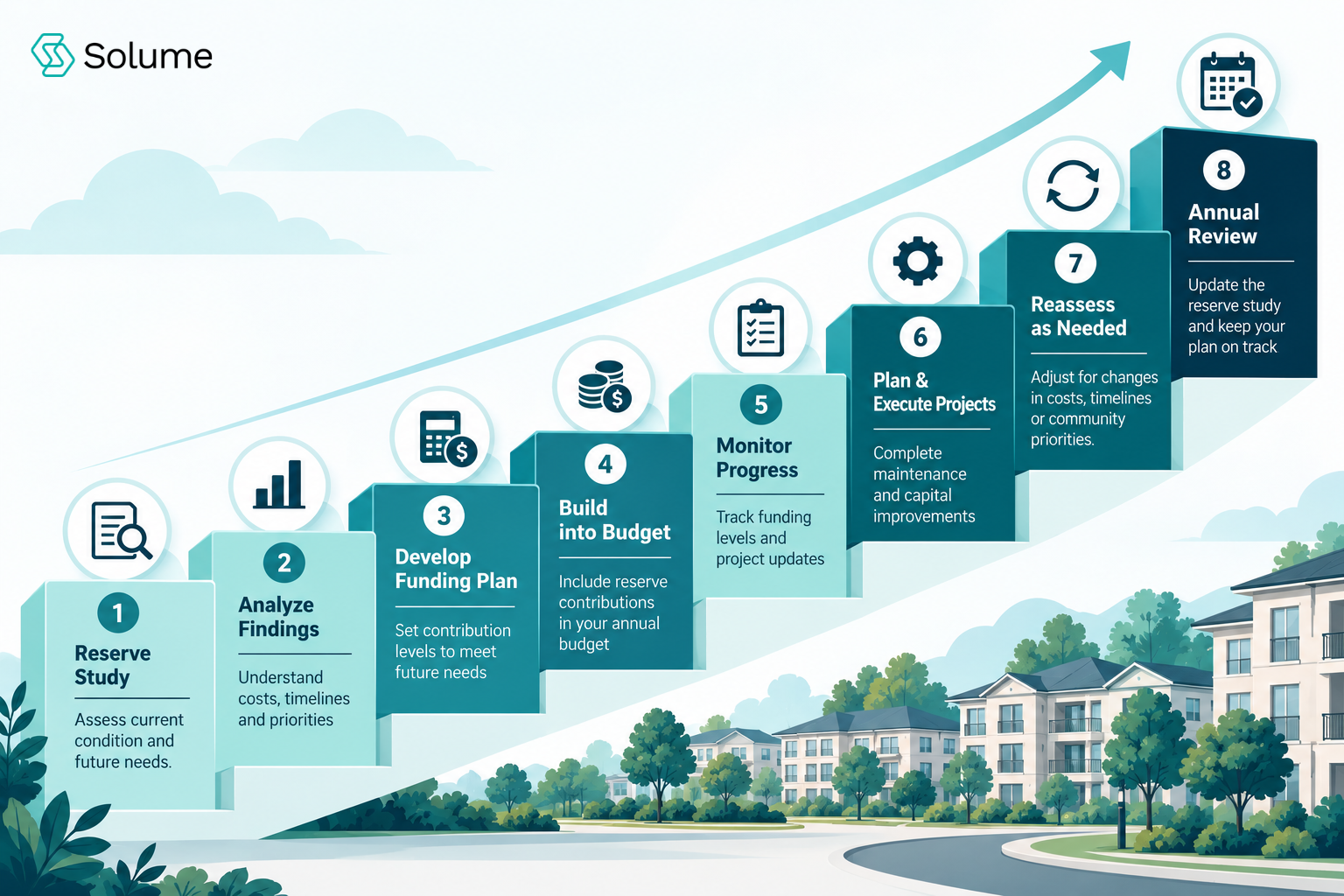
1. Commission a professional reserve study if you don't have a current one, or update your existing study if it's more than three to five years old.
2. Review your current percent funded and the full inventory of major repairs and replacements the association is responsible for.
3. Confirm your state reserve laws and governing documents, including any minimum funding requirements or mandatory disclosures.
4. Choose a funding approach: baseline, threshold, or full funding, based on the age of your components and your tolerance for special assessment risk.
5. Calculate the annual reserve contribution needed to hit that target and translate it into a per-unit monthly dues figure.
6. Adopt the funding plan in a documented board vote and fund the reserve account through a separate transfer.
7. Communicate the reserve budget clearly to homeowners to build trust and financial transparency.
8. Review annually and update the reserve study on schedule.
Using reserve study software to track and automate funding goals
Spreadsheets got us this far, but they break down fast. They don't flag when contributions fall behind, can't model different funding scenarios in seconds, and disappear when the treasurer's term ends. For self-managed communities without an accountant, that's where reserve funding quietly slips, and it becomes harder for volunteer board members to keep up.
Reserve study software closes that gap. It keeps your component inventory, funding plan, and percent funded in one place, updates projections as you log completed projects, and keeps records audit-ready. Solume includes automated reserve study tool and compliance tracking built specifically for self-managed boards, so the funding plan stays current without a finance background.
Automation also supports financial transparency. When homeowners can see where HOA reserve funds stand and why monthly dues are set where they are, trust follows, and community stability improves.
If your board wants a clearer way to handle reserve funding, dues, and compliance in one system, you can see how Solume fits your community on a short 15-minute call. There's no pressure, just a straight answer on whether it's a good fit for a self-managed board like yours.
Frequently Asked Questions
What exactly is a reserve fund in an HOA?
A reserve fund is money an association sets aside specifically for major repairs and replacements, like roofs, roads, or pool equipment, rather than day-to-day operating costs. It's funded separately from the operating budget and is meant to cover expenses the board can predict but can't pay for out of monthly dues alone.
How much money should an HOA actually keep in reserves?
Most reserve studies recommend funding at or near 100% of the calculated reserve requirement, though many associations operate in the 50-70% range without facing immediate penalties. The right number depends on the age of components, local climate, and state law, which is why a current reserve study (not a guess) should drive the target.
Where does reserve funding actually come from?
Reserve funding typically comes from a portion of monthly or annual HOA dues that the board allocates specifically to the reserve account, separate from operating funds. Some associations supplement this with special assessments, loans, or transfer fees collected when homes sell, though relying on special assessments usually signals the reserve was underfunded to begin with.
Is underfunding reserves actually a problem if the community hasn't needed a big repair yet?
Yes, because deferred maintenance doesn't disappear; it compounds, and an underfunded reserve just shifts the cost to homeowners later as a special assessment or loan with interest. Lenders and buyers also check reserve funding levels at resale, so weak reserves can lower property values or delay closings even before anything breaks.
Do boards really need software to manage reserve funding, or is a spreadsheet enough?
A spreadsheet can track reserve funding, but it can't automatically flag when contributions fall behind schedule, model different funding scenarios, or keep records audit-ready if a board member leaves. For self-managed boards without an accountant on hand, that gap is usually where reserve funding quietly falls off track.
Is contributing the bare minimum to reserves ever a reasonable strategy?
It can work short-term in a new community with few aging components, but it's risky for older associations since minimum contributions rarely keep pace with rising repair and replacement costs. Several states now require boards to justify underfunding decisions in writing, which makes 'bare minimum' a harder position to defend if a major system fails early.
What happens if an HOA board spends reserve funds on something else?
Using reserve funds for operating expenses or unapproved projects can breach the board's fiduciary duty and, in some states, trigger legal liability for individual board members. Most governing documents and state statutes require reserve funds to be held in a separate account and used only for their designated capital purposes.
How often does reserve funding need to be reviewed or updated?
Most reserve studies should be updated every 3-5 years, with an internal review of the funding plan annually to adjust for inflation, completed projects, or new components added to the community. States with stricter compliance rules, like Florida and California, often mandate shorter review cycles or specific update triggers.