Picture a homeowner in a Phoenix community who racks up nearly $2,000 in charges over a single dead shrub. The board's fines doubled every 30 days, and nobody ever confirmed the notices reached the right mailbox. That is the trap on both sides. Boards that enforce sloppily create legal exposure, and homeowners who ignore a letter watch a $25 problem turn into a lien. Handling common homeowners association violations well is less about being tough and more about being consistent, documented, and grounded in what your CC&Rs and governing documents actually say. This guide walks through what counts as a violation, how enforcement works, what fines are legal, and how volunteer boards can do it without a management company.
Key Takeaways
- Most HOA violations fall into predictable categories: landscaping, parking, exterior maintenance, and unapproved modifications, because those are the easiest for boards to spot and document.
- A board can enforce only violations and fines explicitly authorized by the CC&Rs, bylaws, and applicable state law.
- Ignoring a violation notice usually triggers escalating daily fines, lost privileges, and eventually a property lien.
- Homeowners have due-process rights, including written notice of the specific rule and a hearing before most fines can be finalized.
- Vague rule language and weak notice delivery are common reasons homeowners get cited for violations they never realized applied to them.
What is an HOA violation (definition and CC&Rs basics)
An HOA violation is any breach of the HOA rules a community adopts to protect shared standards and property values. Those rules live in the covenants, conditions, and restrictions, usually called the CC&Rs, along with the bylaws and any separately adopted rules. When you close on a home inside an association, you agree to these governing documents whether or not you read them.
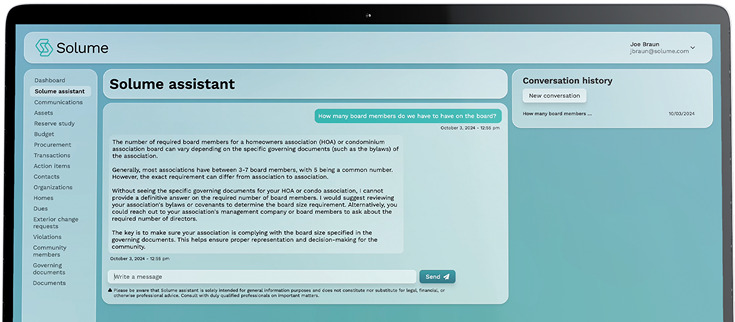
Here's the hard truth most owners miss: the CC&Rs are a recorded contract tied to your deed, not a suggestion. That is why a board can cite you for something minor. The authority comes from the document, not the board member's opinion. Some boards struggle with fine print, so an AI Assistant that helps boards interpret governing documents can be a useful safeguard before issuing a citation.
The CC&Rs typically cover exterior appearance, architectural changes, use restrictions, and maintenance. Rules too vague to interpret consistently, or that conflict with state law, can become unenforceable. HOA authority also varies by state, so boards should reference their state laws governing homeowners associations and homeowners should verify their rights. The Community Associations Institute publishes plain-language resources on how these documents work and what boards can enforce, and its overview of community association governance standards is a helpful starting point.
Most common types of HOA violations (landscaping, exterior, parking, pets, trash)
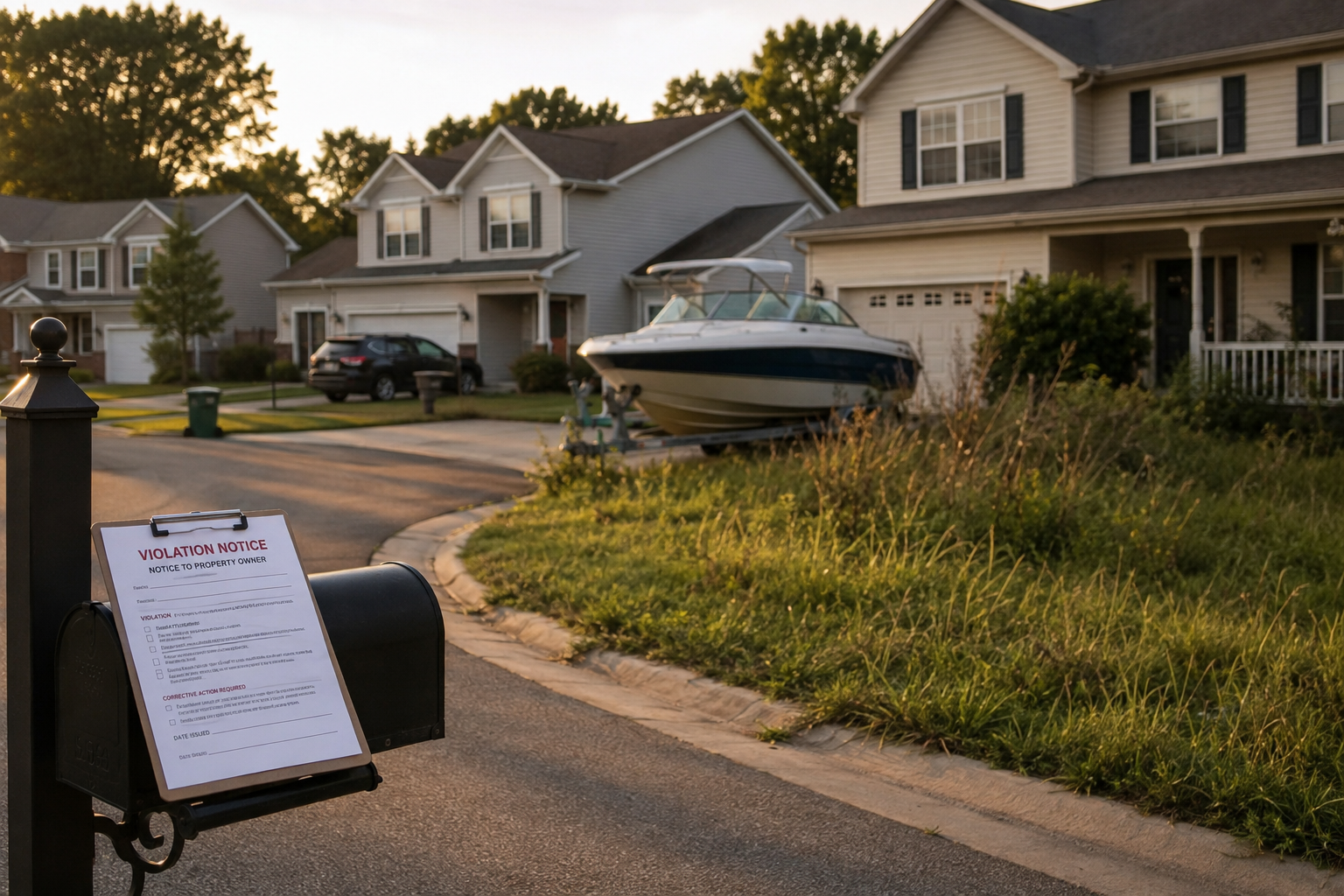
Common HOA violations cluster around what is visible from the street. That is what gets reported and what is easiest to document. Landscaping violations lead the list: dead grass, weeds, overgrown shrubs, and unapproved plantings. Boards notice these landscaping violations first because they degrade the whole block.
Parking violations come next. Commercial trucks, boats, RVs, or cars parked where the CC&Rs prohibit generate constant friction, and parking violations are among the most reported to any HOA board. Then come unapproved exterior modifications: paint colors, fences, satellite dishes, or additions installed without Architectural Review Committee approval. Managing architectural review requests helps boards process approvals consistently. Reversing unapproved exterior modifications is expensive, and disputes drag on.
Pet violations, usually unleashed animals, excessive noise, or breed and number limits, round out the everyday complaints. Trash can etiquette is another quiet source of citations. Bins left at the curb too long or stored in view of the street draw notices fast. The Federal Trade Commission offers a homeowner guide on reading these restrictions before you buy, which prevents most surprises.

The violation enforcement process step by step (observation, notice, fines, hearing)
A fair violation enforcement process follows the same sequence every time, for every homeowner. Consistent enforcement is not just polite. Selective enforcement is one of the fastest ways a board loses in a hearing or in court. Follow these steps in order:
1. Observe and document the violation. Record the date, the specific CC&R section breached, and photo evidence. Documentation is your foundation.
2. Send a courtesy notice. A friendly first letter identifies the issue and asks the owner to correct it by a reasonable deadline, with no fine attached.
3. Send a formal notice if unresolved. This states the rule cited, the cure deadline, and the potential penalty in writing.
4. Offer a violation hearing. Give the homeowner a chance to respond and present their side before the HOA board finalizes anything.
5. Impose fines only after due process. If the violation stands and remains uncured, apply the fine your governing documents authorize.
6. Escalate for repeat violations. Track recurrence and apply increasing penalties or liens as state law allows.
The order matters. Skipping the notice or hearing step can make an otherwise valid fine unenforceable, which hands the homeowner an easy appeal. Picture a board that spots a fence built without approval and immediately mails a $200 fine with no courtesy notice and no hearing. When the owner appeals, the board has to withdraw the fine and start over, and the fence stays up for months longer than if the process had been followed. For boards evaluating outside help, review the HOA management company red flags most boards overlook before assuming a manager handles this better than a well-organized board.
HOA fines: types, typical amounts, and rules for repeat violations
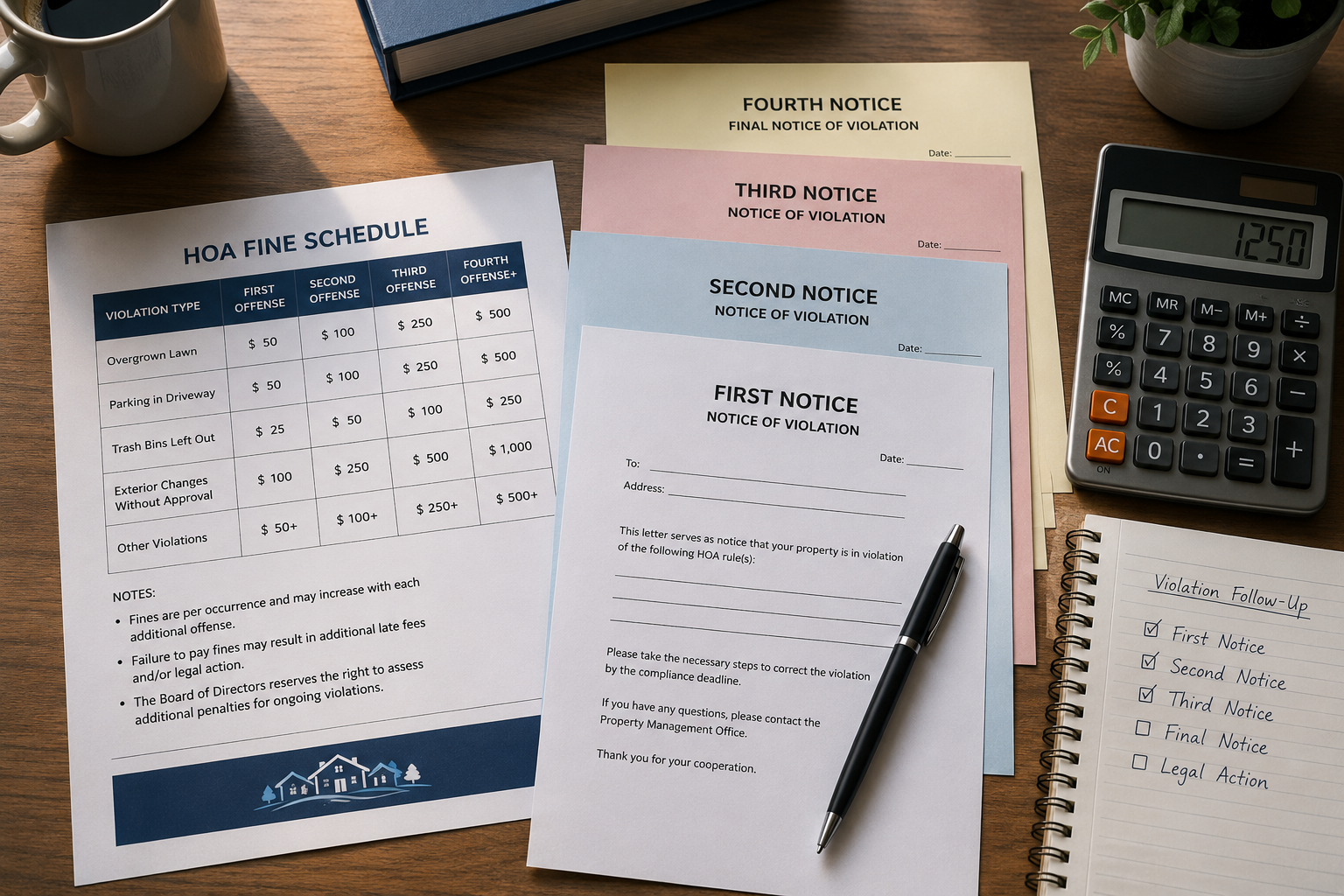
HOA fines generally come in three forms: a flat one-time fine, a per-day continuing fine, and escalating fines for repeat violations. Typical first-offense amounts range from $25 to $100. The ceiling depends entirely on what the CC&Rs authorize and what state HOA laws permit. Some states cap fines or require the board to adopt a written fine schedule before charging anything. For example, Florida's HOA statute on fines and hearings sets specific procedural requirements that boards must follow.
Enforceable HOA fines share three traits. The violation is covered by the governing documents, the amount stays within legal limits, and the HOA board followed proper notice and hearing procedures. Miss any one, and enforceable HOA fines quickly become unenforceable rules dressed up as penalties.
Many boards assume they can double a fine indefinitely for repeat violations. In reality, most states require a defined, disclosed escalation structure, not open-ended penalties, because an owner cannot be penalized under terms they were never told in advance. With continued non-compliance, unpaid fines accrue, privileges get suspended, and eventually the HOA can record a lien against the property. When collecting on those balances, boards should follow federal debt-collection guidance, since aggressive collection can create its own legal problems. That lien is where a nuisance turns into a title problem at resale.
How homeowners can challenge or dispute a violation fairly
If you want to challenge HOA violations, start with paperwork, not emotion. Read the notice for the exact rule cited, the observation date, and the cure deadline. Then pull your CC&Rs and bylaws to confirm the rule actually exists and applies to your property.
To dispute an HOA violation effectively, respond in writing before the deadline. A calm letter that references the section in the covenants, conditions, and restrictions and attaches evidence carries far more weight than a phone call nobody logged. Attach photos, approval letters, receipts, or dated records. If enforcement was inconsistent, note other properties with the same condition that were not cited.
Most associations offer a violation hearing where you present your case before fines are finalized. Many states require this internal step first. If the hearing does not resolve it, some governing documents and state laws allow mediation or arbitration next. When you dispute an HOA violation, the strongest ground is almost always procedural. If the board lacked legal authority, cited a vague standard, or skipped required notice, the fine may not hold. Because these rights vary, check your state HOA laws and consult an attorney.
Preventing violations through clear communication and education
Most violations are not defiance. They are confusion. A homeowner who plants a hedge or repaints a door usually did not know approval was required. That is a communication failure, and it is the board's cheapest problem to fix. If you are new to the approval process, a beginner's guide to ARC requests explains exactly when homeowners need permission before making a change.
Prevention starts with making the HOA rules easy to find and easy to read. Send new owners a short welcome summary of the most-cited HOA rules instead of expecting them to comb through a 60-page document. Post seasonal reminders before predictable problems hit: landscaping standards in spring, trash can etiquette on collection days, and guest parking rules before holidays.
The root cause of "surprise" citations is often language, not behavior. A rule that says "maintain a neat appearance" invites disputes. "Lawns mowed to under four inches" does not. Rewriting vague standards into measurable ones cuts both violations and arguments.
A centralized communication hub for residents, like the resident messaging tools in platforms such as Solume, helps boards send consistent reminders and keep a record of what was communicated and when. That record supports fair enforcement later, because you can show the rule was clearly

Using management software to track violations, notices, and compliance
Paper files and spreadsheets are where fair enforcement goes to die. When violation records live in one board member's inbox, the community loses continuity the moment that volunteer steps down. Inconsistent enforcement then becomes almost guaranteed.
Violation tracking software fixes the two things boards struggle with most: consistency and documentation. Every observation, courtesy notice, formal notice, and hearing outcome gets logged with dates and photos in one place. That timeline is exactly what you need if a fine is ever challenged, because it proves the board followed its own process.
Good HOA management software also standardizes the workflow, so the fifth violation this year is handled the same way as the first. It can auto-generate notices from templates, flag repeat violations, and track cure deadlines so nothing slips.
Many communities don't realize this recordkeeping also doubles as compliance protection. Solume's HOA management software ties violation tracking to member and home records and automated notices. That gives self-managed boards an audit trail that supports consistent enforcement without a management company. Boards that want to go deeper can find more compliance resources for boards covering the recurring pitfalls that trip up self-managed communities.
How self-managed volunteer boards can handle violations without a management company
Self-managed communities can absolutely enforce rules without a management company. The obstacle is not capability. It is structure. Volunteer board members juggle full-time jobs, and enforcement is the responsibility that quietly slides when everyone is busy.
The fix is to systematize before you personalize. Adopt a written enforcement policy and fine schedule so board responsibility is defined, not improvised. Rotate observation duty so one neighbor isn't stuck being the "rule police." Use templates for every courtesy notice and formal notice so the language stays consistent no matter who sends it.
Most boards assume enforcement requires a manager's expertise. In reality, it requires a repeatable process and clean documentation, both of which software handles better than any single person. Sharing board responsibility across the team, backed by software, keeps enforcement from stalling. Solume was built specifically for self-managed boards. It combines violation tracking, resident communication, and financial tools so volunteers can run the community without paying a management company.
The risk most boards overlook is inconsistency. Skip enforcement for a friend and cite a stranger for the same thing, and you have handed away your legal authority. A documented, evenly applied process is what protects both the board and the community's property values.

If your board wants a clearer, more consistent way to manage HOA violations, notices, and compliance without hiring a management company, you can see how Solume works for self-managed communities on a short 15-minute call. It is a straightforward way to find out whether the platform fits how your community already operates.
Frequently Asked Questions
What are the most common violations HOAs fine homeowners for?
The most frequent citations involve landscaping issues like overgrown lawns, weeds, and dead plants, followed closely by parking infractions such as commercial vehicles, boats, RVs, or cars in restricted areas. These rank highest because they are visible from the street, easy to document, and usually spelled out explicitly in the CC&Rs.
Where does an HOA actually get the authority to issue violations?
Enforcement power comes from the community's CC&Rs, bylaws, and adopted rules, which must explicitly authorize fines and penalties. State laws add requirements like proper notice, hearings, and caps on fine amounts, so a board can't invent penalties not grounded in the governing documents.
What happens if I just ignore an HOA violation notice?
After the notice, the HOA typically sets a cure deadline, and if you don't fix the issue, fines begin and often escalate daily as the violation continues. Continued non-compliance can lead to loss of community privileges, unpaid balances, and in serious cases, a lien on your property.
How do I dispute or appeal a violation I think is wrong?
Start by reviewing your CC&Rs, bylaws, and any state-mandated dispute process, then read the notice for the specific rule cited, the date, and the cure deadline. Most associations offer a grievance or hearing process where you can present evidence before fines are finalized, and many states require internal dispute resolution first.
Why does my HOA keep citing me for rules I never knew existed?
When you bought your home, you agreed to the CC&Rs and bylaws, even if you never read them, and vague standards like "maintain exterior appearance" leave plenty of room for interpretation. Poor notice delivery and inconsistent enforcement often make homeowners feel blindsided by rules that were technically in effect all along.
What if my HOA sends fines without a proper hearing?
Most states require due process before fines take effect, meaning you're entitled to written notice describing the specific violation and an opportunity for a hearing. If the board skips these steps, the fine may be unenforceable, and that procedural failure is often your strongest ground for appeal.
Are HOA violations part of the public record?
Violation notices themselves are generally internal association records rather than government public records, but any resulting lien filed against your property becomes public through county records. Homeowners typically have a right to review their own violation history in association files.
Are HOA fines enforceable and what makes a violation unenforceable?
Yes, HOA fines can be enforceable, but the association generally must have authority to impose the fine and follow the required enforcement process. A fine may be unenforceable if the violation is not covered by the governing documents, the fine exceeds applicable legal limits, or the HOA fails to provide required notice and an opportunity to be heard.