A single missed reserve contribution can become a five-figure special assessment three years later. The person who signs off on that gap is usually the treasurer. HOA Treasurer Responsibilities carry real financial and legal weight. Yet most people who take the job are volunteers who have never reconciled a bank statement for anyone but themselves. This guide walks through what the role actually demands: budgeting, reserve oversight, reporting, tax filing, fraud prevention, and the record-keeping that ties it all together.
Key Takeaways
- HOA treasurer responsibilities center on recordkeeping, monthly bank reconciliation, budget preparation, reserve fund oversight, and financial reporting to the board.
- The treasurer is a fiduciary board officer, not a paid employee, and remains ultimately accountable even when a property manager handles daily bookkeeping.
- Reserve funds should sit in separate accounts backed by a reserve study updated every 3-5 years to prevent commingling and underfunding.
- Required reporting typically includes a monthly balance sheet and a budget-versus-actual income and expense statement, with exact rules set by state law and governing documents.
- Leaving the treasurer role vacant increases exposure to fraud, missed payments, and compliance violations because the board still carries the financial liability.

What Is an HOA Treasurer? Role and Definition
An HOA treasurer is the board officer responsible for the association's financial health. Think of the role as the community's chief financial steward. The treasurer tracks money coming in, money going out, and money set aside for the future. This is different from a hired bookkeeper. The treasurer is an elected or appointed HOA board member who answers to homeowners. A bookkeeper simply executes tasks.
The HOA treasurer role sits at the intersection of accounting, governance, and long-term planning. In a self-managed HOA, HOA treasurer responsibilities often include hands-on work: collecting dues, paying vendors, and preparing financial statements. In larger communities, a management company handles daily entries while the treasurer reviews and approves.
Whatever the size, the core financial duties stay the same. Groups like the Community Associations Institute publish guidance on how board officers should handle association finances. A condo treasurer carries the same responsibilities under a different property structure.
Fiduciary Duty and Legal Responsibilities of the Treasurer
Here's the hard truth most boards overlook. The treasurer holds a fiduciary duty, the highest legal standard of care in financial matters. That means acting in the association's best interest, avoiding conflicts of interest, and managing funds with the same caution you'd apply to your own retirement savings. A breach of fiduciary duty can expose an individual board member to personal liability.
Why this matters: courts treat HOA board members as stewards of other people's money. When a treasurer signs off on financial statements or approves spending, they assert the numbers are accurate. Negligence, self-dealing, or reckless record-keeping can trigger lawsuits from homeowners.
Many assume that carrying directors and officers insurance eliminates the fiduciary risk. In reality, that coverage has limits and exclusions. It does not erase the legal fiduciary duty to act prudently. State law defines the specifics, and rules vary widely. The IRS guidance on homeowners associations covers federal tax obligations. Your state's HOA statute and governing documents set the fiduciary standards. Boards should consult their attorney for legal interpretation.
Core Financial Duties: Budgeting, Tracking, and Reporting
An HOA treasurer's financial duties fall into three ongoing streams. First, budgeting: building the annual budget and monitoring spending against it. Second, tracking: recording every transaction, managing dues collection, and reconciling bank accounts each month. Third, reporting: delivering clear financial statements to the HOA board and homeowners.
Tracking is where most self-managed communities stumble. Log every deposit, vendor payment, and assessment to the correct account. Monthly bank reconciliation, matching your ledger to the bank statement, is the single most important habit a treasurer can build. Skip it, and errors compound quietly until a year-end audit surfaces them.
Cash flow deserves constant attention. A community can look solvent on paper while running short on cash to cover a mid-year insurance premium. Separating the operating fund from the reserve fund keeps daily bills from eating into long-term capital. Good accounting and bookkeeping are not optional extras. They are the foundation every report, budget, and reserve decision rests on.
Preparing and Managing the Annual HOA Budget
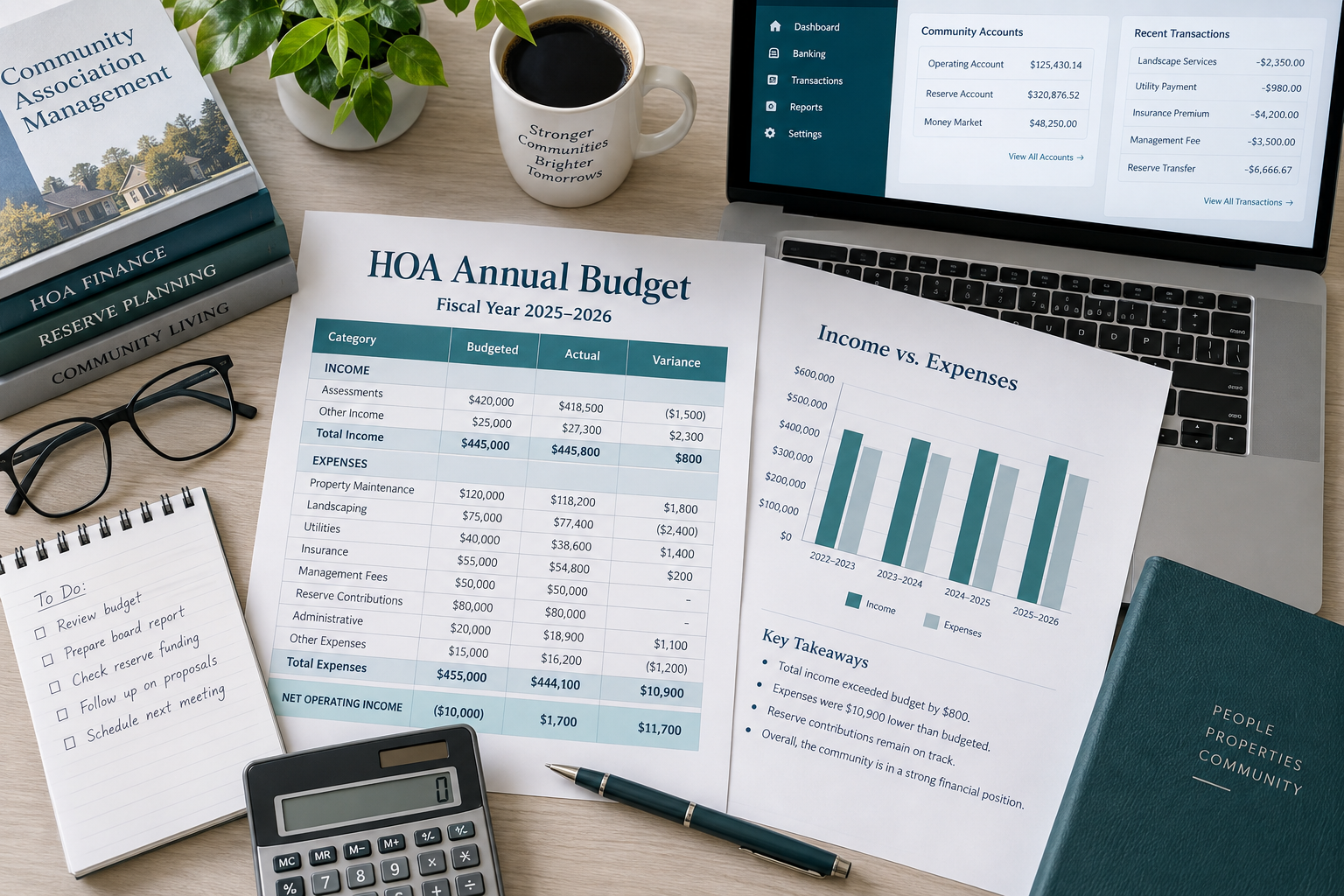
The annual HOA budget is the treasurer's biggest deliverable of the year. It projects every expected expense: landscaping, insurance, utilities, management fees, and reserve contributions. Then it sets the assessments needed to cover them. Get it wrong, and the community either overcharges homeowners or runs out of money before December.
Start by reviewing the prior year's budget-versus-actual results. Where did estimates miss? A pattern of utility overspending signals a rate change worth building in. Next, factor in known increases. Insurance premiums have climbed sharply in many states, and deferred maintenance items keep growing more expensive the longer they wait. It's also worth understanding how HOA fees are treated for tax purposes, so homeowners have accurate expectations about what they're paying.
The reserve contribution is the line item boards love to shrink. Resist that. The reserve study tells you how much to set aside each year to fund future roof, paving, and structural replacements. Underfunding the reserve fund to keep dues low is the exact decision that produces special assessments later. A realistic HOA budget balances what homeowners can afford now against what the community will owe tomorrow. Long-term planning starts in this document.
Financial Reporting to the Board and Homeowners
Transparency is what earns homeowner trust, and reporting is how you deliver it. At minimum, the treasurer presents a monthly balance sheet showing assets, liabilities, and the separate balances of the operating fund and reserve fund. Alongside it goes the income and expense statement comparing actual spending to the budget. For a deeper walkthrough of preparing and reviewing HOA financial statements, the format and terminology matter as much as the numbers themselves.
Here's what happens when reporting is weak: homeowners assume the worst. Rumors spread that the HOA board is hiding money or mismanaging dues. Clear, consistent financial reporting kills those rumors before they start. Post the reports, explain the variances plainly, and answer questions openly.
Financial statements should be readable by someone with no accounting background. A one-page summary highlighting cash position, delinquent accounts, and reserve balance often communicates more than a dense ledger dump. Homeowners in a community association generally have a right to review financial records. Many state statutes require the board to provide them on request. Treat every report as a chance to show transparency, not a box to check. That habit is the difference between a trusted board and a suspected one.
Audits, Reviews, and Year-End Financial Oversight
At year-end, the treasurer shifts from managing money to verifying it. Depending on your state and governing documents, the association may need a full audit, a less intensive financial review, or a compilation performed by a licensed CPA. An audit provides the highest assurance that the financial statements are accurate.
Many assume a small self-managed HOA can skip this entirely. In reality, some states mandate an annual audit or review once the association crosses a revenue threshold. Your bylaws may require one regardless of size. Check your state's HOA statute and CC&Rs before deciding.
Even where no external audit is required, an internal financial review protects the board. A second set of eyes on the books- another director spot-checking bank reconciliations against statements- catches errors and deters fraud. Year-end is also when the treasurer confirms reserve balances match reserve study projections and flags any funding shortfall to the board. Picture a small community that skipped reviews for four years. A bookkeeping error compounded into a $40,000 discrepancy that nobody caught until a new treasurer demanded records. Year-end oversight prevents exactly that.

Tax Filing and Compliance Obligations
Even nonprofit associations file taxes. Most HOAs file federal tax returns each year. They choose between Form 1120-H, designed specifically for homeowners associations, and the standard Form 1120. The treasurer coordinates this filing, usually with a CPA, and ensures the return is filed by the deadline to avoid penalties. Reviewing the IRS instructions for Form 1120-H helps the treasurer understand which election makes sense for the association.
Compliance runs deeper than the federal return. State law may require reserve funding disclosures, annual budget distribution to homeowners, and specific financial reporting timelines. States like Florida, California, and Nevada have tightened HOA financial rules in recent years. They added reserve study and inspection requirements after high-profile failures.
Most compliance trouble stems not from bad intent. It is a volunteer treasurer who simply doesn't know the state deadline exists. Missing a required reserve study or filing late can trigger fines and homeowner complaints. Because HOA laws vary by state, the treasurer should confirm the association's obligations with a CPA and the state's community association statute rather than assuming last year's process applies. Compliance is ongoing, not a one-time setup, and the treasurer keeps it current.
Working With Accountants, Bookkeepers, and Management Companies
A treasurer does not have to do everything alone, and shouldn't. Many boards hire a CPA for taxes and audits, a bookkeeper for day-to-day entries, or a management company for full operational support. The key distinction: these professionals execute tasks, but the treasurer retains fiduciary oversight and accountability.
Here's what many communities don't realize. Delegating bookkeeping does not delegate responsibility. If a management company misapplies a payment or fails to fund the reserve, the board still answers for it. That is why the treasurer must review the financial statements the manager produces, not just accept them.
Set clear expectations. Define who reconciles bank accounts, who approves vendor payments, and how often reports are delivered. Require monthly statements and question anything that looks off. A good management relationship lightens the treasurer's job; a passive one hides problems. For a self-managed HOA that wants professional tools without a management company's fees, software can absorb much of the routine accounting and record-keeping a bookkeeper would otherwise handle. It also helps to understand the challenges self-managed boards face without professional help before deciding how much to delegate. That keeps the board in control of its own finances.
Fraud Prevention and Internal Financial Controls
The risk most boards overlook is internal fraud, and it usually comes from the person everyone trusts. HOA embezzlement cases almost always share one trait: a single individual controlled the money with no oversight. Internal controls make theft harder and detection faster.
Start with separation of duties. The person who writes checks should not also reconcile the bank statement. Require two signatures on payments above a set threshold. Restrict access to bank accounts and review online banking activity monthly. These simple internal controls stop the most common schemes and protect volunteer board members from blame. The CFPB's guidance on fidelity coverage and safeguarding funds adds a layer of protection many associations should carry.
Most fraud cases start as slow drift. A treasurer begins covering a personal shortfall with association funds, intending to repay it, and the amount grows. Regular review by another board member closes that window. Strong internal controls also mean keeping financial records accessible so no single person can hide transactions. Send bank statements to a director other than the treasurer. Share reconciliations; don't silo them. A community that builds these habits before a problem appears protects both its money and its volunteers from suspicion. Transparency is the strongest deterrent.

Record-Keeping and Financial Document Retention
Good record-keeping is what makes every other treasurer duty possible. Bank statements, invoices, reconciliations, tax returns, budgets, reserve studies, and meeting minutes must be stored, organized, and retrievable. When a homeowner requests records or an auditor asks for backup, disorganized files turn a simple task into a crisis.
Retention periods vary. Tax records generally warrant seven years. Governing documents, reserve studies, and financial statements often need permanent retention. Your state statute and CC&Rs may specify exact timelines, so confirm them rather than guessing.
The practical failure here is the shoebox problem. A treasurer keeps everything in personal files, then leaves the board, and the records leave with them. That gap can cost a community years of financial history. Store records centrally, in a system the whole board can access, not on one person's laptop or garage shelf. Digital retention with backups protects against loss and makes the annual audit or financial review far smoother. Clean records also speed the transition when a new treasurer takes over. That handoff is when most communities discover how well the last one kept the books.
How Software Simplifies Treasurer Duties for Self-Managed Boards
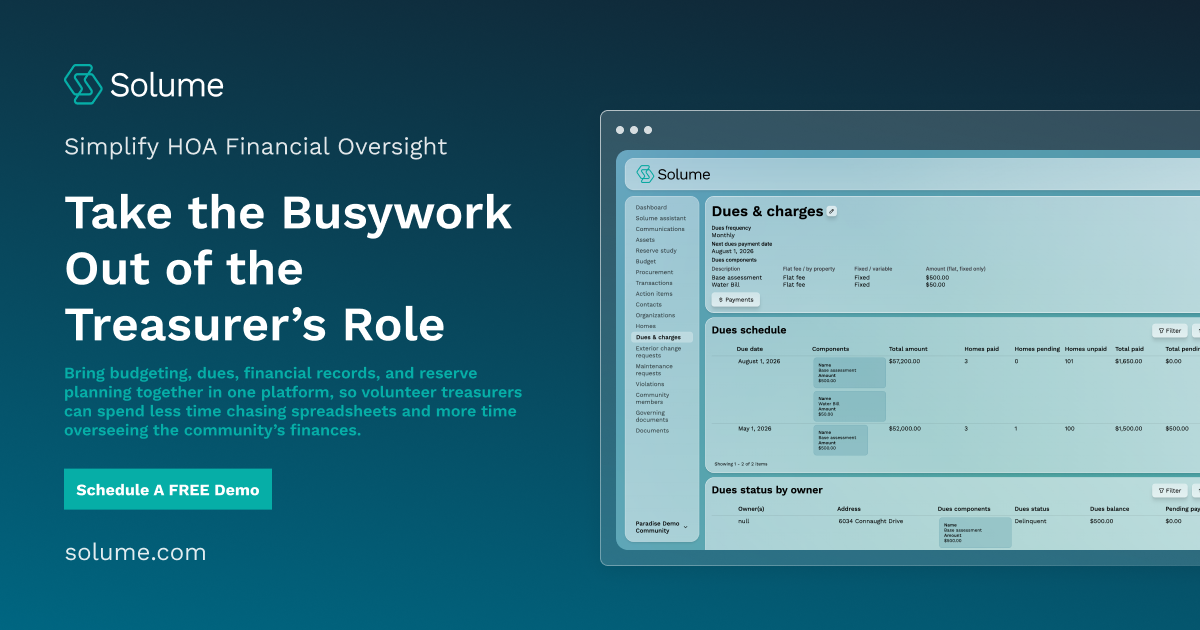
Most treasurers are volunteer board members with day jobs, not accountants, and the workload is exactly what causes board burnout. HOA management software removes the manual grind that overwhelms first-time treasurers. Automated dues collection tracks payments and flags delinquencies without a spreadsheet. Bank feeds speed reconciliation and improve cash flow visibility. Reports generate with a click instead of hours of formatting.
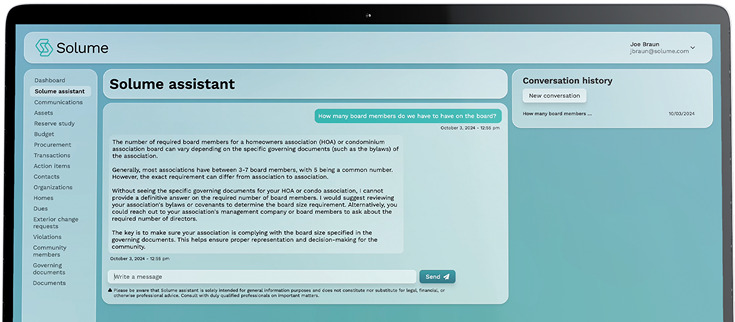
The bigger advantage is long-term planning. Most legacy HOA management software ignores capital planning entirely. Solume integrates automated reserve study tools and compliance tracking, so the reserve fund gets attention alongside daily bookkeeping, not as an afterthought. Financial reporting becomes standardized, which strengthens transparency and homeowner trust. Discipline in managing and funding reserve accounts often separates communities that avoid special assessments from those that don't.
For self-managed communities, the right platform replaces piecemeal spreadsheets, separate payment systems, and paper files. Instead, you get one place to manage budgeting, tracking, reporting, and records. That consistency also protects continuity. When a treasurer steps down, the financial history stays in the system rather than on a departing volunteer's computer. Software won't replace the treasurer's judgment, but it removes most of the technical burden that makes the role feel impossible. Handled well, HOA treasurer responsibilities become a manageable routine rather than a source of dread.
If your board wants a clearer way to handle finances, reserve planning, and reporting without a management company, you can see how Solume fits your community in a 15-minute call. It's a low-pressure way to find out whether the platform solves the specific problems your treasurer is facing.
Frequently Asked Questions
What are the four main duties of an HOA treasurer?
The four core duties are maintaining financial records (dues, assessments, and expenses), reconciling bank statements against ledgers monthly, preparing the annual operating budget, and presenting financial reports like the balance sheet and income statement to the board. State laws and your CC&Rs and bylaws can add specific requirements on top of these.
Do HOA treasurers get paid for their work?
In most associations, the treasurer is an unpaid volunteer board member serving as a fiduciary, not a salaried employee. Some governing documents allow reimbursement for out-of-pocket expenses, but compensation for the role itself is rare and must be authorized in the bylaws.
Does the treasurer have to be a member of the HOA board?
Yes, the treasurer is an officer position held by an elected or appointed board member with fiduciary responsibility for the association's finances. This is different from a hired bookkeeper or property manager, who can handle day-to-day accounting but cannot serve as the fiduciary officer.
Who is responsible for finances when the HOA has a property manager?
The property manager may process payments, keep books, and prepare statements, but the treasurer retains ultimate fiduciary oversight and accountability for the association's financial integrity. The manager executes tasks; the treasurer reviews, approves, and reports to the board and homeowners.
What financial reports is a treasurer actually required to produce?
The core reports are a monthly balance sheet showing assets, liabilities, and separate reserve versus operating fund balances, plus an income and expense statement comparing actual figures against the budget. Your state's laws and governing documents determine additional requirements, such as annual audits or reserve disclosures.
Is it really necessary to keep reserve funds separate from operating money?
Yes, treasurers should maintain reserve funds in dedicated bank accounts and back them with a reserve study updated every 3-5 years. Commingling reserve and operating funds makes it easy to accidentally spend capital-replacement money on daily costs, which leads to underfunding and surprise special assessments.
What happens if our HOA has no treasurer or leaves the role vacant?
Without a treasurer, no one owns bank reconciliations, budgeting, or reserve planning, which raises the risk of missed payments, fraud, and non-compliance with state financial-reporting laws. The board remains legally responsible for finances, so a vacancy shifts liability and workload onto the remaining members.
Can a volunteer with no accounting background actually do this job?
Yes, most treasurers are retirees, homeowners, or working volunteers rather than accountants, and the role is manageable with organized records and the right tools. Software that automates reconciliation, dues tracking, budgeting, and reserve study updates removes most of the technical burden that overwhelms first-time treasurers.