
Tennessee HOA boards are managing more money, more residents, and more compliance risk than ever before. Most are doing it with spreadsheets, email chains, and volunteer labor. That works until it doesn't. A missed payment, a lost vendor invoice, or a question about reserve funding can quickly spiral into a board crisis. The right HOA software for Tennessee communities doesn't just organize information; it prevents the financial and legal problems that can cost communities tens of thousands in special assessments or legal fees.
This guide walks through what Tennessee HOA and condo boards actually need from HOA management software in 2026, how to evaluate platforms for self-managed or professionally managed communities, and what features matter most when you're responsible for other people's money.
Key Takeaways
- HOA software for Tennessee communities must comply with the Tennessee Nonprofit Corporation Act and the Tennessee Condominium Act, which establish specific requirements for compliance and governance.
- Core features for Tennessee boards include dues collection, financial management, document storage, compliance tracking, and communication tools that reduce board workload.
- Reserve study integration is critical for long-term planning and avoiding special assessments, especially as Tennessee communities age and face deferred maintenance.
- Self-managed HOAs need software designed for volunteer board members, not property managers. Look for intuitive interfaces, built-in guidance, and tools that reduce the learning curve.
- Tennessee's rapid population growth is driving HOA expansion across Nashville, Knoxville, Chattanooga, and surrounding suburbs. New communities need software that scales as they grow.
- Transitioning from spreadsheets or legacy systems requires planning, but modern platforms can import historical data and simplify the migration process.
Tennessee HOA Legal Framework and Governing Statutes
Tennessee HOAs and condo associations operate under two primary statutes: the Tennessee Nonprofit Corporation Act (which governs most HOAs) and the Tennessee Condominium Act (which applies to condominiums). These laws establish how boards must handle meetings, elections, financial reporting, and enforcement.
Here's what many boards don't realize: Tennessee law doesn't require HOAs to conduct reserve studies or maintain specific reserve funding levels. That's different from states like Florida, California, or Nevada, where reserve planning is mandated. Understanding state-by-state reserve study requirements helps boards see how Tennessee's approach differs from other jurisdictions. The absence of a legal requirement doesn't eliminate the need. It just means Tennessee boards have to be proactive rather than reactive.
Tennessee HOA laws do require boards to maintain accurate financial records, provide homeowners with access to those records, and follow the procedures outlined in their governing documents. HOA management software that automates financial reporting and document storage makes compliance easier and reduces the risk of a homeowner dispute escalating into a legal claim.
Another area where Tennessee boards face risk: assessment liens. Tennessee law allows HOAs to place an assessment lien on a property for unpaid assessments, but the process has specific notice and timing requirements. Software with built-in dues collection and automated payment tracking reduces the chance of errors that could cost your community thousands in uncollected fees. The Tennessee Real Estate Commission provides additional guidance on property-related compliance matters that boards should understand.
Core Software Features Tennessee Boards Need
Most HOA software platforms market themselves as all-in-one solutions. That's not helpful. What matters is whether the platform solves the specific problems Tennessee boards face: tracking dues, managing vendors, storing documents, and keeping homeowners informed without drowning the HOA board in administrative work.
Here are the features that actually matter:
Dues collection and payment processing: Boards need a system that automates monthly or quarterly dues, tracks who's paid and who hasn't, and sends reminders before accounts go delinquent. Payment processing should support ACH, credit cards, and checks.
Financial management and accounting: Your software should generate balance sheets, income statements, and budget vs. actual reports without requiring an accounting degree. Most volunteer board members aren't CPAs. They need tools that make financial oversight simple and transparent.
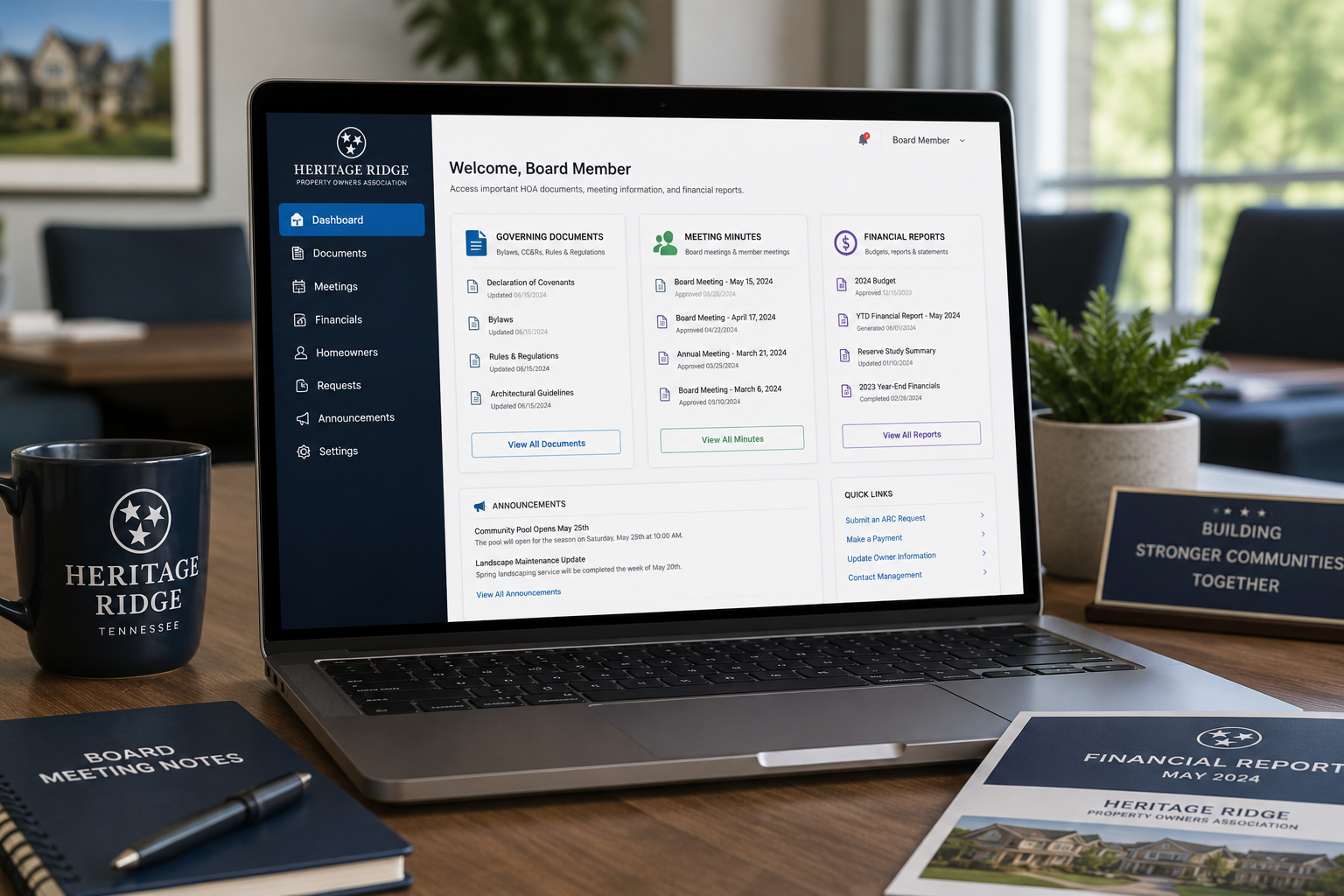
Document storage and access: Governing documents, meeting minutes, vendor contracts, and financial records should reside in a single secure, searchable location. Tennessee law requires boards to provide homeowners with access to certain records. A resident portal that lets homeowners view documents on demand reduces records requests and increases transparency.
Communication tools: Email blasts, resident portals, and mobile app notifications keep homeowners informed and reduce the number of individual questions board members have to answer. Good communication tools also create a record of what was sent and when, which matters if a dispute arises.
Violation tracking and enforcement: If your community has architectural guidelines or rules about parking, noise, or property maintenance, you need a system to document violations, send notices, and track resolution. This protects the board from claims of selective enforcement.
Vendor management and maintenance requests: Boards spend too much time coordinating repairs and tracking vendor invoices. A centralized system for maintenance request tracking, work orders, and vendor communication reduces email clutter and ensures nothing falls through the cracks.
A community management platform that integrates these features into a single system eliminates the need for multiple tools and reduces the risk of information being lost between platforms. When choosing the right HOA management software, boards should evaluate how well each feature addresses their specific operational challenges.
Financial Management and Accounting Capabilities
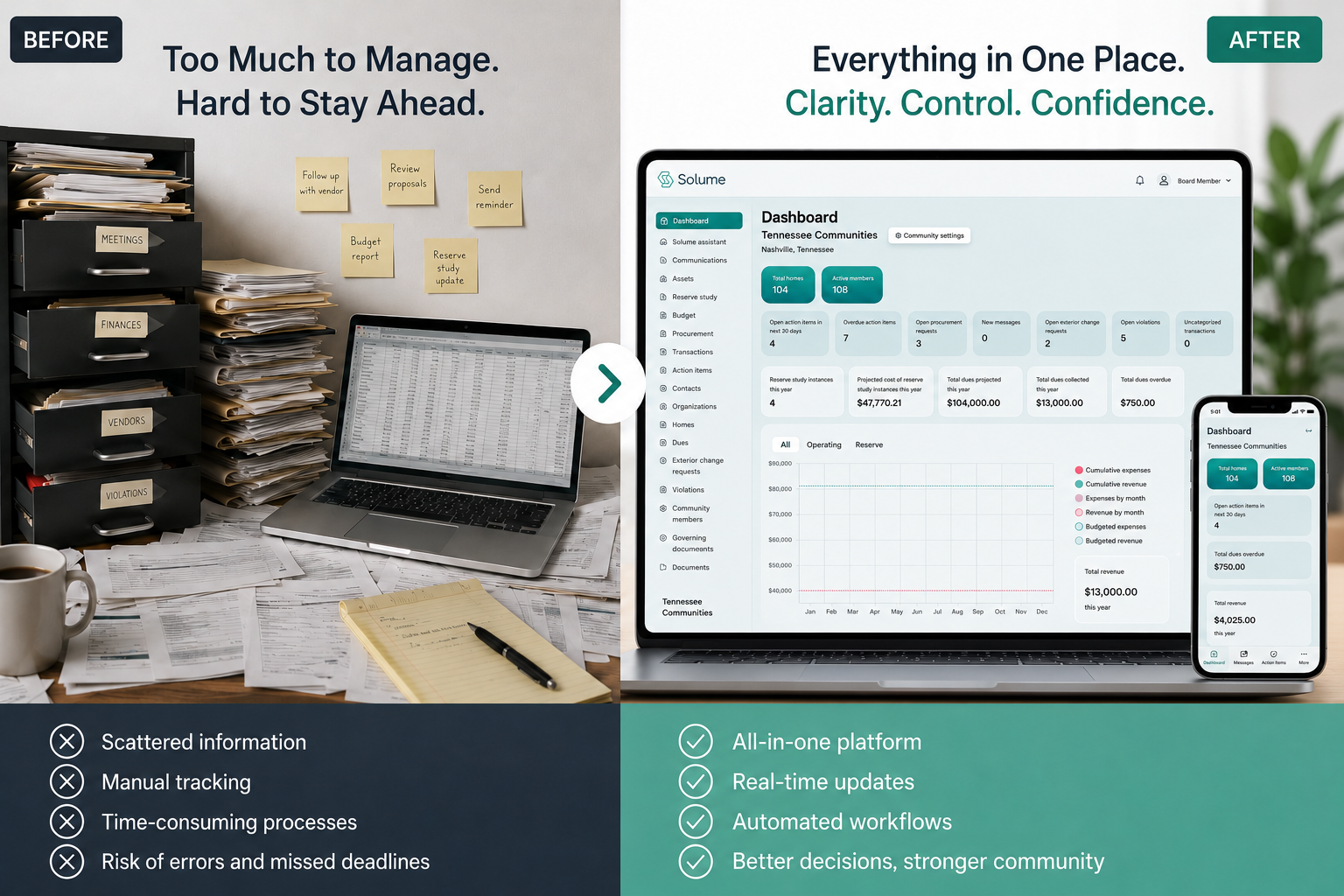
Most HOA financial problems don't start with fraud. They start with disorganization. A treasurer who doesn't know how to categorize expenses. A board that approves spending without checking the budget. A reserve account that's underfunded because no one's tracking long-term capital needs.
Good financial management software prevents these problems by automating the basics: categorizing transactions, reconciling bank accounts, and generating reports that show where the money's going. But the best systems go further. They integrate reserve planning, track special assessments, and provide transparency tools that let homeowners see exactly how their dues are being spent.
Accounting and reporting tools should generate monthly financial statements (balance sheet, income statement, cash flow), budget vs. actual comparisons, reserve fund balances and projections, delinquency reports, and year-end tax documents (1099s, financial summaries for tax preparers).
If your software can't do this automatically, you're spending volunteer time on tasks that should take seconds. Using an HOA budget planning template can help boards establish financial baselines before implementing new software.
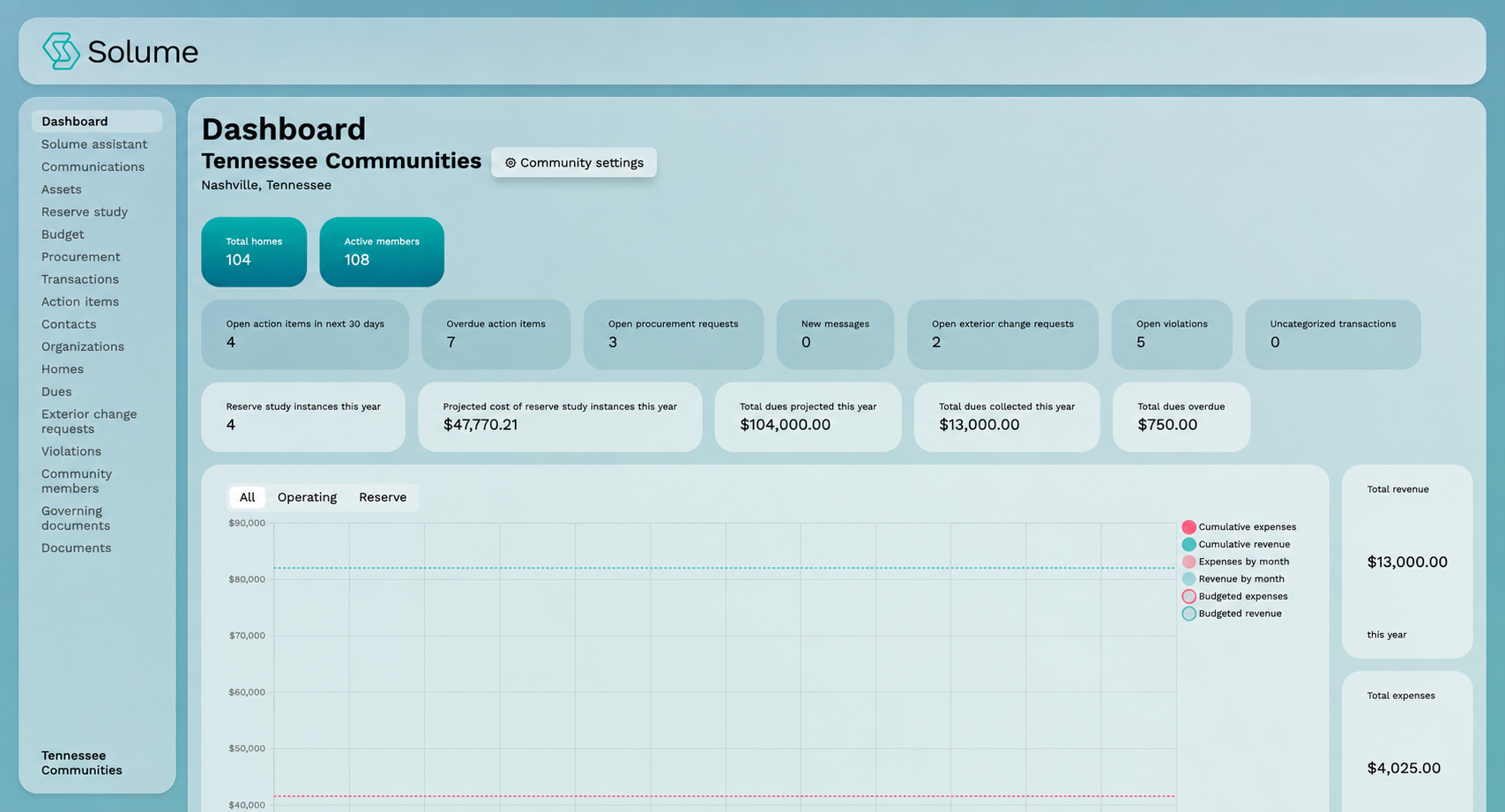
Reserve study integration is where most HOA software falls short. A reserve study identifies your community's major assets (roofs, roads, pools, clubhouses), estimates their remaining useful life, and calculates how much you need to save each year to replace them without a special assessment.
Your software should integrate reserve study data so you can track funding progress, adjust contributions as costs change, and model different funding scenarios. This is especially important in Tennessee, where reserve funding isn't legally required. Boards that ignore long-term planning end up hitting homeowners with $5,000 or $10,000 special assessments when a roof fails, or a parking lot needs repaving.
Self-Managed vs Professionally Managed Community Needs
Tennessee communities fall into two categories: self-managed (run entirely by volunteer board members) and professionally managed (overseen by a property management company). The software needs are different.
Self-managed HOAs need software designed for non-professionals. That means intuitive interfaces that don't require training, built-in guidance (tooltips, help articles, onboarding checklists), automation that reduces manual work (payment reminders, compliance alerts, report generation), and support that's responsive and helpful, not condescending.
Most HOA software is built for property managers who use the system all day, every day. Volunteer board members log in once a week, maybe less. If the interface is confusing or the workflow is complicated, they won't use it. This software, built specifically for volunteer boards, addresses many of the common challenges volunteer boards encounter in their day-to-day operations.
Professionally managed communities need software that supports collaboration between the board and the management company. That means clear role-based permissions, transparency into financials and vendor contracts, and tools that let the board review and approve decisions without micromanaging day-to-day operations.

Tennessee Population Growth and HOA Market Expansion
Tennessee is one of the fastest-growing states in the country. Nashville, Knoxville, Chattanooga, and their surrounding suburbs are adding thousands of new residents every year. That growth is driving new residential development, and much of it is happening in homeowners' association communities.
New communities start small, but they grow fast. A 50-home neighborhood can double in size within a few years. HOA software for Tennessee communities must scale as homes, amenities, and complexity increase.
Look for platforms that can grow with your community: pricing that scales based on the number of units, features that support multiple phases of development, and reporting tools that handle increasing transaction volume without slowing down.
Tennessee's growth also means more first-time HOA board members. Many homeowners in new Nashville HOA, Knoxville HOA, or Chattanooga HOA communities have never served on a board before. Software that includes educational resources, built-in compliance guidance, and responsive support makes the learning curve less steep.

Reserve Study Integration and Long-Term Capital Planning for Tennessee Communities
Most Tennessee boards don't think about reserve planning until something breaks. A roof starts leaking. A pool pump fails. A road develops potholes. Then the board scrambles to figure out how to pay for it. If there's no money in reserves, the only option is a special assessment.
Every community has major assets that will need to be replaced. Roofs last 20 to 30 years. Asphalt lasts 15 to 25 years. HVAC systems last 10 to 15 years. These aren't surprises. They're predictable expenses. The only question is whether you're saving for them or ignoring them.
A reserve study identifies your community's major components, estimates their replacement cost, and calculates how much you need to save each year to cover future expenses. Tennessee doesn't require reserve studies, but that doesn't mean you should skip them.
Software that integrates reserve study data makes long-term planning visible and actionable. Instead of treating the reserve study as a static document, you can track actual reserve contributions vs. the recommended funding level, update cost estimates as inflation or material prices change, and model different funding scenarios.
The risk most boards overlook: deferred maintenance doesn't just cost money. It creates liability. If a board knows a balcony is structurally unsound or a retaining wall is failing, and they delay repairs to avoid a special assessment, they're exposing the community to legal risk. Software that tracks maintenance schedules and capital planning creates a record of responsible decision-making.
Transitioning from Spreadsheets or Legacy Systems to Modern Software
Most Tennessee boards start with spreadsheets. A treasurer tracks dues in Excel. Meeting minutes live in Word documents. Vendor invoices are stored in email. It works until the treasurer moves away, the hard drive crashes, or someone needs to find a document from three years ago.
Transitioning to modern property management technology can feel overwhelming, especially for volunteer board members already stretched thin. But the alternative is worse. Boards that stick with outdated systems spend more time on administrative work, make more errors, and create more risk.
Here's what the transition process actually looks like: audit your current system (what financial records, documents, and data do you need to migrate?), choose a platform that supports data import, set up your account and configure settings (this includes adding board members, setting up bank accounts for payment processing, uploading governing documents, and configuring communication preferences), train your board (most platforms offer onboarding support, video tutorials, or live training sessions), and communicate the change to homeowners (let residents know they'll have access to a resident portal, online payment options, and better communication tools).
The biggest mistake boards make: waiting too long to switch. The longer you delay, the more data you have to migrate and the more entrenched your old habits become.
Tennessee-Specific Compliance Challenges and SB2150 Impact
Tennessee boards face compliance challenges that are specific to the state's legal framework. SB2150, which took effect in recent years, introduced new requirements for HOA governance, including stricter rules around meeting notices and homeowner access to records, requirements for boards to provide financial statements and budgets, and limitations on how boards can enforce certain types of restrictions.
Many boards assume they're in compliance simply by following their governing documents. In reality, many governing documents were written before SB2150 and may not reflect current law. If your governing documents conflict with Tennessee law, the law wins. This is why boards need software that tracks compliance requirements and stores governing documents in a searchable format.
Another compliance challenge: decisions from the architectural review committee. Many Tennessee communities require homeowners to submit requests for exterior modifications. If your board doesn't have a clear process for reviewing and approving requests, you risk claims of arbitrary enforcement. Software that tracks architectural requests, stores approval criteria, and maintains a decision history protects the board from disputes. Effective tools for running effective HOA meetings also help boards maintain proper documentation and compliance with meeting notice requirements.
If your Tennessee board is ready to move beyond spreadsheets and email chains, now is the time to explore your options. HOA software for Tennessee communities like Solume provides the financial oversight, long-term planning tools, and compliance support that self-managed boards need without enterprise complexity. Visit the contact page to speak with the team about whether Solume is a good fit for your community.
Frequently Asked Questions
What is HOA software, and how does it help Tennessee communities?
HOA management software centralizes financial management, communication, compliance tracking, and document storage on a single platform, reducing the administrative burden on volunteer board members and improving transparency for homeowners. Solume's platform is designed specifically for self-managed Tennessee communities that need better financial oversight without the complexity of enterprise software.
How much does HOA management software typically cost for communities in Tennessee?
Pricing varies by platform and community size, but most systems charge between $50 and $300 per month for self-managed communities, with additional fees for payment processing or premium features. Solume's pricing is designed to be affordable for small and mid-sized Tennessee communities, with transparent costs and no hidden fees.
Do Tennessee HOAs have different software needs than communities in other states?
Tennessee HOA management requires unique compliance support under the Tennessee Nonprofit Corporation Act and Tennessee Condominium Act, and because reserve studies aren't legally required, boards need software that proactively supports long-term planning.
What features should volunteer board members in Tennessee prioritize when choosing HOA software?
Prioritize intuitive interfaces, automated dues collection, financial reporting tools, document storage, and compliance tracking that doesn't require professional training. Volunteer board members need software that reduces workload, not adds complexity, and prevents board burnout.
Is HOA software worth the cost for small self-managed communities?
Yes, especially when you consider the cost of errors, missed payments, or legal disputes that result from disorganized record-keeping. A small self-managed HOA that avoids a single special assessment or legal claim due to better financial management has already justified the software cost.
What if our Tennessee HOA board doesn't have anyone with accounting experience?
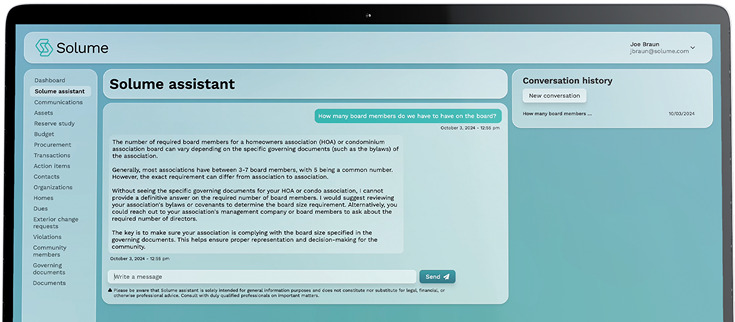
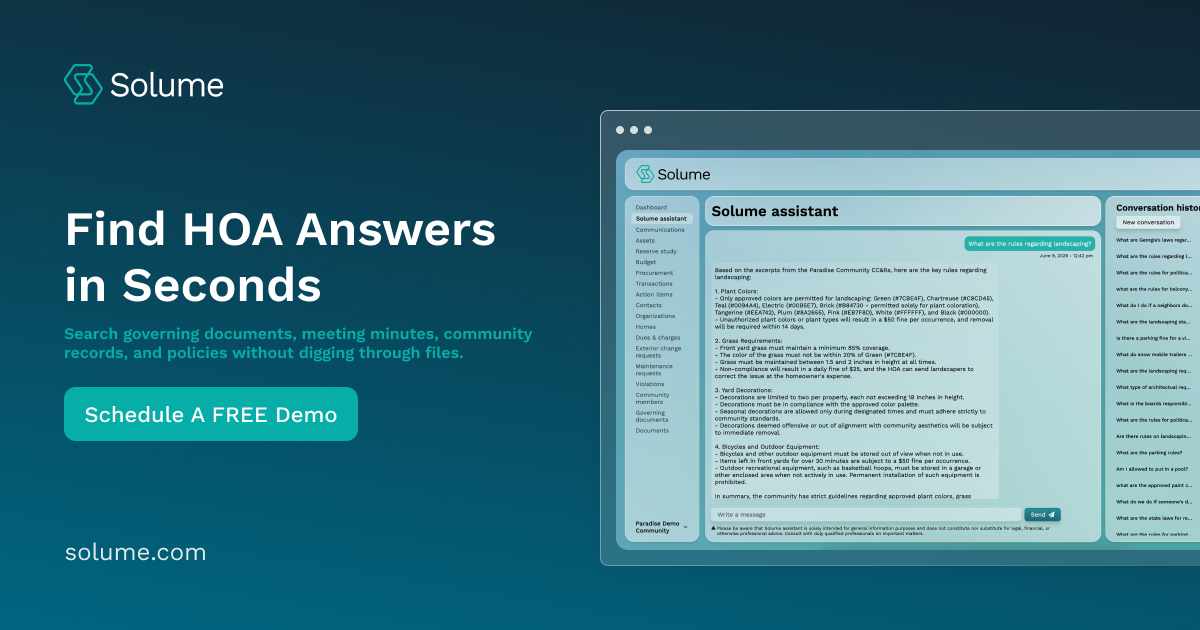
Look for software with built-in financial guidance, automated reporting, and support designed for non-professionals. Solume's platform includes tools that simplify budgeting, reserve planning, and financial oversight, plus an AI assistant that answers questions about your governing documents and Tennessee HOA laws.
How do I file an HOA charter in Tennessee, and can software help with this?
Filing an HOA charter in Tennessee requires submitting Articles of Incorporation to the Tennessee Secretary of State, along with your governing documents. While software doesn't file the charter for you, it can store your governing documents, track compliance deadlines, and help you maintain the records required by Tennessee law.
Can HOA software really prevent the kind of financial problems we hear about in the news?
Software can't prevent fraud or bad decisions, but it creates transparency, accountability, and a clear audit trail that makes financial mismanagement harder to hide. Communities with organized financial records, automated reporting, and homeowner access to financial data are far less likely to experience the kind of scandals that make headlines.