
Key Takeaways
- HOA software should reduce the workload on volunteer board members, not add another system to manage.
- The best HOA software focuses on clarity, transparency, and usability rather than long feature lists.
- Self-managed HOA boards need tools that combine accounting, communication, and record-keeping in one place.
- Legacy HOA systems often overwhelm boards, while underpowered tools fail to solve real problems.
- More features doesn't mean better. A tool with 10,000 glowing reviews might still leave your board drowning in complexity, delays, and hidden fees, especially if those reviews are from property managers—not boards.
- The right HOA software gives boards confidence, visibility, and control over their community’s operations.
Most HOA boards don’t start their term thinking they’ll become part-time administrators, accountants, and customer support reps. Yet that’s exactly where many end up. The irony is that HOA software was supposed to simplify things, not add another layer of anxiety. And yet, when boards search for the best HOA software, they’re usually met with feature-heavy lists that miss what actually matters to a volunteer board trying to keep a community running smoothly.
This article isn’t another checklist of who has the most buttons or integrations. It’s a practical look at how HOA software should support real communities, especially self-managed HOA boards, and how to separate useful tools from noise.
Here’s what matters most: 80% of HOA software on the market all have the same features. But the last 20% are the most important features that nobody other than Solume has.
What Is HOA Software and How Does It Work?
HOA software is a tool designed to help homeowner associations manage day-to-day community operations in one centralized system. At its best, it replaces spreadsheets, scattered email threads, and disconnected accounting software with a single platform that gives boards visibility and control.
For HOA board members, that means fewer administrative tasks, clearer financial reporting, and better resident communication. For property managers, it means less manual work and fewer follow-up questions. But the real value isn’t in the number of features. It’s in how well the software matches the way communities actually operate.
Understanding the Needs of Homeowner Associations
Every homeowners association faces the same underlying challenges, regardless of size. Board members are volunteers. Time is limited. Information is fragmented. And the pressure to maintain community standards while keeping residents satisfied never really lets up.
Many boards rely on basic accounting software or legacy property management systems that were never designed for HOA governance. These tools might handle HOA accounting or payment processing, but they fall short when it comes to record-keeping, maintenance requests, and transparent communication.
Good HOA software brings these pieces together. It streamlines community operations, reduces back-and-forth with residents, and gives board members confidence that nothing is falling through the cracks.
Essential Features of HOA Management Software
Most “Top HOA Software” lists focus on surface-level features because they’re easy to compare. But boards don’t struggle because they lack features. They struggle because the tools they’re given don’t reflect how communities actually function.
All-in-one HOA software should support self-managed HOA communities without requiring weeks of training. HOA accounting tools should make financial operations understandable, not intimidating. Document sharing and violation tracking should live alongside financial records, not in separate systems.
Mobile access matters, but not because every board member wants another app on their phone. It matters because boards need quick access to information when questions come up. Resident portals and owner portals should give community members one place to submit maintenance requests, review documents, and stay informed.
Online voting, event calendars, and HOA website tools can add value, but only when they’re part of a broader system focused on clarity and usability. Too many platforms pile on features without improving how the board actually works.
A Practical Top 10 HOA Software Feature List (And What Most Lists Miss)
Most "Best HOA Software" lists look impressive because they highlight a long list of features. The truth is, about 80 percent of HOA platforms overlap on the basics. Nearly every system offers some form of accounting, communication tools, and document storage. Where boards get misled is assuming those baseline features are what separate good software from great software.
The features below are what HOA boards should actually expect from a modern platform, with two that genuinely differentiate the systems that help boards lead from the ones that simply digitize paperwork. (BTW, Solume has everything you'd expect to see in a platform, but only Solume has the top two features).
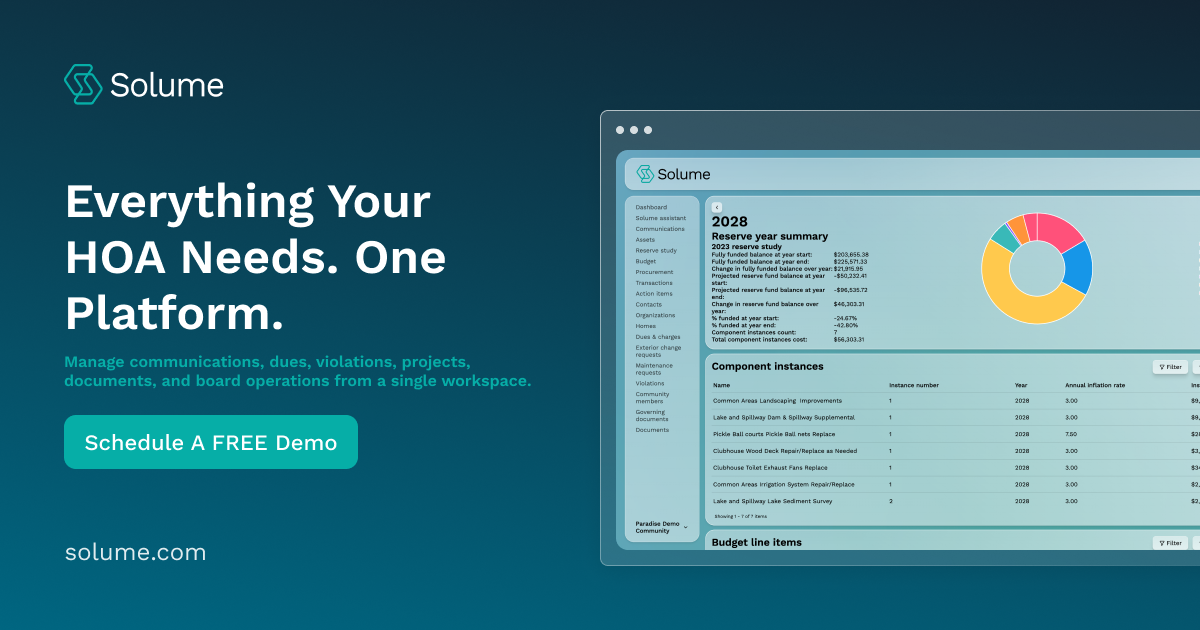
1. Reserve Study ManagementReserve study management allows boards to connect today’s financial decisions with long-term funding plans. Most software stops at accounting, but boards need visibility into how operating expenses impact future reserves.
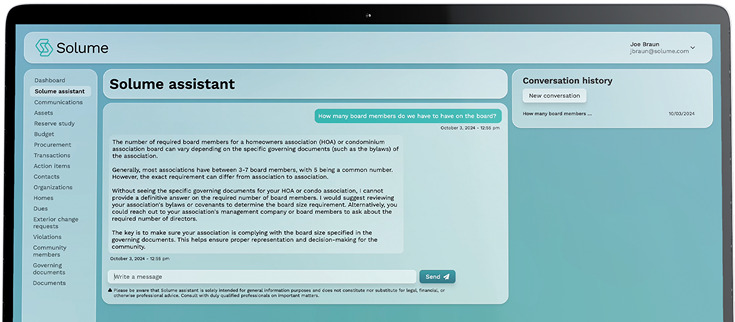
2. AI Legal Compliance and Guidance AI legal compliance tools help boards interpret governing documents, state requirements, and enforcement rules in real time. This replaces slow, expensive back-and-forth with attorneys and reduces uncertainty when questions arise.
3. Communication Tools Strong communication tools centralize announcements, updates, and board messaging so residents aren’t relying on scattered emails or missed phone calls.
4. HOA Accounting Accounting should give boards clear financial reporting without requiring accounting expertise. This includes tracking income, expenses, and balances in a way that is easy to understand.
5. Violation Notification and Tracking Violation tracking ensures enforcement is consistent, documented, and fair. Boards should be able to see the full history without digging through files.
6. Dues Collection Dues collection should be simple for homeowners and transparent for boards, with payments reflected immediately in financial reports.
7. Home and Member Database A centralized database keeps homeowner information, contact details, and property records accurate and accessible.
8. Maintenance Requests and Work Order Management Maintenance requests should flow into a single system where boards can track status, assign vendors, and document completion.
9. ARC Requests Architectural requests should be easy for homeowners to submit and simple for boards to review, approve, and archive.
10. Homeowner Portal A homeowner portal gives residents one place to access documents, submit requests, review notices, and stay informed without contacting the board directly.
But here’s the question no one asks:
Who are those features built for?
Because if you’re a self-managed board… or a small-to-mid-sized community… or a board member with a full-time job and no interest in sorting through accounting modules built for Fortune 500 PMCs—then the answer might look very different. The best HOA software might is going to be different based on whether you're a professional manager or you're a volunteer board member who is self managing (or using a portfolio manager).

Key Benefits of HOA Software for Property Managers
While this article is written primarily for HOA board members, it’s worth acknowledging how the right HOA software supports community managers as well. When systems are designed properly, everyone benefits.
Saving Time With Cutting-Edge Automation
Automation isn’t about replacing people. It’s about removing unnecessary delays. Modern HOA software automates accounts receivable, tracks HOA dues, and reduces manual data entry that leads to human error.
Payment processing, including credit card options, should flow directly into financial reporting so boards always know where they stand. Work order management and maintenance management help track issues from request to resolution. Vendor payments and expense tracking become part of a single workflow instead of a patchwork of approvals and spreadsheets.
The result is simple. Boards save time. Managers spend less energy answering the same questions. And financial operations stay organized.
Improving Resident Communication and Engagement
Resident communication is often where breakdowns happen first. Phone calls go unanswered. Emails get buried. Documents are hard to find. HOA software should solve this by giving residents clear communication tools that reduce confusion.
Push notifications, event calendars, and centralized contact information help keep community members informed without overwhelming them. When residents can access what they need through a member portal, satisfaction improves and friction decreases.
Engaged communities aren’t built through constant reminders. They’re built when systems make it easy for people to stay informed.
How to Select the Best HOA Software for Your Community
Choosing HOA software isn’t about finding the platform with the longest feature list. It’s about finding the right software for how your board actually operates.
Identifying the Specific Needs of Your HOA
Some boards prefer full self management. Others partner with HOA management companies but still want transparency and control. The software should support both models without locking information behind permissions.
For condo management, record-keeping and community standards often require tighter oversight. For smaller associations, simplicity matters more than scale. The best HOA software adapts to community needs instead of forcing boards to adapt to the software.
Communication tools, resident support, and financial visibility should be core features, not add-ons.
Comparing Pricing Plans and Free Trial Offers
While pricing plans matter, they shouldn’t be the only starting point. Boards should look for platforms that offer a free trial or FREE demo so they can evaluate usability before committing.
Many tools look similar during a demo but reveal their limitations once you’re responsible for running reports, managing documents, and responding to residents. The ability to explore the system firsthand often tells you more than any comparison chart.
How Solume Provides Comprehensive HOA Management Software Solutions
Solume was built specifically to address the gaps boards experience with legacy systems and underpowered tools. Instead of focusing on feature quantity, Solume focuses on operational efficiency and clarity.
Solume Assistant uses AI to reduce lag time, minimize human error, and help boards stay compliant without relying on expensive professional services. Rather than replacing people, it supports better decision-making by surfacing relevant information when boards need it.
Solume brings HOA accounting, document sharing, work order management, and community engagement into a comprehensive solution that reflects how communities actually function.
Streamline Your HOA With the Right Software Tools
Successful HOA boards don’t succeed because they have more features. They succeed because they have systems that support good decisions.
The right HOA software improves resident satisfaction, simplifies community management, and reduces the administrative burden that burns out volunteers. It turns scattered tasks into a coherent process and gives boards confidence that they’re managing their community responsibly.
Here’s a question worth asking. Is it really a crazy idea to spend 15 minutes seeing whether a platform could save your board thousands of dollars and countless headaches caused by poor systems or outdated tools?
Solume offers a free trial and a short, no-pressure conversation to help boards decide if it’s the right fit. Sometimes clarity is all you need to move forward.
We built Solume to solve the three most critical pain points that most HOA software ignores:
1. Reserve Study Management
We don’t just show you a budget—we forecast your capital needs, help you plan reserves, and flag shortfalls before they become emergencies. Most platforms don't even touch this, which is terrible for the long-term viability of a community. For us, it’s a primary distinction. Learn More.
2. Vendor Procurement
Solume doesn’t just track vendor approvals, we help you find vendors in the first place. Our built-in vendor search makes it easy to discover professionals other boards actually trust. You can see who other communities have used. Also, you no longer have to wonder if someone followed up or got a bid—we make it visible, trackable, and easy to act on. You’re never stuck asking, “Did we get a bid for that?” or “Who was supposed to call the roofer?”
3. Solume Assistant (AI Legal Tool)
This one is cutting-edge for communities and saving HOAs and Condos thousands in attorney fees. You can ask plain-English questions about your CC&Rs, bylaws, or state laws, and get real answers without waiting for an attorney or flipping through a 50-page PDF. The answers are directly from the rules that govern your community, not some generic AI integration.
No other HOA platform has this. Period. Learn More.

Top FAQs About HOA Software
What does HOA software actually do for a board?
HOA software is a management system that centralizes finances, communication, records, and daily operations so boards can run a community without juggling spreadsheets and email threads. It replaces fragmented tools with one source of truth.
Most boards don’t realize how much time they’re losing until everything finally lives in one place.
Is HOA software worth it for a self-managed HOA?
Yes, HOA software is often more valuable for a self-managed HOA because there’s no buffer between problems and the board. The right system replaces manual tracking with structure and visibility.
I’ve seen more burnout on self-managed boards caused by bad systems than by bad neighbors.
What features should HOA software include?
HOA software should include accounting, communication tools, document storage, violation tracking, maintenance requests, and a homeowner portal. Most platforms cover about 80 percent of these features.
What actually separates useful software is whether it helps boards plan for the future and stay compliant, not how long the feature list is.
Why do HOA boards still feel overwhelmed even with software?
Boards still feel overwhelmed because most HOA software digitizes tasks without reducing decision friction. Legacy systems are complex, and lightweight tools don’t go far enough.
If software adds another login but doesn’t remove uncertainty, it’s not helping.
How does HOA software help with financial management?
HOA software supports financial management by tracking dues, expenses, and balances in real time while generating clear financial reporting. It reduces lag time and manual errors common with spreadsheets.
Most financial stress comes from not knowing where things stand until it’s too late.
Do HOA boards need access to the same software as their property manager?
Yes, HOA boards should have access to the same software and data their property manager uses. Transparency only works when everyone sees the same information.
Any system that hides data creates dependency, not partnership.
What’s the difference between HOA software and property management software?
HOA software is built for volunteer boards managing a community, while property management software is built for professionals managing portfolios. They solve different problems.
Boards struggle when they’re forced to use tools designed for someone else’s job.
How does HOA software improve communication with residents?
HOA software improves communication by giving residents one place to access updates, documents, requests, and notices instead of relying on emails and phone calls. Centralization reduces confusion and repeat questions.
Most resident frustration isn’t about rules, it’s about not knowing where to find answers.
Can HOA software help with legal compliance?
Yes, modern HOA software can support legal compliance by surfacing governing documents, enforcement rules, and state requirements when questions come up. This reduces delays and reliance on expensive outside advice.
Boards don’t need more legal bills, they need faster clarity.
How do HOA boards choose the best HOA software?
Boards should choose HOA software based on usability, transparency, and whether it supports real decision-making, not marketing promises. The best platform is the one your board actually uses.
If you need training sessions just to answer basic questions, it’s the wrong system.
Final Word (from the Founder)
I’m Joe Braun, founder of Solume. I didn’t come from property management—I came from a lifetime of building stories and businesses that move people to action. I spent years in Hollywood working on hit TV shows like ER, The OC, and Third Watch, and most recently directed the feature documentary Ticking Time Bomb, which exposed one of the biggest scandals in automotive history: the Takata airbag crisis. I’ve also built companies, led teams, and solved hard operational problems in the real world. Whether it’s film or software, I’ve always been focused on revealing what’s hidden and making it make sense. That’s what Solume is doing for HOA boards and homeowners.
And that’s really what Solume is about: making HOA management transparent, efficient, and human again.
We don’t think your board should have to navigate overly complicated software just to stay compliant. You shouldn’t have to spend your weekend decoding budgets or waiting two weeks to hear back from support.
Software should make your life easier. If it’s not doing that, it’s the wrong software.
If you want to try something different, let’s talk.