
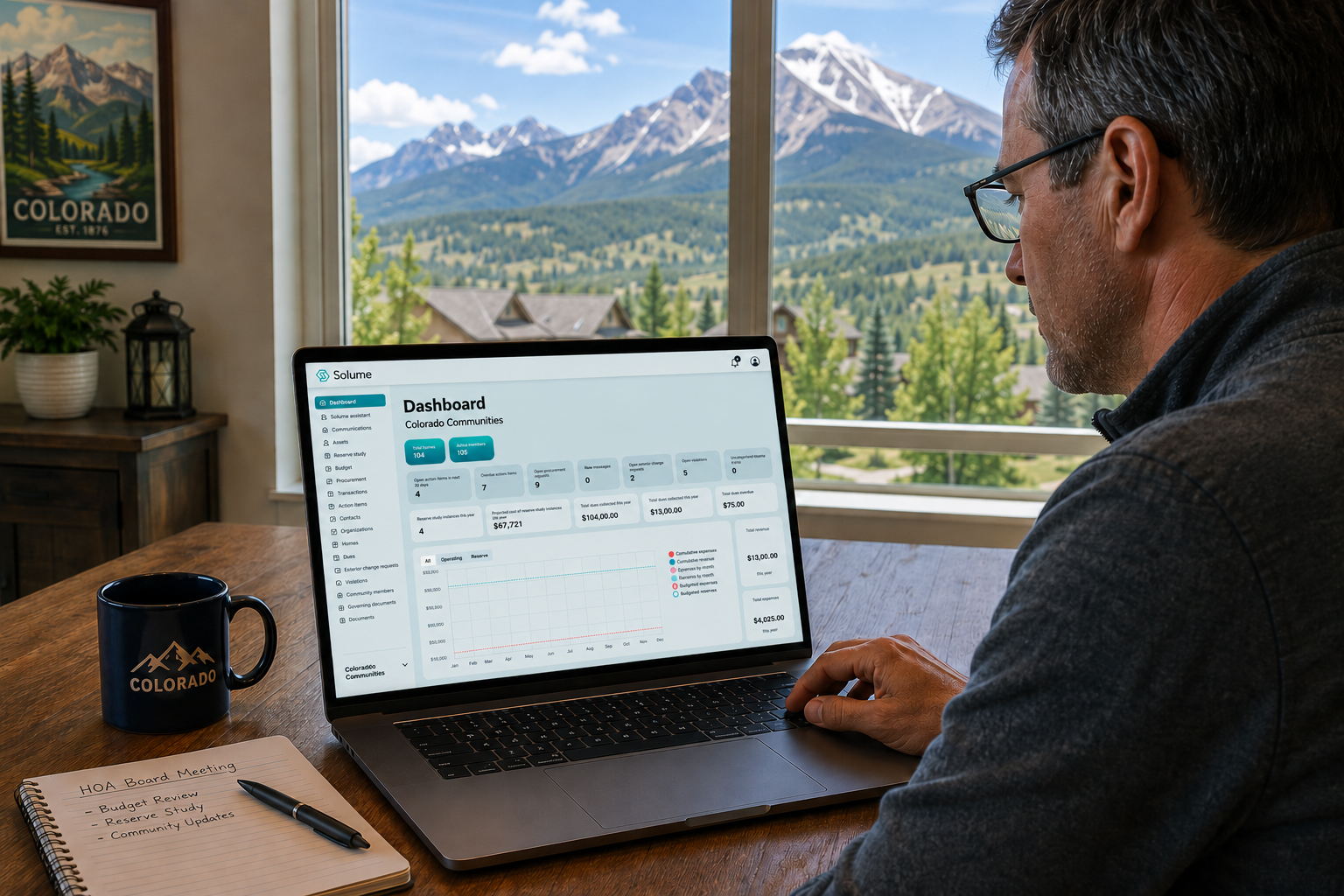
Most Colorado HOA boards still manage their communities with spreadsheets, email chains, and a filing cabinet in someone's garage. That works until it doesn't. When a board member resigns mid-term, when a homeowner disputes a late fee, or when the state auditor requests three years of financial records, those systems quickly fall apart.
Colorado's self-managed communities face a specific problem: they need professional-grade tools without the overhead of hiring full-service property management. The right HOA software for Colorado communities can fill that gap, but only if boards know what to look for and what actually matters for compliance, transparency, and long-term capital planning.
Key Takeaways
- Colorado HOA boards need HOA software for Colorado communities that handles financial management, compliance tracking, and reserve study integration in one platform
- AI-powered assistance helps volunteer board members interpret governing documents and navigate CCIOA regulations without hiring outside consultants for every question
- Self-managed communities in Colorado benefit most from platforms designed for boards, not property managers
- Reserve study tracking is critical for Colorado communities facing aging infrastructure and stricter funding requirements
- Transparent financial reporting and homeowner portal access reduce board liability and improve community trust
All-in-one platform capabilities and core features
For volunteer board members juggling full-time jobs and homeowners association responsibilities, an all-in-one solution isn't just convenience. It's about reducing the number of systems that can fail, the number of passwords to manage, and the number of vendors to coordinate when something breaks.
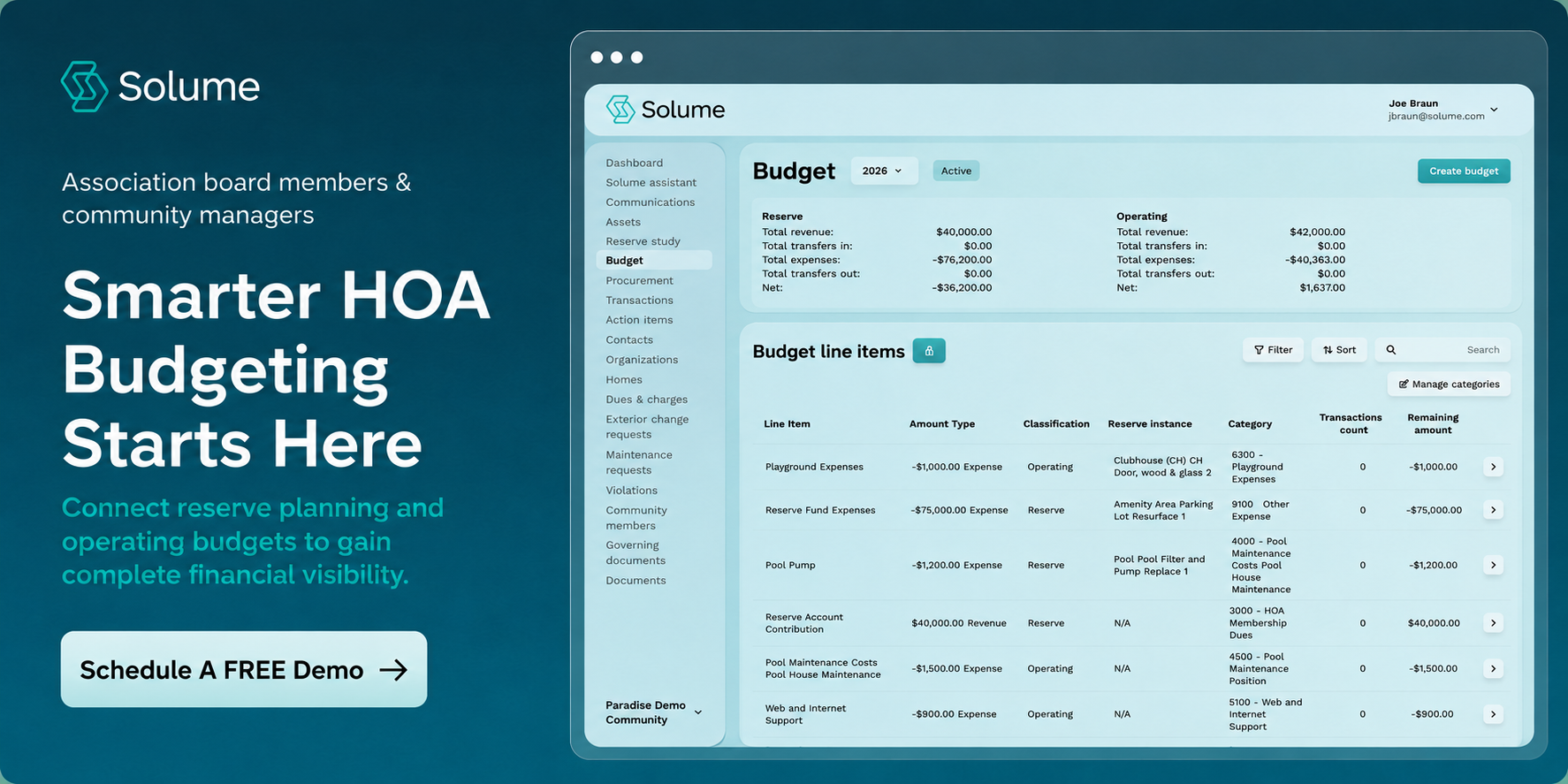
Financial management and accounting tools that handle dues collection, automated invoicing, payment processing, and financial reporting without requiring a CPA on the board. Most boards don't fail because they're careless. They fail because they're using tools designed for accountants, not volunteers.
Communication tools that give homeowners a single place to submit maintenance requests, view financial reports, and access governing documents. When homeowners email individual board members directly, requests get lost. A homeowner portal centralizes that communication and creates a record of what was requested and when, improving community engagement.
Vendor management that tracks bids, contracts, and work orders. Colorado's seasonal weather creates maintenance cycles that are easy to miss. Software that tracks vendor schedules and contract renewals prevents deferred maintenance from becoming a crisis.
Document storage that keeps governing documents, meeting minutes, architectural review requests, and vendor contracts in one searchable system. When a board member leaves, institutional knowledge shouldn't leave with them.
Financial management and accounting tools
Most HOA financial problems aren't caused by fraud. They're caused by confusion. A treasurer who doesn't know how to categorize a roof repair. A board that doesn't realize its reserve account is underfunded until they need it. A homeowner disputes a late fee because no one can find the payment record.
Good community management software prevents those problems by making financial management transparent and accessible to non-accountants. Understanding HOA accounting fundamentals is essential for boards transitioning to self-management, and the right software makes those principles easier to implement.
Automated invoicing eliminates the manual work of generating and sending monthly dues statements. Boards that still email invoices individually waste hours every month and create gaps that allow homeowners to claim they never received a bill.
Online payments reduce collection delays and give homeowners a clear record of what they paid and when. Payment processing should integrate directly with accounting tools so boards don't have to reconcile payments manually, and mobile access ensures residents can pay from anywhere.
Financial reporting needs to be simple enough that any board member can generate a budget variance report or a delinquency summary without calling the treasurer. Boards should also focus on protecting your community from financial fraud through proper internal controls and oversight.
AI-powered assistance and automation
AI in HOA software isn't about replacing board members. It's about giving volunteer board members access to expertise they don't have time to develop on their own.
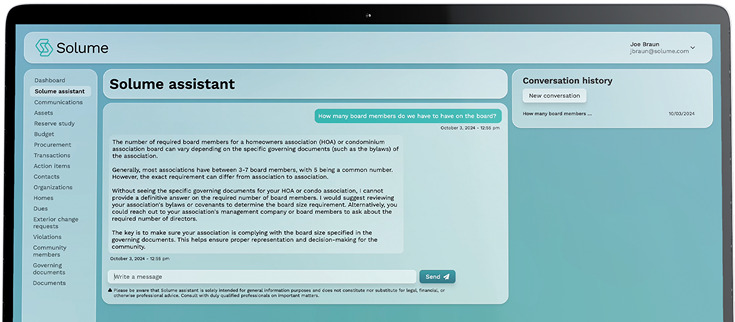
AI-powered legal and compliance assistance helps boards interpret governing documents, understand CCIOA regulations, and identify compliance risks without having to pay an attorney for every question. Most boards assume they need a lawyer to interpret their bylaws. In reality, they need a system that can quickly reference the relevant section and explain its meaning in plain language.
Solume's AI assistant does exactly that: it reads your community's governing documents, cross-references Colorado HOA laws, and answers board questions in real time. That doesn't replace legal counsel for major decisions, but it eliminates the $300 billable hour for routine questions like "Can we restrict short-term rentals?" or "What's the quorum requirement for our annual meeting?"
Automation reduces repetitive administrative work that burns out volunteer board members. Automated late fee calculations, payment reminders, and meeting notice distribution improve board efficiency. These aren't flashy features, but they're the difference between a treasurer who spends five hours a month on invoicing and one who spends thirty minutes. Automation also helps with streamlining architectural review requests, reducing the administrative burden on volunteer board members.
Pricing models and free trials
HOA software pricing varies widely, and boards often make the mistake of choosing based on cost alone rather than total value.
Pricing models typically fall into three categories:
Per-unit pricing charges a monthly fee per home or unit. This scales with community size but can get expensive for larger associations.
Flat-rate pricing charges the same amount regardless of community size. This works well for larger communities but may be overkill for smaller HOAs.
Tiered pricing offers different feature sets at different price points. This sounds flexible, but it often locks essential features, such as reserve study tracking or compliance tools, behind higher tiers.
What many communities don't realize: the cost of community management software should be compared against the cost of hiring property management, not against doing nothing. A self-managed community paying $200/month for software instead of $3,000/month for full-service management is reinvesting $2,800/month back into the community. When comparing HOA management software options for 2026, boards should evaluate total value rather than just monthly fees. Most platforms offer a free trial period to test features before committing.
Colorado-specific HOA compliance and regulations
Colorado's Common Interest Ownership Act (CCIOA) governs most HOAs and condo associations in the state. Compliance isn't optional, and the penalties for violations are getting stricter. The Colorado General Assembly regularly updates HOA regulations, making it essential for boards to stay informed about current requirements.
CCIOA compliance requires boards to:
- Provide homeowners access to financial records within 10 business days of a written request
- Hold annual meetings with proper notice and quorum requirements
- Maintain adequate reserve funding for capital repairs and replacements
- Follow specific procedures for rule enforcement, fines, and liens
HOA software for Colorado communities helps boards manage compliance by automating notice requirements, tracking document requests, and maintaining transparent financial records that satisfy state audit requirements. When a homeowner requests financial records, the software should generate the report instantly, not force the treasurer to spend a weekend compiling spreadsheets.
Transparency is both a legal requirement and a practical necessity. Software that includes a homeowner portal satisfies that requirement automatically by giving residents 24/7 access to budgets, meeting minutes, and governing documents. Boards seeking additional guidance can consult the Colorado Bar Association's resources on HOA law for authoritative legal information.
Reserve study integration and long-term capital planning for Colorado communities
Colorado communities face specific infrastructure challenges: freeze-thaw cycles that damage roads and roofs, high-altitude UV exposure that degrades siding and paint, and aging mountain resort properties built in the 1970s that are all hitting major component failure at the same time.
A reserve study tells boards what needs to be replaced, when, and how much it will cost. Reserve study integration in HOA software turns that static report into a living financial plan. Understanding state-by-state reserve study requirements helps boards ensure they're meeting Colorado's specific standards.
Reserve study tracking in community management software connects the reserve study to the operating budget. Boards can see in real time whether they're on track to meet funding goals, whether a component replacement is coming due sooner than planned, and whether current reserve contributions are adequate.
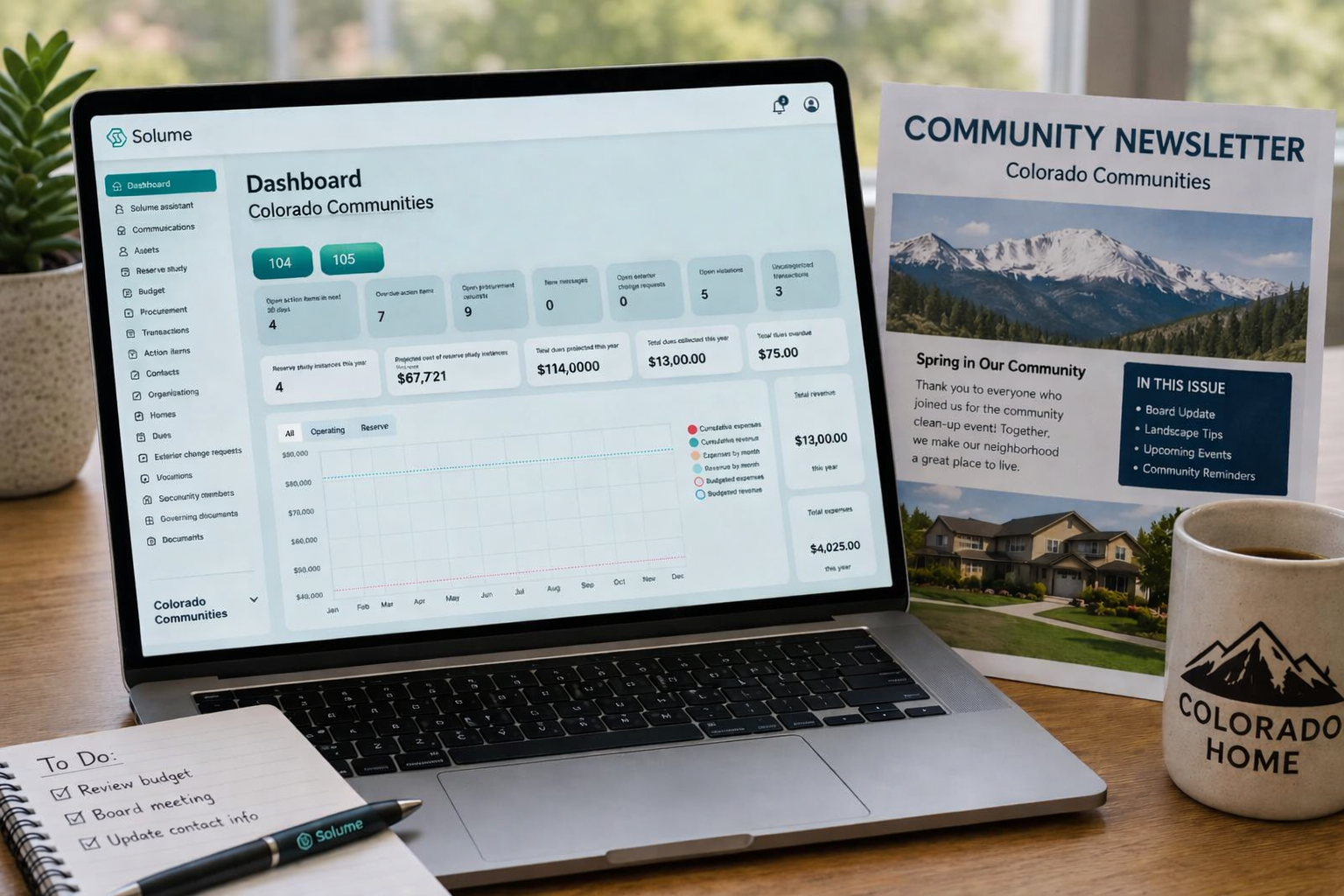
Solume integrates reserve study data directly into the financial dashboard so boards don't have to cross-reference a PDF report every time they review the budget. The software tracks component life cycles, flags upcoming replacements, and calculates whether current funding will cover projected costs.
Most Colorado HOA boards are underfunding reserves. They're not doing it maliciously. They're doing it because they don't want to raise dues and because the consequences of underfunding feel distant. But that deferred maintenance compounds. A roof that should have been replaced in 2024 will cost 30% more in 2027, and the board that delayed it will face a special assessment that could have been avoided.
Challenges unique to Colorado's self-managed HOA market
Colorado has one of the highest rates of self-managed communities in the country. That's partly cultural (residents prefer local control) and partly economic (property management fees are expensive). But self-management creates specific challenges that boards need to solve with technology, not just goodwill.
Volunteer board members in Colorado are often retirees, working professionals, or part-time residents who don't have formal training in HOA management. They're learning on the job, and mistakes are common. The wrong software makes that learning curve steeper. The right software makes it manageable. Understanding the challenges facing self-managed communities helps boards prepare for common obstacles and implement effective solutions.
High turnover on volunteer boards means institutional knowledge disappears quickly. When a treasurer resigns and no one else knows how to access the bank account or generate a financial report, the community is in crisis. Cloud-based HOA software solves that by keeping all records, logins, and processes in one system that the next board member can access immediately.
Transitioning from traditional property management to self-management in Colorado
Many Colorado communities start with full-service property management and later transition to self-management to reduce costs and regain control. That transition is where most boards either succeed or fail.
The transition process requires boards to take over financial management, vendor relationships, compliance tracking, and homeowner communication all at once. Without the right tools, that's overwhelming.
Boards planning to transition should choose an all-in-one solution for HOA management before they terminate the management contract. That gives them time to migrate data, train board members, and test the system while the property manager is still available to answer questions.
Data migration is the biggest technical challenge. Financial records, homeowner contact information, governing documents, and vendor contracts all need to move from the old system to the new one. Good HOA software includes data migration support with strong data security protocols so boards don't have to do that manually.
Ready to see if Solume is the right fit for your Colorado community?
If your HOA board is looking for HOA software for Colorado communities that handles finances, reserve planning, and compliance without the cost of full-service property management, Solume might be worth exploring. Whether you're managing a homeowners association or handling condo management, our platform simplifies community operations and enhances community living. You can explore your options to see if the platform matches your community's specific needs and budget.
Frequently Asked Questions
What features should Colorado HOA boards prioritize when choosing management software?
Reserve study integration, CCIOA compliance tracking, and transparent financial reporting matter most for HOA software for Colorado communities. Boards should prioritize tools that make compliance automatic and financial data accessible to homeowners, not features that add complexity without solving real problems.
How much does HOA software typically cost for communities in Colorado?
Most HOA management software costs between $100 and $500 per month depending on community size and feature set. Compare that cost against property management fees, which typically run $2,000 to $5,000 per month for the same community.
Does HOA software help Colorado boards comply with CCIOA regulations?
Yes, by automating notice requirements, tracking document requests, and maintaining transparent financial records that satisfy state audit requirements. Solume's compliance tracking tools flag upcoming deadlines and generate required reports automatically so boards don't miss statutory requirements.
Is HOA software really worth it for small self-managed communities?
Yes, especially for small communities where one or two volunteer board members are doing all the work. Automation and transparency reduce the time boards spend on administrative tasks and the liability they face from poor record-keeping.
What if our Colorado HOA board doesn't have anyone with accounting experience?
That's exactly why financial management tools in HOA software matter. Good platforms are designed for non-accountants and automate tasks like dues collection, financial reporting, and budget tracking that would otherwise require specialized knowledge.
Can HOA software handle reserve study tracking for Colorado communities?
Solume integrates reserve study data directly into financial planning so boards can track component life cycles, funding progress, and upcoming replacements in real time. Most other platforms treat reserve studies as static documents rather than living financial tools.
How does management software improve communication with homeowners?
A homeowner portal gives residents 24/7 access to financial reports, governing documents, and community updates. Communication tools centralize maintenance requests and architectural review submissions so nothing gets lost in email chains.
What happens if our board switches software and loses our records?
Choose HOA management software that includes data migration support and exports records in standard formats. Cloud-based platforms reduce the risk of data loss compared to locally installed systems that depend on one board member's computer.