A board approves a special assessment at a Tuesday meeting. Six months later, a homeowner disputes the vote. An attorney requests the minutes, and the file is a single handwritten page with no motion recorded, no vote count, and no date. That gap is not a clerical annoyance. It can decide who wins in court. HOA secretary duties are the quiet backbone that keeps an association's decisions defensible, and this guide walks through what the role covers, where it sits on the board, and how to do it without burning out.
Key Takeaways
- HOA secretary duties center on record-keeping, meeting notices, and certifying minutes rather than financial management, which falls to the treasurer.
- A property manager handling paperwork does not shift legal accountability away from the secretary or the board.
- Removing a secretary or any board member typically requires a formal vote, not a unilateral decision by the president.
- Inaccurate or missing meeting minutes can expose the board to legal risk during disputes or audits.
- Most HOA secretary positions are unpaid volunteer roles, with workload varying significantly based on whether the association uses digital recordkeeping tools.
What is an HOA secretary and why the role matters
The HOA secretary is the officer responsible for the association's records, meeting documentation, and official notices. If the treasurer guards the money and the president runs the meetings, the secretary guards the paper trail proving what happened. The role of an HOA secretary is often underestimated until a record request or a dispute exposes a gap, and by then it is too late to reconstruct what happened. Boards that operate without professional management often run into common challenges, and unclear secretary duties are frequently at the root of them.
The HOA secretary's role matters because association records and minutes are often the only admissible evidence of a board's decisions. In litigation, an unrecorded vote is often treated as one that never occurred, since a court weighs the written record over anyone's later memory of the meeting. Requirements vary by state statute, so boards should consult their attorney for jurisdiction-specific legal interpretation.
How the secretary fits within the HOA board of officers
Most associations run on four officers: the HOA president, the vice president, the HOA treasurer, and the board secretary. The board of directors elects these officers, and together they cover the association's leadership. The secretary is not subordinate to the president. Each officer carries distinct HOA board member roles defined in the bylaws, and understanding the role of HOA board officers within that structure helps new volunteers know where their authority starts and stops.
Here is the hard truth many boards miss: the president cannot fire the secretary. Removing any board member, secretary included, generally requires a formal vote by the board of directors following the bylaws and applicable state law. This separation exists on purpose: no officer holds unilateral power over another, which protects the person keeping honest records from being pushed out over an uncomfortable vote they documented accurately.
Roles overlap in small communities, where a volunteer might act as both secretary and treasurer. That is legal in many associations, but the fiduciary duty attached to each position stays separate. For a plain-language overview of officer structures, the U.S. Federal Trade Commission's consumer resources cover general homeowner association basics worth reviewing. When a single volunteer wears two hats, the risk most boards overlook is that a lapse in one role can quietly undermine the other, so keeping records and finances cleanly separated matters even within one person's workload.
Record-keeping and document custodianship
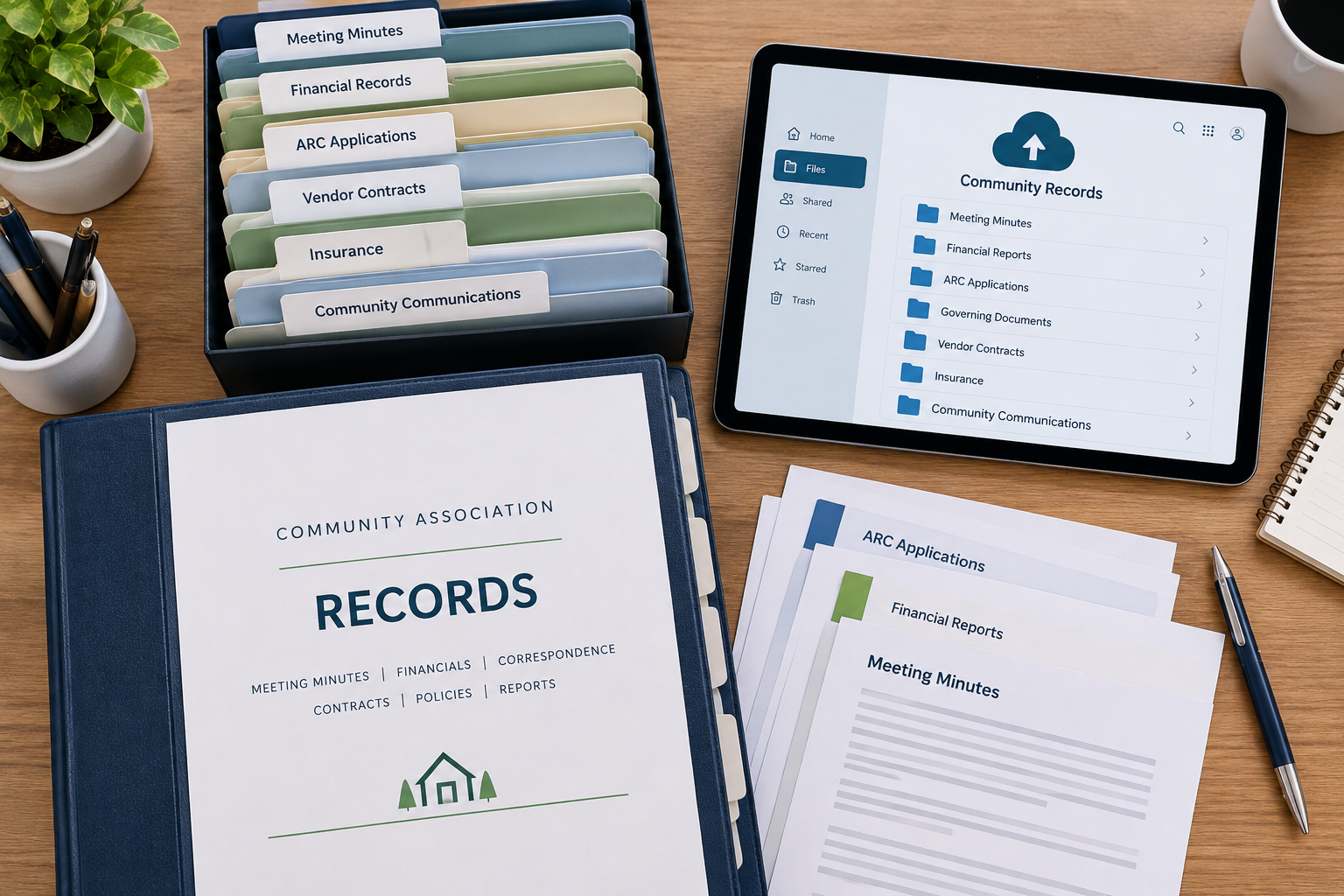
The secretary serves as records custodian, holding, organizing, and protecting the governing documents: the CC&Rs, bylaws, articles of incorporation, minutes, contracts, and membership lists. Record keeping and general association records management make up the largest part of an HOA secretary's responsibilities, and it's arguably the core of the job. One of the clearest best practices for HOA secretaries is treating that habit as daily upkeep rather than a pre-meeting scramble.
Good document filing is not just tidiness. Many states require associations to produce records within a set number of days of a homeowner request, and failing to do so can trigger penalties. That deadline turns sloppy filing into real financial risk, since a board cannot hand over records it cannot find. The secretary also validates documents, confirming resolutions and signed agreements are authentic and consistent with association records before entering the permanent file.
Picture a self-managed HOA that stores everything in one volunteer's personal email. When that member moves away, years of records vanish overnight, and the board has no way to respond to a homeowner's records request or prove a past assessment was properly approved. That single point of failure is exactly the audit risk a strong records custodian should prevent. Keeping membership lists current also matters for voting eligibility and delivering legal notice.
Preparing meeting agendas
The secretary usually drafts meeting agendas alongside the HOA president. The agenda sets what the board can legally discuss and vote on, so it is more than a courtesy list. In many states, boards cannot act on items not properly noticed ahead of time, so incomplete meeting agendas can quietly strip a decision of its legal footing.
A workable agenda follows a predictable order: call to order, approval of prior minutes, treasurer's report, old business, new business, homeowner open forum, and adjournment. Templates keep nothing from slipping through the cracks and make the eventual minutes easier to match up.
Most boards assume the president handles the agenda alone. In reality, the secretary's involvement ties the agenda to the minutes and notice, creating one clean chain of documentation. When those three documents line up, disputes over what the board was allowed to decide mostly disappear.
Recording and distributing meeting minutes
Recording meeting minutes is the most visible of all HOA secretary duties, and boards get it wrong most often. Minutes record actions, not transcripts. They capture motions, who made them, the vote count, and decisions reached, not the back-and-forth debate.
Missing details create exposure. If minutes fail to record a motion or a vote tally, the board loses its proof that the decision followed proper voting procedures. During an audit or lawsuit, that gap can invalidate an assessment or election. Reviewing the legal requirements for HOA meeting minutes is a useful step for any secretary who wants to understand what "official record" actually means in a legal dispute. Accurate minutes are a core piece of legal compliance, and keeping them airtight is one of the simplest best practices for HOA secretaries to adopt.
After each meeting, the secretary drafts the minutes, circulates them to the board for review, and presents them for approval at the next meeting. Once approved, the secretary certifies them as the official record. Distribute them to members promptly. Timely access supports transparency and reinforces homeowner communication about what the board decided and why. This approval step is what converts a rough draft into legally weighty evidence, which is why a board should never treat unapproved minutes as final.
Sending meeting notices and correspondence
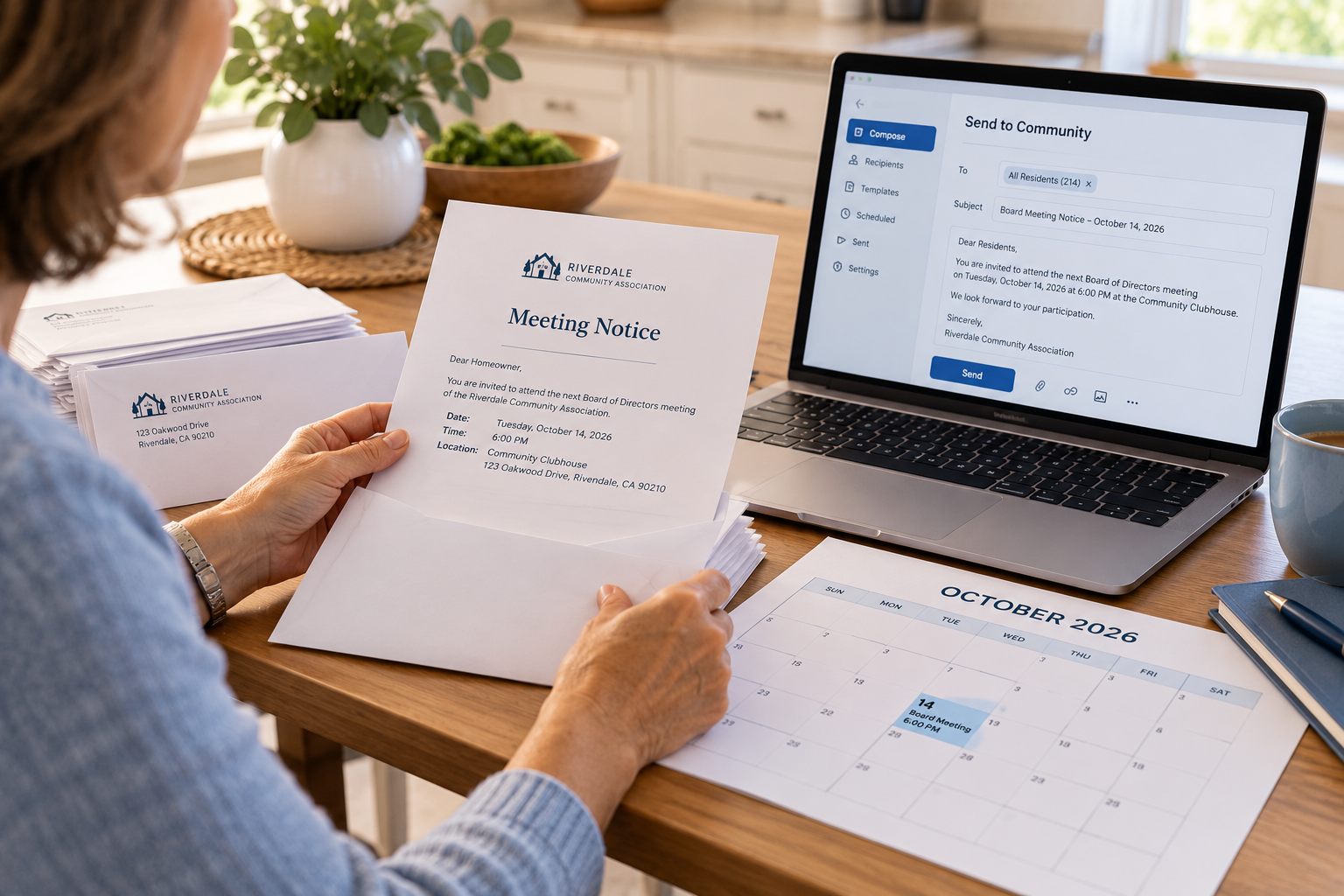
Meeting notice is a legal requirement, not a formality, and the secretary typically manages it. Most state statutes set a minimum notice period, often a few days to a few weeks depending on meeting type, and specify how notice must be delivered. Skip it, and you can challenge any decisions made at that meeting as invalid.
The secretary tracks which meetings require notice, when it must go out, and how it reaches every member on the current list. This is where accurate record keeping pays off, since notices sent to outdated addresses can void the notice entirely. Annual, board, and special meetings each carry their own notice requirements under most state law.
Correspondence rounds out the job. Official letters, responses to record requests, and formal communications on behalf of the board all flow through or are documented by the secretary. When a dispute over notice or process gets contentious, that's often when boards realize their HOA needs legal guidance rather than trying to resolve it internally.
Homeowner and community communication
The secretary is often the documented voice between the board and residents. While the whole board shares responsibility for homeowner communication, the secretary logs it, responds to record requests, and keeps a trail of what was sent and when. In a community association, that consistency builds trust.
Transparency is the point here. When homeowners can see the minutes, access the governing documents, and get straight answers to record requests, they stop assuming the board is hiding something. Most conflict in a self-managed HOA comes from information gaps, not bad decisions, because homeowners fill silence with suspicion faster than they accept a delay.
Scattered communication is where this breaks down: updates buried in personal inboxes, records nobody can locate, and residents left guessing. Solume gives self-managed boards a single hub where residents can find records and receive board updates, which directly addresses the information gaps that drive most community conflict. Clear, documented homeowner communication also supports election support duties, since members need reliable information before they vote.
Traits and best practices of an effective secretary
A good HOA secretary is organized, consistent, and comfortable with detail. Best practices for HOA secretaries are less about talent and more about systems. People who struggle usually improvise every meeting instead of following a repeatable process. Learning how HOA management companies actually operate can also help self-managed secretaries borrow the same systems professional managers rely on, without paying management fees.
Here is what separates a good HOA secretary from an overwhelmed one:
- Use templates to keep agendas, minutes, and notices consistent so nothing depends on memory.
- Digitize records instead of relying on paper or a personal inbox.
- Reconcile the agenda, minutes, and notice for every single meeting.
- Keep membership lists current for accurate notice and voting eligibility.
- Understand which duties are set by state law versus by the governing documents.
Many volunteer board members assume the role requires legal training. In reality, sound HOA secretary responsibilities come down to discipline and good tools. A secretary who commits to the same process every meeting will produce records that hold up far better than one working without a system.
Using software and templates to reduce secretary workload
Most secretary burnout comes from manual document tracking, not the duties themselves. The root cause is scattered systems: minutes in one folder, notices in an email account, membership lists in a spreadsheet, contracts in a filing cabinet. Pull those together, and the workload drops sharply.
Modern HOA software centralizes association records, automates meeting schedules, and stores approved minutes where the whole board can find them. Good HOA software also enforces templates for consistency, so every set of minutes captures motions and voting procedures the same way. Choosing software built for self-managed HOA boards rather than a generic tool makes a real difference here, since these platforms are designed around the exact workflow a volunteer secretary needs. Learning to digitize records also guards against the single-point-of-failure problem that sinks so many self-managed communities.
For volunteer board members juggling this alongside full-time jobs, the difference is real. Because the scattered-systems problem drives most secretary overload, the fix has to be consolidation, not more effort. Solume was built for self-managed communities to handle member and home records, meeting documentation, and resident communication in one place, so the board secretary spends less time chasing files and more time on decisions that matter.

Handled well, HOA secretary duties protect the board, stabilize the community, and build homeowner trust. The right systems turn a volunteer role into the backbone of defensible governance. If your board wants a clearer way to manage records, meeting documentation, and resident communication without a management company, you can see how it works for self-managed communities on a 15-minute call to find out whether Solume fits your association.
Frequently Asked Questions
Do HOA secretaries get paid for the role?
Most HOA secretaries are unpaid volunteers serving on the board, since HOA officer positions are typically structured as elected duties rather than paid jobs. Some larger associations offer a small stipend or fee waiver, but this depends entirely on the bylaws, not state law.
What are the core duties of an HOA secretary?
The secretary maintains official records (minutes, bylaws, CC&Rs, membership rolls), prepares and distributes meeting notices and agendas with the president, certifies board resolutions, and manages association correspondence. Exact scope varies by state law and the association's governing documents, so two HOAs rarely define the role identically.
How is the secretary's job different from the treasurer's?
The secretary handles records, minutes, and official notices, while the treasurer manages dues collection, budgeting, and financial reporting. The two roles sometimes overlap in small, self-managed HOAs where volunteers wear multiple hats, but their fiduciary responsibilities are legally distinct.
Does an HOA still need a secretary if a property manager handles paperwork?
Yes, the secretary remains the legally accountable officer even when a management company drafts minutes or sends notices, because compliance and accuracy still fall on the board, not the vendor. This is a common blind spot: boards assume outsourcing paperwork also outsources liability, and it doesn't.
Is serving as HOA secretary worth the time commitment?
It depends on your community's size and whether you have digital tools; secretaries at self-managed HOAs often spend several hours monthly on minutes, records, and notices without software support. Boards using automated recordkeeping tools typically report a substantial reduction in workload, since much of the burden comes from manual document tracking rather than the duties themselves.
Can an HOA president remove a board member, including the secretary?
No single officer, including the president, can unilaterally remove another board member; removal generally requires a membership vote or board action following procedures set in the bylaws and applicable state statutes. This protects secretaries from being pushed out over disagreements about how records or minutes are handled.
What happens if HOA meeting minutes are inaccurate or incomplete?
Inaccurate minutes can create real legal exposure, since minutes often serve as the official evidence of what the board approved during audits, disputes, or litigation. Best practice is to use a consistent template that matches the agenda and bylaws so you don't leave out anything required.
Does the HOA treasurer have to be a board member?
In most associations, yes, the treasurer is an elected officer position filled by a sitting board member, per the bylaws. Some HOAs allow non-board members to assist with bookkeeping tasks, but the officer title and fiduciary responsibility stay with the board.