
A mid-size HOA community pays a management company $60,000 a year. Most of that money buys work three volunteers could do in a few evenings a month with the right tools. That's the uncomfortable math thousands of boards never run. Most boards assume they need an HOA management company to stay compliant and keep the books straight. In reality, the biggest obstacle is a lack of organized systems, not professional staff. This guide walks through how to run a self-managed HOA, what duties a board can absorb, how to set up finances and compliance, and where the real savings show up.
Key Takeaways
- An HOA community is a residential development governed by a legally incorporated Homeowners Association whose CC&Rs bind every current and future homeowner who buys in.
- Whether an HOA community is a good buy hinges on the strength of its reserve fund, since underfunding leads directly to surprise special assessments.
- The core trade-off is convenience and consistent property values in exchange for mandatory dues and enforceable restrictions on your home's exterior and use.
- Reviewing governing documents, financial statements, and recent board minutes before buying reveals whether a community is stable or heading toward financial trouble.

Can an HOA run without a management company? The self-managed reality
Yes, and plenty already do. A large share of small and mid-size communities in the U.S. operate as self-managed communities. Volunteer board members handle finances, maintenance, and enforcement directly. The Community Associations Institute estimates more than 365,000 community associations nationwide, and a meaningful portion run without a professional manager.
Here's the hard truth: an HOA management company is a convenience, not a legal requirement. Generally, no state statute forces an HOA to hire one, though requirements vary by state. The law does require the association to meet its obligations. That means accurate HOA financials, timely HOA dues collection, reserve planning, and compliance with its governing documents and state code. It's worth understanding the common challenges self-managed HOA communities face before making the switch, so you can plan around them from the start.
Self-management works best for small to mid-size communities with engaged volunteers and predictable operations. It gets harder for large associations with dozens of vendors, complex shared amenities, or constant litigation. The deciding factor is not size. It's whether the HOA board has the systems and time to stay organized. Most boards that struggle fail on process, not effort.
What a management company actually does (and which duties boards can absorb)
Strip away the branding and a management company performs a defined set of tasks. It collects HOA fees, pays vendors, keeps the books, coordinates maintenance, mails violation notices, and prepares the HOA budget. Useful work. But none of it is beyond a motivated board.
Most boards assume a manager provides legal protection. In reality, the fiduciary duty always sits with the board of directors, whether or not a company is involved. A manager can advise, but the HOA board carries the board responsibility for every financial and compliance decision. The Federal Trade Commission's guidance on managing your finances and debt collection is worth reviewing, because dues collection follows the same fair-practice rules any creditor must follow.
Which duties can a self-managed HOA absorb? Almost all of the routine ones. Bookkeeping, resident communication, ARC (Architectural Review Committee) requests, and maintenance tracking are all manageable in-house with software. Boards keep only narrow specialties outsourced: an accountant for the audit, an attorney for legal interpretation, and an engineer for the reserve study. That's a far smaller bill than full HOA management services.
Step-by-step: how to transition from a management company to self-managed
Timing matters. Give notice, then use the window before your contract ends to move every record in-house.
1. Review your current management contract for the notice period and any early-termination penalties, and calendar the exact date you must send written notice.
2. Send formal written notice of non-renewal or termination to the HOA management company, keeping a dated copy for your records.
3. Request a full handoff of records: bank statements, HOA financials, vendor contracts, member and home records, insurance policies, and the current reserve study.
4. Open new association bank accounts under board control and update all signatories to reflect current board of directors members.
5. Notify every vendor of the change and confirm who now approves invoices and schedules work.
6. Choose HOA management software to handle accounting, HOA dues collection, communication, and maintenance tracking in one place.
7. Migrate homeowner records, unit data, and outstanding balances into your new system before the old provider's access ends.
8. Update residents with new payment instructions and points of contact well before the first post-transition billing cycle.
9. Schedule the recurring board tasks: monthly financial review, annual budget, and reserve planning updates.
This sequence matters because of access. Once a management company's contract lapses, retrieving records gets slow and costly. Pull everything while the relationship is active.

Setting up your financial system: budgeting, dues collection, and reserve planning
Money is where self-managed communities either build trust or lose it. Start with a clean chart of accounts and separate operating and reserve funds. Never commingle them. Mixing reserve money with operating cash is one of the fastest ways to undermine fraud prevention and blow financial transparency.
Build the HOA budget from actual costs, not last year's guess. Line up insurance, utilities, landscaping, and common-area expenses. Then set HOA fees to cover them plus a real reserve contribution. Boards should also understand how HOA dues and fees are treated financially, since that affects both budgeting and what you communicate to owners. Underfunding the reserve is the single most common mistake. It's how communities end up hitting owners with special assessments they can't afford.
A current reserve study tells you what to save. It projects the useful life of every major component, from roofs to pool decks, and sets the annual funding target. Skipping a reserve study is the root cause of most surprise assessments because deferred wear keeps accruing whether anyone is setting money aside for it. Solume includes automated reserve study tools and compliance tracking. That lets an HOA treasurer keep funding on target without a full-time accountant. Consistent HOA dues collection keeps cash flowing, and automating it reduces late payments and the chasing that burns out volunteers.
Handling compliance and legal responsibility as a volunteer board
Compliance is where boards feel most exposed, and for good reason. State laws have tightened. After the 2021 Surfside condo collapse in Florida killed 98 people, Florida enacted strict structural inspection and reserve funding rules for condo associations. Other states followed with their own reserve and disclosure requirements.
Here's what boards overlook: the HOA rules and regulations you enforce must match your governing documents and state statute. If they don't, an enforcement action can be reversed and the association exposed, because a rule the board can't tie back to its documents or state code has no legal footing. Beyond state code, associations must also meet IRS filing requirements for homeowners associations, which govern how the association reports income and expenses each year. HOA laws vary by state, so a board in Nevada operates under different reserve rules than one in Texas or California. Always refer directly to your state's HOA or condo statute, and consult your attorney for interpretation. This article isn't legal advice.
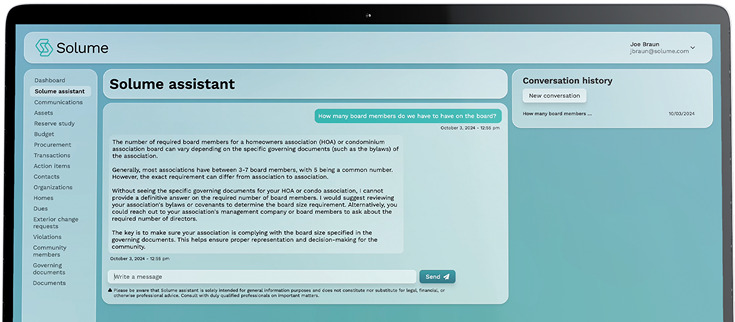
Practical compliance for a self-managed HOA comes down to routine: hold and document open meetings, keep accurate minutes, follow due process on violations, and file required annual reports. Solume's AI assistant helps boards locate provisions in their documents and flag risks, though it doesn't replace an attorney. Many assume only a manager can keep a homeowners association compliant. In reality, an organized board with good records and the right AI assistant often maintains cleaner compliance than an overloaded manager juggling dozens of properties.
Managing vendors, maintenance, and community operations in-house
Vendor management is where disorganization costs real money. Picture a community that never tracks warranties or bid history. It repaves a lot two years early, overpays a landscaper nobody re-bid in a decade, and lets a small roof leak become a $40,000 repair. That's deferred maintenance in action, and it's entirely preventable.
Good vendor management starts with getting at least three bids on any significant job. Keep every contract, insurance certificate, and warranty inone file. Competitive bidding matters for more than price. It's fiduciary duty. The board owes homeowners documented, defensible spending decisions.
Maintenance tracking closes the loop. Log every request, assign it, and record when it's done. Nothing slips, and you build a history that informs the next reserve study. Staying on top of vendors and repairs is one of the biggest challenges HOA boards face, and a self-managed HOA can handle it with maintenance and vendor tools instead of a manager's inbox. For shared community amenities like pools and gyms, schedule preventive maintenance rather than waiting for failure. Reactive repairs almost always cost more and frustrate residents faster. Organized community management here directly protects both property values and the HOA budget.

Communication and transparency with residents
Distrust between boards and homeowners almost always traces back to one thing: hidden or hard-to-find information. When owners can't see where HOA dues go, they assume mismanagement, even when the board is doing everything right.
Financial transparency is the fix, and it's cheaper than the alternative. Publish the HOA budget, monthly HOA financials, and reserve funding status where every owner can see them. A community that shares numbers openly gets fewer angry emails, faster dues collection, and smoother meetings. When boards go transparent, suspicion drops, and voluntary compliance rises, because owners who can see exactly where their money goes have far less reason to assume the worst. For owners who want to understand the bigger picture, the CFPB offers helpful consumer guidance on housing costs and dues that boards can share with residents.
Centralized resident communication beats scattered emails and paper notices. A single hub for announcements, documents, ARC decisions, and payment records means residents stop calling three volunteer board members for the same answer. Solume centralizes resident communication and gives homeowners self-service access to their records and payment history, reducing the board's workload. Documented communication also protects the board. When a dispute arises, a clear record of notices and decisions is your defense. Transparency isn't a courtesy. It's risk management and a direct antidote to board burnout.
The real cost comparison: management fees vs. self-management with software
Let's talk numbers. The cost of HOA management for a small to mid-size community typically runs $10 to $25 per unit per month. Add setup and transition fees, special-project markups, and sometimes a cut of vendor invoices. For a 200-unit association, that's easily $40,000 to $60,000 a year. That figure holds true whether you run an HOA or a condo association of similar size.
Self-management with software flips that math. A platform costs a fraction of a management contract, and you keep the specialty help you need: an accountant for the audit, an attorney on retainer, an engineer for the reserve study. Even after those, most self-managed communities spend far less than half of full management fees. The total cost of HOA management drops sharply.
Here's what boards miss: the savings don't vanish. They go back into the reserve fund and shared amenities. Redirecting even $30,000 a year into reserves can meaningfully reduce the odds of a future special assessment. The objection "but our management company handles all this" misses the point. If a company does work your board can do with software, that's an argument for reinvesting the money into the community, not spending it on overhead.
How software replaces a management company for self-managed boards
The gap between a self-managed HOA and a professionally managed one closes when software absorbs the manager's daily tasks. That's the whole idea behind purpose-built HOA management software.
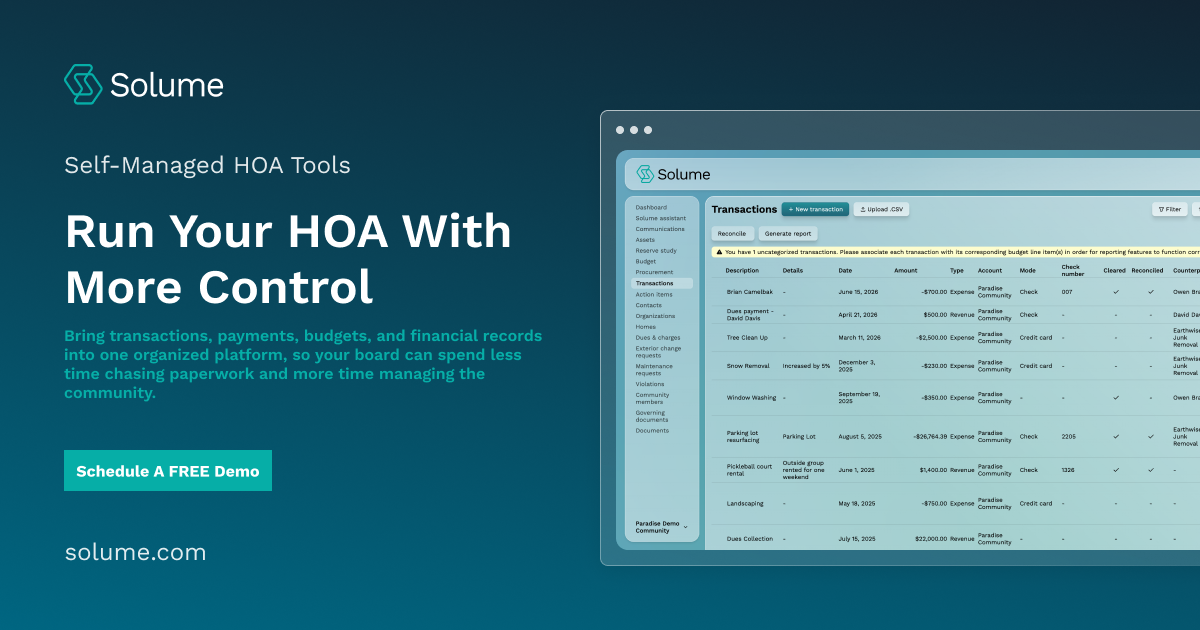
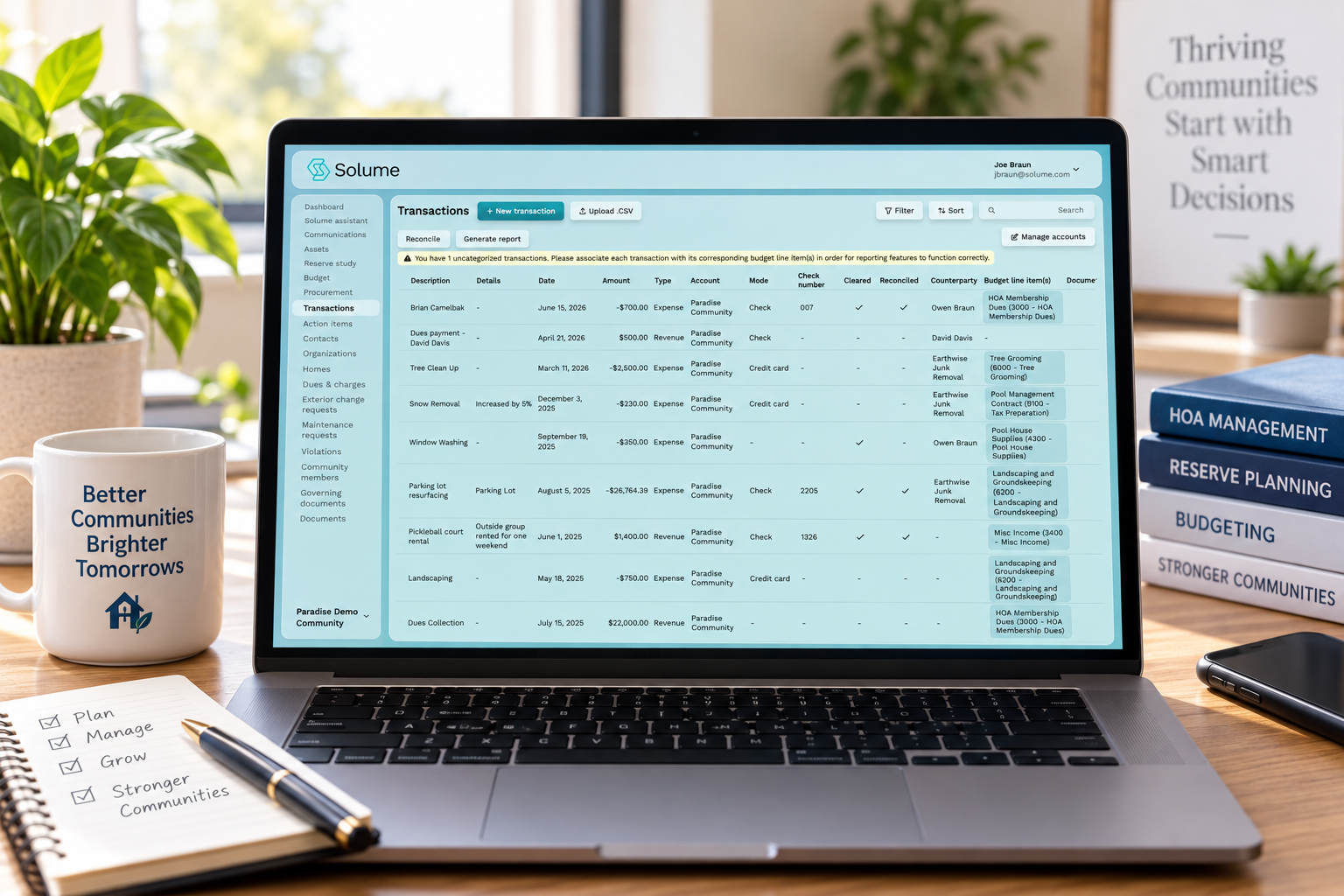
An all-in-one platform handles the routine load: accounting and reporting, automated HOA dues collection with flexible payment options, budgeting, and financial reports owners can actually read. It manages member and home records, ARC requests, vendor management, and maintenance tracking in one place, so nothing lives in a departing volunteer's inbox. The same setup works whether you run a single-family HOA or a condo association with shared structures.
Two features matter most for self-managed communities and are usually absent from software built for property managers. First, integrated reserve study tools that tie long-term reserve planning directly to your budget instead of treating capital planning as an afterthought. Second, an AI assistant available around the clock to help interpret governing documents and flag compliance risks. Solume is software built for self-managed boards rather than management firms, and it offers a free 30-day trial so a board can test the system first. The point isn't to make boards work harder. It's to give them the same operational muscle an HOA management company has, at a fraction of the cost, while keeping full control and financial transparency inside the community.
Running an HOA community without a management company comes down to systems, not luck. If your board wants a clearer way to manage finances, reserve planning, and vendor oversight without paying for a full management company, you can book a 15-minute call to see if Solume fits your community. It's a short, no-pressure conversation to see whether self-management with the right tools makes sense for your situation.
Frequently Asked Questions
What does it actually mean to live in an HOA community?
Living in an HOA community means you automatically agree to a set of binding rules when you buy property, laid out in documents like the CC&Rs (Covenants, Conditions, and Restrictions), bylaws, and articles of incorporation. These rules "run with the land," so they apply to every current and future homeowner regardless of who bought in first.
What does HOA stand for, and how is it structured?
HOA stands for Homeowners Association, a private, legally incorporated organization that governs residential communities such as planned neighborhoods, condos, townhomes, and gated developments. A volunteer board of homeowners typically runs it, enforcing rules and managing shared finances.
How much do HOA fees cost and what do they pay for?
The national median HOA or condo fee was about $135/month as of 2024, though single-family suburban dues often run under $200-$300 and condo or luxury developments can reach $400-$700+ per month. Fees typically cover common-area upkeep, landscaping, amenities like pools, snow removal, and contributions to the reserve fund for future repairs.
What are the real disadvantages of living in an HOA community?
The main downsides are ongoing mandatory dues, restrictions on things like exterior paint, fences, and parking, and the risk of special assessments when the reserve fund is underfunded. Poorly managed boards can also create financial and compliance problems that fall directly on homeowners.
What if the HOA runs out of money for major repairs?
When the reserve fund can't cover a major repair like a roof or plumbing system, the board typically issues a special assessment, charging each homeowner a lump sum on top of regular dues. That is why reviewing an HOA's reserve study and funding percentage matters more than the monthly fee alone.
How is an HOA neighborhood different from a non-HOA one for buyers?
HOA neighborhoods bundle shared maintenance, amenities, and appearance rules into mandatory dues, which can protect resale value but limit what you can do with your own property. Non-HOA neighborhoods give you more freedom and no dues, but leave upkeep, amenities, and neighborhood standards entirely up to individual owners.
What should I check before moving into an HOA community?
Read the CC&Rs, bylaws, and rules to understand restrictions and enforcement, then examine the association's financial health, including current dues, reserve funding, and any planned assessments. Recent board meeting minutes will also reveal ongoing disputes or maintenance issues the community hasn't resolved.