
Picture this: a board skips one roof reserve contribution to keep dues flat for a year, and three years later homeowners get hit with a five-figure special assessment. Trace it back, and the trail almost always leads to sloppy dues collection. Boards running their own communities often treat billing as an afterthought, until a bounced check or spreadsheet error leaves the operating account short. This article walks through what HOA dues actually cover, how dues collection software handles the recurring work, and how to set up a system that keeps a volunteer-run community solvent without burning out the people doing the work.
Key Takeaways
- Dues collection is the recurring process HOAs use to fund both operating expenses and long-term reserve contributions, not just a billing formality.
- Dues and fees serve different accounting purposes: dues are budgeted recurring charges, while fees cover one-time actions like transfers or ARC reviews.
- Automated recurring billing reduces the manual reconciliation burden that volunteer treasurers in self-managed communities often face.
- Inconsistent dues collection directly contributes to reserve funding shortfalls and the special assessments boards try to avoid.
- Failed or late payments need a documented escalation process, since software can flag a missed charge, but a board still has to decide how to resolve disputes and delinquencies.
What are HOA dues, and what do they cover
HOA dues are recurring payments every homeowner agrees to pay as a condition of ownership. Collecting them covers two separate buckets. The first is day-to-day operating costs: landscaping, insurance, utilities for common areas, trash, and administrative expenses. The second, and the one most boards underweight, is the reserve fund, which pays for big-ticket repairs down the road, like repaving a parking lot or replacing a roof.
Most governing documents set the base assessment amount, and the board adjusts it each year through the budget. In a condo association, monthly dues often run higher because the association maintains more of the physical structure. Many associations now rely on Solume's dues collection tools to collect membership dues online and keep that larger volume manageable.
Here's the hard truth: association dues are not a fee you can skip in a lean year. State law and governing documents typically tie the reserve portion to the property's long-term health, and the Community Associations Institute's Reserve Funds best practices overview explains how to budget and disclose these funds. Underfunding dues today just shifts the bill to a future special assessment. Requirements vary by state, so confirm your obligations in your governing documents and with legal counsel.
Why reliable dues collection matters for community stability
Predictable revenue is the entire point. When dues collection is reliable, a board can pay vendors on time, keep reserves on schedule, and plan capital projects years in advance. When it isn't, every decision gets reactive.
This matters because of timing. HOA expenses don't pause when a homeowner falls behind. Insurance premiums come due, the landscaper still invoices, and the reserve study still expects its scheduled contribution. A gap in collections doesn't shrink the bills. It forces the board to drain cash reserves or defer maintenance, and deferred maintenance turns small problems into structural ones. Persistent delinquency can also follow a homeowner beyond the HOA ledger; the Consumer Financial Protection Bureau's guidance on how delinquent HOA dues can affect credit reporting outlines when an association can escalate unpaid balances to a credit reporting company.
The 2021 Surfside condo collapse in Florida, which killed 98 people, is the extreme example of what deferred funding can lead to. The investigation prompted stricter reserve laws in some states, and the National Institute of Standards and Technology's Surfside investigation findings document how delayed repairs and funding gaps compound. Consistent dues collection is the first line of defense for community stability and financial responsibility.
Dues vs. fees vs. special assessments explained
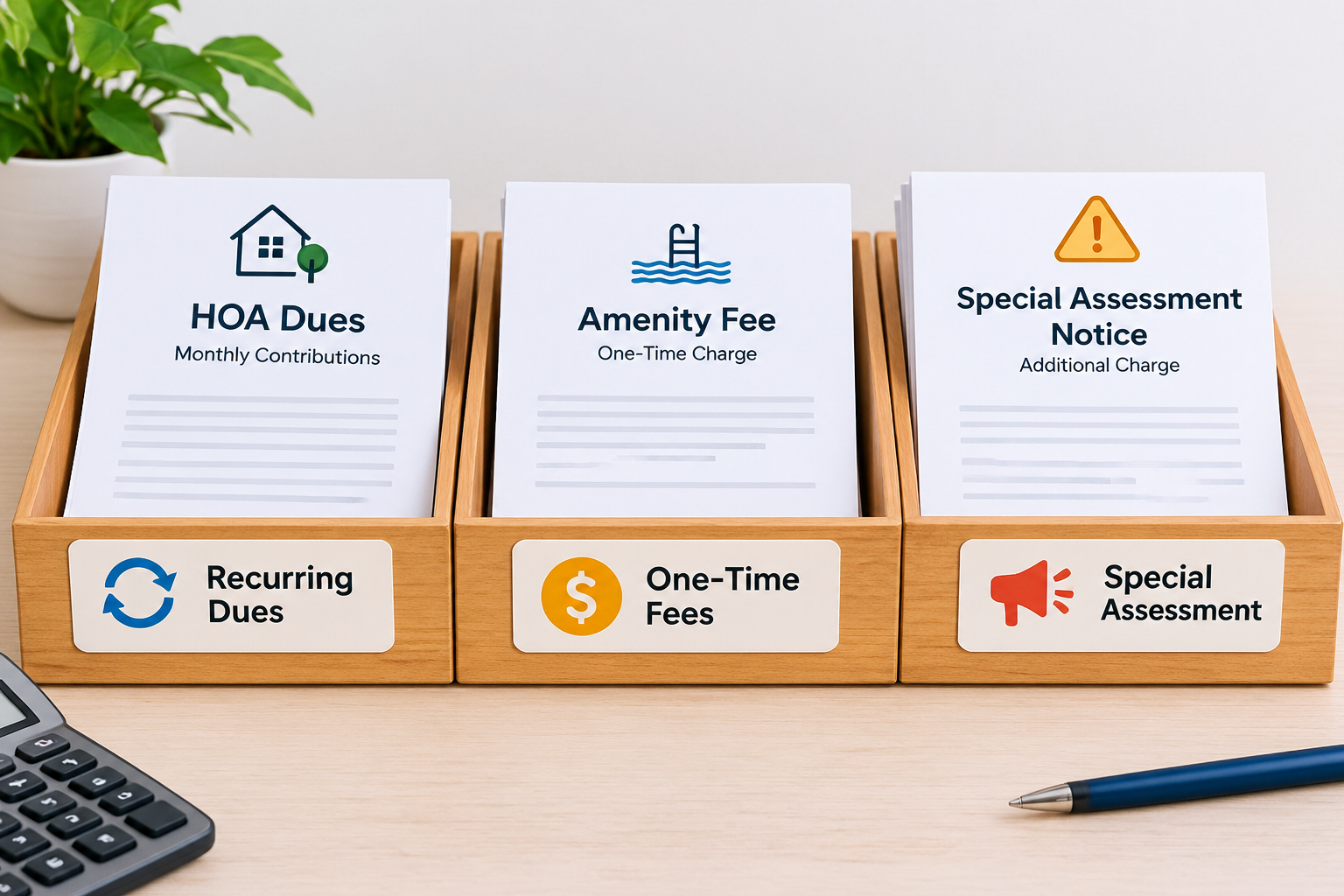
Boards constantly blur these three, and it causes disputes. Here's the clean separation.
Dues are the budgeted, recurring assessments every owner pays on a set schedule. They're planned, predictable, and cover the normal operating and reserve budget. Think of membership dues as the baseline every homeowner knows about in advance.
Fees are one-time charges tied to a specific action. A transfer fee when a home sells, a late payment penalty, or an architectural review (ARC) application fee all fall here. They apply only to the owner who triggered them, not the whole community.
Special assessments are the one nobody wants: an extra charge levied when the reserve fund can't cover a necessary expense, like a sudden roof failure or a code-mandated repair. Many assume special assessments are unavoidable emergencies. In reality, most are the predictable result of years of underfunded reserves. Keeping these three categories separate in your accounting isn't bookkeeping fussiness. It's what makes your financial statements defensible during an audit or disclosure, and it's one of the fundamentals covered in most guides to HOA bookkeeping best practices.
Payment frequency models: monthly, quarterly, and annual dues
How often you collect changes the math for everyone involved. The three common models each have tradeoffs.
Monthly dues are the default for larger communities and most condo associations. Smaller, predictable amounts are easier for homeowners to budget, and the association gets steady cash flow for recurring bills. The downside is more transactions to process, which matters if your platform charges transaction fees per payment.
Quarterly billing cuts the number of payments to four a year. It's a middle ground: lighter on processing, but requiring homeowners to set aside larger sums.
Annual dues work for small, low-expense communities with minimal shared infrastructure. One payment, one reconciliation. The risk is obvious: if an owner can't cover the lump sum, the association waits a full year to recover, and delinquent dues get harder to chase.
Some associations use membership tiers tied to amenity access, which can shift how frequently different owners are billed. Whatever cadence you pick, match it to your actual cash flow needs, not just what's easiest to invoice.
How dues collection software works
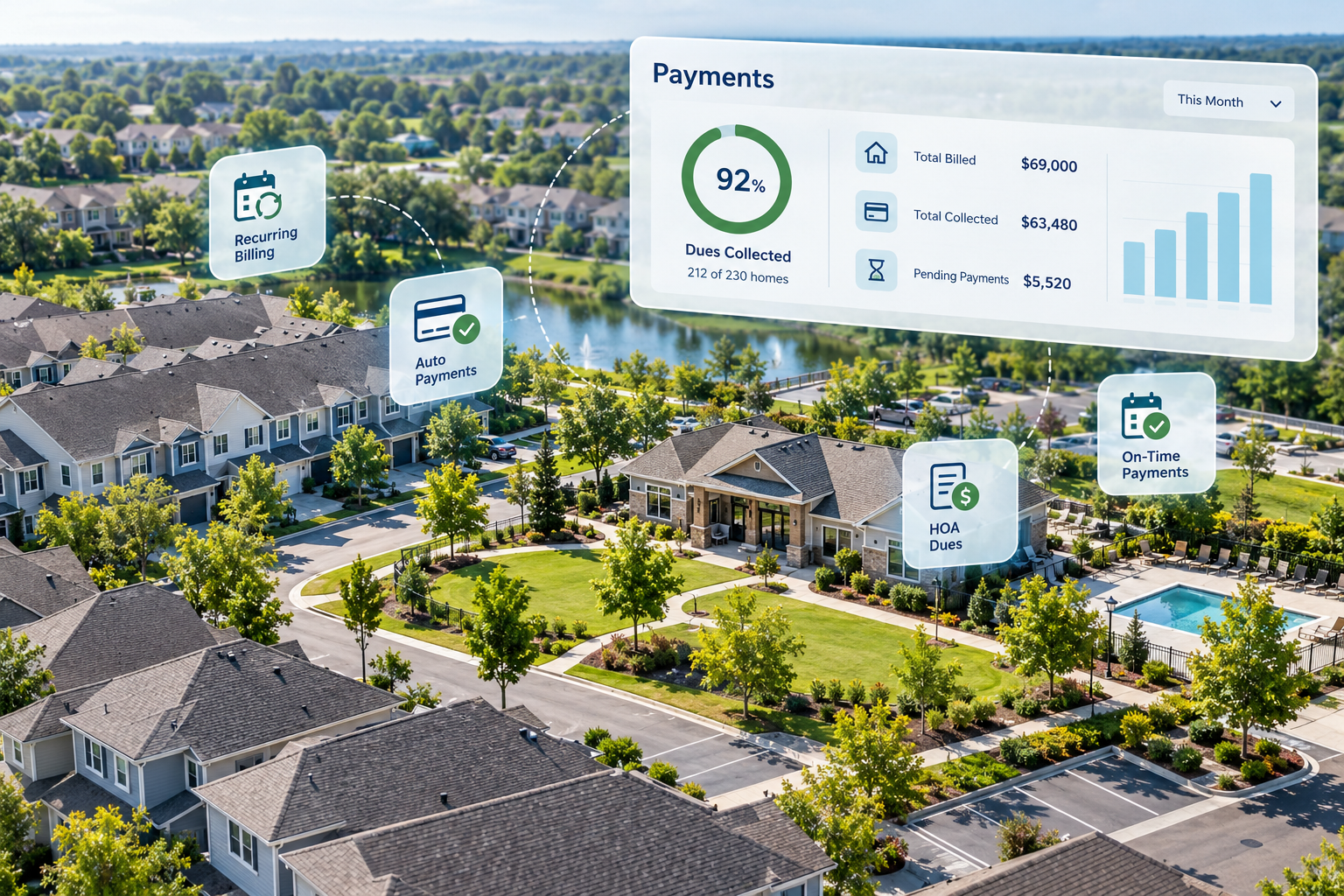
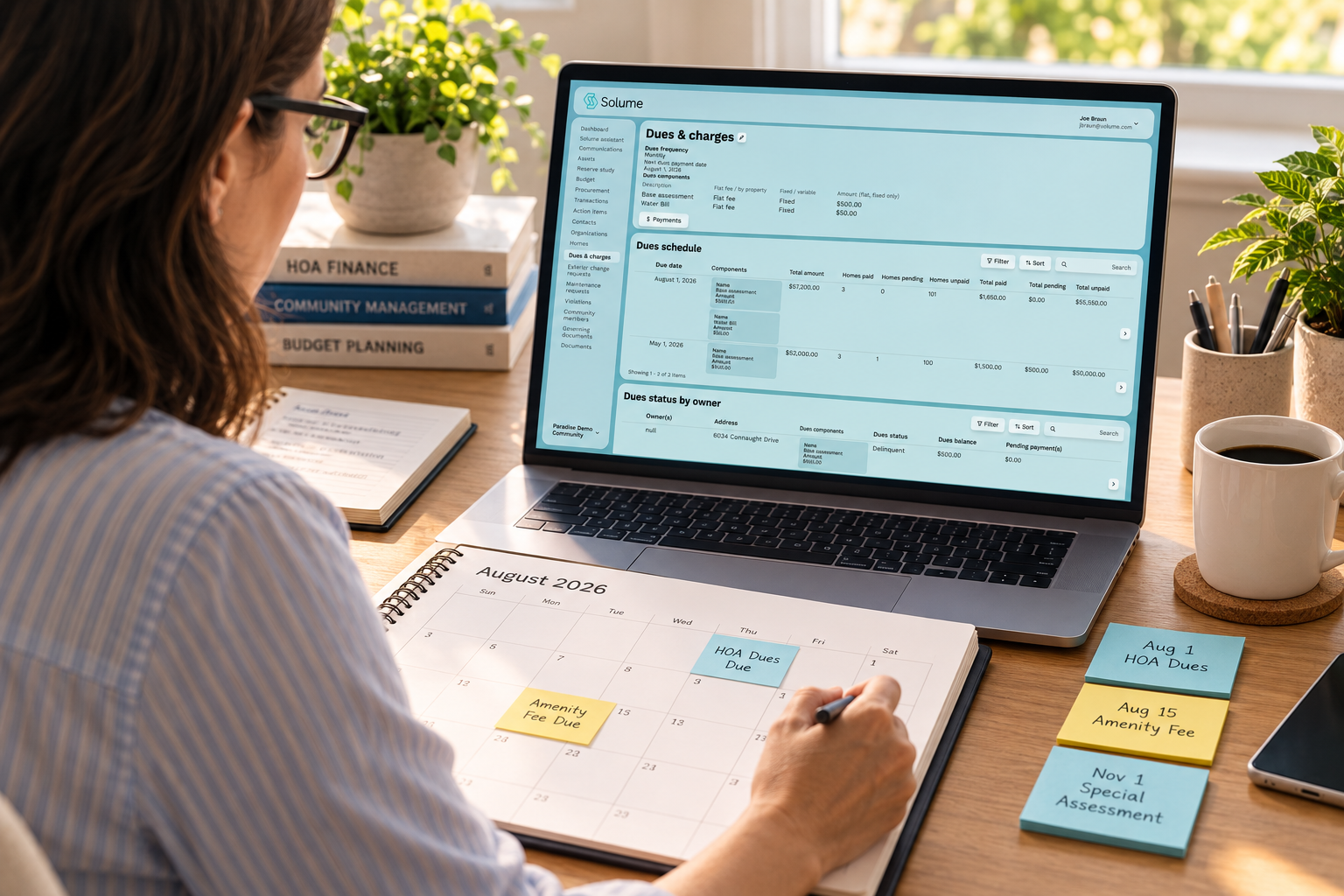
At its core, dues collection software connects each homeowner's account to a payment system and a ledger. You set the assessment amount and schedule once, and the platform generates recurring charges automatically on the dates you specify.
Here's what happens behind the scenes: when a charge is due, the system bills the homeowner's stored payment method, records the transaction against their account, and updates the balance in real time. This is where you collect membership dues online without anyone cutting a check or mailing an invoice. Homeowners get several online payment options, usually ACH bank transfer or card, and can opt into recurring payments so they never have to remember a due date.
The reconciliation side is the real time-saver. Every payment ties directly to the right account, so there's no manual matching of deposits to spreadsheet rows. Solume automates the entire dues-collection workflow for self-managed boards, handling the accounting and reporting that would otherwise fall to a volunteer treasurer as part of its broader financial management platform. The system also flags failed transactions immediately instead of letting a gap sit unnoticed until month-end.
Setting up a clear collection schedule and communication plan
A collection schedule is worthless if homeowners don't know what to expect. The two have to be built together.
Start with the schedule: define the exact due dates, the grace period, and when late fees apply. Put it in writing and tie it to your fiscal year so it lines up with budgeting. A clear collection schedule removes the "I didn't know it was due" excuse that drives most late payments.
Then build the communication plan around it. Homeowners should get notice well before a charge hits, a reminder as the date approaches, and a clear follow-up if a payment fails. Automated reminders handle this far more consistently than a volunteer sending emails when they remember. Most boards assume a single annual notice is enough, and then wonder why delinquencies pile up.
Transparency runs through both. When homeowners can see their balance, understand the collection schedule, and get consistent automated reminders, financial transparency improves, and homeowner trust follows. A documented communication plan also protects the board if a dispute ever escalates.
How to choose dues collection software for a self-managed HOA
Not all platforms are built for the same user. Most HOA software is designed for professional property managers juggling dozens of properties. A self-managed HOA run by volunteers needs something different.
Start with these questions. Does it support online payments and recurring payments, with the payment options your homeowners actually use? What transaction fees apply, and who absorbs them, the association or the homeowner? Can a non-accountant run the reports your state requires? Is it a user-friendly solution a retiree treasurer can learn in an afternoon, or does it assume a bookkeeping background?
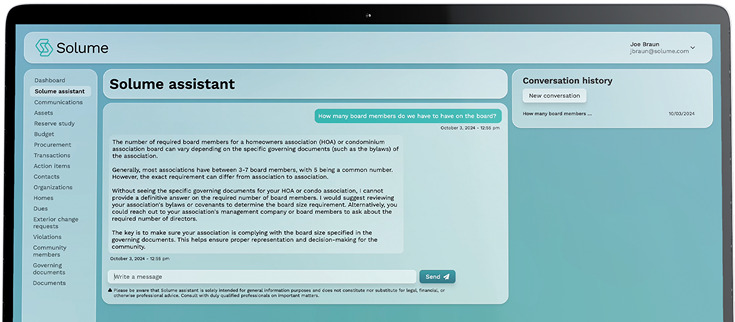
Then look past billing. The best fit for a self-managed HOA ties dues collection to the rest of the operation: accounting and reporting, reserve tracking, and resident communication in one place. For a deeper comparison of what to look for, review a guide to the best HOA management software for self-managed boards before you commit. Solume was built specifically for self-managed and volunteer-run boards, which is why its dues collection sits alongside reserve study tools rather than as a standalone billing add-on.
HOA laws vary by state, so confirm any platform you consider supports the disclosures and compliance requirements where your community sits. When in doubt, have your attorney review the fit.
Handling late or delinquent dues and debt collection basics
Even with automation, some accounts go delinquent. The board's job is to respond consistently, not emotionally.
Build a written escalation ladder. Step one is an automated reminder when a payment fails. Step two is a late fee applied per your governing documents after the grace period. Step three, for accounts that remain unpaid, may involve a formal demand letter, a payment plan, or, eventually, a lien, depending on your state's HOA collection statute and the dollar threshold involved.
Consistency matters because of legal exposure. Applying late fees to one owner but waiving them for a neighbor undermines the board's fiduciary duty and invites a selective-enforcement claim. Software that logs every notice and charge gives you the paper trail to prove you treated everyone the same.
For persistently delinquent dues, some boards hand the account to a debt collection agency or an HOA attorney. That's a last resort, and the rules around it, including required notices, differ sharply by state. Check your state's property or HOA statute before escalating, and consult your attorney rather than improvising collection practices that could expose the association to liability.
Reducing volunteer board burnout through automation
Board burnout is real, and billing is one of its biggest sources. Chasing checks, updating spreadsheets, and sending reminder emails are thankless, repetitive tasks that make volunteers quit mid-term.
Consider a 60-unit self-managed community where the treasurer spends six hours a month reconciling payments by hand and emailing late notices. That's 72 hours a year on work a system could do automatically. When that treasurer steps down, the knowledge often walks out the door with them, and the next volunteer starts from scratch.
Automation changes the equation. When recurring payments, automated reminders, and reconciliation run on their own, the treasurer reviews exceptions instead of processing every transaction. The role shifts from data entry to oversight, which is both less draining and easier to hand off. Volunteer board members stay in their roles longer when this mechanical load isn't crushing them, and that continuity is itself a form of community stability. Reducing that administrative load is one of the clearest returns a self-managed HOA gets from good software.

Linking dues collection to reserve planning and long-term funding
This is where everything connects. Dues collection isn't just about covering this month's bills. It's the mechanism that funds your reserves and your long-term planning.
A reserve study tells you what major components will fail and when, and how much you need to set aside each year to cover them. That required contribution gets built into the dues. If collection is unreliable, the reserve falls behind quietly, and the shortfall only surfaces when a roof or boiler actually fails. At that point, the board faces a special assessment, exactly what reserve planning is meant to prevent. Associations organized as corporations should also keep their tax filings current on this schedule; many file IRS Form 1120-H for homeowners associations each year, and consistent dues records make that filing far easier to complete accurately.
The root cause of most special assessments is a reserve that was underfunded for years, not a single catastrophic surprise. Reliable, automated dues collection keeps reserve contributions flowing on schedule, making predictable, surprise-free funding possible. Tying your HOA dues directly to your reserve plan turns long-term planning from a spreadsheet exercise into something your community actually funds every month.
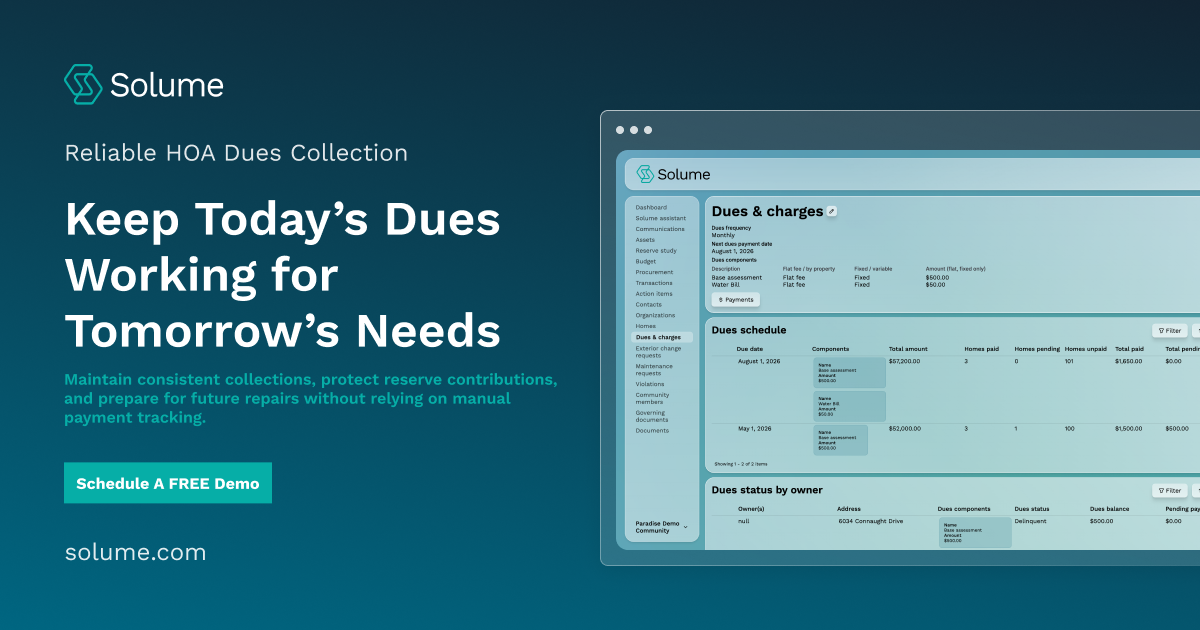
If your board wants a clearer way to connect dues collection with reserve planning and financial transparency, you can schedule a 15-minute call to see if Solume fits your community and walk through how automated billing and reserve tools work together.
Frequently Asked Questions
What exactly does it mean to be a 'dues paid' member in an HOA?
A dues-paid member is a homeowner whose recurring assessment payments are current, which keeps their voting rights, amenity access, and account standing intact. Falling behind doesn't remove membership in most HOAs, but it can trigger late fees, lien filings, or loss of privileges like pool or clubhouse access.
Is there a real difference between HOA dues and HOA fees?
Dues are the recurring, budgeted payments (monthly or annual) that fund shared operating and reserve expenses, while fees are typically one-time charges for specific services like a transfer fee, late payment penalty, or ARC application review. Mixing the two in board communications often confuses homeowners and leads to disputed charges.
How are dues treated in HOA accounting records?
In HOA accounting, dues are recorded as recurring revenue under operating and reserve fund categories, distinct from special assessments or one-time fee income. Properly separating these line items matters for audits, reserve study compliance, and state-mandated financial disclosures in places like California and Florida.
Is switching to automated dues collection actually worth it for a small, self-managed HOA?
For most small associations, yes, automated recurring billing reduces missed payments and removes the burden of a volunteer treasurer manually chasing checks every month. The tradeoff is an initial setup cost and the need to handle occasional payment failures (expired cards, insufficient funds), which software can flag automatically instead of relying on someone noticing a gap in the ledger.
What happens if a homeowner's automatic dues payment fails or they dispute a charge?
Most dues collection platforms flag failed transactions immediately and trigger a reminder or retry before late fees apply, rather than letting the shortfall sit undiscovered until the next manual reconciliation. Boards still need a documented process for disputes and delinquencies, since software can surface the problem but can't resolve a homeowner's objection on its own.
What's the practical difference between manual and automated dues collection?
Manual collection relies on someone drafting invoices, tracking payments in spreadsheets, and personally following up on late accounts, while automated collection triggers recurring charges, reminders, and reconciliation without staff intervention. The manual approach is prone to human error and delayed follow-up, which is often where self-managed boards lose track of delinquencies.
Do small HOAs really need dedicated dues collection software, or can spreadsheets work?
Spreadsheets can work for a handful of units, but as a community grows past a few dozen homes, manual tracking makes it hard to catch missed payments, apply late fees consistently, or produce the financial reports many states now require. Dedicated software closes that gap by tying payment status directly to each homeowner's account in real time.
Why does consistent dues collection matter beyond just paying the bills?
Reliable dues collection funds reserve contributions for future roof replacements, repaving, and other capital projects identified in a reserve study. Communities that let collection slip often end up underfunded, which increases the odds of an unplanned special assessment.