A homeowner in Aurora challenged a $750 fine over an unapproved fence color, and the board had to refund it plus cover attorney costs. The problem wasn't the fence. The board had no written enforcement policy and didn't know Colorado HOA laws cap most fines at $500. These are the kinds of expensive, avoidable mistakes that trip up volunteer boards every month, and they echo common self-managed HOA challenges that keep surfacing across the state. HOA rules vary by state, so this guide focuses on Colorado specifically: what the state requires, where boards most often slip, and a practical checklist you can run against your own association.
Key Takeaways
- Colorado HOA laws are governed primarily by CCIOA (C.R.S. Title 38, Article 33.3), which applies almost entirely to communities formed after July 1, 1992.
- Non-safety-related HOA fines in Colorado cannot exceed $500 per violation under C.R.S. 38-33.3-209.5.
- Associations must adopt a written covenant enforcement policy that guarantees homeowners notice and a hearing before an impartial decision-maker.
- Pre-1992 Colorado communities may still operate under the older Condominium Ownership Act for certain governance provisions instead of full CCIOA coverage.
- The 35-acre rule is a land-subdivision statute, not an HOA regulation, though it often appears in the same search queries as Colorado HOA laws.

What Colorado HOA laws are and why they matter
Colorado HOA laws set the ground rules for how a homeowners association can govern, collect money, and enforce its covenants. They exist because an HOA holds real power over your property. It can fine you, place a lien, and in extreme cases pursue foreclosure. Without state limits, that power would run unchecked.
This matters because of money and due process. A board that enforces rules without following the statute can lose in court and stick the whole community with legal bills. Many homeowners assume a homeowners association can do whatever its board decides. In reality, state law overrides any covenant that conflicts with it. Keep in mind these rules are Colorado-specific; a neighboring state's HOA statutes can read very differently.
The Colorado General Assembly maintains the full text of these statutes, and the state's Division of Real Estate HOA Center publishes plain-language guidance for both boards and owners. Reading both separates what your HOA can legally do from what it merely wants to do.
The Colorado Common Interest Ownership Act (CCIOA) explained
The Colorado Common Interest Ownership Act, usually shortened to CCIOA, is the backbone of HOA regulation in the state. It covers assessments, voting requirements, open meeting requirements, records inspection, and homeowner rights. If your community was formed on or after July 1, 1992, CCIOA almost certainly governs it in full.
Here's the hard truth most boards miss: CCIOA applies to your association even if your governing documents say nothing about it. The statute controls, and your declarations and bylaws fill in the gaps underneath it. Pre-1992 communities get partial treatment. They may still operate under the older Condominium Ownership Act for some governance provisions, though newer CCIOA sections on things like fine caps still reach them.
You can read the act directly through the Colorado Revised Statutes on the General Assembly's website, which hosts Title 38, Article 33.3. Boards should check CCIOA first before any major decision, and staying current also means watching recent Colorado HOA legislation (HB23-1105), which has already reshaped how some associations handle enforcement and disclosure.
How governing documents (declarations, bylaws, CC&Rs) fit into the legal hierarchy
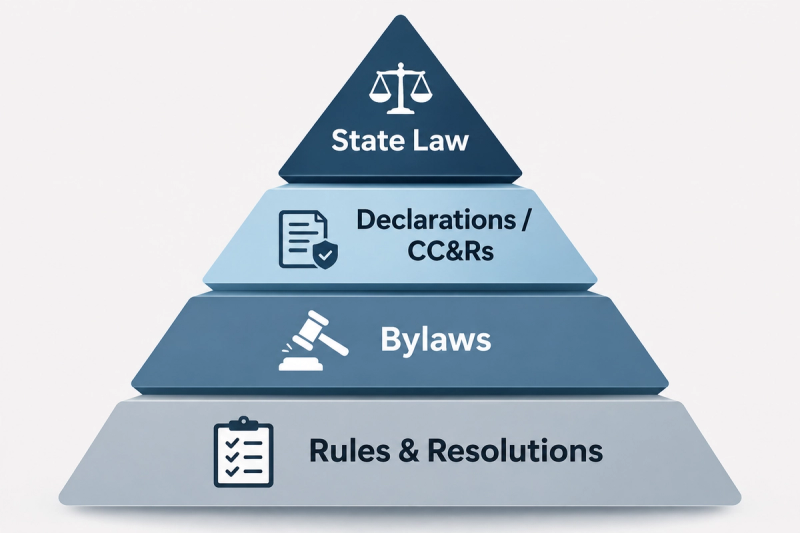
Think of your association's rules as a stack, with the strongest authority at the top. State and federal law sit above everything. Below that come your declarations, often called CC&Rs, which define property rights, assessment obligations, and use restrictions. Then your bylaws govern how the HOA board operates: elections, meetings, officer roles, and quorum rules. At the bottom sit board-adopted rules and resolutions.
The order matters because a lower document can never override a higher one. If your bylaws contradict CCIOA, the statute wins. If a board resolution contradicts your declarations, the declarations win.
Most boards assume their governing documents are the final word. They aren't. The CC&Rs bind only to the extent they don't conflict with Colorado HOA laws. When a dispute reaches a courtroom, judges read the hierarchy top down, and homeowner rights built into statute cannot be contracted away by a covenant.
Board member roles, fiduciary duty, and responsibilities under Colorado law
Every HOA board member in Colorado owes the association a fiduciary duty: acting in good faith, in the community's best interest, with the care an ordinarily prudent person would use. This is not a loose expectation. It is a legal standard that can expose individual directors to liability if ignored.
Board responsibilities under CCIOA include setting an annual budget, maintaining reserve funding, enforcing covenants fairly, keeping accurate records, and running meetings that meet open meeting requirements. These duties sit at the core of what boards are legally accountable for. The treasurer carries extra weight because financial transparency is where homeowner trust is won or lost, which is also why fraud prevention practices for HOA boards deserve a permanent spot on every board's agenda.
What actually happens when a board skips reserve planning is predictable: deferred maintenance piles up, and the community gets hit with surprise special assessments years later. Picture a mid-size community that defers roof work for a decade to keep dues flat; when the roofs finally fail, the board has no choice but to levy a $12,000-per-home special assessment that homeowners never saw coming. Boards that want a clearer picture of their obligations should also review Colorado's reserve study requirements, since funding shortfalls rarely show up until it's too late to fix cheaply. The 2021 Surfside condo collapse in Florida, which killed 98 people, remains the clearest warning about what underfunded reserves and deferred structural work can produce. Colorado directors carry that same fiduciary duty to plan for long-term capital costs, not just this year's bills.
Recent and upcoming Colorado HOA law changes (HB and SB updates)
Colorado HOA law changes have come fast in recent years, and boards that stopped reading statutes in 2020 are already out of date. Recent legislative sessions tightened the rules around covenant enforcement, fining procedures, and collections. One major shift limited how aggressively associations can pursue foreclosure for unpaid dues, adding required payment-plan offers and longer notice periods before an HOA can act.
Other Colorado HOA law changes expanded homeowner protections around flags, political signs, and installing solar and xeriscaping improvements. Boards can no longer flatly ban water-wise landscaping, which matters in a drought-prone state. Groups tracking industry advocacy on Colorado HOA regulations often flag these shifts well before they take effect, giving boards a head start on updating policy.
The risk most boards overlook is assuming last year's compliance checklist still holds. It often doesn't. The Colorado legislature revisits common-interest community rules nearly every session, so boards should review new bills annually and update their policies before enforcement season begins. Check the General Assembly's bill tracker each spring.
The Colorado HOA Information and Resource Center and registration requirements
Colorado runs an HOA Information and Resource Center inside the Division of Real Estate. It fields homeowner complaints, publishes guidance, and tracks trends across the state's thousands of associations. It does not resolve individual disputes or provide legal advice, but it is the first stop when an owner wants to understand their rights.
HOA registration is mandatory. Every common interest community must register annually with the state and keep its contact and management information up to date. Skipping registration carries consequences: an unregistered association can lose the ability to impose or enforce fines and collect certain charges until it comes back into compliance.
Many communities don't realize that registration also feeds the HOA Information and Resource Center's data, which the state uses to shape future legislation. Keeping your filing accurate protects your enforcement authority, supports HOA transparency, and keeps your board on the right side of Colorado HOA board compliance.

Covenant enforcement limits and homeowner rights (flags, xeriscaping, EVs, solar)
Covenant enforcement in Colorado is limited by statute, and those limits are stricter than most boards realize. Before imposing any HOA fines, the association must give written notice and offer a hearing before an impartial decision-maker. Non-safety fines are capped at $500 per violation under C.R.S. 38-33.3-209.5. A board that fines first and explains later risks violating the statute. The statute front-loads notice and a hearing for a simple reason: a fine is a property charge that can escalate to a lien, so the law requires due process before money is ever on the line.
State law also carves out protected homeowner rights your covenants cannot override:
- Flags: Associations cannot prohibit the U.S. flag or service flags displayed consistent with federal flag etiquette.
- Solar and xeriscaping rules: Boards cannot ban solar energy devices or require that homeowners keep thirsty turf lawns. Reasonable aesthetic guidelines are allowed, but outright bans are not.
- Electric vehicles: Homeowners generally have the right to install EV charging stations, subject to reasonable board conditions.
Many boards assume a covenant on the books is automatically enforceable. In reality, if it conflicts with these statutory protections, it is void.
A step-by-step Colorado HOA compliance checklist for boards
Use this compliance checklist as a yearly audit. Run through it at your first board meeting each year and assign an owner to each item.
1. Confirm CCIOA status. Verify whether your community falls fully under CCIOA (post-1992) or partially under the older act.
2. Review governing documents. Read your declarations, bylaws, and CC&Rs against current statute for conflicts.
3. Adopt a written enforcement policy. Spell out notice requirements, the hearing process, and the $500 fine cap.
4. Complete annual HOA registration. Keep contact and management details current with the state.
5. Fund reserves and set the annual budget. Base it on a current reserve study, not guesswork.
6. Disclose financials. Provide owners the required annual documents to maintain HOA transparency.
7. Honor records inspection requests. Respond within statutory timelines.
8. Meet open meeting and voting requirements. Document quorum, notice, and votes.
This compliance checklist won't cover every edge case, but it catches the issues that most often cost boards money. Rules vary by community, so confirm specifics against your own governing documents and consult a qualified attorney for guidance specific to your situation.

How self-managed boards can stay compliant without a management company?
A self-managed HOA faces the same legal standard as a professionally managed one. The statute does not lower the bar because your board is made up of volunteer board members with day jobs. That's the uncomfortable part. A missed notice deadline or a skipped hearing exposes your community whether or not you pay a management company.
The good news: a self-managed HOA can meet Colorado HOA board compliance without outsourcing. The key is organized records and automated deadline tracking. Legal compliance most often fails not from bad intent, but because a volunteer treasurer forgets a disclosure date or loses track of a fine's notice window.
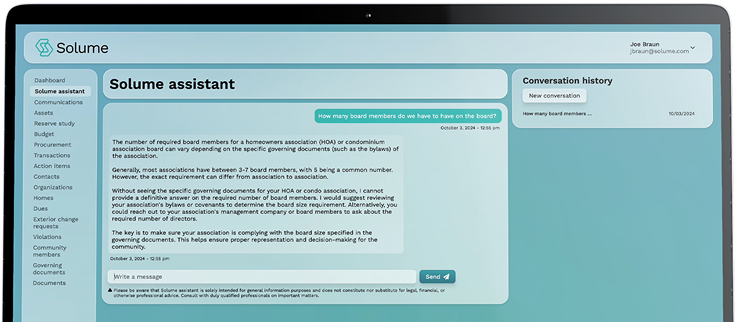
That specific failure point, a missed deadline buried in a volunteer's inbox, is where software built for self-managed boards earns its place. Solume centralizes member records, automates dues collection, and keeps financial reporting and reserve study data in one place, so a volunteer board can produce the disclosures and audit trail the law expects. HOA software built for Colorado communities can be especially useful here, since it's built around the state's specific notice periods and disclosure rules rather than generic compliance templates. That record-keeping protects a board if an enforcement action is ever challenged.

Colorado HOA laws reward boards that stay organized and punish the ones that improvise, and that gap only widens as the statutes change. If your board wants a clearer way to handle reserve planning, dues collection, and the record-keeping that Colorado compliance demands, you can book a 15-minute call to see if Solume fits your community. No pressure, just a straight answer on whether it solves the problems your board is actually facing.
Frequently Asked Questions
Are HOAs actually regulated in Colorado, or can they make up their own rules?
Colorado HOAs are regulated under the Colorado Common Interest Ownership Act (CCIOA, C.R.S. Title 38, Article 33.3), which sets rules for governance, assessments, and homeowner rights. HOAs formed after July 1, 1992 must follow nearly all of CCIOA, while older communities may still operate under the earlier Condominium Ownership Act for certain provisions.
What can I actually do if I think my HOA is being unfair?
Start by requesting the HOA's written covenant enforcement policy, which state law requires and which must spell out notice requirements and a hearing process before an impartial decision-maker. You can also file a complaint with the Colorado Division of Real Estate's HOA Information Office, which tracks association compliance.
Can my HOA fine me for anything, or are there limits?
For violations that don't threaten health or safety, Colorado law caps fines at $500 under C.R.S. 38-33.3-209.5. HOAs also can't impose fines without first giving written notice and a chance to be heard, so a board that skips that process violates the statute, not just being difficult.
Does the 35-acre rule have anything to do with HOAs?
No, the 35-acre rule is a Colorado land-use statute allowing property to be divided into parcels of 35 acres or more without triggering county subdivision review, unrelated to CCIOA or HOA governance. It occasionally surfaces in HOA conversations when rural properties or large planned communities are being subdivided or annexed.
Is it even worth pushing back on my HOA instead of just paying the fine?
If the board skipped the required notice-and-hearing process or exceeded the $500 cap on non-safety fines, you have a legitimate statutory basis to contest it. That said, CCIOA doesn't protect against fines tied to legitimate, properly enforced covenant violations, so the outcome depends on whether the board actually followed its own policy.
Do Colorado's landlord-tenant law changes affect HOA rules too?
Colorado's landlord-tenant law updates govern lease terms, security deposits, and eviction procedures between landlords and tenants; they operate separately from CCIOA and don't override HOA covenants. Landlords renting out units in an HOA community still must comply with both sets of rules independently.
Why does my HOA keep asking for financial disclosures? Is that normal?
Yes, Colorado law requires HOAs to annually disclose operational and financial information, including budgets, reserve funding status, and any pending special assessments, under CCIOA's transparency requirements. Sellers must also disclose common interest community obligations to buyers under C.R.S. 38-35.7-102 before closing.
Is switching to HOA software actually going to help with Colorado compliance, or is that overkill for a small board?
For boards without legal or accounting staff, most compliance failures happen when they track CCIOA's notice periods, fine caps, and disclosure deadlines manually. Software that flags these deadlines and keeps records organized reduces the risk of a homeowner successfully challenging enforcement actions in court.