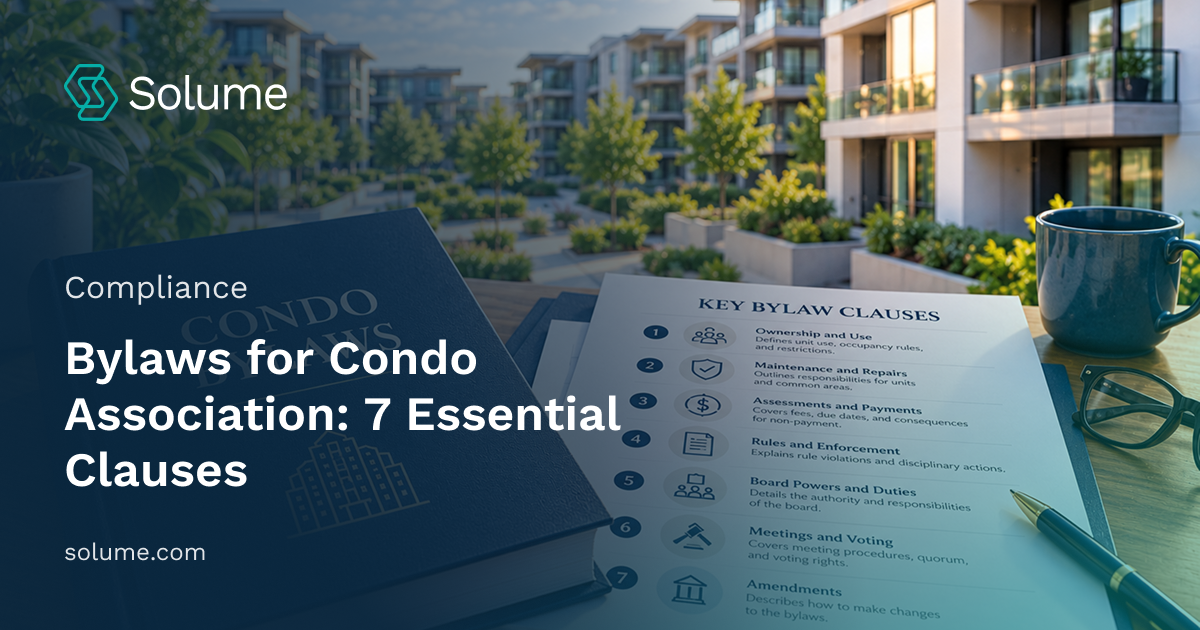
A condo board in a four-story building votes to waive its reserve funding to keep monthly dues low. Three years later, the façade needs $2 million in repairs, and owners get hit with a special assessment averaging $40,000 per unit. A condo association's bylaws are supposed to prevent exactly this kind of blind spot. Yet most boards treat them as filing-cabinet paperwork until a crisis forces a reading. This article walks through the seven clauses that shape how your community runs, how they generally interact with state law, and what boards miss when they ignore them. This article is for general informational purposes only and isn't legal advice; consult a licensed attorney in your state for guidance specific to your association.
Key Takeaways
- Bylaws for a condo association set the internal operating rules: board elections, meeting quorum, officer duties, while the declaration controls property rights and is far harder to amend.
- Amending condo bylaws usually requires a specific vote threshold defined in the bylaws themselves, with state statutes stepping in only when the bylaws are silent.
- Florida's SB 4-D and structural integrity reserve study requirements now override any bylaw language that tries to waive mandatory reserve funding for buildings three stories or taller.
- A board that skips required meeting notices, votes without a quorum, or withholds financial records typically violates obligations already written into its own bylaws.
- Condo bylaws and HOA bylaws serve the same governance purpose but differ because condo owners share common-area interests while HOA members own their land outright.
What are condo association bylaws (definition and purpose)
Condo bylaws are the rulebook for how condo associations operate day to day. They answer the mechanical questions. How many people sit on the board? How are they elected? When must the association hold meetings, and how many owners constitute a quorum? What powers do the officers have? The declaration creates the condo's legal existence and defines ownership. By contrast, the bylaws for a condo association govern the operation of the property.
Most boards never read their own bylaws until a dispute forces them to. That's a mistake, because nearly every authority a board exercises traces back to a specific clause in this document. This is the mechanism people miss: a board can act only where the bylaws grant it power, so any authority not written down is an authority the board doesn't actually have. The Community Associations Institute, the leading trade body for community governance, publishes best-practice governance guidance that boards can use alongside their own documents, and its legislative resources track how changes in state law can reshape what bylaws can say. Bylaws exist to keep volunteer-run communities predictable, fair, and legally defensible.
Bylaws vs. CC&Rs vs. rules and regulations vs. declaration (governing document hierarchy)
People use these terms interchangeably, and that confusion causes real problems. Think of the governing documents as a stack, with each layer controlling the one below it.
- Declaration (or CC&Rs): The recorded document that creates the condo and defines ownership, common elements, and use restrictions. Hardest to amend.
- Bylaws: Internal operating rules covering board structure, association meetings, voting rights, and officer duties. Sits below the declaration.
- Rules and regulations: Day-to-day policies the board adopts (pool hours, pet limits, parking). Easiest to change and must never contradict the layers above.
If a rule conflicts with the bylaws, or the bylaws conflict with the declaration, the higher document wins. The reason is simple: lower-tier documents derive their authority from the higher ones, so a rule can never grant the board power the bylaws or declaration withheld. A board that passes a rule contradicting the CC&Rs has passed an unenforceable rule. The Consumer Financial Protection Bureau offers a plain-language overview of what buyers should know about condo and HOA documents that reinforces this hierarchy. Many boards assume rules carry the same weight as bylaws. In reality, they don't, and the gap appears the moment an owner challenges a fine before a judge who reads the documents in order.
Clause 1: Board of Managers/Directors, composition, powers, and election
The board of directors (called the board of managers in some states) is the engine of the condominium association. This clause defines how many seats there are, how long terms last, who qualifies to serve, and how elections work. It also lists the board's powers: adopting budgets, hiring vendors, enforcing rules, and setting common charges.
Here's what actually happens when this clause is vague: contested elections, deadlocked votes, and board members who overstay their terms because no one scheduled an election. Spell out the number of directors, term length, staggered terms if you want continuity, and the nomination process in plain language.
Every board member takes on a fiduciary duty to the association, meaning they must act in the community's financial interest, not their own. That duty doesn't disappear because the role is unpaid. For self-managed communities run by volunteer board members, a clear composition clause is the difference between smooth transitions and governance chaos.

Clause 2: Officers, roles, duties, and appointment
Officers carry out the board's decisions. The standard lineup is president, vice president, secretary, and treasurer. This clause should spell out how officers are appointed (usually elected by the board after the board itself is elected), their terms, and the specific duties attached to each role.
The treasurer position deserves special attention. This officer upholds financial transparency, keeps the books, and signs off on reporting, tying the role directly to the board's fiduciary duty. The secretary handles meeting minutes and notice requirements. That matters more than most boards realize, because sloppy recordkeeping is one of the first things challenged in a dispute.
Most boards assume officer duties are obvious. They aren't. Write them down. Picture a small self-managed association where the treasurer resigns mid-year and leaves behind an unlabeled spreadsheet and a shoebox of receipts: the incoming volunteer spends months reconstructing the books, late payments pile up, and two vendors threaten to walk. A tight officers clause, paired with documented handoffs, keeps the association functional even when volunteers turn over.
Clause 3: Meetings, quorum, voting, and notice requirements
This clause is where boards get into legal trouble fastest. It defines how often the association meets, how much written notice owners must receive, what counts as a quorum, and how voting rights are allocated.
Quorum is the minimum number of unit owners or board members required for a vote to be valid. Without it, the decision can be voided. Notice and quorum rules carry such weight because they protect absent owners' right to participate, so a court may treat a violation as a denial of that right, not a technicality. If your bylaws require 14 days' written notice for an annual meeting and the board sends it in 10, any action taken is vulnerable to challenge.
Voting rights in condos are usually tied to each unit's percentage interest in the common elements, not one-vote-per-person. This clause should state how votes are weighted, whether proxies are allowed, and how electronic voting works if your state permits it. A board that skips notice and votes on a $300,000 roofing contract without quorum risks a single objecting owner unwinding the decision entirely.
Clause 4: Unit owner rights and obligations
Bylaws aren't just a leash for owners; they also protect them. This clause lays out what unit owners are entitled to and what they owe. Rights typically include access to financial records, the ability to attend and speak at association meetings, voting rights in elections, and the right to run for the board.
Obligations run the other direction: paying common charges on time, following use restrictions, maintaining the interior of their unit, and allowing access for emergency repairs to common elements. This balance between rights and obligations keeps a community stable.
The risk most boards overlook is transparency. When owners can't see where their money goes, trust collapses, and contested assessments and hostile meetings follow. A clear records-access provision in this clause, often guided by the same bylaws for condo association boards rely on elsewhere, defuses most of that before it starts.

Clause 5: Common charges, assessments, and financial management
This is the clause that determines whether your community can pay its bills. It sets how common charges are calculated (typically by each unit's percentage interest), when they're due, and what happens when an owner falls behind. It also authorizes special assessments for expenses the regular budget can't cover. These charges also intersect with insurance requirements condo bylaws typically address, since underinsured common elements can turn a routine repair into a budget crisis.
Here's the hard truth about reserve planning. Bylaws should require the board to fund reserves for major repairs, not just operating costs. Boards that underfund reserves to keep dues artificially low are deferring the problem, not solving it. The mechanism is unforgiving: a roof or façade degrades on a fixed timeline whether or not the money is set aside, so every year of underfunding converts a planned contribution into a larger emergency bill later. Deferred maintenance compounds into emergency special assessments that can run tens of thousands per unit. The 2021 Surfside collapse in Florida, which killed 98 people, became a widely cited warning of what chronic reserve underfunding can lead to.
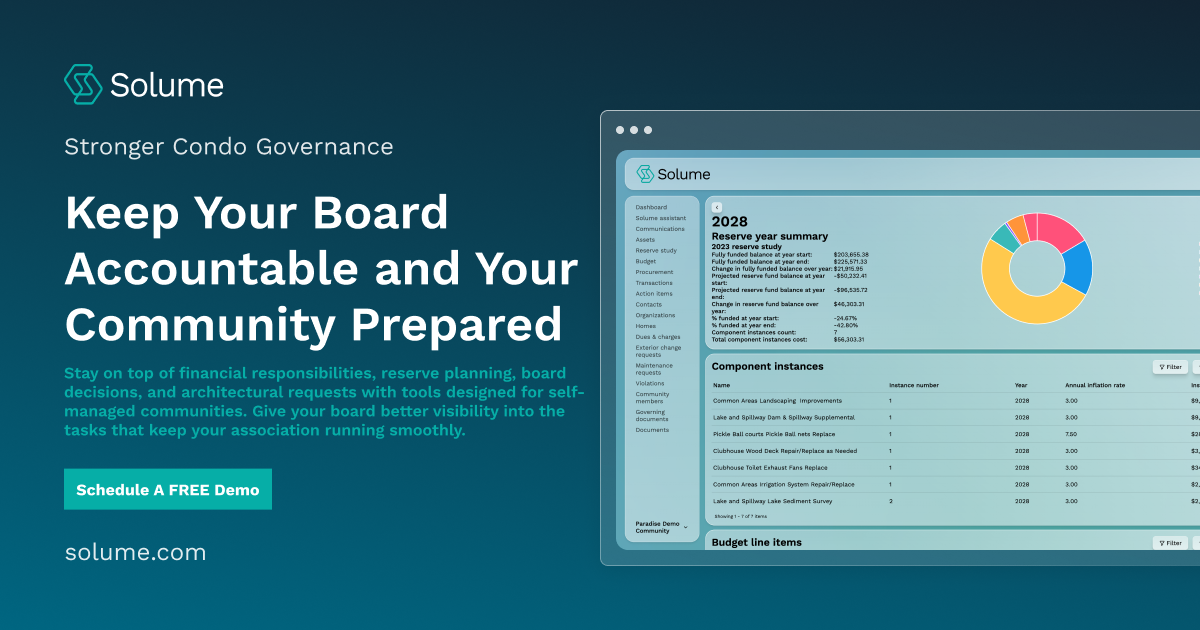
For self-managed boards without an accountant, tools like Solume's financial management and reporting tool for boards, plus automated reserve study tools, help track common charges, flag underfunding, and keep reserve planning on schedule so the numbers don't surprise anyone. Associations structured as nonprofits should also follow IRS rules on homeowners association tax status, since financial recordkeeping tied to bylaws often overlaps with tax-reporting obligations.
Clause 6: Operation, maintenance, and architectural/use restrictions
This clause divides maintenance responsibility between the association and individual owners, and it governs what owners can and can't do with their units. The association typically maintains common elements (roof, hallways, landscaping, structural systems), while owners handle the interior.
Use restrictions live here or in the declaration: rules on short-term rentals, pets, satellite dishes, exterior modifications, and noise. Architectural changes usually go through an architectural review committee that approves or denies requests based on standards in the governing documents.
Most owner-versus-board fights stem from ambiguity about who pays for what. If a pipe inside a wall bursts, is it the owner's problem or the association's? A precise maintenance clause answers that before the water damage arrives, and can help head off conflicts that might otherwise need mediation. Managing architectural requests on paper or by email creates lost submissions and inconsistent decisions. Centralized ARC request management tool keeps every application, approval, and denial on record, which matters enormously when an owner claims they were treated unfairly.
Clause 7: Rule enforcement, fines, and amendment procedures
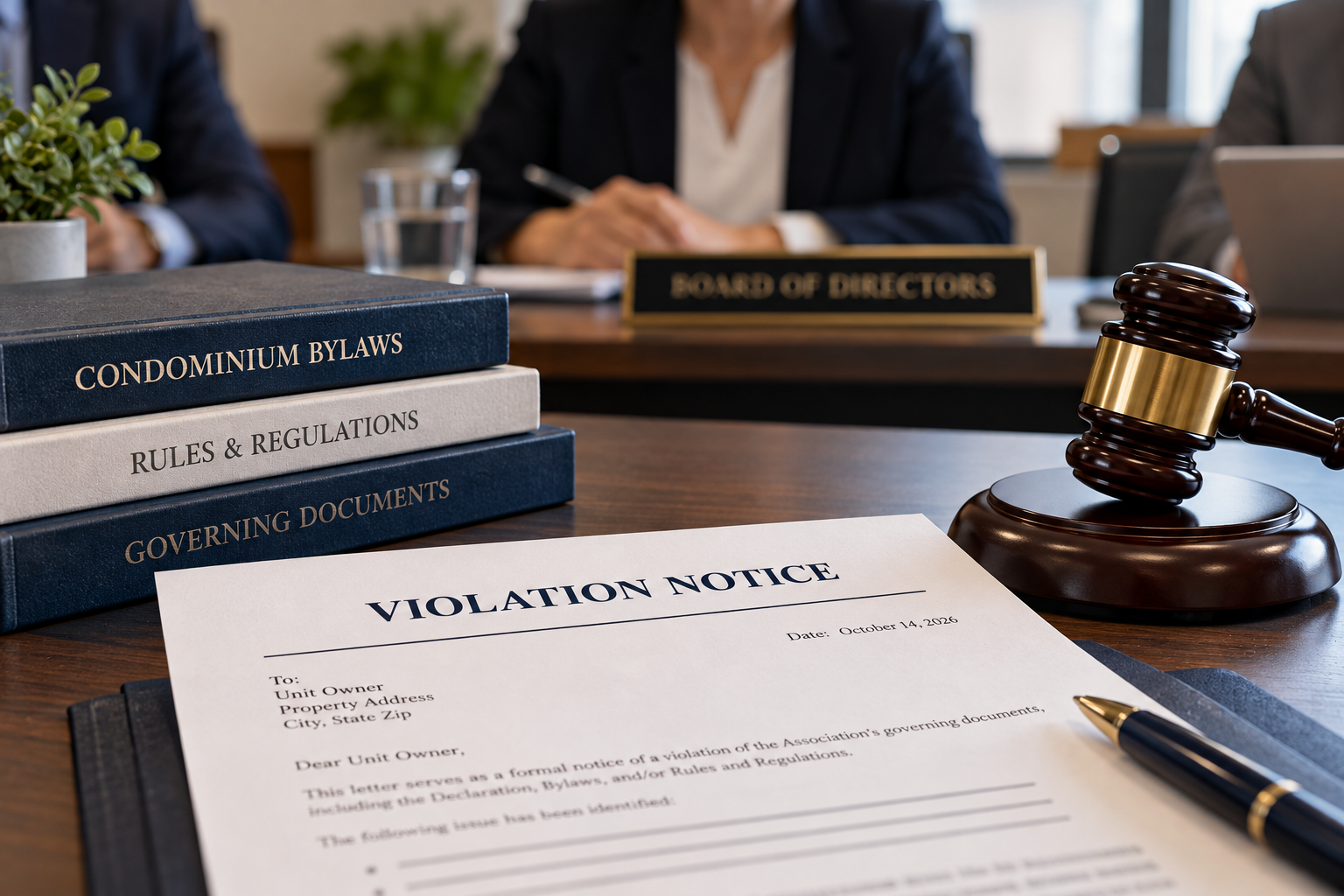
A rule no one enforces is worse than no rule at all. This clause gives the board authority to enforce rules and regulations, impose fines and penalties, and conduct a disciplinary hearing before levying serious penalties. It should spell out the process: written notice of the alleged violation, an opportunity to respond, and a defined fine schedule.
The biggest legal exposure here is inconsistency. Boards that selectively enforce rules, fining one owner for a violation while ignoring the same conduct from another, hand the fined owner a strong defense and invite discrimination claims. Uniformity matters because enforcement authority is defensible only when applied by a written standard rather than board discretion, so a documented, consistent process holds up if a fine is contested. Rule enforcement has to be uniform and documented.
This clause also sets out the procedure boards use to amend bylaws, defining who can propose changes and the required vote threshold, often a majority or supermajority of unit owners. Consistent compliance tracking across violations, hearings, and outcomes is what keeps enforcement defensible if a decision is ever challenged.
How to review, amend, and keep bylaws current
Bylaws drafted when a building was constructed in 1985 often clash with how communities operate today, and worse, with current state law compliance. Review your bylaws at least every few years and after any major statutory change in your state.
The process for amending bylaws follows the clause described above: propose the change, give proper written notice, reach quorum, and meet the required vote threshold. When your existing bylaws conflict with a newer condominium act, the statute generally controls, which means outdated reserve-waiver language may already be void in states that mandate reserves; an attorney can confirm how this applies to your association.
Condominium rules vary significantly by state, so always verify against your state's condominium act and consult your association's attorney before finalizing any amendment. For example, Florida condominium rules now require structural integrity reserve studies for taller buildings and outright restrict reserve waivers. A board that relies on a generic template without checking state law compliance can adopt provisions that are unenforceable the day they're signed.
Using software to track bylaw compliance and board responsibilities for self-managed communities
Reading your bylaws once isn't enough. The real challenge is operating by them consistently, year after year, across volunteer board members who rotate in and out. That's where most self-managed communities quietly drift out of compliance: notices go out late, reserve contributions slip, enforcement becomes uneven, and no one notices until there's a problem. Every risk this article has walked through- voided votes, underfunded reserves, inconsistent fines, lost records- traces back to the same root cause: a gap between what the bylaws require and what a rotating group of volunteers can track by hand.
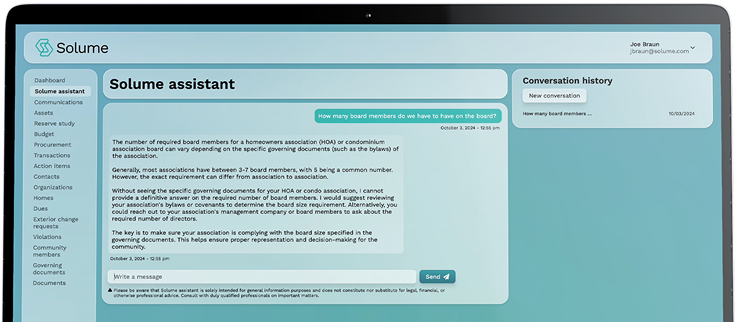
Software built for self-managed communities closes that gap. Compliance tracking tools timestamp meeting notices, log quorum and votes, store financial records owners are entitled to see, and keep reserve planning on schedule. Solume centralizes dues collection, financial reporting, reserve study tracking, and ARC request management in one place, plus an AI Assistant that helps volunteer board members understand what their governing documents and state law may require. For boards without an accountant or attorney on call, that structure turns board responsibility from a guessing game into a repeatable process, though it isn't a substitute for professional legal or financial advice.
If your board wants a clearer way to manage finances, reserve planning, and bylaw compliance for your condo association without a management company eating into your budget, you can see whether this fits your community in a 15-minute call. No pressure, just a straight look at how your current setup holds up.
Frequently Asked Questions
What exactly are bylaws for a condo association, and how are they different from the declaration?
Bylaws are the internal operating rules for a condo association: covering board elections, meeting procedures, quorum, and officer duties. The declaration (or CC&Rs) is the recorded document that creates the condo and governs property rights, so it sits above the bylaws and is much harder to change.
Can condo bylaws actually be amended, and how hard is it?
Yes, most bylaws include an amendment clause that specifies who can propose changes and the required vote threshold, often a simple majority or supermajority of unit owners. If the bylaws are silent on the process, state condominium statutes typically supply a default procedure the board must follow.
What happens if a condo association doesn't have bylaws at all?
A condo legally required to organize as an association almost always must adopt bylaws as a condition of formation, so a true absence is rare and usually signals lost or never-filed documents rather than an actual exemption. In that situation, state default statutes govern board elections, meetings, and voting until the association adopts or recovers formal bylaws.
What new Florida condo laws affect how association bylaws operate?
Florida's post-Surfside reforms, including SB 4-D and related structural integrity reserve study (SIRS) requirements, now override conflicting bylaw language that allows boards to waive or reduce reserve funding. Associations with buildings three stories or higher must align their bylaws and financial practices with these mandatory reserve and inspection rules regardless of what older bylaws say.
What are the warning signs that a condo board is operating outside its own bylaws?
Common red flags include skipping the notice periods bylaws require before meetings, failing to reach quorum but voting anyway, or officers serving past their defined terms without an election. Boards that can't produce meeting minutes or financial records on request typically violate recordkeeping obligations written into the bylaws.
Do condo association bylaws need to be recorded like the declaration?
In most states, bylaws don't need to be recorded with the county the way a declaration does, since they govern internal operations rather than property rights. However, some states require a reference to the bylaws in the recorded declaration or require filing with a state agency, so boards should confirm their state's specific rule before assuming no filing is needed.
Are condo association bylaws the same as HOA bylaws?
Condo bylaws and HOA bylaws serve the same governance function: board elections, meetings, officer roles; but they apply to different ownership structures. Condo owners hold title only to their unit interior plus a shared interest in common areas, while HOA members typically own their home and lot outright, which changes how each set of bylaws addresses assessments and maintenance responsibilities.