
Picture a board in Florida that skips its reserve contribution for three years to keep dues flat. Then the roof fails, and every homeowner opens the same envelope: a $14,000 special assessment notice. That outcome almost always traces back to one document: the annual budget. For a self-managed HOA, the annual budget is the single most important financial decision the board makes each year. This guide walks through the budget process from defining terms to estimating expenses, funding reserves, and adopting the final number without a homeowner revolt.
Key Takeaways
- An annual budget for an HOA or condo association is a 12-month plan that separates operating expenses from reserve fund contributions.
- Budget calculations should start with the prior year's actual spending, not estimates, then adjust for contract increases and reserve study funding targets.
- Many states, including Florida and California, give homeowners the legal right to challenge or veto an adopted annual budget through a membership vote.
- Missing the statutory or governing-document deadline to adopt a budget can expose board members to disputes over dues collection and fiduciary duty.
- Underfunded annual budgets directly drive special assessments, which is why reserve contributions should be tied to a current reserve study rather than a flat percentage guess.

What is an annual budget (definition for HOA boards)
An annual budget is a written 12-month plan for your association's revenues and expenses. It tells homeowners what the community will spend, what it will collect in dues, and how much it will put into savings. For an HOA, the budget splits into two parts: an operating budget for recurring maintenance costs like landscaping, utilities, and insurance, and a reserve budget that funds major repairs over time.
This split matters because operating money and reserve money serve different purposes. Mixing them hides whether your community is actually solvent. The operating budget keeps the lights on this year. The reserve budget protects you from a roof, road, or elevator failure a decade out. Boards new to self-management often underestimate how much structure it requires; reviewing the common challenges self-managed boards face is a useful starting point before you even open a budget spreadsheet.
Your governing documents and state law define what the HOA budget must include and when it must be adopted. The federal government also follows a budgeting discipline through the Congressional Budget Office. The scale is wildly different, but the core principle is identical: project income, project expenses, and plan for the gap before it arrives.
Why annual budget planning matters for self-managed HOAs
Here's the hard truth: in a self-managed HOA, no management company is quietly fixing budget mistakes behind the scenes. The volunteer board owns the outcome. Annual budget planning is where your community either builds financial responsibility or quietly drifts toward insolvency. Following that discipline every year is itself a form of financial responsibility, and too few boards treat it that way.
Most boards assume a flat HOA budget is a win because dues stay low. In reality, flat dues often mean underfunded reserves, and underfunded reserves mean special assessments later. The reason is mechanical: capital assets like roofs and pavement wear out on a fixed schedule whether or not the board saved for them, so skipped contributions don't lower the cost; they just shift it to a single painful bill. The 2021 Surfside condo collapse in Florida killed 98 people and became a national example of what happens when deferred maintenance and reserve planning get ignored for years. You can read the structural findings from the National Institute of Standards and Technology investigation.
Good planning protects three things: community stability, homeowner trust, and board responsibility. A clear process also builds financial transparency, the fastest way to reduce the suspicion boards face when HOA dues go up. Rules vary considerably by state, so boards should consult their attorney to interpret state-specific budget requirements, and reviewing state-by-state HOA budget and reserve laws compiled by the Community Associations Institute can help you understand where your state falls before you finalize anything.
Core components of an HOA annual budget (income and expenses)
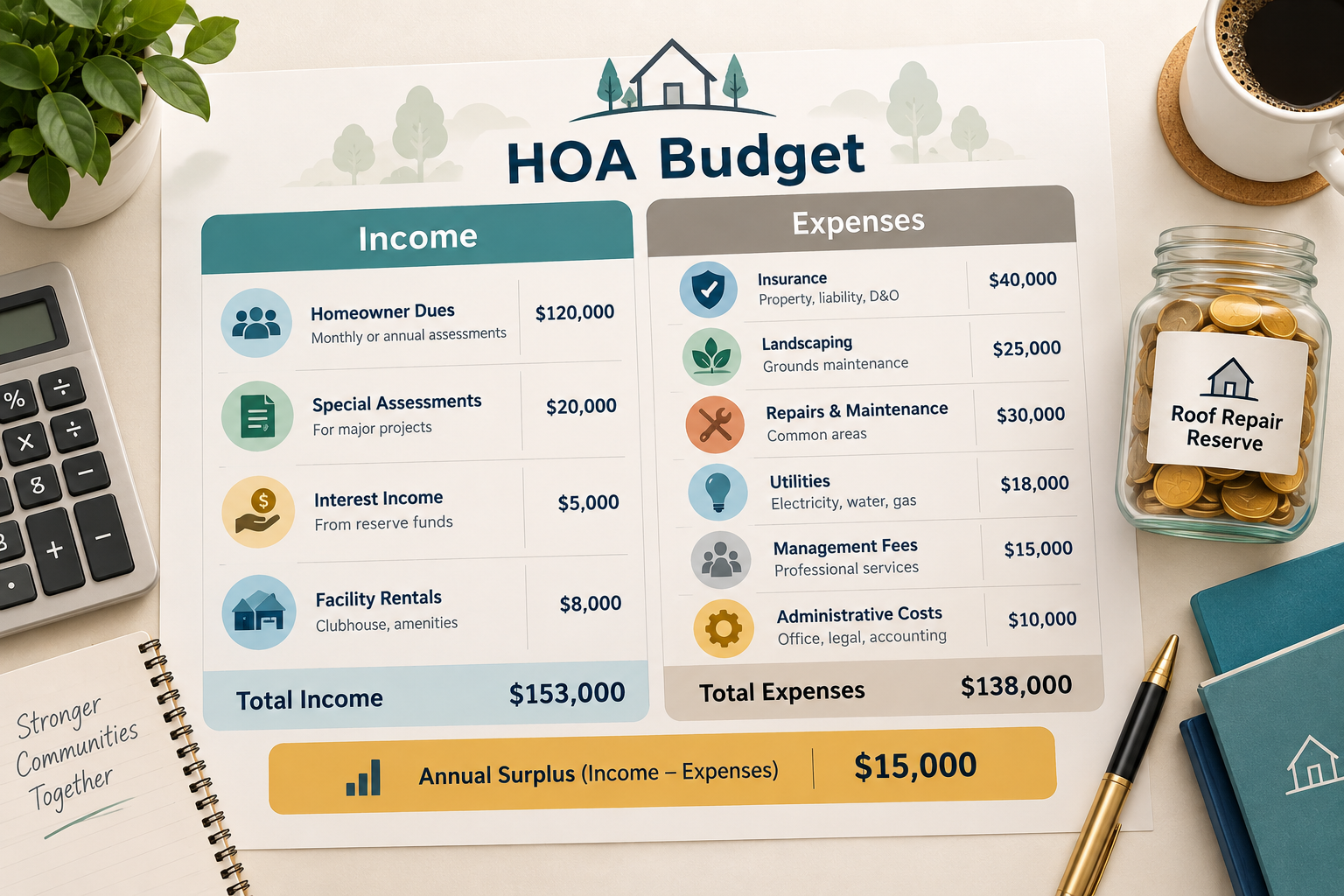
Annual operating budgets fall into two buckets: money coming in and money going out. On the income side, dues are the backbone, supplemented by late fees, fines, transfer fees, interest, and amenity rentals where they apply. On the expense side, the budget covers the predictable costs of running the community.
A typical HOA budget expense list includes:
- Utilities (water, electric, trash, shared gas)
- Insurance (property, liability, directors and officers)
- Landscaping and grounds
- Repairs and routine maintenance
- Administrative and legal fees
- Vendor contracts (pool service, pest control, snow removal)
Then comes the piece most boards shortchange: the reserve budget. Reserve contributions are not optional savings. They fund capital expenses like roofs, paving, and painting that wear out on a predictable schedule.
Leaving reserves out of the budget template causes slow decay. The community looks fine on paper while liabilities pile up invisibly. A real annual operating budget accounts for this year's revenues and expenses, plus the capital costs coming years down the road. Associations also need to factor in tax filing requirements tied to their income structure; most HOAs file IRS Form 1120-H for homeowners associations rather than a standard corporate return, and that distinction can affect how certain income and expenses are categorized in the budget.
Estimating HOA expenses for the fiscal year
Estimating expenses starts with one rule: use last year's actuals, not last year's budget. The budgeted number was a guess. The actual number is what happened. Pull 12 months of real spending by category, then adjust.
Adjust for what you already know. If your landscaping contract renews at a 6% increase, build in 6%. If your insurance carrier signaled a hike, call the agent and get a number before you guess. Insurance has climbed sharply in coastal and wildfire states, and a flat estimate there can blow your whole budget by spring.
For variable maintenance costs like repairs, use a three-year average rather than a single year. This smooths out the one-off expensive year. Flag deferred maintenance you've been putting off, because that work doesn't disappear; it grows more expensive. A fence postponed this year becomes a bigger line item next year, often with water damage attached.
The root cause of most budget misses is optimism. Boards estimate based on the best case. Build in a contingency line, usually 3% to 5% of the operating budget, so one surprise invoice doesn't force a mid-year scramble.
Estimating HOA income and dues to fund the budget
Once expenses are set, estimate income by working backward from them. Total your operating expenses plus required reserve contributions, divide by the number of units (adjusting for any ownership-percentage formulas in your declaration), and you have your per-home assessment.
Be realistic about collection. Not every homeowner pays on time. Many associations budget income at 95% to 98% of billed HOA dues to account for delinquencies, so a few late accounts don't leave you short. Budgeting at a full 100% is how a community ends the year in the red, even when it sets dues "correctly."
HOA dues are your primary funding source, but they shouldn't be your only one. Late fees, fines, and amenity income are smaller but real. Just don't inflate them. Padding income with optimistic fine revenue to avoid raising dues only disguises an underfunded budget.
Many assume raising dues ends board terms. In reality, homeowners tolerate reasonable, well-explained increases far better than surprise special assessments, which arrive with no warning and no payment plan.
Step-by-step process for building your annual budget
A repeatable budget process keeps the work from becoming a last-minute panic. For boards that want a ready-made framework rather than building one from scratch, a step-by-step HOA budget template can save hours of trial and error. Here's a sequence most boards can follow:
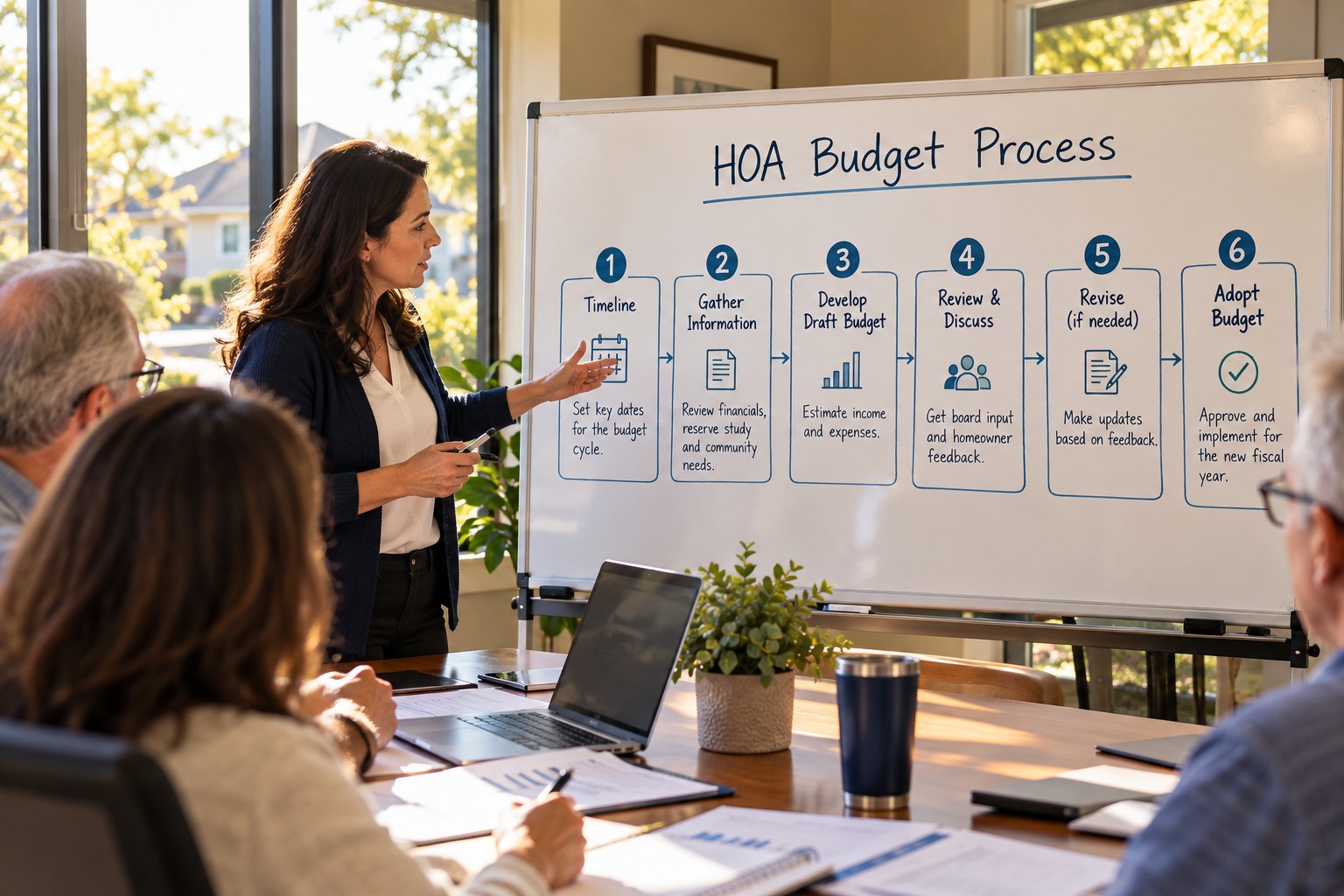
1. Set your timeline. Work backward from your fiscal year start and any statutory notice deadlines. Start 90 to 120 days out.
2. Pull prior-year actuals. Export real spending by category, not budgeted figures.
3. Update your reserve study. Confirm reserve funding targets against a current study before setting contributions.
4. Estimate operating expenses. Apply known contract increases and a contingency line.
5. Calculate required income. Back into the dues figure needed to fund both budgets.
6. Draft the budget document, ideally from a consistent template so prior years stay comparable and a homeowner can follow it.
7. Review as a board, then notice and adopt per your governing documents.
Consider a 60-unit association that skips step three and sets reserves by a flat 10% guess. When the actual reserve study later shows the real target was closer to 22%, the board faces a $160,000 shortfall and a special assessment nobody saw coming. Tying reserves to a current reserve study is the step that prevents this.
Analyzing, adjusting, and approving the budget
Before adopting anything, stress-test the draft. Compare the proposed annual operating budget line by line against the prior two years. Any category that jumped more than 15% deserves an explanation you can give a skeptical homeowner at the meeting, because someone will ask.
Check the reserve number hardest. Ask whether contributions actually move the community toward the funding target in the reserve study, or whether you're just avoiding a dues increase this cycle. Reserve planning that keeps your percent-funded flat or falling is a warning sign, not a success.
Then follow your adoption procedure precisely, applying the same best practices each cycle so you don't reinvent approval every year. Many states require advance notice of the budget meeting, distribution of the budget to owners, and in some cases a homeowner ratification window. The steps are so rigid because the budget gives the association legal authority to levy dues, so a procedural miss can undermine the board's ability to collect. In Florida and California, specific statutory notice and approval steps apply, and skipping them can create complications for the board. Confirm exact requirements against your state's HOA statute, and consult your attorney when the language is unclear.
Document the vote in your minutes. That record is part of the financial transparency and compliance trail that protects the board if someone later questions a decision.
Working with and monitoring the budget throughout the year
Adopting the budget is the start, not the finish. A budget you file and forget is just a wish. Review actuals against the budget every month, or at minimum every quarter, so variances surface while you can still react.
Watch for categories trending over. If utilities run 20% above budget by mid-year, you want to know in month five, not at year-end when the choice is a deficit or an emergency transfer. Monthly financial reporting turns the budget into a live management tool instead of a static document.
Monitoring also strengthens vendor management. When you track spending against each contract, you catch an invoice that doesn't match the agreed scope, and you have real numbers at renewal time instead of a vague sense that "landscaping seems high."
The risk most boards overlook is drift. Small overages feel harmless each month, then compound into a year-end shortfall that forces a special assessment or a reserve raid. Consistent reporting and honest mid-year adjustments keep long-term planning intact and the community on stable footing, since long-term planning only works if the numbers behind it stay current. This is also a good point in the calendar to start thinking ahead; many boards find it easier to begin HOA budget planning for the year ahead while the current year's numbers are still fresh rather than waiting until the deadline is looming.
Using HOA software to simplify annual budgeting for volunteer boards
Most volunteer boards build their first budget in a spreadsheet, and for a tiny community that can work. But spreadsheet chaos sets in fast: version conflicts, broken formulas, no audit trail, and a reserve schedule living in a separate file nobody updated. One treasurer's laptop becomes a single point of failure.
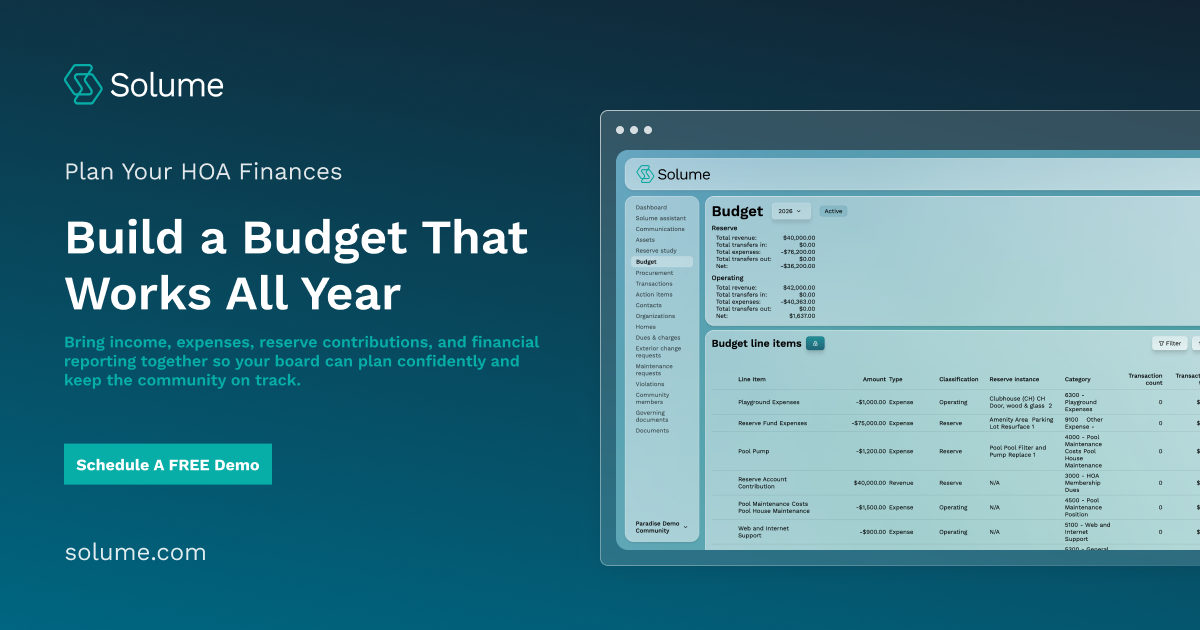
HOA management software fixes the structural problems a spreadsheet can't. It keeps revenues and expenses in one place, automates HOA dues collection and late tracking, and generates reporting owners can actually read. That's a direct path to the financial transparency self-managed communities need to build trust, and adopting financial management tool built for HOA boards early often saves boards from costly rebuilds later.
Most platforms ignore reserve planning. Solume ties reserve study data directly to the budget process, so contributions align with real funding targets instead of a flat guess. The platform also helps boards track compliance deadlines and manage vendors, removing two of the biggest sources of volunteer board burnout.
Good software doesn't replace board responsibility. It gives a volunteer board the structure to meet it without a management company absorbing your dues. The whole point of annual budget planning is to protect the community's long-term stability, and the right tools make that discipline easier to sustain year after year.
If your board wants a clearer way to handle annual budget planning, reserve funding, and financial reporting without living in a spreadsheet, you can see how it works for your community on a 15-minute call to find out whether Solume is a good fit.
Frequently Asked Questions
What exactly is an annual budget for an HOA or condo association?
It's a 12-month financial plan that projects operating expenses, reserve contributions, and expected income from dues and fees. For HOAs, it typically splits into two parts: an operating budget for day-to-day costs and a reserve budget for long-term repairs like roofs or paving.
How do you calculate an annual budget for a community association?
Start by totaling last year's actual expenses across categories like landscaping, insurance, utilities, and management fees, then adjust for known increases such as contract renewals or inflation. Add required reserve contributions based on your reserve study, divide the total by the number of homes, and that becomes your per-unit assessment.
What's the current US federal annual budget?
The federal government operates on roughly $6.75 trillion in annual spending as of fiscal year 2024, according to Congressional Budget Office data. This figure is unrelated to HOA budgeting, but boards sometimes reference it when explaining budget concepts like deficits or fiscal years to homeowners.
Has Congress passed a budget for fiscal year 2026?
As of now, Congress has not finalized a full-year fiscal 2026 budget and has relied on continuing resolutions to keep federal agencies funded. This federal process doesn't directly affect HOA budgets, but it illustrates how different governing bodies handle the same budgeting discipline at vastly different scales.
Is building a detailed annual budget actually worth the effort for a small self-managed HOA?
Yes, because an underfunded or vague budget is the leading cause of surprise special assessments, which can run homeowners hundreds to thousands of dollars with little warning. A detailed annual budget protects board members from fiduciary liability and gives homeowners a clear reason to trust the numbers.
What happens if a board doesn't pass an annual budget on time?
Most governing documents and state statutes require boards to adopt a budget before the new fiscal year starts, and missing that deadline can delay dues collection or trigger default budget rules written into the CC&Rs. In states like Florida and California, failing to follow statutory budget notice and ratification procedures can expose the board to legal challenges from homeowners.
Can homeowners reject or veto the annual budget?
In many states, homeowners can call a special meeting and vote down a budget if a majority objects, which reverts the association to the prior year's budget. This mechanism exists in states like Florida and California specifically to keep boards accountable to the community rather than imposing dues unilaterally.
Do small associations really need software to manage an annual budget, or is a spreadsheet enough?
A spreadsheet can work for very small, simple communities, but it offers no audit trail, no automated reserve tracking, and no built-in compliance checks against state law. Boards that outgrow spreadsheets often do so after a bookkeeping error or missed reserve contribution creates a funding gap that goes unnoticed until it becomes expensive to fix.