Picture a board in Fairfax County that sat on an owner's resale packet for three weeks. They missed the statutory delivery window, and the sale fell apart. The homeowner walked away, and the association absorbed the fallout. That is the kind of avoidable mess Virginia HOA laws are built to prevent, and it is exactly why volunteer board members need to understand the statutes that govern their community. This article walks through the laws that apply, who enforces them, and a practical compliance checklist you can actually use.
Key Takeaways
- Virginia HOA laws are primarily set out in the Property Owners' Association Act (POAA), Title 55.1, Chapter 18, which applies to lot-based communities rather than condos.
- Condominium associations in Virginia follow a separate statute, the Virginia Condominium Act, so the applicable rules depend on the property type.
- State law overrides any HOA declaration, bylaw, or rule that conflicts with the POAA, regardless of how long that provision has existed in the governing documents.
- Virginia requires associations to register with the Common Interest Community Board, which also licenses community managers and fields complaints.
- Home sellers in Virginia HOAs must provide a resale disclosure packet, giving buyers a statutory window to review governing documents and rescind the contract if needed.

What Virginia HOA laws are and why they matter
Virginia HOA laws are the state statutes and recorded documents that define what a homeowners association can and cannot do. They set the boundaries for dues collection, architectural rules, meetings, record access, and board authority. For most lot-based communities, the controlling statute is the Property Owners' Association Act, part of Title 55.1 of the Code of Virginia.
Here is the hard truth: these laws matter because they override your governing documents whenever the two conflict. A declaration written in 1988 does not get a pass just because nobody updated it. If a bylaw clashes with current state law, the statute wins and the bylaw becomes unenforceable. This is also where boards run into trouble enforcing provisions that were never valid to begin with; our guide to unenforceable HOA rules walks through the most common examples.
The reason this matters for board responsibility is liability. Board members carry a fiduciary duty, and mishandling a records request or a special assessment can expose the association, and sometimes individual directors, to risk. Many assume the association can simply make its own rules. In reality, the Property Owners' Association Act caps what rules are even valid, because the statute sits above the governing documents and voids any rule that reaches past the authority it grants.
You can read the text of the Virginia Property Owners' Association Act directly in the Code of Virginia. Homeowners associations that treat the statute as optional learn the cost the hard way, usually in a courtroom. The practical takeaway is simple: review the statute before you write a rule, not after an owner challenges it.
Key Virginia statutes governing HOAs (POA Act and Condominium Act)
Two statutes do most of the heavy lifting. The Property Owners Association Act governs lot-based communities: single-family homes, townhomes, and planned developments where owners hold title to land. The Virginia Condominium Act, found in Title 55.1, Chapter 19, governs condo associations where owners hold a unit plus an interest in common elements.
The distinction is not academic. A condo association calculating reserve contributions, handling insurance for common elements, or allocating special assessments follows different rules than a lot-based HOA. If you treat your condo association like a POA, you will cite the wrong statute at the worst possible moment.
Both acts share a common oversight body: the Common Interest Community Board. This agency sits under the Department of Professional and Occupational Regulation, registers associations, licenses community managers, and handles homeowner complaints. You can verify your association's registration and review resources through the Common Interest Community Board at Virginia DPOR.
What actually happens when boards get the statute wrong is predictable: a disclosure packet drafted under the wrong act, a notice sent under the wrong timeline, and an owner with grounds to challenge the whole process. Consider a townhome board that quotes a condominium insurance provision in its resale packet because a neighboring condo board shared a template. The buyer's attorney spots the error, the packet is deemed deficient, and the board has to reissue it and restart the review clock. Knowing which act applies is step one of compliance.

The role of governing documents in Virginia associations
Governing documents are the association's internal rulebook, and in Virginia they sit directly under state law in the hierarchy. The stack runs: state statute first, then the recorded declaration or CC&Rs, then the bylaws, then board-adopted rules and resolutions. When two levels conflict, the higher one controls, because each lower level only has the authority the level above it grants.
The declaration is the foundational document. It runs with the land, binds every owner at purchase, and sets out dues obligations, architectural standards, and common area use, often reflecting early developer control before the board took over. The bylaws handle the mechanics of association governance: how the board of directors is elected, how annual meetings are called, and quorum requirements.
Most boards assume their rules are automatically valid because the board voted on them. In reality, a board-adopted rule that exceeds the authority granted in the declaration, or that contradicts the POAA, is dead on arrival. The root cause of most enforcement disputes is a rule the board never had the power to pass. When a dispute escalates past a simple documentation fix, it helps to know when a board should consult an HOA lawyer rather than trying to resolve it internally.
For self-managed communities, this means recordkeeping is not busywork. Owners have statutory rights to inspect governing documents and certain records, and a board that cannot produce them looks both disorganized and non-compliant. Keep the full document set current, indexed, and accessible, because the law assumes you can hand it over on request.
Who enforces Virginia HOA laws and board authority
Enforcement runs in two directions. The board enforces the governing documents against owners, and the state, through the Common Interest Community Board, holds the association accountable to the law. Owners who believe a board has violated the POAA can file a complaint with the CICB, which can investigate licensed managers and registered associations.
The board of directors derives its enforcement authority from the declaration and the statute, not from personal preference, and that authority is usually broader during early developer control than afterward. A board can levy fines, demand architectural compliance, and pursue dues collection, but only through the process the governing documents and the POAA allow. Skip the required notice or hearing, and the fine becomes unenforceable.
Here is where volunteer board members get caught: enforcement has to be consistent. Selective enforcement, letting one owner's violation slide while fining another for the same thing, invites a discrimination or selective-enforcement challenge. Courts and the CICB look at the pattern, not just the single case, because inconsistent application signals the rule is being used as a weapon rather than a standard.
Board authority is also limited by jurisdiction. An HOA board controls common areas and exterior compliance. It does not get to enter a private home without consent, a court order, or a genuine emergency. Board members who overreach do more damage to community stability than the violation they were chasing.

Homeowner rights and board responsibilities under Virginia law
The POAA builds in real homeowner protection, and boards that ignore it create needless conflict. Owners have the right to inspect association records, receive notice of meetings and assessments, attend open board meetings, and review the governing documents. Owners and boards both carry rights and responsibilities under this framework: owners must pay dues and follow recorded restrictions, while boards must operate transparently.
One of the most practical protections is the resale disclosure packet. When an owner sells, the association must supply a packet containing the governing documents, assessment information, and current financial details. The buyer gets a statutory window to review it and, in some cases, cancel the contract. A board that delivers a late or incomplete packet can blow up a sale and face liability.
What many communities don't realize is how much homeowner rights depend on timing. Notice periods for meetings, assessments, and architectural decisions are written into the statute, and missing them resets the clock or voids the action. The mechanism is straightforward: the statute treats proper notice as a precondition for the action itself, so an improperly noticed vote never legally happened.
Board responsibility here comes down to fiduciary duty: acting in the association's interest, keeping accurate records, and handling money carefully. Virginia HOA laws do not expect perfection from volunteer board members, but they do expect good faith and a documented process. Consult your association's attorney for interpretation of any specific provision, because facts change outcomes.

Compliance checklist for Virginia HOA boards
Use this compliance checklist as a working baseline. It is not a substitute for professional guidance, and your attorney should confirm how each item applies to your community, but it covers the obligations that trip up most boards.
1. Confirm your governing statute. Lot-based HOA under the POAA, or condo association under the Virginia Condominium Act. Cite the right one.
2. Verify CICB registration. Keep your Common Interest Community Board registration current and your annual filing on time.
3. Audit governing documents. Flag any bylaw or rule that conflicts with current state law, because the statute overrides it.
4. Standardize meeting notice. Hold annual meetings and board meetings with the notice periods the POAA requires.
5. Document enforcement. Apply rules consistently, with written notice and hearings before levying fines.
6. Prepare resale packets correctly. Deliver a complete disclosure packet within the statutory window on every sale.
7. Protect record access. Maintain recordkeeping so owners can inspect documents on request.
8. Fund reserves. Commission a reserve study and follow a reserve planning schedule.
9. Keep financial transparency. Share budgets, assessments, and financial reports with members.
Work through this list at least once a year, assign each item to a named board member, and keep dated proof that you completed it. The risk most boards overlook is treating this as a one-time exercise. Compliance is a yearly task, because Virginia amends Title 55.1 almost every legislative session.
Financial transparency and reserve planning obligations in Virginia
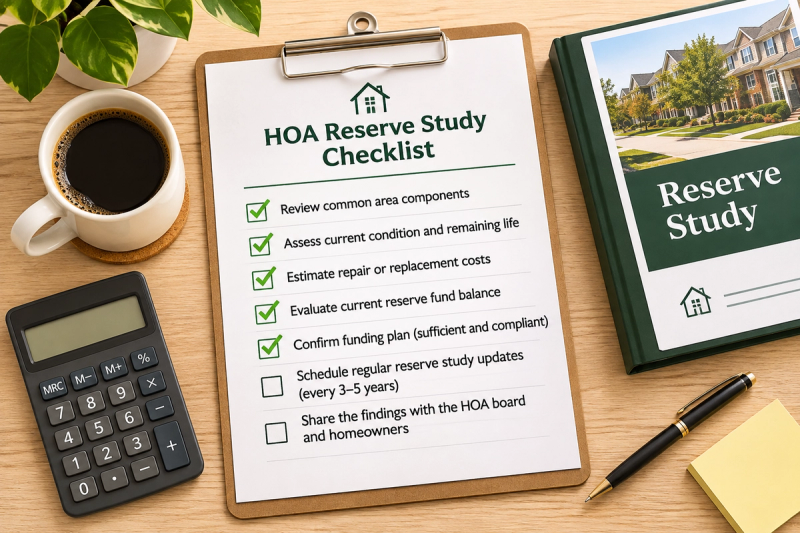
Money is where self-managed communities get into the deepest trouble. Virginia requires associations to maintain financial records and, under the POAA, to prepare reserve studies and budget for the repair and replacement of major capital components. A reserve study tells you what your roofs, roads, and pools will cost to replace and when, so you can fund for it in advance. Boards that haven't reviewed Virginia's reserve study requirements recently should start there before assuming their current schedule is adequate.
Here is the risk most boards overlook: deferred maintenance plus underfunded reserves equals a surprise special assessment, and special assessments are what turn neighbors into enemies. The partial collapse of Champlain Towers South in Surfside, Florida, which resulted in 98 deaths according to the NIST investigation, is the extreme consequence of ignored structural maintenance and inadequate reserve planning.
Financial transparency is also a statutory obligation, not a courtesy. Owners can inspect financial records, and a board that hides or fumbles the numbers erodes trust fast. Most boards assume a bank balance proves they are funded. In reality, a healthy checking account with a 20% funded reserve is a community one bad winter away from a crisis.
Reserve planning protects community stability. A funded reserve spreads large costs across the owners who used the asset, instead of dumping a five-figure special assessment on whoever happens to live there when the roof fails. The underlying logic is fairness over time: the owners benefiting from a roof's full lifespan should each pay a share, not just the unlucky ones present at failure. Treat the reserve study as a living document and update it on schedule.
How software helps self-managed Virginia boards stay compliant
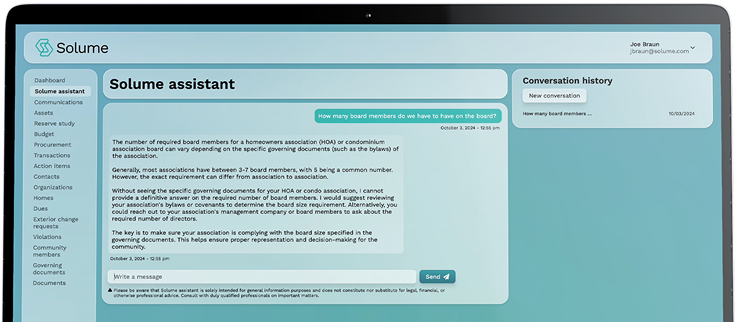
Volunteer boards burn out trying to track all of this on spreadsheets and shoeboxes of receipts. The administrative load, notices, records, dues collection, reserve math, and enforcement documentation, is exactly where things slip and compliance gaps open. Community management software exists to carry that load so the board can focus on decisions instead of paperwork. HOA software built for Virginia communities is designed around the specific statutory deadlines and disclosure requirements covered above.
For reserve planning specifically, Solume includes automated reserve study tools and compliance tracking, which gives self-managed Virginia boards a structured way to project long-term capital costs and reduce the risk of unexpected special assessments. That matters in a state where the POAA expects associations to budget for major repairs.
Financial transparency gets easier when the numbers live in one place. Solume's financial management tools handle budgeting, tracking, and reporting, so owners can see where their dues go and treasurers are not reconstructing the ledger from memory at the annual meeting.
Here is what software does not do: it does not replace your attorney, and it does not guarantee compliance. What it does is keep the records, deadlines, and financial picture organized enough that a volunteer board can actually meet its obligations under Virginia HOA laws. For self-managed communities without a management company, that organization is the difference between staying compliant and scrambling.

If your board wants a clearer way to manage reserve planning, financial transparency, and day-to-day compliance without a management company, you can talk to the Solume team in a 15-minute call to see if it fits your community. No pressure, just a look at whether the tools solve the problems your board is actually facing.
Frequently Asked Questions
What law actually governs HOAs in Virginia?
Most lot-based HOAs fall under the Virginia Property Owners' Association Act (POAA), Title 55.1, Chapter 18 of the Code of Virginia. Condominiums are governed separately by the Virginia Condominium Act, so the rulebook depends on whether you own a lot or a condo unit.
Can an HOA in Virginia stop an owner from renting out their home?
Yes, if the recorded declaration (CC&Rs) includes rental restrictions, Virginia law allows associations to enforce them, including caps on the number of rentals or minimum lease terms. Owners should check their governing documents before assuming rentals are unrestricted.
Is there a real difference between an HOA and a Property Owners' Association in Virginia?
Not legally, Virginia statute doesn't use the term 'HOA' at all; it uses 'Property Owners' Association' under the POAA. In everyday use, people say HOA, but the governing law and your resale packet will reference a POA.
Can an HOA board or manager enter a homeowner's home without permission in Virginia?
No, an HOA's authority under the POAA generally extends to common areas and exterior compliance, not forced entry into a private residence. Any access to the interior of a home typically requires a court order, an emergency safety situation, or specific authority granted in the declaration.
What new HOA-related rules are coming to Virginia in 2026?
Virginia legislators regularly amend Title 55.1 each session, with recent changes touching resale disclosure packets, record access, and board transparency requirements. Boards should check the Common Interest Community Board (CICB) updates each year rather than assume last year's compliance checklist still applies.
Why do Virginia HOAs seem to have so much legal power over owners?
Because buying a lot in a common interest community automatically binds you to the recorded declaration and the POAA, whether or not you helped write the rules. That contract, backed by state statute, gives the association authority over dues, architectural standards, and common area use.
Is it even worth learning Virginia HOA law as a volunteer board member?
It matters because board members carry fiduciary duty under the POAA, and ignorance of the statute doesn't protect a board from liability for mishandled dues, records requests, or special assessments. A basic working knowledge of the Act is what keeps volunteer boards out of legal and financial trouble.
What if my HOA's bylaws conflict with Virginia state law?
State law wins, if a declaration, bylaw, or rule conflicts with the POAA, the statute controls and the conflicting provision is generally unenforceable. This is a frequent issue in older communities whose governing documents haven't been updated in decades.