
A single failed roof can wipe out a small HOA's entire savings account and hand every homeowner a $9,000 bill they never saw coming. That scenario plays out constantly. Almost always, it traces back to a board that skipped or ignored its reserve study. A reserve study for homeowners associations tells your board how much to save, for what, and by when. Those emergencies stop being surprises. This guide walks through what a study includes, what it costs, how often to update it, what your state may require, and how self-managed boards can handle it without hiring a management company.
Key Takeaways
- A reserve study for homeowners associations combines a physical inspection of common components with a 20-30 year financial forecast so boards know how much to save for future repairs.
- Full study costs range from about $1,200 for small communities to $25,000+ for large high-rise associations, driven by unit count and amenity complexity.
- Experts recommend a full site-visit study every 3-5 years, with lighter updates in between, though state law and governing documents may require more frequent reviews.
- Skipping or neglecting a reserve study is the most common path to underfunded reserves and surprise special assessments for homeowners.
- A funded reserve plan doubles as documented proof that a volunteer board met its fiduciary duty to plan for long-term capital costs.

What a reserve study is and why boards can't skip it
A reserve study is two things bolted together: a physical analysis of your shared assets and a financial roadmap for replacing them. The physical side catalogs every major component the association owns: roofs, private roads, elevators, pool equipment, siding, and fencing. It estimates how long each has left. The financial side turns that inventory into a multi-decade plan showing how much to set aside every year. If you're new to the concept, it helps to first understand what a reserve study actually is before diving into the numbers.
Here's the hard truth: most boards assume the operating budget covers everything. It doesn't. Your operating budget handles landscaping and utilities. Reserves handle the big-ticket major repair and replacement costs that arrive on their own schedule. An HOA reserve study is a capital-planning tool that keeps those two buckets separate and honest.
This matters because of timing. Roofs don't fail politely at the end of a budget year. A board budgeting blind without a study either hoards cash it doesn't need or, far more often, keeps underfunding your reserves until a component fails. The Community Associations Institute publishes national reserve study standards that most credentialed preparers follow, giving boards a framework instead of guesswork. Reviewing the CAI reserve study best practices is a smart first step for any board trying to get its footing.

The real cost of doing nothing: special assessments and deferred maintenance
Deferred maintenance is not free. It's a loan you take out against your own community, and the interest is brutal. A patched roof could have been replaced on schedule for $40,000. Once water damage spreads to the units below, it becomes $70,000. That gap lands on homeowners as a special assessment, usually with weeks of notice.
Consider a 30-unit community that keeps deferring a $50,000 road repaving because the reserve balance looks thin and nobody wants to raise dues. Two winters later the base layer fails, the project balloons to $85,000, and the board has to split it across owners as a special assessment averaging nearly $3,000 per home. What could have been a planned contribution becomes a bill several owners genuinely struggle to pay.
The most severe example of what neglected reserves can do is the 2021 Champlain Towers South collapse in Surfside, Florida, where 98 people died. Investigators pointed to years of deferred structural repairs and a reserve fund far short of what the building needed. The National Institute of Standards and Technology continues to investigate the failure, and Florida rewrote its reserve laws in response.
Underfunded communities face a slow erosion of community stability. Homeowners who can't cover a sudden assessment fall behind on dues. Property values slip because buyers see the deferred maintenance, and the board burns out fighting fires. Underfunding your reserves doesn't save money. It moves the bill to the worst possible moment and adds a premium.
How to get started: the physical, financial, and lifespan analysis process
A study breaks into three connected steps. First is the physical analysis. A preparer inspects your common-area assets on-site, measures them, and documents their current condition. Here the inventory gets built: every reserve component with a quantity, a placement date, and a repair or replacement figure. If you want the full sequence laid out, this step-by-step guide to conducting a reserve study walks boards through each phase.
Second is the lifespan analysis. Each component gets a useful life and a remaining life. A pool resurface might last 12 years; asphalt might last 20. The lifespan analysis tells you a $180,000 roof replacement is coming in year 14, not "sometime." Without it, you're saving toward nothing in particular.
Third is the financial analysis. The preparer takes the inventory and lifespan data and builds a 20- to 30-year cash flow model, factoring in inflation and interest on your reserve balance. The output is your reserve funding plan: a specific annual contribution that keeps the fund solvent as components age out. Many assume you can skip the site visit to save money. In reality, the physical analysis makes the numbers trustworthy. A plan built on bad component data just fails on a slower timeline.

How much a reserve study costs and how often to update it
Reserve study costs scale almost entirely with size and complexity. A small HOA reserve study for a community under 50 units typically runs $1,200 to $6,000. Mid-size communities of 50 to 150 units land around $3,000 to $10,000. Large or high-rise associations with multiple buildings and structural components can hit $10,000 to $25,000 or more. High-rises cost more because they have more common-area assets and often structural elements that need specialized inspection.
The reserve study cost feels steep to a volunteer board, but compare it to a single missed replacement. One surprise assessment can easily dwarf a decade of study fees.
How often to update a reserve study depends on your state and governing documents. The working standard is a full site-visit study every three to five years, with lighter updates in between. Many boards do a with-site-visit refresh every three years and a no-site-visit financial refresh annually against cost inflation. Updates matter because construction costs and interest rates drift constantly, so a funding plan built on year-one numbers slowly stops reflecting what replacements will actually cost. Reserve studies exist to give you a cheaper update option. Choosing among these types of reserve studies keeps you from budgeting on numbers that are five years stale.
Building your funding plan and hitting a healthy funded ratio
Once you have the study, the number to watch is percent funded. It compares what you actually have in reserves against what the study says you should have accumulated by now. A community at 100 percent funded is fully on track. Below 30 percent is where special assessment risk climbs sharply.
A healthy reserve fund isn't about hoarding cash. It's about matching your balance to your liabilities over time. Your reserve funding plan sets the annual contribution needed to get there. Most boards choose between full funding, threshold funding, or baseline funding, which is the riskiest because it aims to never quite hit zero.
The root cause of most funding failures is treating the reserve contribution as optional when dues feel high. That's backward. A modest, steady increase built into the operating budget now is the cheapest path to a healthy reserve fund, because early contributions earn interest and spread the cost across every owner who benefits from the component. Skipping it just converts predictable contributions into an unpredictable special assessment later. Long-term planning is the difference between a community that ages gracefully and one that lurches from crisis to crisis. Percent funded is the single metric that tells homeowners and prospective buyers whether the board is doing its job.
State compliance and legal/fiduciary requirements
Reserve study requirements vary widely by state, so you cannot generalize. Florida's SIRS legislation now mandates structural integrity reserve studies for many condo buildings and restricts the ability to waive reserves. California requires reserve studies and specific disclosures under its Davis-Stirling Act. Nevada, Hawaii, Colorado, Virginia, and others set their own reserve study requirements with different intervals and content rules. Because statutory details and deadlines vary and change over time, confirm the exact requirements in your state's current statutes with your attorney before relying on any summary.
Board responsibility here is real. In most states, board members owe a fiduciary responsibility to plan for major repair and replacement costs. A current, funded HOA reserve study is the cleanest documented proof they met that fiduciary responsibility. When a board waives reserves without one and a component fails, that's where personal liability questions may arise.
Solume includes reserve study software with compliance tracking that flags upcoming state deadlines, helping boards keep studies current instead of discovering a lapse during an audit. Boards should still consult their attorney for legal interpretation, because requirements and state reserve fund laws change frequently and the details matter. This guide is general information, not legal advice.

Reserve studies for small and self-managed communities
Small and self-managed communities often assume reserve studies are a big-community problem. The opposite is true. A 24-unit condo association has fewer homeowners to spread a sudden cost across, so a single failed component hits each owner harder. For that condo association, a small HOA reserve study is arguably more essential, not less.
The obstacle is usually expertise. Volunteer board members are retirees, homeowners with day jobs, and treasurers who never asked to become finance experts. They're often handed a spreadsheet by an outgoing board and told to "keep it going," with no analysis behind it. That's how communities drift into underfunding without realizing it.
What many communities don't realize is that self-managed doesn't have to mean under-informed. You can hire a credentialed firm for the study itself, then handle the ongoing tracking yourself with the right tools. The plan the study produces is the same regardless of size. It gives volunteer board members a defensible answer when a homeowner asks why dues went up. For self-managed communities, that transparency is often what keeps homeowners from second-guessing every financial decision.
How Solume automates reserve planning and compliance tracking without a management company
Most HOA software treats reserves as an afterthought, if it addresses long-term planning at all. That gap is exactly why so many self-managed boards end up managing reserves in a spreadsheet nobody fully understands, then getting blindsided by a deadline or a shortfall. Solume was built for self-managed communities, so a reserve study for homeowners associations sits at the center, not bolted on.
Solume's automated reserve study tool let boards track component conditions, funding progress, and percent funded in one place. It ties that data to compliance tracking that surfaces state-specific deadlines. Instead of digging through a PDF once a year, board members see a live picture of where the reserve fund actually stands.
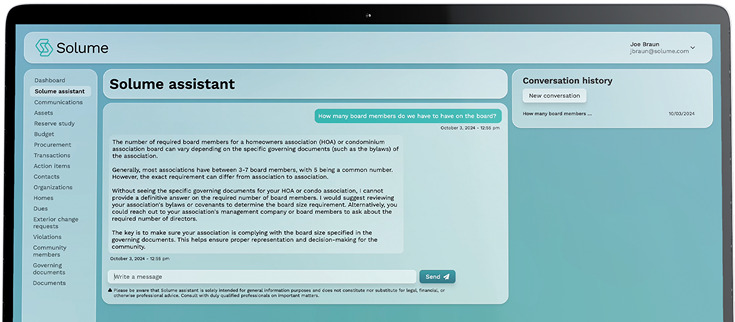
The HOA financial management tool connect reserves to the operating budget and dues collection, so a volunteer treasurer can see the whole financial picture without stitching together three programs. Because the platform includes an AI assistant for questions about governing documents and compliance, boards get plain-language answers instead of guessing. The point isn't to replace your reserve study preparer. It's to make the ongoing financial responsibility and financial transparency manageable for people who never signed up to be accountants.
From spreadsheet chaos to a live reserve dashboard: how to switch
Switching off spreadsheets is less painful than most boards fear. Start by gathering three things: your most recent reserve study, your current reserve fund balance, and your list of common area assets with their last-known replacement dates. That's the raw material.
From there, the work is to enter the component inventory once and let the software carry it forward. Instead of a treasurer manually recalculating a funding plan every year, the dashboard updates percent funded as balances change. It flags when a component is nearing the end of its lifespan analysis window. The compliance tracking piece watches for your state's reserve study update deadlines so nothing lapses quietly.
The practical payoff shows up at the next annual meeting. Rather than defending a spreadsheet, the board projects a clean dashboard showing exactly where reserves stand and why the funding plan looks the way it does. That protects community stability and property values. If you ever need an HOA loan, it gives lenders the documented capital planning tool they want to see.

A solid reserve study for homeowners associations is the foundation, and most boards struggle to keep it current. If your board wants a clearer way to handle reserve planning, compliance tracking, and financial transparency without paying for a management company, you can book a 15-minute fit call with Solume to see whether the platform is a good match for your community. No pressure, just a straight conversation about where your reserves stand and what would make managing them easier.
Frequently Asked Questions
What does a reserve study for a homeowners association actually include?
It has two parts: a physical analysis where a professional inspects reserve components like roofs, pools, private streets, and elevators to estimate their remaining useful life and replacement cost, and a financial analysis that projects year-by-year funding needs over 20-30 years. Together, they tell your board how much to set aside now to avoid a funding gap later.
How often does an HOA need to update its reserve study?
Best practice is a full site-visit study (Level I) every 3-5 years, with a site-visit update roughly every 3 years and a no-site-visit financial update in between. State law and your governing documents may dictate your exact cadence, so check both before setting a schedule.
Who is qualified to prepare a reserve study for an HOA?
Reserve studies are typically prepared by specialized firms with credentialed analysts, such as Association Reserves or Reserve Advisors, rather than a board member or general property manager. Look for preparers who follow the National Reserve Study Standards and can deliver full, site-visit, and desktop update levels.
Is a reserve study really worth the cost for a small self-managed HOA?
For a few thousand dollars, a reserve study replaces guesswork with a documented funding plan that can prevent a five- or six-figure special assessment down the road. For volunteer boards without accounting expertise, it also serves as evidence you met your fiduciary duty to plan for major repairs.
What happens if our HOA skips the reserve study or lets it go stale?
Without a current study, boards tend to underfund reserves and get surprised when a roof or road fails, forcing an emergency special assessment or loan onto homeowners. In compliance states like Florida and California, an outdated or missing study can also put the association out of legal compliance.
What's the difference between a full reserve study and an update?
A full study (Level I) builds the component inventory from scratch, with a specialist measuring and assessing every common element on-site. An update reuses the existing inventory and refreshes conditions, costs, and funding projections, either with or without a site visit, which is why updates cost less and take less time.
How does a reserve study help prevent special assessments?
By listing every major asset, projecting when each will need replacement, and comparing that need against your current reserve balance, the study shows exactly how much to save each year. Following that funding plan spreads costs smoothly over time instead of hitting owners with a sudden lump-sum charge.