A homeowner files a formal request to inspect three years of financial records. The board treasurer realizes those files live in a former president's personal Gmail account, and half of them are already deleted. That scenario happens more often in self-managed communities than most boards admit. It's exactly why records management isn't a back-office chore. It's an important obligation with real deadlines and real liability attached. This article walks through what HOA records are, how long you may need to keep them, who's allowed to see them, and how to build a records management system that survives leadership turnover.
Key Takeaways
- Records management is the structured handling of information from creation through storage to final disposition, not simply filing paperwork.
- A record becomes legally distinct from a working document the moment it's finalized, so retention rules apply only after that point.
- Retention periods are often dictated by external rules rather than internal preference, with common examples requiring 3-4 years for tax-related records.
- Missing or disorganized records most often surface as a liability during audits, legal disputes, or leadership transitions rather than day-to-day operations.

What records management means for an HOA
What is records management, once the jargon gets stripped away? It's the structured handling of a community's information from creation or receipt, through active use, into storage, and finally to disposal or permanent archive, and asking what records management actually means is the right starting point before building any process. For an HOA, that covers governing documents, board meeting minutes, financial records, member records, vendor contracts, and reserve study documents. The goal isn't neatness. The goal is producing the right record, in its original form, on demand.
Most boards assume recordkeeping means stuffing papers into a filing cabinet. In reality, records management for a self-managed HOA is a defined process with rules about retention, access, and secure data storage, and knowing what that actually requires is the first step toward fixing a broken system. The discipline borrows directly from established practice. The U.S. National Archives publishes general records management policy that frames records as information an organization must keep for a set period, not just whatever sits on a hard drive. The same principle governs an association's obligations, and boards seeking a broader framework can find useful parallels in federal recordkeeping and compliance standards published by the U.S. Small Business Administration.
Why records management matters for HOA boards
Here's the hard truth: disorganized HOA records don't hurt you on a quiet Tuesday. They hurt you during an audit, a dispute, or a board transition, when a missing document becomes evidence of a problem. A board that can't produce signed board meeting minutes approving a special assessment may find that assessment challenged. A treasurer who can't show three years of financial records invites homeowner distrust and, in some states, personal liability.
This matters because board members carry a fiduciary duty to safeguard community assets, and missing records can be viewed as a breach of that duty, which is why fiduciary duty sits at the core of every retention decision a board makes. Good records management is how boards demonstrate financial transparency and support their decisions. The Community Associations Institute, the main trade association for community associations, consistently points to documentation as a frontline defense in governance disputes. Strong record-keeping also protects volunteer board members personally, since a board that cannot document a decision is treated, in practice, as if it never properly made one.
Types of records HOAs must keep (governing docs, financials, minutes, member records)
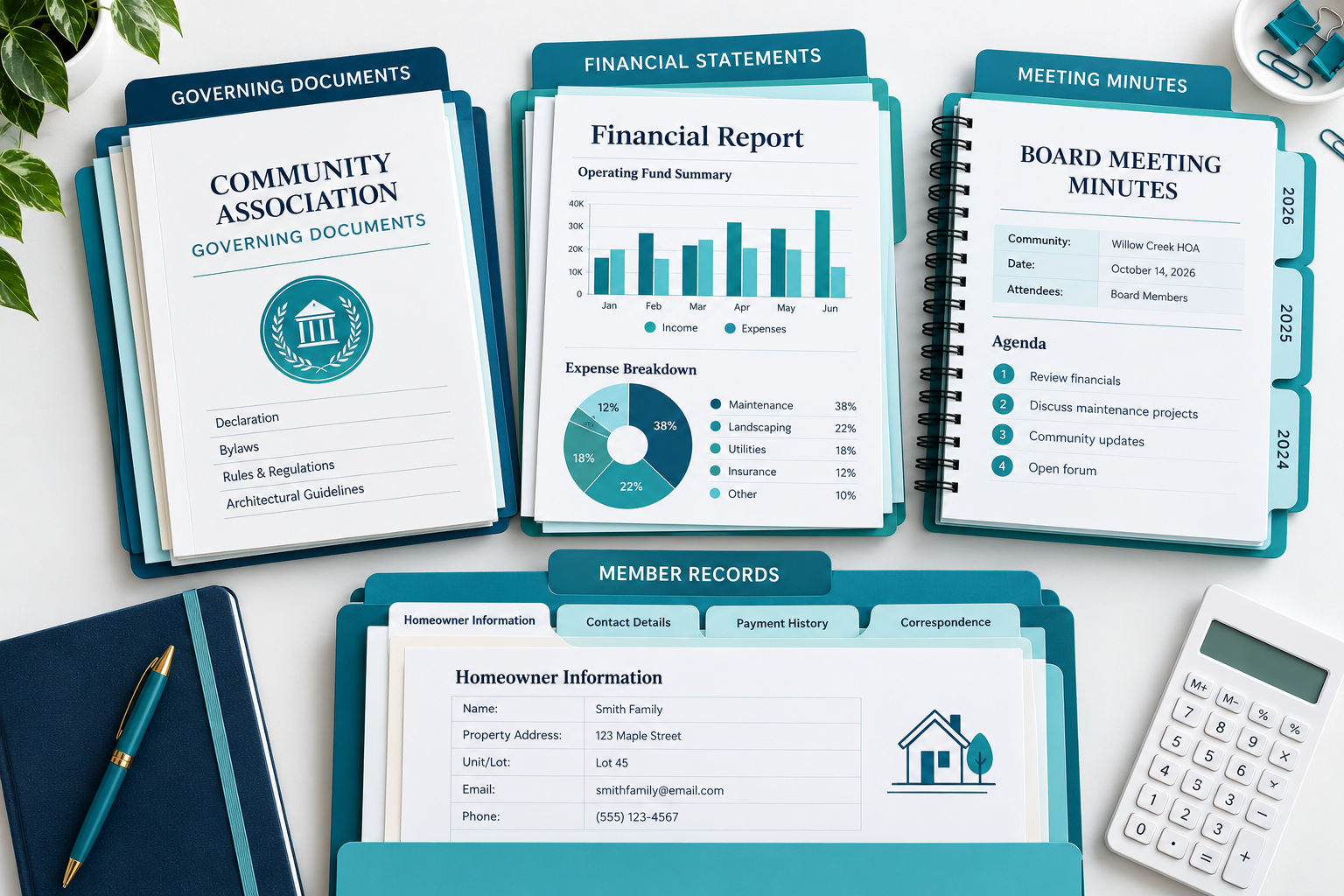
An HOA's records fall into a few clear categories. First, governing documents: the declaration, bylaws, CC&Rs, articles of incorporation, and recorded amendments. These rarely change but must always be accessible. Second, financial records: budgets, bank statements, audits, tax filings, reserve study documents, and dues ledgers. Boards that want a deeper walkthrough of how to organize these day-to-day can reference this guide to HOA bookkeeping best practices for a practical starting point.
Third, board meeting minutes and official correspondence, which document every formal decision the board makes. Fourth, member records: owner contact information, account balances, violation histories, and architectural review requests. Keeping these in one place is far easier with centralized member and home records rather than scattered spreadsheets and email threads. Fifth, operational files like vendor contracts, insurance policies, and maintenance logs.
Many boards treat all of these as interchangeable paperwork. They aren't. Governing documents are permanent. Member records carry data security and privacy obligations because they contain personal information. Vendor contracts and financial records follow retention schedules tied to tax rules and compliance requirements. Classification drives retention length, disposal method, and inspection rights, so a misfiled document is also a misgoverned one, and getting those compliance requirements right starts with knowing which category a document belongs to.
The records lifecycle: creation, use, retention, and disposal
Every record moves through four stages. Understanding this lifecycle is what separates real records management from random filing. Stage one is creation: a document is drafted, received, or generated. Stage two is active use, when the record gets referenced for ongoing decisions, like a current budget or an open vendor contract.
Stage three is retention. Once a document is finalized, it becomes an official record and enters storage under a record retention schedule. A draft budget is a working document, but the board-approved version is a record to which retention rules apply, since retention requirements generally govern final decisions, not the drafts that led to them.
Stage four covers record disposal, the final step most boards overlook until a privacy complaint forces the issue. Once the required retention period ends, files are either permanently archived or destroyed through a documented process, and this final stage matters most for member records containing personal data. Manually tracking every document type is tedious, which is where an electronic records management system earns its keep by automating each transition and flagging what's due for action.
Core principles of good records management (integrity, accountability, accessibility)
Three ideas anchor the key principles of records management, and grasping them matters more than memorizing any single rule. Integrity means a record stays unaltered after it's finalized. If someone can quietly edit approved board meeting minutes, those minutes stop being reliable evidence of what the board actually decided. Version control and audit trails protect integrity.
Accountability means someone is clearly responsible for each record. In a typical self-managed HOA, records scatter because no one owns them, so files vanish when a volunteer resigns. A records management policy fixes this by naming who stores, maintains, and disposes of each record type.
Accessibility means the right people can find the right record quickly, while the wrong people can't. This is access management: homeowners get their records inspection rights, sensitive member records stay protected, and board roles determine who sees what. Consider a treasurer who keeps every financial record in a personal spreadsheet with no backup or shared access. When that treasurer resigns mid-year without handing off the file, the new board rebuilds budgets and reserve study documents from bank statements, and a records request during that gap can stall for weeks. These principles separate answering a request in minutes from spending weeks reconstructing history from scattered digital and paper records.
Benefits of strong records management for communities
The benefits of records management go beyond simple compliance, and they start with operational efficiency: boards stop wasting meetings hunting for last year's audit or a vendor invoice. Decisions move faster when supporting documents are a search away, especially when boards use dedicated HOA financial management tools instead of ad hoc spreadsheets.
Financial transparency is the bigger payoff. When homeowners can see clean financial records and understand how reserves are funded, trust improves and conflict drops. Picture a community facing a surprise $40,000 roof repair: the board that kept organized reserve study documents can show owners the plan was funded and expected, while the board without those records faces an emergency special assessment and furious homeowners who feel blindsided.
Strong record-keeping also supports regulatory compliance, protects volunteer board members from liability, and makes leadership transitions painless. When a treasurer steps down, the next one inherits a working system instead of a mystery. This is where long-term planning pays off: records organized while the board is calm support it when a dispute arrives. For small communities running on volunteer time, those benefits translate directly into less burnout and more community stability.

Record retention schedules: how long to keep each document
A record retention schedule tells you approximately how long to keep each document before you can dispose of it. This is where boards get into trouble by guessing. Retention periods are usually set by external rules, not internal preference. Tax-related financial records are commonly kept three to four years, matching the audit windows described in IRS guidance on homeowners association tax filings, while some states may require seven years for certain association financials.
Governing documents are kept permanently. Board meeting minutes are typically retained for the life of the association. Contracts are often held for several years past their expiration. Member records follow privacy rules that may require secure disposal once retention ends.
Here's the catch: retention periods can vary significantly by state, since Florida, California, Nevada, and others may each set their own statutory minimums for HOA records. Each state statute can set the clock differently, so a federal tax guideline does not necessarily override a longer state minimum. Because state laws differ on these specifics, build your record retention schedule around your specific state's HOA statute, and have your association attorney confirm the interpretation for your community. A state-mapped records management checklist, reviewed with legal counsel, keeps the board from destroying records too early or hoarding documents long past their required life.
Members' rights to inspect and access HOA records
Homeowners generally have record-inspection rights under state law, and ignoring them is one of the fastest ways a board can end up in a dispute. Most state HOA statutes give members the right to inspect governing documents, financial records, budgets, and board meeting minutes, usually within a defined response window and sometimes with reasonable copying fees.
Many boards assume they can decide case by case what to share. In reality, statutes typically set these records-inspection rights, and refusing a valid request can trigger penalties or disputes. The specifics vary by state: some set strict deadlines, some limit which records members can see, and some protect certain sensitive member records, like individual delinquency details, from general inspection.
Good access management handles both sides. It lets homeowners quickly access what they're entitled to under applicable law while protecting data security and the privacy of records that shouldn't be public. A system that logs who accessed what also protects the board by showing it responded to a request, since a timestamped record is far stronger than a board member's memory. Because inspection rules vary by jurisdiction, confirm your obligations under your state's HOA statute and consult your attorney when a request is unusual.
How HOA software centralizes records and reduces board burnout
Board burnout is real, and scattered records are a major cause. When governing documents live in one person's email, financial records sit in a spreadsheet, and board meeting minutes are in a shared drive nobody updated, every records request becomes a scramble. Centralization fixes the root cause, because the problem was never a shortage of effort; it was the absence of a single place where records live and update as the board works.
A well-run records management program pulls every record type into one secure location with defined access management and secure data storage. That means governing documents, financial records, vendor contracts, and member records are searchable in seconds, not days. Digital records with proper backups also survive the volunteer turnover that destroys paper records, and an AI Assistant that helps boards track compliance can flag gaps before they become a liability.
Purpose-built HOA management software goes further by tying records to the work that creates them. Solume keeps member and home records, financial reporting, vendor management, and reserve study documents in one platform built for self-managed boards, so the records organize themselves as the board operates. That turns record-keeping from a separate chore into a byproduct of normal work, which is exactly how you reduce the administrative load on volunteer board members.
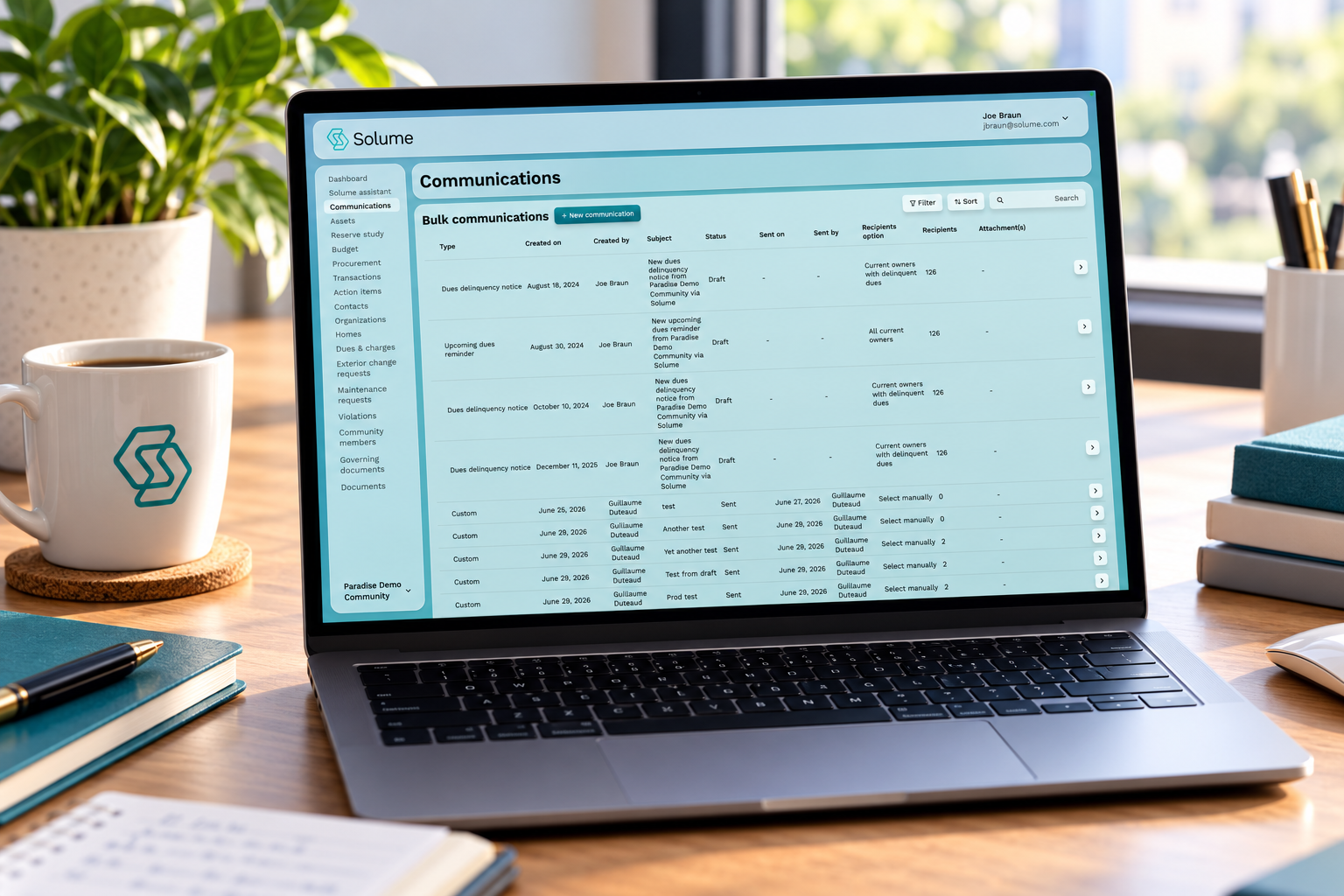
If your board is tired of chasing documents and wondering whether you're meeting your state's record retention rules, there's a simpler path. Solume centralizes financial records, reserve planning, vendor oversight, and member records in one system built specifically for self-managed communities, so you can see whether it fits your community on a 15-minute call. No pressure, just a straight answer about whether it solves the records management problems your board is actually facing.
Frequently Asked Questions
What exactly does records management involve?
It covers the full life-cycle of a record: from the moment it's created or received, through storage and active use, to final disposition by destruction or permanent archiving. For an HOA, that means everything from board meeting minutes to vendor contracts needs a defined path from creation to retention or disposal, not just a folder on someone's laptop.
How is records management different from just storing documents?
Document management handles files while they're still active- being drafted, edited, and shared- while records management takes over once a file becomes an official record that must be preserved unaltered and disposed of per policy or law. A draft board resolution is a document; once approved and signed, it becomes a record subject to retention rules.
What are the four main types of records?
Records are typically grouped into financial, legal, administrative, and operational categories, though the exact labels vary by organization. For a self-managed community, that means financial statements; governing documents and contracts; meeting minutes and correspondence; and maintenance or vendor records.
How do I actually set up record keeping for a small organization or board?
Start with a written policy that lists every record type you hold, assigns a retention period based on legal or regulatory requirements, and names who's responsible for storage and access. Many state and federal rules specify minimums: for example, tax-related records are commonly kept 3-4 years, so the schedule should be built around those requirements rather than guesswork.
Is formal records management really necessary for a small volunteer-run board, or is it overkill?
It's not overkill: it's the difference between answering a homeowner's records request in minutes and digging through someone's personal email for weeks. Boards that skip this step often discover the gap during an audit, a legal dispute, or a board transition, when missing records become a liability rather than an inconvenience.
What happens if records are poorly managed or go missing?
Gaps in records create compliance exposure under laws like state HOA statutes, HIPAA, or Sarbanes-Oxley, depending on the sector, and they weaken an organization's position in disputes or audits because there's no documentation to point to. For boards specifically, missing financial or meeting records can undermine homeowner trust and expose directors to personal liability claims.