A homeowner in a 45-lot subdivision outside Charlotte asks to see the association's bank statements. The board refuses. That single decision, denying records access that North Carolina HOA laws plainly require under Chapter 47F, is how a routine dispute turns into a lawsuit the board pays for out of its own reserves. Most volunteer boards don't break the rules on purpose. They break them because nobody ever explained which rules apply to their community. This article walks through the statutes that govern North Carolina associations, what fiduciary duty actually demands of your board, and where the state draws the line on HOA power, a topic especially relevant for self-managed HOA boards navigating these challenges without professional management support.
Key Takeaways
- North Carolina HOA laws are split primarily between Chapter 47F for planned communities formed after 1999 and Chapter 47C for condominiums formed after 1986.
- Communities with 20 or fewer lots, or those established before the 1999 cutoff, are often exempt from the Planned Community Act unless they opt in through their declaration.
- No state agency actively enforces HOA compliance in North Carolina, so disputes are typically resolved through the governing documents and civil court.
- Homeowner protections under Chapter 47F include access to financial records and advance notice before fines or liens are imposed.
- North Carolina's HOA regulatory framework is generally considered moderate compared to stricter states like Florida and California, but boards still carry fiduciary liability under the Nonprofit Corporation Act.
What North Carolina HOA laws are and why they matter
North Carolina HOA laws are not one single rulebook. They live in a few separate statutes, and which one governs your community depends on when and how it was formed. The two that matter most are the North Carolina Planned Community Act (Chapter 47F) for subdivisions and the North Carolina Condominium Act (Chapter 47C) for a condo association. In addition, nearly every homeowners association is also a nonprofit corporation, so the NC Nonprofit Corporation Act (Chapter 55A) governs elections, meetings, and corporate records. The formation date matters because the legislature set hard cutoffs: a community's founding date determines which statute's protections and procedures apply, which is why no single rulebook can cover every association.
Here's the hard truth: no state agency in North Carolina polices HOA behavior. There's no complaint hotline and no regulator auditing your budget. When an HOA board oversteps, or a homeowner feels wronged, the fight happens in civil court, using the governing documents and these statutes as the yardstick. Because enforcement is reactive rather than proactive, the only thing standing between your board and a lawsuit is how well it already follows the law. Knowing North Carolina HOA laws is self-protection.
You can read the full statutory text through the North Carolina General Assembly's official statute portal, which publishes Chapter 47F in its entirety. Rules vary by state and by community age, so boards should confirm which chapter applies and consult a licensed attorney for guidance specific to their situation.
How an HOA functions: maintaining and protecting property value
An HOA exists to do one practical job: keep shared property functioning and protect value across every home in the community. Roofs on shared buildings, private roads, retaining walls, pools, landscaping, and stormwater systems are collective assets. No single owner can maintain them alone, so the association collects fees, hires vendors, enforces architectural standards, and plans for repairs.
Here's why this matters: property value in a planned community is interconnected. A neglected clubhouse or a cracked private road drags down every nearby appraisal, not just the one next door. The reason is simple: buyers and their lenders price in the condition of shared assets, so deferred maintenance on common property quietly discounts every home attached to it. The National Association of Realtors documents how neighborhood condition and shared amenities influence buyer decisions, viewable through the National Association of Realtors. Lenders scrutinize finances during due diligence, and a weak reserve fund can kill a sale.
Many homeowners assume the board exists to issue fines. In reality, its core function is stewardship: fair dues collection, maintaining common areas, and preventing the slow decay that erodes community stability. Architectural review, vendor management, and dues enforcement all serve that goal. When boards treat enforcement as the mission instead of a tool, they lose the trust needed to do the actual work.

What fiduciary duty means for an HOA board
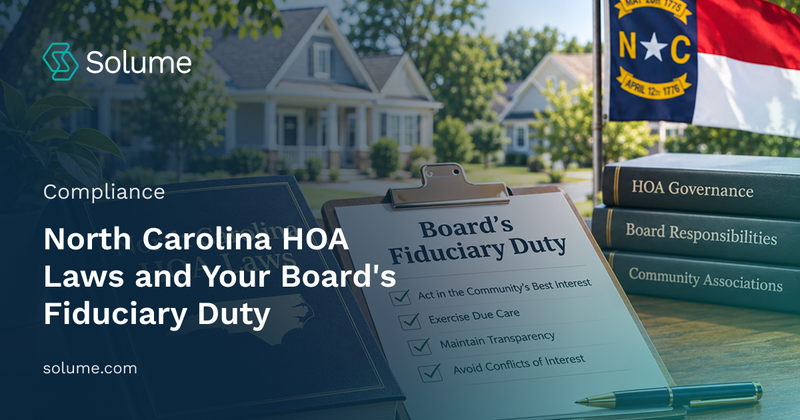
Fiduciary duty is the legal obligation every board member takes on the moment they're elected. It means acting in the community's best interest, not your own, and not the interest of a friend who happens to own a landscaping company. Under the NC Nonprofit Corporation Act, board members owe the association a duty of care and a duty of loyalty that doesn't soften for volunteer board members.
Here's what happens when an HOA board ignores fiduciary duty: decisions get challenged, and individual members can be named personally in a lawsuit. Approving a vendor contract without bids, ignoring a reserve shortfall, or spending money outside the governing documents can expose the board to breach-of-fiduciary-duty claims. Knowing when a board needs legal counsel can be the difference between a quietly resolved dispute and a costly courtroom battle.
Picture a board that approves a $30,000 repaving contract with the treasurer's brother-in-law, skips competing bids, and never records the decision in the minutes. When another owner challenges the cost, the board has no process to point to, and the duty-of-loyalty question lands on individual members. That is how a routine vendor choice becomes personal exposure.
Many volunteers assume good intentions protect them. Courts look at process, not feelings. The duty of care is satisfied by acting on reasonable information: reviewing the budget, getting multiple quotes, documenting decisions, and following the declaration. Board responsibility here is procedural, and that same board responsibility separates a defensible decision from a costly one. A board with clean records and documented choices is far harder to hold liable than one running on gut and goodwill.
The financial reality: reserves and financial responsibility
Most boards underfund their reserves. That's the quiet crisis in self-managed communities across North Carolina. Reserves are the savings account for big-ticket capital repairs: the roof, the private road, the pool resurfacing due in year 15. When that money isn't there, boards have two bad options: defer maintenance or hit every owner with a special assessment.
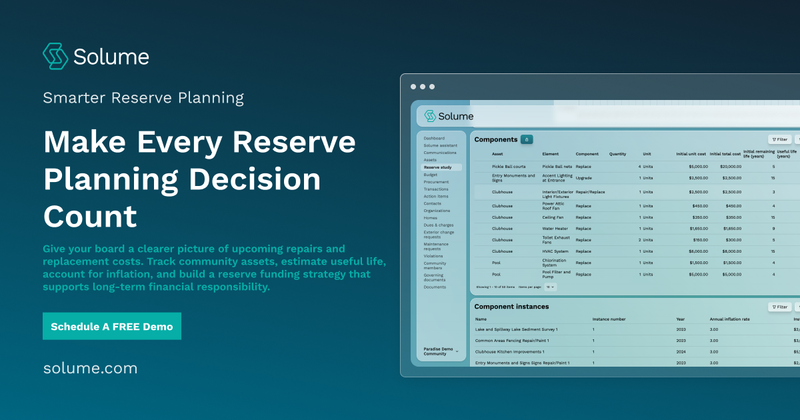
The 2021 Surfside condominium collapse in Florida, which killed 98 people, is the extreme consequence of deferred maintenance left unaddressed for years and chronic reserve underfunding. North Carolina doesn't mandate reserve studies the way Florida does now, but the underlying financial responsibility is identical. A professional reserve study, guided by an understanding of North Carolina's reserve study requirements, tells your board what components will fail, when, and how much to set aside each year so you're not scrambling. The mechanism is straightforward: capital components wear out on a predictable schedule, so a reserve study converts a known future cost into a smaller annual contribution spread across every owner who benefits from the asset.
Here's the risk most boards overlook: underfunded reserves don't just threaten safety; they tank property value. Lenders flag weak reserves during financing, and special assessments scare off prospective owners. Diagnosing a reserve shortfall early is hard when the numbers live in spreadsheets nobody updates, which is where Solume's automated tools help boards project future liabilities and build a funding plan instead of guessing, turning reserve planning into routine math rather than crisis management. Long-term planning turns a looming $400,000 roof replacement from a panic-inducing assessment into a line item funded quietly over a decade.

Reviewing CC&Rs and governing documents under NC law
Your governing documents are the constitution of your community. They include the declaration, often called the CC&Rs (covenants, conditions, and restrictions), the bylaws, and any rules the board adopts under them. These documents define the HOA's power: what it can enforce, how dues are set, how the board is elected, and what owners can and can't do with their homes.
Under North Carolina law, the statute fills gaps the documents leave open, but the documents control first. If your declaration predates January 1, 1999, and has fewer than 20 lots, Chapter 47F may not apply unless you've amended the declaration to opt in. That's why two neighborhoods a mile apart can live under entirely different rules. North Carolina HOA laws are written as a default layer, so wherever your declaration is silent, the statute steps in, but it never overrides a valid provision your community already adopted.
What many communities don't realize: you can't enforce a rule that isn't actually in your governing documents. Boards routinely try to fine owners for violations the declaration never addressed, then lose when challenged. Before issuing any fine or restriction, pull the CC&Rs and confirm the authority exists in writing. Keeping member and home records organized, along with the declaration and amendments, isn't busywork. It's the evidence that proves your board acted within its granted power, which is exactly what a court examines first.
Limits on HOA power under North Carolina statutes
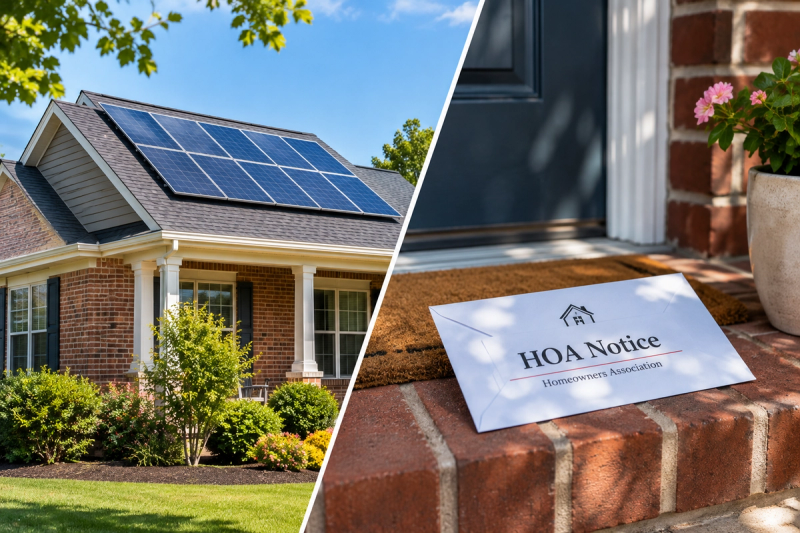
An HOA is not a government, and it doesn't have unlimited authority. North Carolina statutes and the governing documents both cap what a board can do. Chapter 47F requires advance notice and a hearing before most fines or liens, and it guarantees owners access to financial records. A board can't fine in secret, lien a home on a whim, or deny a homeowner the records they're entitled to inspect.
State laws also carve out specific protections. North Carolina law generally prevents associations from prohibiting solar panels outright, reflecting a broader statutory trend protecting owners' energy choices. Rules around accessory dwelling units are shifting too, driven by local zoning changes that can override an older restriction. Boards should check their local zoning board and current state laws rather than assume the declaration still controls.
Most power disputes trace back to a board acting beyond its documents or skipping required process, a compliance risk that's easy to avoid. Homeowner rights under Chapter 47F are procedural: notice, a hearing, records access, and consistent enforcement. A board that selectively enforces, fining one owner's fence color while ignoring another's, invites a discrimination or unequal-enforcement claim. The underlying reason is that courts treat inconsistent enforcement as evidence the rule was never applied fairly, which weakens the board's standing even when the original violation was real. Limits exist to keep boards accountable, and ignoring them is how volunteer leaders end up personally exposed.
Why transparency and compliance protect boards from liability
Transparency is not a nicety; it's the cheapest liability insurance a board can buy. When homeowners can see where their fees go, trust rises, and disputes fall. When financial information is hidden, owners assume the worst, and that suspicion drives records requests, contested elections, and lawsuits. Financial transparency defuses conflict before it starts.

Legal compliance works the same way: following your governing documents, giving proper notice, keeping accurate books, and documenting decisions creates a paper trail proving the board met its fiduciary duty. That record is your defense. The risk isn't just a fine; it's a board member being named personally when process breaks down. Financial transparency and preventing fraud and protecting association funds go hand in hand, because open books make it far harder for funds to quietly disappear.
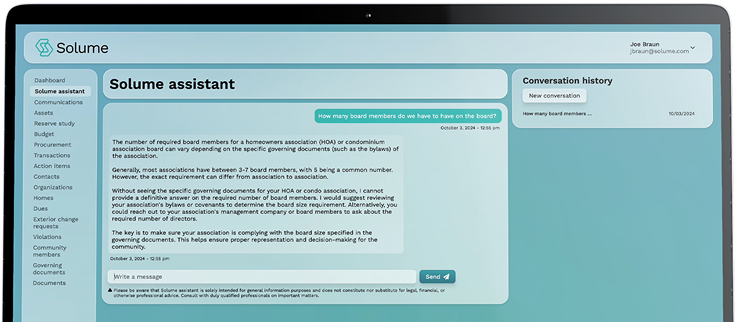
Self-managed communities carry this weight without a management company's staff, so the records that prove compliance often live in one volunteer's inbox or a binder nobody can find at meeting time. That scattered recordkeeping is the specific problem Solume is built to solve: it centralizes financial reporting, compliance tracking, and communication so boards can show their work. The AI Assistant helps members understand their governing documents and general compliance topics, though it is not a substitute for advice from a licensed attorney. Transparency and compliance reduce risk together, protecting both the community and the people who volunteer to run it. Boards that treat North Carolina HOA laws as a working checklist rather than an afterthought are the ones that stay out of court.
If your board wants a clearer way to manage reserve planning, financial transparency, and compliance without a management company, you can see how it works for your community on a quick call with the Solume team to find out whether it is a good fit.
Frequently Asked Questions
Are HOAs in North Carolina actually regulated by the state?
Yes, but through several separate statutes rather than one agency. Planned communities formed on or after January 1, 1999 fall under the Planned Community Act (Chapter 47F), while condominiums created after October 1, 1986 fall under the Condominium Act (Chapter 47C). There's no state HOA regulatory board, so enforcement typically happens through civil court or the governing documents themselves.
Does the Planned Community Act apply to every HOA in North Carolina?
No. Chapter 47F automatically applies only to planned communities with more than 20 lots established after January 1, 1999. Smaller or older communities aren't covered unless their declaration specifically opts into the Act, which means two neighborhoods a mile apart can operate under completely different legal rules.
Can a group of homeowners just decide to form an HOA without everyone agreeing?
No, an HOA can't be created or imposed on existing homeowners without their consent. HOAs are established when a developer records a declaration before lots are sold, so the authority comes from that original legal document, not a later vote by neighbors.
What rights does a homeowner actually have against their HOA under NC law?
Homeowners have the right to inspect governing documents and financial records, attend and vote at meetings, and receive proper notice before fines or liens are assessed. Chapter 47F also requires HOAs to follow their own declaration and bylaws, so a board acting outside those documents can be challenged in court.
Is it even worth learning the difference between Chapter 47F and Chapter 47C?
It matters more than most boards assume, because the two statutes set different rules for assessments, meetings, and record-keeping depending on whether a community is a condominium or a planned subdivision. Applying the wrong statute's requirements can lead to invalid fines or improperly adopted budgets.
If North Carolina's HOA laws are mid-range, is compliance still a real risk for small boards?
Yes. Even though North Carolina isn't as strict as states like Florida or California, volunteer boards still face liability for mishandled assessments, improper lien filings, or missed notice requirements under Chapter 47F. The lighter regulatory environment doesn't remove the board's fiduciary duty, it just means fewer state agencies are checking the work.
What are the baseline rules every NC HOA has to follow, regardless of statute?
Every HOA must operate according to its recorded declaration, bylaws, and any rules adopted under those documents, covering dues collection, architectural standards, and use restrictions. Beyond the governing documents, associations formed as nonprofit corporations also answer to the NC Nonprofit Corporation Act for things like board elections and corporate recordkeeping.
Does North Carolina have the highest HOA fees in the country?
No, North Carolina is not typically cited among the states with the highest HOA fees; that distinction tends to go to states with dense condo markets like Hawaii, California, and Florida. Fee levels in NC vary widely by community size and amenities rather than being driven by state law.