To track an HOA maintenance request through completion, give it four things: one named person who owns the follow-up, one shared record the whole board can see, a status that says what you're waiting on and when someone will check again, and proof the work is actually done before you close it. Calling the vendor is step one. It is not the finish line.
This works for HOA and condo boards, whether you self-manage or work with a manager. Condo associations often fall under different state laws, and their documents may split repair responsibility differently, so check your own rules before you borrow anyone else's.
Key Takeaways
- Every open request needs one named owner. "The board will handle it" means nobody will.
- Routine requests go to one place. When a report shows up by text or in the parking lot, the board member who hears it logs it.
- Check who's responsible before you promise a repair. A report tells you something is broken. It doesn't tell you who pays to fix it.
- A status should answer two questions: what are we waiting on, and when does someone check again?
- Residents should always know when they'll hear from you next, even when the answer is "still waiting."
- Close with evidence, not memory. A photo for visible work. The professional's paperwork for technical work.
Why do HOA maintenance requests fall through the cracks?
You've been to the group dinner where everyone assumed someone else covered the check. Same thing happens with a broken gate.
A resident reports a problem. Five board members see the email. Each one figures another director is on it. Two weeks later the resident follows up, a different director answers, and the whole request starts over from scratch.
Nobody did anything wrong, exactly. Nobody did anything at all. The fix is not working harder. The fix is making it obvious who owns the next step.
Where should residents send routine maintenance requests?
Pick one standard place: a designated email address or a maintenance-request form in your software's resident portal. Then tell residents what to include:
- The exact location
- What they noticed
- When they noticed it
- A photo, if it's safe to take one
You'll still hear about problems at the mailbox and in personal texts. That's fine. The board member who hears it puts it in the shared record. The resident shouldn't have to report the same leak twice because they told the wrong neighbor first.
One rule: keep emergencies separate. Your routine inbox is not a 911 line, and residents shouldn't think it is. For anything that threatens life or safety, post the emergency contacts where people can find them.
Who is responsible for the repair: the association or the owner?
Before you promise a fix, find out whose fix it is. A leak behind a wall might be the owner's problem, the association's, or both, depending on your governing documents and existing agreements. When it's genuinely unclear, get qualified advice before anyone writes a check.
The person coordinating the request also needs to know their limits. Owning the follow-up is not a blank checkbook. Keep the approved scope and any required approvals attached to the request.
If the repair belongs to the owner, a utility, or someone else, tell the resident why and what to do next. Then record that referral, so the next director doesn't schedule a repair the association already decided it doesn't owe.
Who should own an HOA maintenance request?
One person. Not "the board." Not "whoever gets to it."
Owning a request doesn't mean crawling into the attic with a flashlight. The vendor owns the repair. A board member or your manager owns the association's follow-through: knowing whether the request is waiting on a decision, a vendor, or someone to check the finished work.
For each open request, record three things: who's following up, what happens next, and when they'll check again. If that person is going out of town, name a backup and hand it off out loud.
Here's what that looks like. A resident reports a broken light on a common walkway. The record says:
"Dana is coordinating. Electrician contacted Tuesday. Waiting on a visit date. Dana follows up Thursday and updates the resident."
Now any director can answer the resident without calling Dana. And if Dana rotates off the board next spring, the next person can see the request, the vendor, and the promise that was made.
What should a maintenance request status actually say?
Your residents get more status updates on a pizza than on a leaking roof. That's a low bar, and plenty of boards still trip over it.
"In progress" tells nobody anything. Keep your statuses simple, but make them mean something:
- Received and awaiting review
- Waiting on approval or a vendor response
- Scheduled, with the visit date recorded
- Reported complete and awaiting verification
- Verified complete, with the completion record attached
Every open item needs a next action and a date. "Waiting on vendor" with no follow-up date isn't a status. It's a tombstone.
Review open requests on a regular schedule that fits your board's workload, and handle urgent issues sooner. The goal is simple: the left hand should know what the right hand did yesterday. One director may be making calls nobody else can see. Put the latest call, decision, or change in the record, and the problem disappears.
What should you tell residents when a repair is delayed?
The truth, on a schedule. Say what you know, what you're doing next, and when you'll update them again. Don't promise a date the vendor hasn't confirmed.
Something like:
"The vendor told us the repair is running a few days behind. We're waiting on a confirmed visit date. Dana is following up Thursday, and we'll update you by Friday even if we still don't have a date."
You can't control when a part ships. You can control whether someone checks and tells the resident. Pick an update deadline you'll actually keep.
If the risk grows or the delay stops being reasonable, reassess. That might mean calling another qualified vendor. Not every delay is an emergency, but some delays turn into one.
Log every update in the request history. That keeps another director from giving the resident a different answer, or asking them to explain the whole problem again.
How do you know a repair is actually done?
Close the request with evidence, not with "I think Mike said they came out."
Before you mark anything complete, compare the work against the approved scope. Who checked it? What did they see? Is anything still outstanding? Save a short completion note and the evidence with the request.
For visible work, a photo does a lot. If the sidewalk repair is marked finished, a photo shows the next board exactly what "finished" looked like, without anyone relying on memory. In Solume, you can attach that photo right to the request.
Match the evidence to the job, though. A photo can't prove hidden work was done right, or that an electrical or structural repair is safe. For technical work, keep the professional's report, inspection paperwork, or required sign-off. If part of the job is still open, keep it open. Don't close the whole request just to clean up the list.
Once it's verified, tell the resident what was done and how to report anything that's still wrong. Keep the history. If the same problem comes back, link the new report to the old one so the board can see the pattern. Repeat repairs are often a sign the issue belongs in your preventive maintenance plan instead of your request queue.
Start with the requests already waiting
You don't need a new system to start. At your next working session, pull up every unresolved repair. For each one, fill in three blanks: who's following up, what happens next, and what evidence will close it. Do that before you add any more process.
Then use this checklist for every new request.
Repair Follow-Through Checklist
Adapt this to your association's responsibilities and approval rules. Emergencies go through your emergency route, not this list.
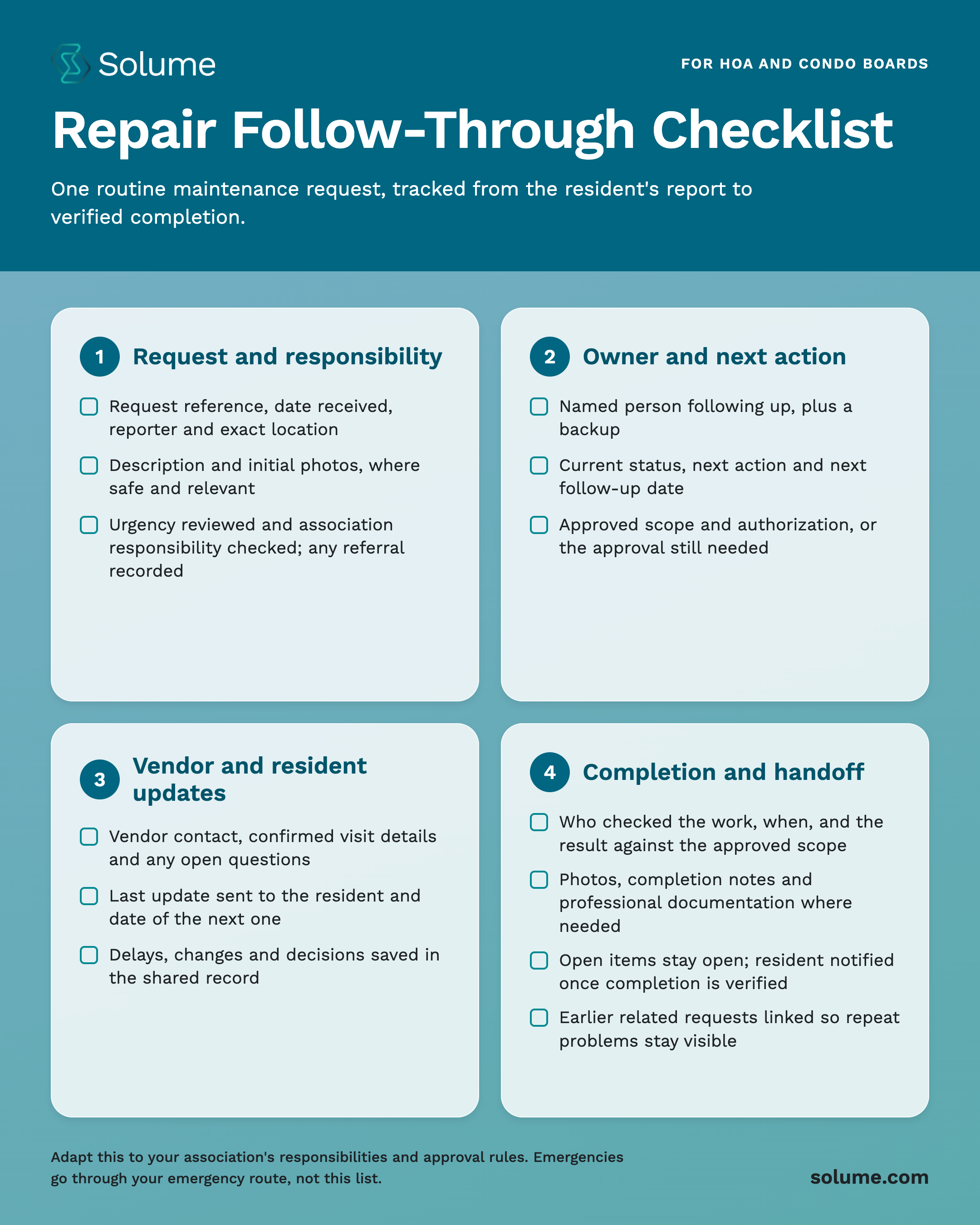
Request and responsibility
- Request reference, date received, reporter, and exact location
- Description and initial photos, where safe and relevant
- Urgency reviewed and association responsibility checked; any referral recorded
Owner and next action
- Named person following up, plus a backup
- Current status, next action, and next follow-up date
- Approved scope and authorization, or the approval still needed
Vendor and resident updates
- Vendor contact, confirmed visit details, and any open questions
- Last update sent to the resident and date of the next one
- Delays, changes, and decisions saved in the shared record
Completion and handoff
- Who checked the work, when, and the result against the approved scope
- Photos, completion notes, and professional documentation where needed
- Outstanding items left open; resident notified once completion is verified
- Earlier related requests linked so recurring problems stay visible
Frequently Asked Questions
What's the best way for an HOA to track maintenance requests?
Use one shared record for every request, assign a named person to each open item, give each item a specific status with a next follow-up date, and close requests only with evidence the work is done. A shared spreadsheet works when volume is low. As requests pile up, HOA software makes the history easier to keep and hand off.
Who on the HOA board should handle maintenance requests?
One named person per request, not the board as a whole. It can be any director, a maintenance committee member, or your community manager. What matters is that everyone can see who owns it and what happens next. Name a backup for when that person is away.
How often should an HOA board review open maintenance requests?
There's no universal rule. Pick a regular schedule that fits your board's workload, such as each working session, and stick to it. Urgent issues shouldn't wait for the next routine review.
Does the HOA have to fix every maintenance request?
No. Some repairs are the owner's responsibility, a utility's, or another party's. Check your governing documents and existing agreements before promising a fix, and get qualified advice when responsibility is unclear. If the association isn't responsible, explain why and record the referral.
Is a photo enough to close a maintenance request?
For visible work, a photo is often good evidence. For hidden, electrical, structural, or other technical work, it isn't enough. Keep the professional's report, inspection documentation, or required sign-off instead.
What's the difference between a maintenance request and preventive maintenance?
A maintenance request is a reported problem that needs a response. Preventive maintenance is scheduled work that keeps problems from happening. If the same request keeps coming back, it probably belongs in your preventive maintenance plan.
Does this process work for condo associations?
Yes. The same steps apply: one owner, one record, specific status, and verified completion. Condo associations often fall under different state laws and may divide repair responsibility differently between the association and unit owners, so check your own documents.
Where Solume fits
Solume gives your board one place to log requests, assign vendors, attach photos, and keep a visible history that survives board turnover. You can see how Solume handles vendors and maintenance requests here. The software holds the record. Your board still decides who follows up, what needs approval, and how completion gets checked.
Want to see it work? Book a demo and bring one open maintenance request. We'll walk it from the resident's report to documented completion.
By Joe Braun, Co-Founder and CEO of Solume