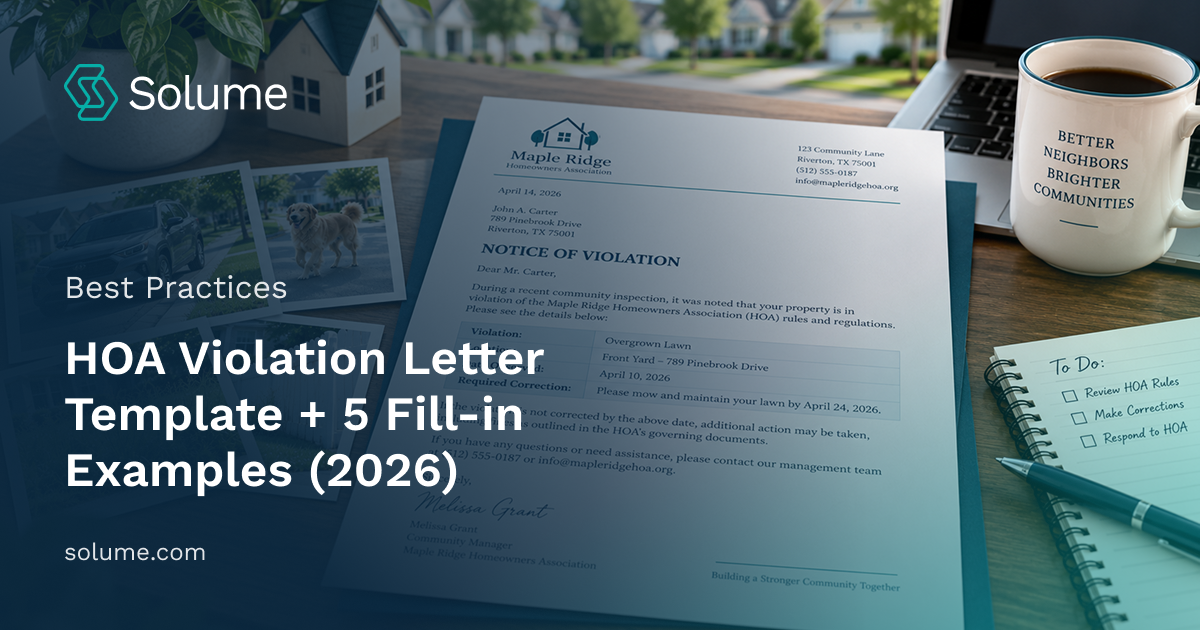
A homeowner leaves a boat in their driveway for three weeks. The board sends a vaguely worded email. Six months later, the association sits before a hearing panel with nothing on paper to defend its position. That scenario plays out constantly in self-managed communities. The fix is boring but effective: a proper HOA violation letter template that cites the exact rule, states the deadline, and stays objective. This article gives you the core structure plus five fill-in examples. They cover everything from a first courtesy notice to a final fine letter, along with the state-law catches most boards miss.
Key Takeaways
- An effective HOA violation letter template pairs the association's letterhead with the exact CC&R section, an objective description of the violation, and a stated compliance deadline.
- Objective, fact-based language protects the board, while emotional or vague wording weakens enforceability if the notice is later challenged.
- First courtesy notices usually give a 10-30 day cure window with no penalty, while final notices reference fines, hearings, and legal escalation.
- Matching the template to the specific violation category- parking, noise, landscaping, or unapproved modifications- keeps the rule citation accurate and defensible.
- State-specific notice and hearing requirements in places like Florida and California mean a downloaded template must be adjusted to local law before it's sent.
What an HOA violation letter is and when to send one
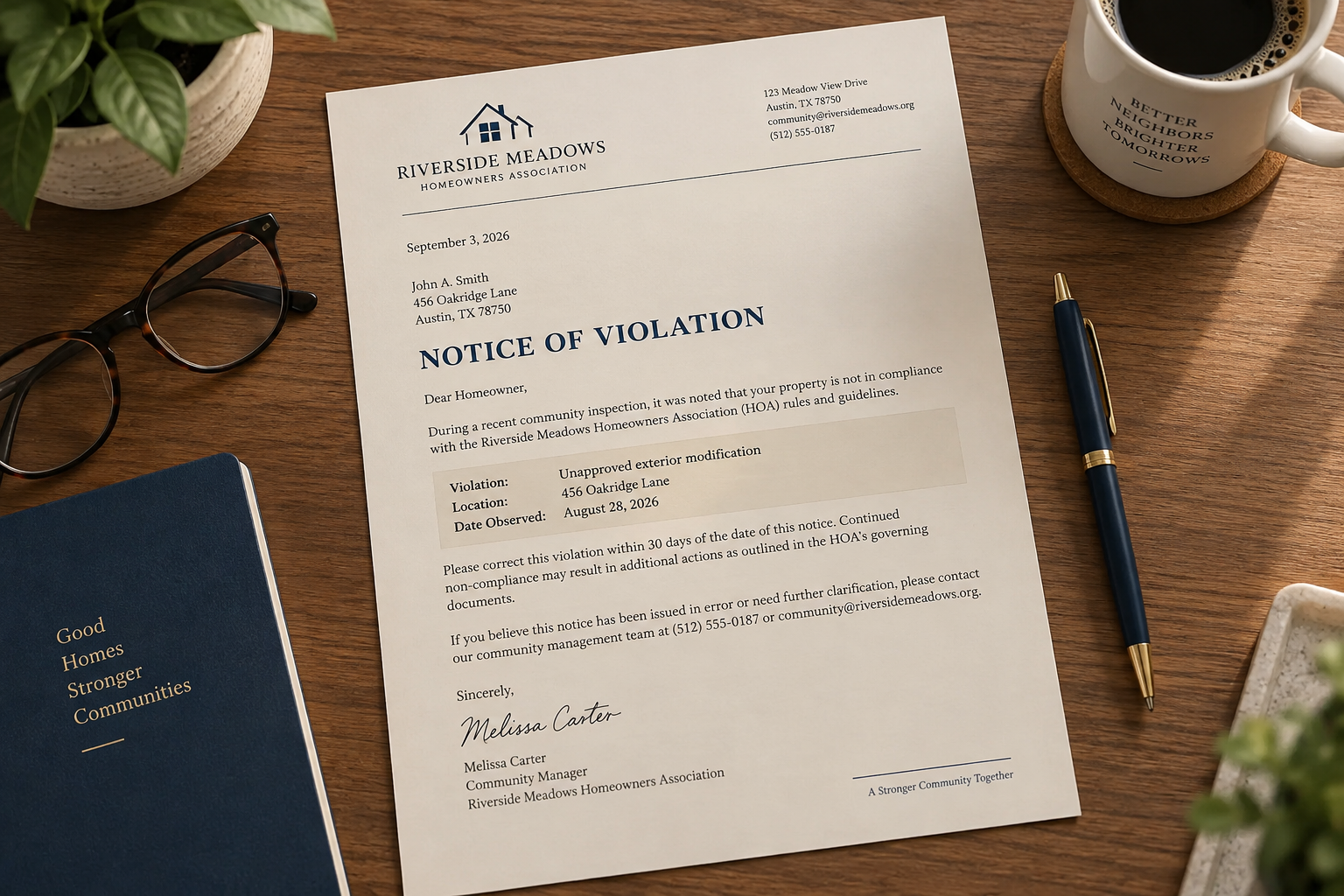
An HOA violation letter is the written notice a board sends when a homeowner breaks a rule in the community's governing documents. It's not a personal complaint. It's the first formal record that the association spotted a problem, cited the relevant rule, and gave the owner a chance to fix it.
Send one as soon as you document a violation, not after it's festered for months. Timing matters for a simple reason. Inconsistent or delayed enforcement gives owners a fairness argument if they later challenge the citation. A board that fines one homeowner for a fence but ignores three others has a weak position. Before you send anything, it helps to understand how self-managed boards handle enforcement without a management company, since volunteers bear the full burden of consistency.
Most boards assume a friendly phone call is enough for early issues, and sometimes it is. But nothing exists on paper. The written HOA violation notice creates the dated trail you'll need if the matter escalates to fines or a hearing. Requirements differ by state, so review your obligations against your state's HOA statute. When unsure, ask your association attorney. The Community Associations Institute publishes practical guidance on enforcement procedures at caionline.org. It's worth reading before you draft your first notice.

The fill-in HOA violation letter template (core structure to copy)
Every solid HOA violation letter template follows the same skeleton. Fill in the brackets, and you're done:
1. Letterhead and date: association name, contact info, and the date sent.
2. Owner name and property address: full legal name and the lot or unit.
3. CC&R citation: the exact section number, quoted, not paraphrased.
4. Violation details: what was observed, when, and where, stated as fact.
5. Required action: precisely what the owner must do to cure it.
6. Compliance deadline: a specific date, not "as soon as possible."
7. Consequences of non-compliance: fines, hearing rights, or escalation.
8. Resolution path and signature: how to respond, plus board contact.
When a letter gets challenged, a judge or hearing panel checks whether the notice named a specific rule and gave a real deadline. Vague letters lose. Before you draft, it's worth taking a moment to make sure the rule you're enforcing is actually enforceable, because a perfectly written letter citing an invalid rule still fails. Keep the tone factual and neutral even in an HOA warning letter. Save any friendliness for the courtesy stage. You can build this free HOA violation letter template once and reuse it for every case.
Example 1: First courtesy notice (friendly reminder)
The first courtesy notice is the one place a friendly tone belongs. Its whole purpose is to fix the problem without souring positive community relations. It should read like a neighbor tapping on your door, not a legal threat.
A typical fill-in:
> *Dear [Owner Name], during a routine inspection on [date] we noticed [violation details] at [property address]. Community rules section [CC&R citation] asks that [required action]. Please take care of this by [compliance deadline, often 10-30 days]. This is a friendly reminder, and no fine applies at this stage. If there's a circumstance we should know about, please reach out.*
Most first violations get resolved right here, which is exactly why this stage exists. Escalation usually starts with a missed message or a genuine misunderstanding, not defiance. A calm first courtesy notice clears up both, and consistent early outreach is one of the best ways to reduce recurring complaints before they escalate into formal disputes. Keep a copy anyway. Even a friendly reminder is part of your documentation. If the same issue returns, you'll want the record showing the board acted reasonably before moving to a formal violation notice.
Example 2: Formal second violation notice
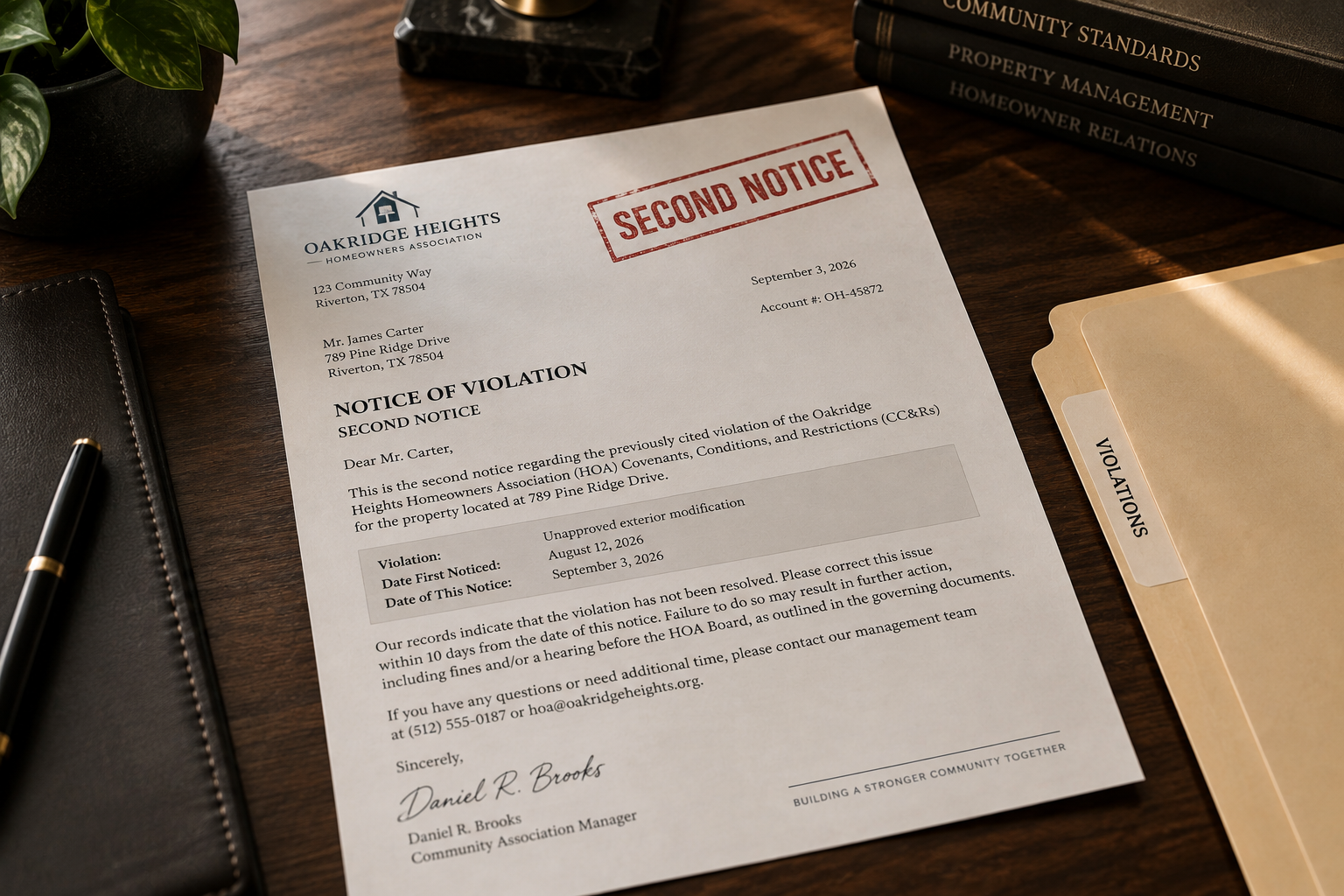
When the courtesy window closes and the issue remains, the second violation notice drops the warmth and states facts. This is a formal violation notice. It's still professional, but firm about the required action and the compliance deadline.
A fill-in structure:
> *Dear [Owner Name], our records show a courtesy notice was sent on [date] regarding [violation details] at [property address], citing community rules section [CC&R citation]. As of [date], the violation remains uncorrected. This second violation notice requires that you [required action] no later than [compliance deadline]. Continued non-compliance may result in fines and a hearing as provided in the governing documents.*
Many boards assume they can jump straight to fines the moment a deadline passes. In reality, most governing documents and several state statutes require a documented second notice. They often require a hearing opportunity too, before any penalty attaches. Skipping this step is how associations lose collection cases. This letter also serves as your CC&R citation on record for a second time. That strengthens the board's position if the matter later becomes a violation escalation letter or ends up before a panel.
Example 3: Final notice before fine or hearing
The final notice before a fine is the last off-ramp. By now, the owner has had a courtesy notice and a formal one. This letter tells them exactly what happens next and when. It should read as serious without being hostile.
A fill-in:
> *Dear [Owner Name], despite prior notices dated [dates] regarding [violation details] at [property address], the violation of section [CC&R citation] remains unresolved. This is your final notice before a fine. Unless [required action] is completed by [compliance deadline], the board will impose a fine of [amount] and/or schedule a hearing. You have hearing rights under the governing documents and applicable state law; to request one, contact [board contact] by [date].*
The final notice before a fine must spell out hearing rights for a concrete reason. Omitting them can invalidate the fine entirely in states with mandatory due-process rules. California boards, for example, should review California Civil Code §5850 on enforcement and fine policies before setting any penalty schedule. Cure timing matters here too. Give a real, calendar-specific window, because a fine imposed before the stated deadline is easy to overturn. This letter closes the informal phase. Everything after it, the HOA fine notice and any hearing- flows from what you documented in these three steps.
Example 4: Common-issue letter (parking, pets, lawn, signage)
Some violations show up over and over, and having category-specific templates keeps the rule citation accurate. The most common HOA violations fall into a handful of buckets. A generic letter that cites the wrong section is worse than no letter at all.
Match the template to the problem:
- Parking: an HOA parking violation letter cites the vehicle rule and names the specific vehicle, location, and dates observed.
- Pets: an HOA pet violation letter references the pet limit, leash, or noise provision and describes the exact incident.
- Lawn and landscaping: an HOA lawn maintenance violation notice cites the upkeep standard and describes the overgrowth or dead turf.
- Signage: cites the display rule and identifies the sign type, size, and placement.
Picture a board that sends a single boilerplate letter for a parking complaint but cites the landscaping section by mistake. The owner spots the wrong citation, ignores the notice, and the board has to restart the whole process, months lost over one copy-paste error. Precision is what makes these defensible. "A blue sedan parked on the lawn strip on [date]" holds up, while "your car is always in the wrong spot" does not. Owners also contest the most common HOA violations, so objective detail matters. Keep each category as its own HOA violation notice template. That way a volunteer board member isn't editing legal language under pressure.

Example 5: Fine or assessment notice letter
Once the deadline passes and you've honored your hearing rights, the fine or assessment notice makes the penalty official. This letter records the amount, the reason, and how to pay. It also doubles as your paper trail if the debt goes to collections.
A fill-in for an HOA fine notice:
> *Dear [Owner Name], following notices dated [dates] and the hearing held or offered on [date], a fine of [amount] has been assessed against [property address] for the continuing violation of section [CC&R citation]. Payment is due by [compliance deadline]. Unpaid fines may accrue interest and become subject to further collection under the governing documents and state law.*
For overdue dues rather than rule violations, the same structure becomes an assessment collection letter. It states the balance, the due date, and any late fees. When collections come into play, boards should know the Fair Debt Collection Practices Act rules, which can apply to how associations pursue unpaid balances. This letter must reference prior notices and the hearing for a simple reason. A fine imposed without documented process is the first thing a homeowner's attorney attacks. State law compliance is not optional here. Fine caps, notice periods, and collection procedures vary widely, so verify yours before sending an HOA fine notice or moving to a lien. It also helps to know when to involve an HOA attorney for enforcement so you don't escalate to a lien without professional guidance.
How Solume automates violation tracking, letters, and compliance
Here's the hard truth: most self-managed boards lose enforcement cases not because they were wrong, but because the paper trail was a mess. A courtesy notice in one person's email. A fine logged nowhere. No record of the compliance deadline. That's a documentation problem, and it's the exact gap software closes.
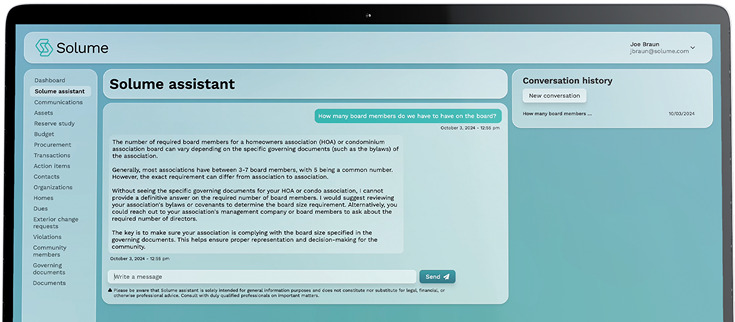
Solume gives self-managed HOA or condo boards compliance tracking that ties each violation to its rule citation, notices, and deadlines in one record. Instead of an HOA board member rewriting a free HOA violation letter template from scratch each time, violation tracking software keeps the sequence timestamped and searchable, from first courtesy notice to HOA fine notice. The AI Assistant can also help a board understand how a governing document provision or state notice requirement applies before sending a letter.
Good HOA management software won't guarantee compliance or prevent a dispute. What it does is make the board's process consistent and defensible, which is the part that actually holds up. State law compliance also gets simpler when every notice and deadline lives in one place. Positive community relations get easier too, because owners see the rules applied the same way to everyone.
If your board wants a cleaner way to track violations, send consistent notices, and keep compliance in one place, you can see if Solume fits your community on a quick 15-minute call. No pressure, just a look at whether it solves the problems your board is actually dealing with.
Frequently Asked Questions
What information does an HOA violation letter template need to include?
A defensible template should include the association's letterhead and contact details, the date, the homeowner's full name and property address, and the specific CC&R or rule section being violated. It also needs an objective, fact-based description of what was observed and a compliance deadline.
How do I actually write an HOA violation notice that holds up?
Open with a clear subject line like "Notice of Violation:[Lot #]" and describe exactly what was observed, when, and where. Quote the exact governing document section, state the correction deadline, and explain the next steps if the issue isn't fixed.
What's the difference between a first violation letter and a final notice?
A first letter is a courtesy notice with a friendly tone, no fines, and a cure window that's often 10-30 days depending on your governing documents. A final notice signals escalation and references fines, hearings, or legal action if the violation remains uncorrected.
What are the most common violations these letters address?
The most frequent categories are parking, noise, lawn and landscaping neglect, unapproved exterior modifications, and trash or storage issues. Most template libraries offer separate versions for each, so the rule citation matches the specific problem.
Is a generic template really enough, or will it cause legal problems?
A generic template is fine as a starting frame, but it becomes a liability if you don't insert the exact CC&R section, follow your state's notice and hearing timelines, and keep the language objective. States like Florida and California have specific procedural rules that a plain template won't account for on its own.
What if a homeowner disputes or ignores the violation letter?
A properly documented letter with dated observations and rule citations protects the board if the owner requests a hearing or the matter escalates. If ignored, you follow the escalation path outlined in your governing documents, typically a final notice, fines, and then a formal hearing.