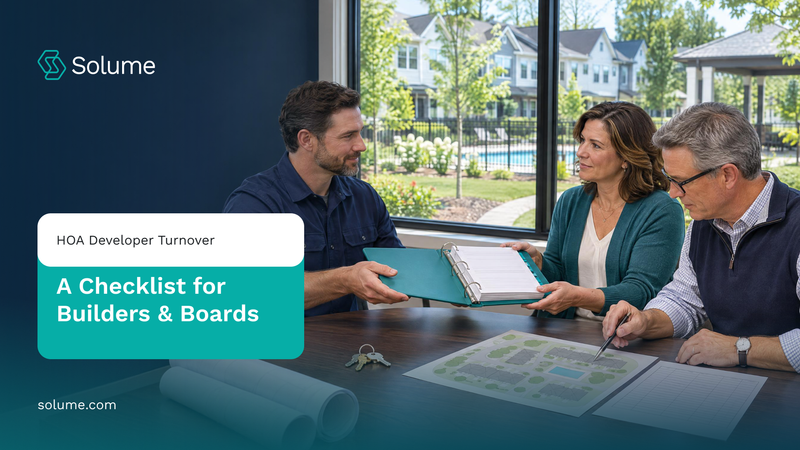
If you build homes, you want to finish the project, sell the homes and move on. You don't want to spend the next several years helping people find a pool warranty or explaining who handles an architectural request.
The incoming homeowners have a different problem. They're about to run an association, and they need to know what they own, what they're responsible for maintaining and how they're going to pay for it.
HOA developer turnover is the transition from developer-controlled governance to homeowner-controlled governance. A useful handoff gives the new board the records, financial information, property details and access it needs to operate. Preparing those records while the community is being built is much easier than trying to reconstruct them at the end.
This guide explains the practical handoff for builders and incoming boards. The legal requirements depend on the community's state, association type and governing documents. Use it to organize the work with the association's qualified advisers, not to replace their review.
Key takeaways
- Confirm the actual turnover trigger. A percentage you've heard about elsewhere may refer to only some board seats, not full homeowner control.
- Inventory individual components and maintenance obligations, including the things people overlook: unused land, drainage systems, ponds and dams.
- Give the board actual operating costs, contracts and financial records, then show what changes when construction or a developer subsidy ends.
- Keep the association's records accessible when the builder, manager or board president changes.
- Start that system during development. Software can organize the handoff, but it doesn't certify construction, settle legal obligations or replace a professional reserve study.
What is a declarant and when does the HOA take over?
The declaration is a recorded document that sets out important rights and obligations for the community. The declarant is generally the person or entity establishing those restrictions and holding the development rights described in the documents. That may be the developer rather than every company building homes in the neighborhood. The California Department of Real Estate's subdivision guide explains this relationship between the declaration, subdivider and association.
Don't assume turnover happens whenever the builder says the neighborhood is finished. Have association counsel identify the applicable legal trigger, the relevant documents, any phases still to be added and the election process.
For Florida HOAs covered by section 720.307, one trigger gives nondeveloper members the right to elect at least a majority of the board three months after 90% of the parcels in all phases ultimately operated by the association have been conveyed to them. Buyers acquiring parcels to build for resale are excluded from that calculation. Other triggers and exceptions also apply.
Texas Property Code section 209.00591 instead requires at least one-third of the board to be elected by owners other than the declarant within 120 days after 75% of all lots that may be created under the declaration are conveyed, excluding conveyances to the declarant and qualifying homebuilders. That provision does not itself require full homeowner control. If the declaration does not specify the possible number of lots, the provision requires that owner representation by the tenth anniversary of recording the declaration.
These examples are a reason to check your own rules, not a national timetable. Condominium associations may fall under different statutes. Also confirm separately when common property, contracts, permits and operational responsibility transfer. Don't assume every part of the handoff happens on election day.
Why builders should start before the last homes sell
Hiring a community manager doesn't remove the need for a handoff system. A manager can run day-to-day work during construction and continue after turnover. Or the homeowners may later change managers or become self-managed.
Either way, the association needs its own working history.
Think about the questions that keep coming back: Which pool pump was installed? Where is the landscaping contract? Was that repair completed? Where does an owner submit a paint request?
Put the answers and supporting documents in an organized system as the work happens. Then make sure the appropriate people can use it. That gives routine questions somewhere to go besides the builder's inbox and keeps the new board from starting over.
There's a reputation issue here, too. If the community starts looking run-down, people may think it was built poorly. They see peeling paint or a neglected pool. They don't necessarily know whether the cause was construction, poor maintenance or years of postponing repairs.
A builder can't control every future board decision. But leaving accurate equipment records, maintenance information and realistic financial information gives the homeowners a better chance of looking after what was built. That's a practical business reason to prepare the transition, even when a manager is already involved.
Build a component list that someone can actually use
“Clubhouse” and “pool” are not enough detail.
The board needs to know what is inside those categories. Record the clubhouse HVAC equipment, roof material, pool pump and other components separately. For each item, capture what is known:
- Location and a clear description.
- Manufacturer, model and serial number where applicable.
- Installation or in-service date, with the source of that date.
- Warranties, manuals, installer details and service contacts.
- Maintenance instructions and work already completed.
- Known condition issues, unfinished work and who is following up.
- Information needed for future repair or replacement planning.
If the only available date is “the clubhouse was built in 2026,” label it as an estimate. Don't turn a construction year into a verified installation date for every component.
This inventory gives the incoming board and its advisers a starting point for maintenance and reserve planning. A reserve study evaluates physical components and funding needs; the builder's equipment list supplies useful information but isn't a substitute for that work.
Ask what the association must maintain even when nobody uses it
An unused parcel can still come with a landscaping bill. A lake can look like scenery while carrying substantial maintenance responsibilities.
Before the handoff, work through the deeds, plats, easements, permits, recorded agreements and governing documents with the appropriate advisers. For each area, answer:
- Who owns it and who has the maintenance obligation?
- What work is required, and who can access the property to do it?
- What has that work cost, and what larger work may be needed later?
- Where is the expense included in the operating budget or reserve plan?
For example, a board might know it is receiving an unused half-acre parcel without working out the annual cost of caring for it. The practical question is not just “Are we getting this land?” It is “What are we now responsible for maintaining, and where is the money to maintain it?”
Apply the same check to lakes, stormwater ponds and dams. Don't assume the HOA is responsible just because homes overlook the water. The Town of Tyrone, Georgia, points residents to maintenance agreements and recorded subdivision plats to determine pond responsibility. Florida's Southwest Florida Water Management District explains that the permit and maintenance responsibility for a permitted residential stormwater system typically pass to an association after construction. The handoff should include permits, plans and maintenance guidelines.
Dam obligations can be more complicated than mowing the bank. Georgia's Environmental Protection Division explains that, for Georgia Safe Dams Act purposes, an operator can count as an owner through certain easement or maintenance arrangements. That does not establish who holds title, and not every pond is a regulated dam. If a dam is involved, get advice from the relevant regulator and a qualified engineer.
This checklist does not establish a universal right to reject a property transfer or delay a legally required turnover. Get advice about the specific documents and obligations before signing an acceptance or release.
Give the new board a budget based on actual costs
The dues charged while homes were selling don't, by themselves, prove that the post-turnover budget will work.
Start with the association's actual financial records. Ask the accountant to help reconcile cash and reserve balances, receivables, unpaid bills and contributions. Review vendor agreements and historical spending for recurring services such as landscaping, pool care, utilities and insurance.
Then identify what will change:
- Is a developer subsidy ending?
- Are new amenities or additional phases bringing new operating costs?
- Are contract prices changing or renewal dates approaching?
- What maintenance has been postponed or remains incomplete?
- What funding does the reserve plan call for?
Keep documented amounts separate from estimates. If there is no operating history for a new amenity, get a supported estimate rather than presenting a guess as last year's cost.
As a hypothetical example, owners might have paid $250 a month during development and later discover that the proposed budget calls for $400. That increase alone doesn't tell you why. The board needs a clear explanation of operating costs, reserve contributions and any support that is ending.
The useful test is simple: Do these dues cover the responsibilities we're inheriting?
Legal financial-handoff requirements also vary. Florida's HOA turnover statute, for example, specifies financial records to be delivered. Its independent CPA audit provision applies to associations incorporated after December 31, 2007, with a qualification for periods already audited. Ask counsel and the accountant which requirements apply to yours.
Use the right people to check different parts of the handoff
A collection of uploaded files doesn't tell a first-time board whether the handoff is complete. As a practical review plan, assign questions to people qualified to answer them:
- Association counsel: control and election requirements, property obligations, contracts, releases, warranties and claim deadlines.
- Accountant or CPA: financial records, reconciliations, developer contributions and the scope of any required or appropriate audit.
- Qualified engineer or property inspector: common-property condition, incomplete work and defects, within the professional's expertise. Specialty structures may need specialty expertise.
- Reserve professional: component condition and remaining life, future costs and funding assumptions within the reserve-study scope.
These are recommended roles, not a claim that every state requires the same team or report. Confirm the scope and independence of each engagement. A construction-defect investigation and a reserve study answer different questions.
Track findings in a shared list with the supporting document, responsible person, next action and follow-up date. “We sent it to someone” isn't enough for the next board member to know what happened.
Keep the records when the people change
The transition shouldn't end with a binder on someone's kitchen table or a large email attachment sent to whoever volunteered to be president.
Prepare a documented access handoff. Confirm who administers the system, who pays for it, which records the association can retrieve, and what happens if a manager or software provider changes. Give people the access their role requires, while protecting resident information and confidential records.
The incoming board should test the handoff with real tasks: find the pool equipment warranty, retrieve the current service agreement, follow an unresolved repair and explain the next budget's major costs.
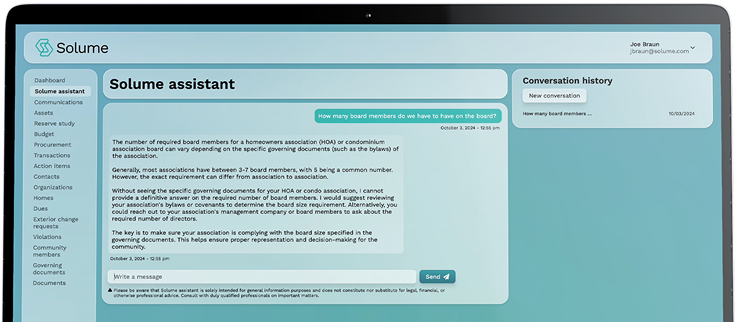
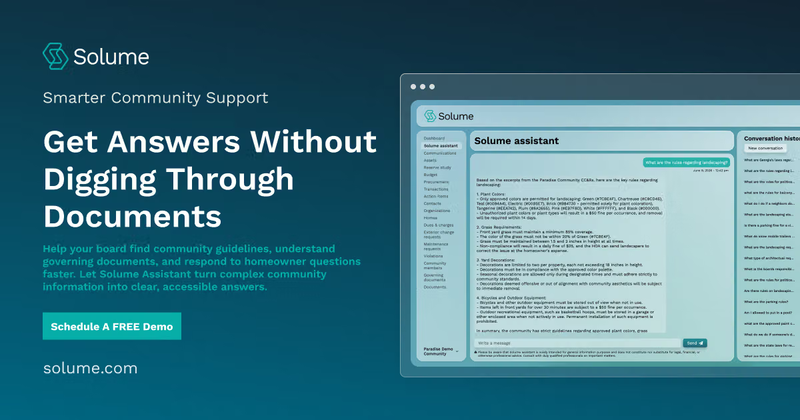
That is where Solume can fit into the transition. Its financial tools organize budgets, transactions, contracts, invoices and vendor history. Solume Assistant provides document-based guidance on governing-document questions. A routine question about the paint process can begin with the documents; the actual approval still belongs to whoever has that authority.
The proposal is to establish the system while the community is being built and keep using it when homeowners take control, whether they employ a manager or manage the association themselves. Confirm the account, access and data arrangements during setup. Software supports the work; it does not remove the developer's obligations or the board's responsibility to make decisions.
If you're preparing a handoff, bring your current document list, maintenance inventory and budget questions to a Solume demo. Ask us to show how the relevant records and ongoing work can be organized for the builder, manager and incoming board.
HOA developer turnover checklist
Use one handoff record for each item. Add the document location, person checking it, missing information and next step.
- Applicable turnover trigger and election steps confirmed with counsel.
- Current governing documents and amendments located.
- Property and maintenance responsibilities checked against the relevant records.
- Equipment details, manuals, warranties and available installation dates collected.
- Existing contracts, insurance information and permit responsibilities reviewed.
- Actual financial records reconciled and the post-turnover budget explained.
- Reserve planning information and professional recommendations retained.
- Incomplete work and unresolved findings assigned for follow-up.
- Association access and record retrieval tested, with privacy restrictions preserved.
- Owners told where routine questions go and who makes decisions.
Frequently asked questions
When does a developer have to turn over an HOA?
It depends on the applicable law, governing documents, association type and development circumstances. Check the actual rule for your community. A threshold requiring owner representation on the board may not transfer majority control.
Is the declarant always the company that built my house?
Not necessarily. Identify the declarant and any transferred development rights in the relevant recorded documents. A homebuilder buying lots from a developer should not automatically be treated as the same entity.
Does homeowner control mean the HOA must become self-managed?
No. Governance and day-to-day management are different decisions. Homeowner control does not by itself require a particular management arrangement. Review existing agreements and the board's authority before making changes.
What should the financial handoff explain?
What money is available, what is owed, what recurring services actually cost and what changes after turnover. The new board also needs to understand reserve funding assumptions, future amenities and any ending subsidy. Have qualified advisers confirm the required records and review scope.
Does the association automatically maintain the lake or dam?
No universal assumption is safe. Check ownership, easements, maintenance agreements, permits and the applicable law. Obtain specialist advice where dam safety or significant drainage work is involved.
Can HOA software replace professional turnover reviews?
No. It can keep records, assignments and follow-up work organized. It doesn't provide a legal determination, financial audit, engineering inspection or professional reserve study.
Can Solume be used if the builder already has a manager?
The transition approach discussed here includes managers. The aim is to keep useful association records available through changes in management and board membership. Review the actual workflows and access arrangements with Solume and the manager before implementation.
This article provides general education, not legal, accounting or engineering advice. Have qualified professionals review the requirements and facts for your association.
Sources
Government and product sources checked November 6, 2026. The California guides below are used for explanatory concepts, not current statutory deadlines.
California Department of Real Estate subdivision guide (2014)
Florida Statutes section 720.307
Texas Property Code section 209.00591
California Department of Real Estate reserve study guidelines (August 2010)
Town of Tyrone pond maintenance responsibility
Southwest Florida Water Management District stormwater systems