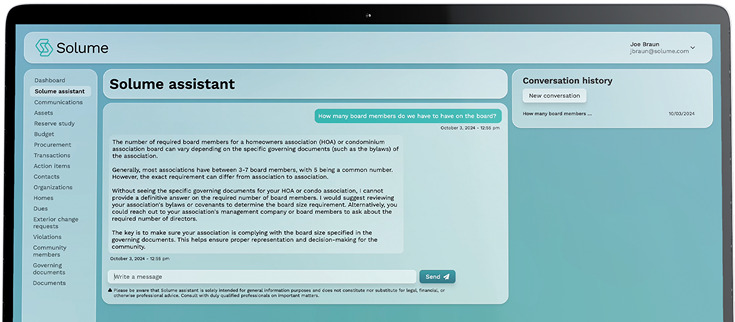

A board votes to approve a $40,000 roof repair. Then a homeowner points out the item never appeared on the posted agenda. The vote is now open to challenge, and the board may have to redo the whole process. That single misstep is why the mechanics of an HOA board meeting matter as much as the decisions made in it. This article covers the types of HOA meetings, agenda structure, notice rules, quorum, voting, executive sessions, minutes, and how volunteer boards run it all without a management company.
Key Takeaways
- An HOA board meeting is a formal gathering of elected directors to review finances, approve maintenance, and vote on decisions that affect the community.
- State law and bylaws typically require advance notice- often 48 hours to 10 days- listing the date, time, place, and agenda before any vote can take place.
- A quorum, usually a majority of directors, must be present for the board to legally conduct business or make binding decisions.
- Homeowners can generally attend open board meetings and speak during a comment period, but only the directors cast votes.
- Board decisions require a majority vote, and no single officer, including the president, holds unilateral authority over the association.

What is an HOA board meeting and why it matters
An HOA board meeting is where the elected board of directors handles the association's core business. That means approving budgets, awarding vendor contracts, setting policy, and voting on items that touch every owner's wallet. These are not casual chats. Any time a quorum gathers to discuss association business, the law usually treats it as a meeting subject to notice and recordkeeping rules.
Here's why it matters: fiduciary duty. Directors must act in the community's best interest. HOA board meetings are the documented proof that decisions were made openly and by a proper vote. Skip the process, and even a good decision can be voided. The mechanism is straightforward: authority to bind the association flows from a properly noticed, properly recorded vote, so when the paper trail breaks, the decision loses its legal footing.
State rules vary widely, so boards should confirm requirements under their own statute and consult their attorney for interpretation. California's Davis-Stirling Act shows how detailed these open meeting rules can get, and you can review California's open meeting requirements under the Davis-Stirling Act directly in the statute. Your state's common interest community statute controls your association.
Types of HOA meetings (regular/open, executive, special, annual, committee, emergency, work sessions)
Not every gathering is the same, and mixing them up creates compliance problems. Here are the common types of HOA meetings:
- Regular/open meeting. The recurring board meeting where routine business happens, and members may observe.
- Executive session. A closed portion of a board meeting for confidential matters like legal disputes, delinquencies, or personnel.
- Special meeting. A special meeting is called between regular sessions to handle a specific issue that can't wait for the next scheduled date.
- Annual meeting. The annual meeting is where homeowners vote to elect directors and decide member-reserved matters.
- Committee meetings. Committee meetings gather groups like the architectural review committee that recommend actions to the board.
- Emergency meeting. Convened on short notice for urgent threats, such as a burst main or storm damage.
- Work sessions. Informal planning discussions where no binding votes are taken.
The distinction is not academic. Each meeting type carries its own notice window, quorum expectation, and voting authority, which is why boards get exposed when they treat a work session like a regular meeting or slip a binding vote into one. The Community Associations Institute offers member governance resources that explain how these meeting types fit together. Board members can also explore the broader set of Community Associations Institute resources for board members to deepen their understanding of governance obligations. Each has its own notice and voting rules, so treating them interchangeably can cause disputes.
Building and structuring the HOA board meeting agenda
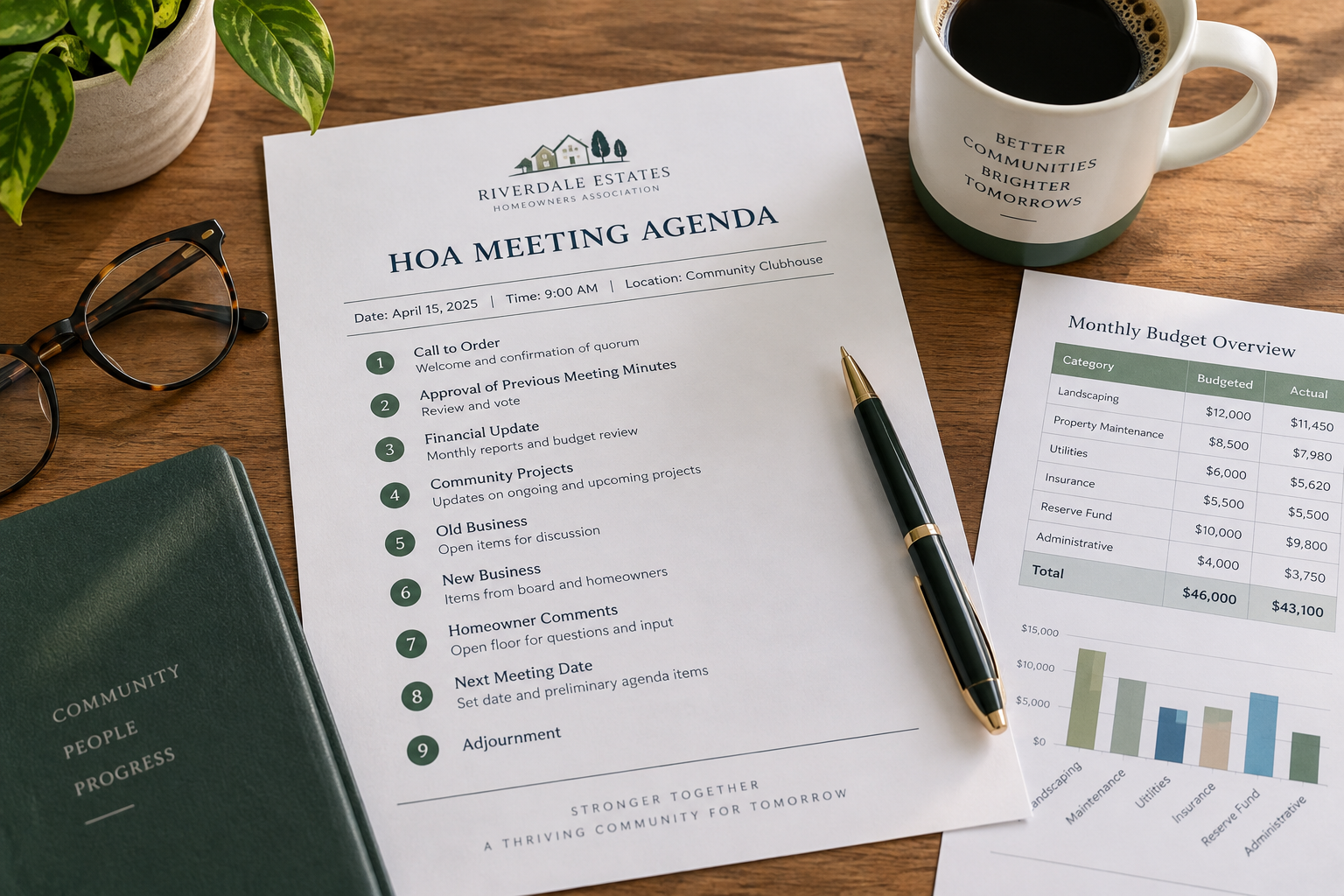
A meeting agenda is the backbone of an orderly session. Without one, discussions wander, votes get sloppy, and owners lose trust. Most boards structure HOA meeting agendas in a predictable order so everyone knows what's coming.
A workable agenda usually includes:
1. Call to order and roll call to confirm a quorum.
2. Approval of prior meeting minutes.
3. Financial report covering the budget, reserves, and delinquencies.
4. Homeowner comment period for community concerns.
5. Old business carried over from prior meetings.
6. New business with specific action items and motions.
7. Executive session, if confidential matters require it.
8. Adjournment.
Here's the hard truth: an item that isn't on the agenda usually can't be voted on. The reason is rooted in notice law. Owners are entitled to know in advance what the board intends to decide, so a vote on an unlisted item denies them that chance and becomes challengeable. Well-built hoa meeting agendas aren't a formality. They protect your decisions. A clear agenda is also one of the simplest ways of reducing homeowner complaints, since owners can see exactly what the board plans to decide. List specific action items rather than vague topics like "maintenance" so owners understand what the board is deciding and why.
Notice requirements: timing, delivery, and what must be included
Proper notice is where many boards get tripped up. Meeting notices tell owners when and where the board will meet and what it plans to decide. Get the timing wrong, and you can challenge any resulting vote.
Requirements vary by state, but most rules governing the notice of meetings share a common shape:
- Timing. Advance notice usually runs from 48 hours to 10 days, depending on the meeting type and your state statute.
- Delivery. Posting in a common area, mailing, email, or a resident portal, per what your bylaws and state law allow.
- Contents. Include the date, time, place, and meeting agenda listing the items to be discussed and voted on.
Emergency meetings are the exception, with shortened or waived notice for genuine urgencies. Boards should still document the reason. What happens when notice fails is simple: a single owner can point to the defect and force a re-vote, sometimes months later. Consider a board that emails notice the night before a special assessment vote and skips its usual mailed notice. One owner who never saw the email challenges the vote weeks later, and the assessment stalls while the board reissues notice and reconvenes. Consistent, transparent practices protect both the board and the homeowners association. Check your governing documents and state statute for the timeframe that applies to your community.
Quorum, motions, and how valid votes are made
No quorum, no business. A quorum is the minimum number of directors, usually a majority of the board of directors, who must be present for the board to act. If four of seven directors show up, you generally have a quorum. If only three do, the meeting can proceed for discussion, but the board can't make a binding decision.
Motions at HOA board meetings follow a basic rhythm. A director makes a motion, another seconds it, the board discusses, then votes. How votes are valid depends on your bylaws, but the standard is a majority of the quorum present. So if four directors vote and three approve, the motion passes.
Many assume the president decides ties or overrides the board. In reality, each director holds one equal vote, and the president has no special authority over an outcome. The reason is structural: the board holds power collectively, as a governing body, and no bylaw grants an individual officer the right to bind the association alone. The board acts as a body, not as individuals. Clean motion-and-vote records feed directly into your meeting minutes, which is where the decision becomes official and defensible.
Executive session rules and confidential matters
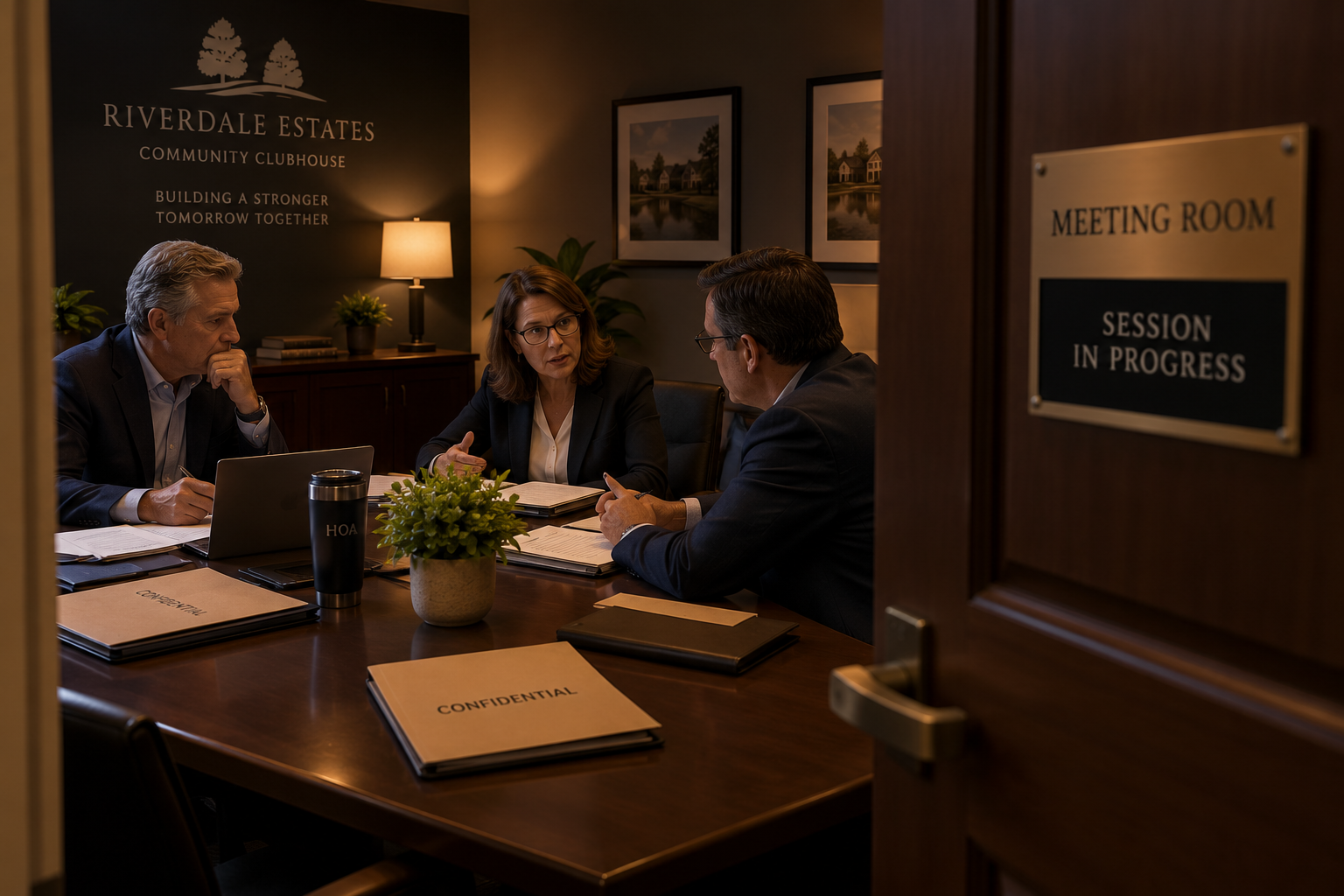
Some topics don't belong in an open meeting. Executive session is the closed portion of a board meeting reserved for sensitive matters where public discussion would harm the association or an individual. Most states limit what you can discuss there.
Matters typically allowed in executive session include:
- Pending or threatened litigation.
- Contract negotiations with vendors.
- Personnel and employee issues.
- Individual homeowner delinquencies or discipline hearings.
These board meeting rules exist for privacy. Discussing one owner's unpaid dues in front of neighbors invites embarrassment and legal exposure. But boards abuse this too. A common misconception is that moving a discussion into executive session hides it forever. In reality, the session occurred, and the general subject must usually be noted in the open meeting minutes. Boards should record the general nature of confidential decisions without exposing protected details, balancing transparency with confidentiality.
Member attendance, speaking rights, and open meeting requirements
Owners have a stake in these decisions, and most state laws recognize it. Open meeting requirements generally give homeowners the right to attend and observe board deliberations, even if they can't vote. Member attendance is a transparency safeguard, not a courtesy.
Speaking rights are separate from attendance. Many states require a homeowner comment period so owners can raise concerns before the board votes. Colorado's common interest law, for example, generally gives members a statutory right to speak before a vote on an agenda item. Other laws leave the format to the board, but a reasonable comment period is best practice regardless.
Boards can set fair ground rules: a time limit per speaker, a sign-up sheet, and a rule that comments stay on topic. Boards can't bar owners from an open meeting or eliminate all speaking rights where state law grants them. The logic behind open meeting requirements is accountability: owners fund the association, so the law generally treats their right to watch decisions being made as a check on the board. Getting this balance right builds trust and helps prevent many common problems boards face when owners feel shut out of the process. It also keeps routine HOA board meetings from turning into a grievance session that derails the agenda.
Meeting minutes: what to record and member access rights
Meeting minutes are the official legal record of what the board decided, and they carry more weight than most volunteer board members realize. If it isn't in the minutes, it effectively didn't happen. Courts and owners rely on them to confirm that decisions were made properly.
Good meeting minutes record:
- Date, time, location, and directors present (confirming quorum).
- Each motion, who made and seconded it, and the vote tally.
- Decisions reached and actions assigned.
- The general subject and fact of any executive session.
Minutes are not a transcript. They capture decisions, not every comment or debate. Owners generally have a right to inspect meeting minutes on request, often within a set number of days under state law. That's why sloppy records create real risk. Picture a board challenged over a fee increase two years later, only to find its minutes never recorded the motion or the vote count. With no clean record, the board struggles to prove the increase was ever properly approved. Solume centralizes records and communication so self-managed boards can store minutes, notices, and votes in one place instead of scattered email threads. Keeping clean minutes is one of the simplest ways a board shows compliance and financial responsibility.
Preparing for a board meeting and gathering materials
Knowing how to prepare for an HOA board meeting separates a 45-minute working session from a two-hour argument. Preparation is where most of the real work happens. The meeting is just where decisions get ratified.
A practical checklist for how to prepare for an HOA board meeting:
- Draft and distribute the agenda with enough lead time to satisfy notice rules.
- Assemble the financial packet: budget-to-actual, reserve balances, and delinquency reports.
- Collect vendor bids and proposals for any maintenance items up for a vote.
- Review governing documents relevant to agenda items so decisions stay within authority.
- Prepare draft motions so votes are clean and specific.
Picture a self-managed board that shows up without reserve figures for a roofing decision. They defer the vote, the contractor's bid expires, and the price climbs $8,000 by the next meeting. That delay is avoidable. Preparation matters because most disputes at the table trace back to missing information, not disagreement: when directors have the reserve numbers and vendor bids in front of them, the decision is about judgment, not guesswork. Gathering materials in advance, especially reserve and financial data, keeps decision-making grounded in numbers rather than assumptions.

Running board meetings as a self-managed, volunteer board without a management company
Running an HOA meeting without a management company is entirely doable, and thousands of self-managed communities do it well. The trade-off is that volunteer board members carry the compliance load themselves, from notice to minutes to reserve tracking. Understanding the challenges self-managed boards face upfront helps a board build systems before problems pile up.
Best practices that keep self-managed boards on track:
- Follow the same board meeting rules a professional manager would: proper notice, quorum, motions, and minutes every time.
- Use consistent templates for agendas and minutes so nothing slips.
- Automate repetitive tasks like dues collection, notices, and record storage to reduce burnout.
- Track reserves year-round, not just at budget time.
Most boards assume dropping their management company means more chaos. In reality, the right tools often make community management cleaner and cheaper, and that saved fee gets reinvested in the community. Here's the mechanism: most of a board's compliance work is repetitive- notices, minutes, dues, reserve tracking- so once those tasks run on a system instead of one volunteer's memory, the workload drops and the error rate drops with it. Solume was built for exactly this: the repetitive compliance load that buries volunteer boards- financial tracking, reserve study tools, dues collection, and centralized communication designed for boards, not managers. With disciplined, in-house decision-making, you improve transparency and community stability.
If your board wants a clearer way to manage finances, reserve planning, and vendor oversight without a management company, you can book a 15-minute call to see if Solume fits your community. It's an honest conversation, not a sales pitch.
Frequently Asked Questions
What actually happens during an HOA board meeting?
The elected board reviews finances, approves maintenance and vendor decisions, discusses policy and governing document issues, and votes on agenda items. Most boards also open a portion of the meeting for homeowner comments before deliberations.
How often does an HOA board need to meet?
Most boards meet monthly or quarterly depending on community size and workload, with governing documents often setting a minimum. A 1,000-home community typically needs monthly meetings to keep up with budgets, maintenance, and compliance decisions.
Can homeowners attend and speak at a board meeting?
Many states require "open meetings" where homeowners can attend and observe deliberations and votes, though they can't vote. Some states, like Colorado under CCIOA, give members a statutory right to speak before the board votes on an issue.
Does the HOA president have more power than other board members?
No, each director generally holds one equal vote, and the president cannot decide matters alone. The president typically runs the meeting, sets the agenda, and signs documents, but board decisions require a majority vote of a quorum.
What's the difference between a board meeting and the annual membership meeting?
At a board meeting, only the elected directors vote on association business while owners observe. The annual membership meeting is where homeowners vote directly, usually to elect directors and handle matters reserved to the members.
Can a board just vote on any issue that comes up during the meeting?
Generally no: boards can't vote on items not listed on the advance agenda, which must go out ahead of time under state law or the bylaws (often 48 hours to 10 days' notice). Emergency or special meetings have separate rules for urgent matters.
Is a formal board meeting really necessary for a small self-managed HOA?
Yes, any gathering of a quorum of directors where association business is discussed legally counts as a meeting, even a casual email thread or phone call. Skipping proper notice and minutes can invalidate decisions and expose the board to compliance challenges.
What happens if our board holds meetings without proper notice or quorum?
Homeowners can challenge or void decisions made without the required notice or a quorum (usually a majority of directors). This is a common source of disputes, so documenting notice, quorum, and minutes protects the board's fiduciary standing.