
Georgia doesn't require homeowners associations to conduct reserve studies. That's the short answer. But here's the hard truth: we have worked with many boards that wait until something breaks before they realize they should have planned for it. By then, the only option is a special assessment that nobody saw coming, and nobody wants to pay.
While Georgia HOA Reserve Study Requirements are minimal for most homeowners associations, the Georgia Condominium Act does impose specific Reserve Fund Requirements on condominium associations. And even when the law doesn't require it, boards that skip reserve planning are gambling with their community's financial stability and property values.
While Solume has communities throughout the country that use our software, our offices are based here in Atlanta. So this one is personal. Joe Braun, the co-founder of Solume, has friends who are in situations where their community has recently or is about to issue major special assessments because the board didn't have a pulse on their finances.
Key Takeaways
- Georgia HOA Reserve Study Requirements do not mandate reserve studies for most homeowners associations, but the Georgia Condominium Act requires condominium associations to maintain replacement reserves and provide detailed financial reporting
- Condominium associations in Georgia must include reserve account information in their annual budget and condominium resale disclosures
- Reserve studies identify major components, estimate replacement cost, and create a funding strategy that prevents special assessments
- A professional reserve study includes a component inventory, useful life analysis, and reserve funding levels that match the community's maintenance needs
- Neighboring states like South Carolina, North Carolina, and Florida have varying reserve study requirements, with some mandating full reserve studies for condominium associations
- Reserve planning protects property values, reduces the risk of major repairs catching boards off guard, and fulfills the board of directors' fiduciary duty to homeowners
What Are Georgia HOA Reserve Study Requirements?
Understanding Reserve Study Basics
A reserve study is a financial planning tool that tells you three things: what will break (pretty much anything the community owns), when it will break, and how much money you need to fix it. The study examines major components like roofs, parking lots, HVAC systems, and other common elements that wear out over time. It estimates the useful life of each component, calculates the replacement cost, and recommends reserve contributions to fund future capital expenditures.
Most boards assume they can handle maintenance as it comes up. Sometimes that is true, but often it's a terrible strategy. In reality, that approach leaves communities chronically underfunded. When a roof replacement or major repairs become urgent, the reserve balance is too low, and the board has no choice but to levy a special assessment.
A professional reserve study includes:
- Component inventory: A detailed list of all major components the association is responsible for maintaining
- Useful life analysis: How many years each component has left before replacement
- Replacement cost estimates: Current cost estimates for repair or replacement
- Reserve balance assessment: How much money is currently in the reserve account
- Funding strategy: A reserve schedule showing how much the association should contribute annually to meet future capital expenses
Legal Requirements for Georgia Associations
Georgia law treats homeowners associations and condominium associations differently regarding reserve planning.
For most homeowners associations, there is no statutory requirement to conduct a reserve study or maintain a reserve account. The Georgia State legislature has not imposed a legal obligation on HOA boards to plan for long-term capital expenditures. That doesn't mean boards should ignore reserve planning—it just means the law won't force them to do it.
Condominium associations operate under different rules. The Georgia Condominium Act requires condominium boards to maintain replacement reserves for capital expenditures and deferred maintenance. While the Georgia Condominium Act doesn't explicitly mandate that condominium associations commission a full reserve study, it does require:
- Replacement reserves to be included in the annual budget
- Financial reporting that discloses the reserve balance and reserve funding levels
- Condominium resale disclosures that include information about the reserve account and any recent reserve study
In practice, most condo associations in Georgia need a professional reserve study to comply with these financial reporting requirements. Without a reserve study, the condominium board can't accurately determine how much money should go into replacement reserves or whether the current reserve balance is adequate.
What many communities don't realize is that even when Georgia law doesn't require a reserve study, the board still has a fiduciary duty to manage the association's finances responsibly. If the board ignores long-term maintenance needs and property values decline as a result, homeowners can argue the board failed in its fiduciary duty.
Reserve studies aren't the only place Georgia boards should be paying attention right now. SB 406, the Georgia Property Owners' Bill of Rights Act, passed both chambers in 2026 with near-unanimous votes and, once signed, takes effect January 1, 2027, introducing mandatory registration, new foreclosure standards, and a state complaint process that signals Georgia is no longer content to leave HOA governance entirely unregulated. Read more about SB 406 here.
Why Reserve Studies Are Crucial for Property Owners
Impact on Property Values
Property values in community associations are directly tied to how well the common areas and major components are maintained. Buyers who see deferred maintenance—cracked pavement, aging roofs, outdated facilities—either walk away or negotiate a lower price. They also ask to see the reserve balance. A low reserve balance signals financial trouble, and that scares off buyers.
A reserve study gives buyers confidence. It shows that the board of directors is planning ahead, that the reserve account is adequately funded, and that the community won't need a surprise special assessment next year. That stability protects property values.
Financial Planning for Homeowner Associations
Reserve planning is about avoiding surprises. Without a reserve study, boards are guessing. They don't know how much money they need, so they underfund the reserve account. When a major component fails, they scramble to cover the cost. Special assessments follow, and homeowners are blindsided by bills they didn't budget for.
A professional reserve study removes the guesswork. It tells each Board Member exactly how much money should go into the replacement fund each year. It spreads the cost of major repairs over time, so no single year's budget gets hit with a massive line item. And it gives the board the data they need to justify dues increases to homeowners.
The alternative is reactive management: waiting for things to break, then figuring out how to pay for them. That approach always costs more. Emergency repairs are more expensive than planned replacements, and special assessments create resentment that makes it harder for the board to govern effectively.
Components of a Reserve Study in Georgia
A full reserve study includes both a physical analysis and a financial analysis.
The physical analysis starts with a site visit. A reserve study professional inspects the property, identifies all major components, and assesses their current condition. This includes roofing systems, pavement, parking lots, building exteriors, HVAC systems, pools, clubhouses, fencing, and structural integrity of buildings and common elements.
For each component, the reserve study professional estimates the useful life, the replacement cost, and the timing of future capital improvement needs based on industry standards, manufacturer specifications, and the actual condition observed during the site visit.
The financial analysis takes that data and builds a funding strategy. It calculates how much money the association needs to accumulate, how much is already in the reserve balance, and how much should be added through reserve contributions each year. The funding strategy includes:
- Current reserve balance
- Projected capital expenses over the next 20–30 years
- Annual reserve contributions needed to meet those expenses
- A reserve schedule showing when major components will need replacement
- Recommendations for adjusting reserve funding levels if the current balance is too low
The goal is to reach full reserve funding, meaning the reserve account has enough money to cover the replacement cost of all major components as they reach the end of their useful life. Many Georgia associations don't achieve full reserve funding immediately, but the reserve study provides a roadmap to get there over time.
Reserve Study Practices in Georgia and Neighboring States
Regional Reserve Study Requirements
Georgia's approach to reserve study requirements is more relaxed than that of many neighboring states. Understanding the regional differences helps Georgia associations see where they stand.
South Carolina does not mandate reserve studies for homeowners associations, similar to Georgia law. However, South Carolina condominium associations face stricter requirements, including the need to maintain replacement reserves and provide detailed financial reporting to unit owners.
North Carolina requires condominium associations to conduct a reserve study and update it periodically. The study must include a component inventory, useful life estimates, and cost estimates for major components.
Florida has some of the strictest reserve study requirements in the country, especially after the Surfside condominium collapse. Florida now requires condominium associations to conduct a Structural Integrity Reserve Study for buildings three stories or higher. The study must be performed by a licensed professional and updated every 10 years. Florida law also mandates that condominium associations fully fund reserves for structural integrity and major components—boards cannot waive reserve contributions.
Tennessee and Alabama do not require homeowners associations or condominium associations to conduct reserve studies, but many community associations choose to do so as a best practice.
Broader Regional Insights
Looking beyond the Southeast, reserve study requirements vary widely:
- New Jersey requires condominium associations to conduct a reserve study and update it at least every five years.
- New York does not mandate reserve studies for most homeowners associations, but requires condominium associations to include reserve account information in the public offering statement when units are first sold.
- New Hampshire and New Mexico both require Unit owners' associations to maintain replacement reserves, though New Hampshire does not mandate a full reserve study while New Mexico has a specific reserve requirement for condominium associations.
The trend across the country is toward stricter reserve study requirements, especially for Unit owners' associations. States that experienced high-profile building failures or financial collapses of community associations have responded by imposing Mandatory Reserve requirements and stronger financial reporting standards.
Georgia associations should pay attention to these trends. Even if state statutes don't currently require a reserve study, the board's fiduciary duty to homeowners remains. And as more states require reserve studies, buyers and lenders increasingly expect to see reserve planning in place.
Best Practices for Georgia HOA Management
Even without a legal obligation, Georgia associations should treat reserve planning as essential. Here's what strong boards do:
Conduct a reserve study every 3–5 years. Major components age, replacement costs change, and the reserve balance needs regular reassessment. A reserve study isn't a one-time project—it's an ongoing financial planning tool.
Hire a qualified reserve study professional. Some boards try to create their own reserve schedule using spreadsheets and guesswork. That rarely works. A professional reserve specialist has the expertise to accurately estimate useful life, replacement cost, and funding strategy. The Community Associations Institute provides resources for finding qualified reserve study professionals and understanding best practices in reserve planning.
Communicate the findings to homeowners. Most homeowners don't understand reserve planning until they get hit with a special assessment. Boards should explain the reserve study, show homeowners the projected capital expenditures, and make the case for adequate reserve contributions before a crisis hits.
Fund reserves consistently. It's tempting to skip reserve contributions when the budget is tight, but that just defers the problem. Consistent reserve contributions spread the cost over time and prevent the need for special assessments.
Update the reserve study after major repairs or capital improvement projects. If the association completes a roof replacement or other major work, the reserve study should be updated to reflect the new useful life and remaining replacement needs.
Integrate reserve planning with the annual budget. Reserve contributions shouldn't be an afterthought. The board should review the reserve schedule each year and adjust the budget to meet reserve funding levels.
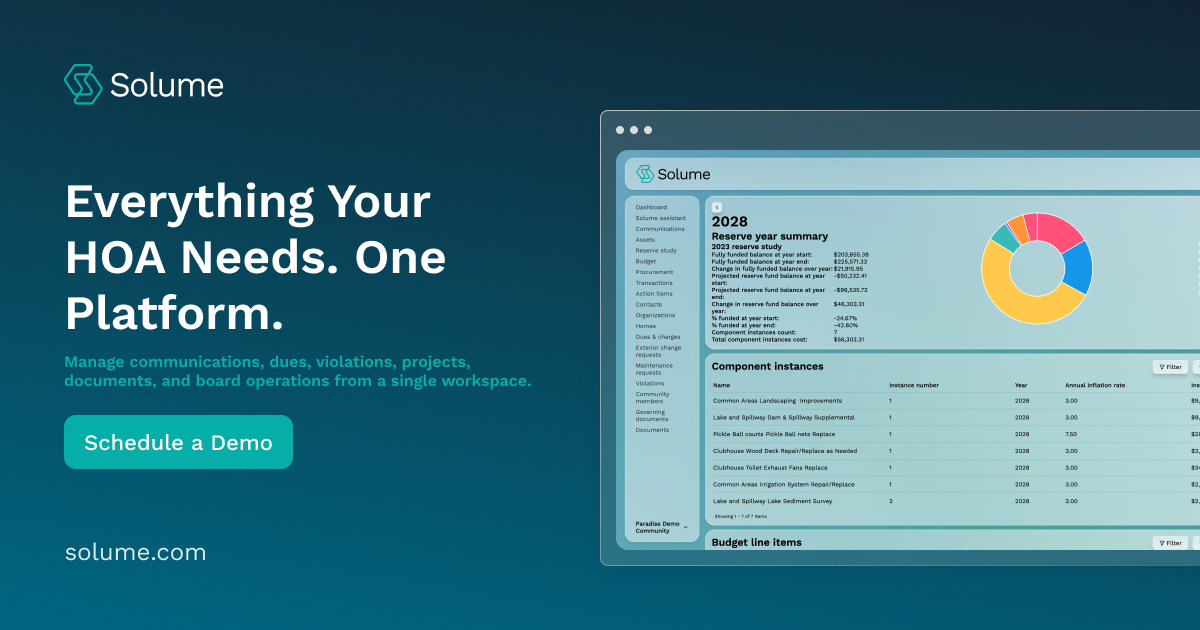
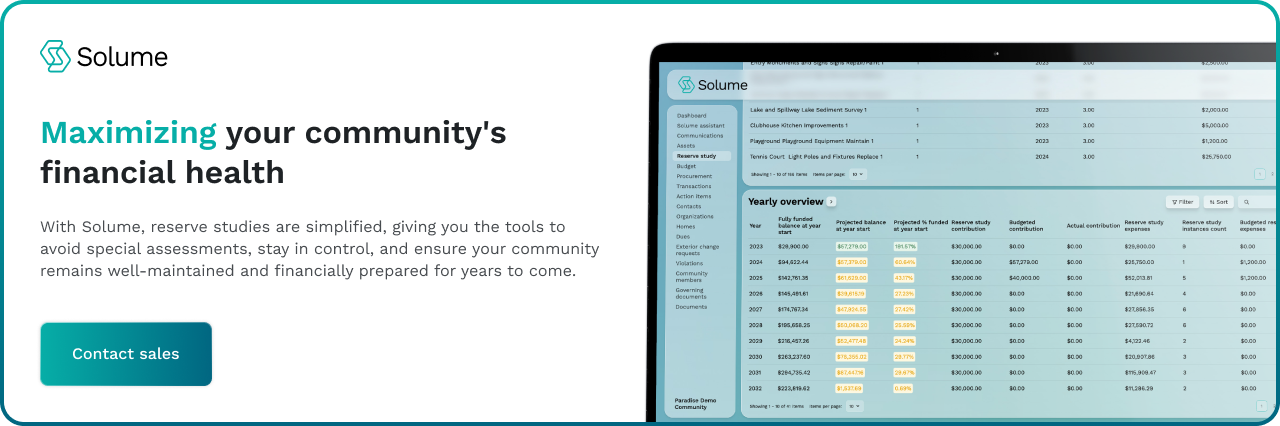
For self-managed communities, reserve planning can feel overwhelming. Most volunteer board members don't have financial planning experience, and the management company (if there is one) may not prioritize long-term capital expenses. That's where tools like Solume help. Solume integrates reserve planning directly into the platform, so boards can track the reserve balance, monitor upcoming capital expenses, and adjust reserve contributions without needing a separate spreadsheet or consultant.
How Reserve Studies Help HOAs Plan for the Future
Reserve studies force boards to think beyond the current year. Most HOA boards focus on the annual budget: how much money do we need to cover landscaping, insurance, utilities, and routine maintenance? That's important, but it's not enough.
The real financial risk comes from major components that fail every 15, 20, or 30 years. A roof replacement might cost $200,000. Repaving the parking lot might cost $150,000. If the reserve account only has $50,000, the board has a problem.
A reserve study maps out those future expenses. It shows the board exactly when major components will need replacement and how much money needs to be in the reserve account to cover the cost. That allows the board to plan reserve contributions over time, so the money is there when it's needed.
Reserve planning also helps boards make better decisions about maintenance. If the reserve study shows that the roof has five years of useful life left, the board can plan for replacement in the next budget cycle. If the roof is already past its useful life, the board knows that delaying replacement is a risk—and that the cost will only go up the longer they wait.
For condominium associations, reserve planning is even more critical. Condominium buildings have more shared infrastructure—elevators, HVAC systems, structural components—and the cost of major repairs can be enormous. The Surfside collapse in Florida killed 98 people and was directly linked to deferred maintenance and inadequate reserve funding. That tragedy led to Florida's Structural Integrity Reserve Study requirements, and it's a reminder that reserve planning isn't just about money—it's about safety.
Georgia HOA Reserve Study Requirements haven't faced the same regulatory response, but the lesson applies. Boards that ignore reserve planning are gambling with their community's structural integrity and financial stability. That assessment will come due whether you planned for it or not.
If your board is ready to take reserve planning seriously, explore your options with a platform that makes financial management straightforward. The right tools help you stay ahead of major expenses instead of scrambling to catch up.
Frequently Asked Questions
Does Georgia require HOAs to conduct reserve studies?
No. Georgia law does not require most homeowners associations to conduct reserve studies. However, the Georgia Condominium Act does require condominium associations to maintain replacement reserves and include reserve account information in their annual budget and condominium resale disclosures. Even when not legally required, reserve planning is a best practice that protects property values and prevents special assessments.
What is the difference between a reserve study and a reserve account?
A reserve account is the bank account where the association sets aside money for future capital expenditures. A reserve study is the financial planning tool that tells the board how much money should be in that account. The reserve study analyzes major components, estimates replacement cost and useful life, and recommends reserve contributions to adequately fund the reserve account.
How much does a reserve study cost in Georgia?
The cost depends on the size and complexity of the community. A professional reserve study for a small condo association might cost $2,000–$3,000, while a large community with extensive common elements could pay $5,000–$10,000 or more. That upfront cost is far less than the financial chaos that comes from skipping reserve planning and facing an unexpected $200,000 repair bill.
Can a Georgia HOA waive reserve contributions?
For most homeowners associations, yes—Georgia law doesn't mandate reserve contributions, so the board can choose not to fund reserves. For condominium associations, the Georgia Condominium Act requires replacement reserves, which makes waiving contributions more complicated. But just because a board can waive reserve contributions doesn't mean it should. Boards have a fiduciary duty to manage the association's finances responsibly, and skipping reserve funding puts the community at financial risk.
How often should a reserve study be updated?
Every 3–5 years. Major components age, replacement costs change, and the reserve balance shifts as the association makes capital expenditures. A reserve study that's more than five years old is probably outdated. Some associations also conduct a reserve study after completing major repairs or capital improvement projects.
What happens if our reserve account is underfunded?
You have three options: increase reserve contributions over time to catch up, levy a special assessment to bring the reserve balance up immediately, or defer maintenance and hope nothing breaks. The third option is the worst—it just pushes the problem down the road and usually makes it more expensive.
Is a reserve study really worth the cost for a small HOA?
Yes. Small associations often have fewer resources to absorb unexpected expenses, which makes reserve planning even more critical. A $3,000 reserve study might seem expensive, but it's nothing compared to a $50,000 special assessment that catches homeowners off guard. The study gives you a clear picture of what you're facing and time to plan for it. That's worth far more than the upfront cost.
What if our board can't afford to fully fund reserves right now?
Start where you are. A reserve study will show you the gap between where your reserve balance is and where it needs to be. You don't have to close that gap overnight. The study provides a roadmap for gradually increasing reserve contributions over several years. The key is to start moving in the right direction instead of ignoring the problem until it becomes a crisis.