A Georgia HOA that forgets to register with the Secretary of State in 2026 can lose the right to collect a single fine, charge a late fee, or file a lien. That is not a slap on the wrist. It is the difference between an association that can enforce its rules and one that cannot. Georgia HOA laws changed significantly with Senate Bill 406, and self-managed HOA boards running on volunteer hours and spreadsheets are the ones most likely to miss what shifted. This guide walks through what generally applies to communities like yours, which statutes to watch, and steps many boards take before deadlines catch up. This article is for general informational purposes only and is not a substitute for advice from a licensed Georgia attorney.
Key Takeaways
- Georgia HOA laws apply only when a community's declaration has opted into the Property Owners' Association Act, so many HOAs are governed solely by their own CC&Rs.
- Senate Bill 406 requires HOA registration with the Georgia Secretary of State, and failure to register blocks an association from collecting fines, charging fees, or filing liens.
- Homeowners get a 180-day complaint window under the new law, during which the HOA cannot collect fines or fees tied to the disputed issue.
- Georgia limits HOA foreclosures to judicial proceedings only, and lien thresholds are shifting toward $4,000 or 12 months of assessments, whichever is lower.
- Georgia has no statewide cap on HOA dues, which puts the burden on boards to justify fee levels through transparent budgets and documented reserve planning.

What are Georgia HOA laws and why do they matter for self-managed boards
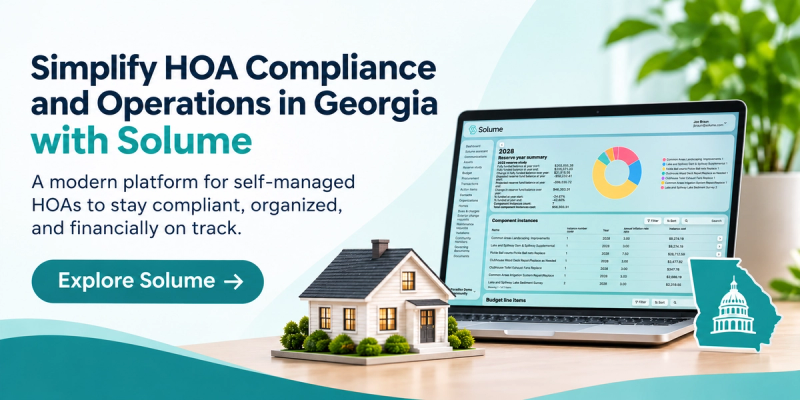
Georgia HOA laws mix state statutes, federal rules, and each community's recorded documents that decide what a board can and cannot do. The two main pieces of state law are the Georgia Property Owners' Association Act and the Georgia Condominium Act. On top of those sits Senate Bill 406, the Property Owners' Bill of Rights, which reshaped registration and complaint rules for a self-managed HOA in 2026. Boards that want a deeper look at how this legislation plays out in practice can review Georgia's SB 406 board guide for a fuller breakdown of obligations and timelines.
Here's the hard truth for volunteer board members: unfamiliarity with these rules does not protect you. A board that enforces a fine without statutory authority can find the fine unenforceable, or worse, expose itself to a homeowner challenge. Meeting this board responsibility head-on matters because state law sets the floor, and your governing documents build on top of it. Get the floor wrong, and everything above it wobbles. Many of these missteps trace back to common challenges self-managed boards face, from thin administrative capacity to outdated recordkeeping.
HOA rules vary significantly by state, so always verify current requirements against the official statutory text. You can read the full statutory language through the Georgia General Assembly's legislation portal, and you can also search specific bills and session history through the Georgia General Assembly's legislative database. For legal interpretation of how a specific provision applies to your community, boards should consult their attorney.
The Georgia Property Owners' Association Act (O.C.G.A. § 44-3-220 to § 44-3-235)
The Georgia Property Owners' Association Act, found at O.C.G.A. § 44-3-220 through § 44-3-235, gives a community association stronger statutory authority than it would have under general nonprofit law alone. When a community operates under the Act, the association gains clearer authority to levy assessments, record automatic liens, and enforce covenants with fewer procedural hoops.
O.C.G.A. § 44-3-220 lays out the framework, and the following sections spell out how assessments, liens, and fines work. One practical benefit: an association governed by the Act gets a statutory lien on a unit when an assessment goes unpaid, as the Act provides. The reason this matters is simple: the lien attaches by operation of the statute, so the association does not have to win a separate money judgment before securing its claim. That can simplify HOA fee collection compared with suing for a debt. For the complete text of the Georgia Property Owners' Association Act, boards can cross-reference each section before making enforcement decisions.
Many boards assume the Act applies automatically. In reality, it does not. Coverage depends on an opt-in choice recorded in the declaration, covered below. Review the exact statutory text through the Justia Georgia Code database, a useful starting point before any attorney review.

The Georgia Condominium Act (O.C.G.A. § 44-3-70 to § 44-3-117)
Condominiums in Georgia play by a different rulebook. The Georgia Condominium Act, codified at O.C.G.A. § 44-3-70 through § 44-3-117, applies automatically to condominium regimes created after it took effect. Condo boards skip the opt-in question that haunts traditional HOAs.
O.C.G.A. § 44-3-70 opens the chapter and defines how condominium ownership works, from shared common elements to each unit owner's percentage interest. The Act governs how a condo association assesses dues, maintains common areas, and collects condo association fees, including the statutory lien that attaches when an owner falls behind.
Many communities don't realize the Condominium Act has detailed requirements for reserve funding disclosures, budgets, and record-keeping that are stricter than those for a non-condo HOA. These requirements exist because condominium owners share ownership of the physical structure itself, so underfunded reserves put every unit's value at direct risk. For condo board members, this makes financial responsibility a duty tied directly to fiduciary duty, not just good practice. If your community is a condominium, the Condominium Act, not the Property Owners' Association Act, is your primary source of statutory authority, and your governing documents must be read against it.
Governing documents and how they interact with state law
Your governing documents are the layered rules that run your community: the declaration of covenants (often called the CC&Rs), the bylaws, and any board-adopted rules. State law sets the outer boundaries, and these documents fill in the specifics your community chose.
The order of authority matters. State law overrides any governing document provision that conflicts with it. Below that, the declaration outranks the bylaws, and the bylaws outrank board rules. A board that adopts a rule contradicting the declaration has adopted an unenforceable rule, full stop.
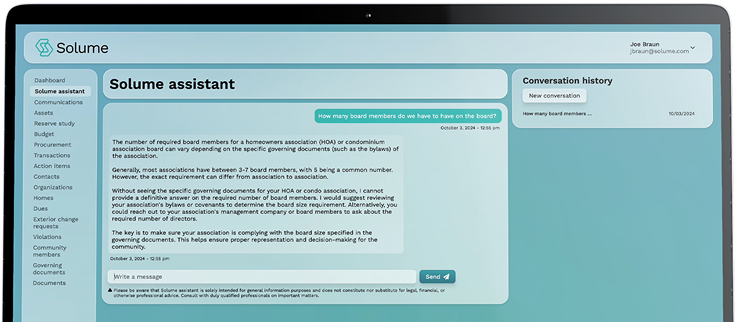
In self-managed communities, nobody reads the declaration until a dispute hits. Then a board discovers it has been collecting a fee the covenants never authorized. The root cause is almost always poor records access, and upholding fiduciary duty starts with knowing what your documents actually say. These gaps recur in lessons from HOA transparency failures, where poor documentation practices eventually surfaced as much larger governance problems. Keeping your declaration, bylaws, and amendments organized and searchable in one place is one of the most valuable things a board can do. Tools like Solume's member and home records management keep governing documents centralized, so a treasurer can confirm the facts before acting.

Opt-in nature of the POA Act and what it means for your community
This is the single most misunderstood point in Georgia HOA laws. The Property Owners' Association Act does not apply just because you are an HOA. The declaration has to specifically elect to be governed by it, usually through language submitting the community to the Act under O.C.G.A. § 44-3-220 and the sections that follow.
If your declaration never opted in, your association runs on its recorded covenants and general Georgia nonprofit corporate law. That means no automatic statutory lien, weaker fine authority, and a tougher path to dues collection. Many boards operate for years assuming they hold powers the Act grants, when they never adopted it.
The practical takeaway: pull your declaration and search for an explicit reference to the Property Owners' Association Act. If it is there, you have the full toolkit. If not, your enforcement powers are narrower, and amending the declaration to opt in requires the owner vote threshold your bylaws specify. Either way, every board member should know which rules govern their community, and should confirm open questions with their attorney before the next homeowner argument tests it.
HOA fee collection, liens, and foreclosure rights under Georgia law
When an owner stops paying, Georgia gives associations real but limited tools. If your community operates under the POAA or the Condominium Act, unpaid assessments create an automatic statutory lien against the unit. That is what makes HOA liens enforceable without first winning a lawsuit for the debt.
Georgia draws a firm line at foreclosure. An HOA cannot use a nonjudicial power-of-sale foreclosure the way a mortgage lender can. Any HOA foreclosure must go through a judicial proceeding, which means court filings, costs, and time. Senate Bill 406 also tightens the lien threshold, moving the minimum owed before an association can foreclose toward $4,000 or 12 months of assessments, whichever is lower.
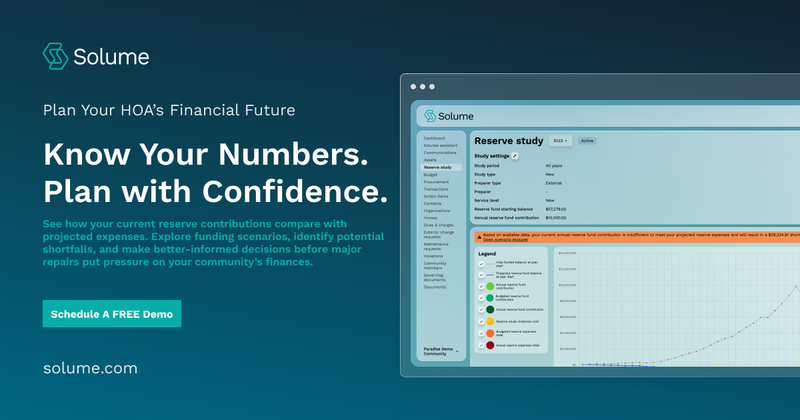
Consider a hypothetical 40-unit self-managed HOA where three owners each owe $3,500. Under the shifting threshold, none individually clears the foreclosure line, so the board's near-term tools would likely be liens and collection, not forced sale. That is exactly where HOA management software earns its keep: Solume's dues collection system tracks balances, applies late fees consistently, and flags accounts nearing lien thresholds so nothing slips. Special assessments and reserve planning reduce how often you ever reach this point, and boards unsure of what adequate reserves look like can review Georgia's reserve study requirements before setting next year's budget.

Fair housing, debt collection, and federal laws affecting Georgia HOAs
State law is only half the picture. Federal rules apply to every homeowners association in Georgia regardless of opt-in status. The Fair Housing Act prohibits discrimination in housing, which reaches HOA rules, architectural decisions, and how a board handles reasonable accommodation requests for disabilities. A neutral-looking rule can still violate the Act if it has a discriminatory effect.
Debt collection is the other federal tripwire. When a board or its agent pursues unpaid dues, the Fair Debt Collection Practices Act can apply, especially if a third party handles collection. That shapes what you can say in notices, when you can contact an owner, and how you document the debt. Review the federal protections directly through the U.S. Department of Housing and Urban Development.
Many volunteer board members assume federal law is a problem only for large communities. In reality, a single mishandled accommodation request or an aggressive collection letter can create more liability than years of routine operations. Treat fair housing and debt collection as non-negotiable parts of compliance, and keep your written communications consistent and documented.
Compliance checklist for Georgia self-managed boards
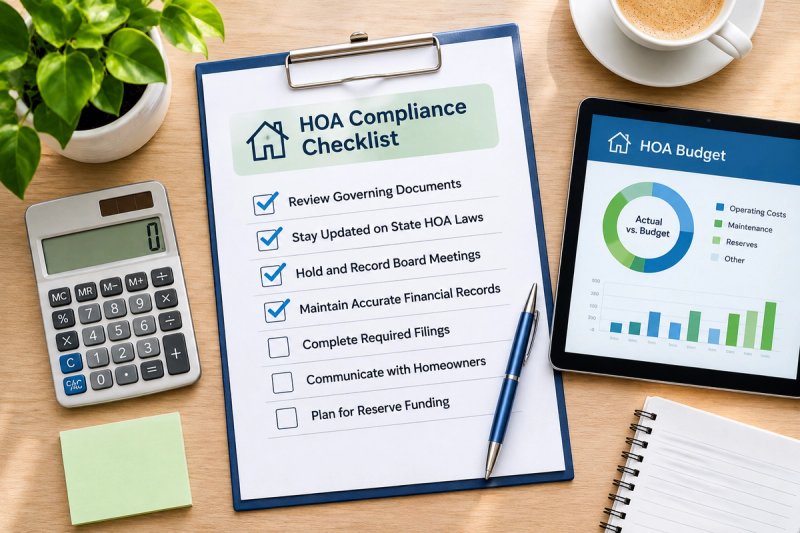
Here is a practical Georgia HOA compliance checklist for the year ahead, built around the core board responsibility of staying ahead of deadlines and strengthening compliance before problems surface. Work through it with your fellow board members before the next annual meeting.
- Confirm registration with the Georgia Secretary of State under SB 406. Unregistered associations lose the power to collect fines, charge fees, or file liens.
- Determine whether your declaration opted into the Property Owners' Association Act, or whether the Condominium Act governs your community.
- Pull and organize all governing documents: declaration of covenants, bylaws, amendments, and board rules.
- Set up a process to log homeowner complaints and track the 180-day window, during which related fines and fees cannot be collected.
- Verify current lien thresholds before pursuing any foreclosure, and confirm you are using judicial process only.
- Build a transparent annual budget with documented reserve planning to justify dues, reduce deferred maintenance surprises, and avoid surprise special assessments.
- Schedule annual meetings and preserve owners' access to records as required, reinforcing transparency across the board.
This compliance checklist is a starting framework, not legal advice. Deadlines and thresholds under SB 406 are still rolling out, so verify specifics with your attorney and the Secretary of State.
Staying on top of Georgia HOA laws, from registration deadlines and lien thresholds to complaint windows and reserve planning, is a lot to carry on volunteer time. If your board wants HOA management software that brings finances, compliance tracking, and records into one place, you can see how it works for your community on a short 15-minute call to find out whether Solume is a good fit.
Frequently Asked Questions
Does every HOA in Georgia have to follow the Property Owners' Association Act?
No. The POAA (O.C.G.A. §§ 44-3-220 to 44-3-235) is opt-in, meaning it only applies if the association's declaration specifically elects to be governed by it. If an HOA never opted in, disputes fall back on the community's recorded CC&Rs and general nonprofit corporate law instead.
What does Georgia's new HOA law (SB 406) actually change?
SB 406, the Georgia Property Owners' Bill of Rights Act, requires HOAs to register with the Secretary of State starting in 2026-2027, and associations that skip registration lose the ability to collect fines, impose fees, place liens, or foreclose. It also sets up a formal complaint process and a 180-day window for homeowners to file disputes.
How can a homeowner hold a Georgia HOA accountable?
Under SB 406, homeowners can file a formal complaint during a 180-day window, and once filed, the HOA is barred from collecting related fines or fees until it's resolved. Homeowners can also request financial records and meeting minutes directly, since boards governed by the POAA have disclosure obligations tied to assessments and budgets.
Can a Georgia HOA foreclose on a home over unpaid dues?
Yes, but only through judicial foreclosure, not the nonjudicial process some states allow. Lien thresholds are also changing, moving from a $2,000 minimum toward $4,000 or 12 months of assessments, whichever is lower, once SB 406 provisions take effect.
What if a Georgia HOA ignores SB 406's registration requirement?
An unregistered HOA can still exist and hold meetings, but it loses the legal ability to collect fines or fees, place liens, or pursue foreclosure for noncompliance. That makes registration a practical requirement for any association that wants to enforce its governing documents.
Does Georgia regulate HOA fee increases or special assessments?
Assessment authority comes primarily from each HOA's recorded declaration and bylaws, not a single statewide cap, but the POAA sets a framework for how fees must be levied when an association has opted in. SB 406 adds further notification and process requirements around how and when boards communicate fee changes to homeowners.