Picture a board in a small Florida subdivision sending a $500 fine notice for an unapproved fence. No hearing, no written notice, just a letter demanding payment. That single move violates Chapter 720, and if the homeowner pushes back, the board may risk losing and owing attorney's fees. Florida HOA laws are specific about procedure, dollar caps, and homeowner rights. Most violations aren't malicious. They happen because volunteer boards don't know the rules changed. This article walks through the mistakes that get Florida boards in trouble and how to avoid each one, and is intended as general information rather than legal advice.
Key Takeaways
- Florida HOA laws are primarily governed by Chapter 720 of the Florida Statutes, which sets rules for assessments, fines, elections, and records access.
- HB 797, effective July 1, 2026, rewrote Chapter 617 and introduced qualified director requirements and new conflict-of-interest standards for HOA boards.
- Fines under Chapter 720 are capped at $100 per violation and $1,000 in aggregate for continuing violations unless the governing documents state otherwise.
- Condominiums and HOAs operate under separate statutes in Florida, Chapter 718 for condos versus Chapter 720 for homeowners' associations.
- Dissolving a Florida HOA requires near-unanimous homeowner consent and formal termination of the declaration, making it a rare outcome rather than a simple opt-out.

What Florida HOA laws are and why they matter (Chapter 720 overview)
Florida HOA laws live mostly in Chapter 720 of the Florida Statutes, the Homeowners' Association Act. It governs how your board collects assessments, levies fines, runs elections, and handles records requests, and it sits above your own Florida HOA covenants. When your declaration of covenants conflicts with it, the statute usually wins.
Most volunteer board members have never read Chapter 720 Florida Statutes start to finish, relying instead on what the last board did, which is how bad habits get passed down. Enforcement authority generally exists only when the board follows the required procedures, because the statute conditions a board's power to fine, lien, or amend on completing the specific steps it lays out, and skipping one can get that action thrown out.
Knowing the baseline rules in Chapter 720, Florida Statutes is the first defense against legal compliance risk for any community association. The compliance requirements that flow from it also shape how courts treat a board's fiduciary duty to members, and they define core HOA board responsibilities from day one. Boards that want a deeper look at how these obligations play out in practice can find helpful context in resources on self-managed HOA compliance support, which walk through where volunteer boards commonly fall short.
Governing documents and covenants every board must follow
Your governing documents include the declaration of covenants, the HOA bylaws, and the articles of incorporation; together, they define what your board can and can't do. The declaration of covenants contains the restrictive covenants that run with the land and bind every owner, and it carries the most weight of the three. The bylaws govern meetings, quorum, member voting rights, and officer roles.
Many boards assume they can enforce any rule they feel is reasonable. In reality, enforcement authority is limited to what Florida HOA covenants actually say, and restrictions not written into the recorded documents usually can't be enforced. The Florida Division of Florida Condominiums, Timeshares, and Mobile Homes oversees condo complaints, but HOAs lack a parallel state regulator, putting more responsibility on the board to read the documents correctly. Owners and boards alike can also check requirements directly through Florida's Division of Condominiums, Timeshares, and Mobile Homes for licensing and regulatory specifics. Keep your governing documents current, recorded, and accessible, since every compliance decision traces back to them.
Architectural review and approval requirements boards often mishandle
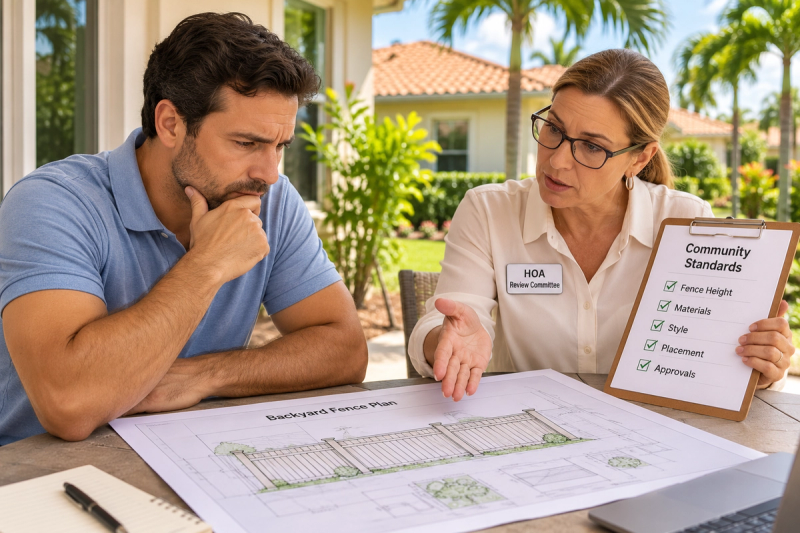
Architectural controls cause more neighbor disputes than almost anything else. A homeowner wants a shed, a fence, or a new paint color, and the board either sits on the request or denies it without a clear reason. Both are mistakes. Covenants that establish architectural controls usually require the association to respond within a defined window, and some governing documents state that silence equals approval.
The root cause of most architectural approval fights is a vague standard. If your architectural controls say "harmonious with the community" without objective criteria, denials can look arbitrary, and homeowners may prevail on appeal. Document everything: a board granting or denying approval should put the decision in writing, cite the specific covenant, and date it. Consistency matters too, since approving one owner's fence and denying an identical one invites a discrimination claim. Clear criteria, prompt responses, and a written record keep architectural controls defensible and protect homeowner rights.
Proper fining and hearing procedures (due process requirements)
This is where boards get burned most often. Under Chapter 720, HOA fines are capped at $100 per violation and $1,000 in aggregate for continuing violations, unless your governing documents authorize higher amounts. More important than the cap is the process: before any fine sticks, the association must give written notice and offer a proper hearing before an independent committee of members who are not board members or their relatives.
Skip the hearing and the fine can become uncollectible, giving the homeowner a defense if it ever reaches court. The hearing requirement exists because the statute treats a fine as a penalty that can't be imposed without due process, so an independent committee has to be able to confirm or reject the fine, not just rubber-stamp the board's decision. Send notices by certified mail so you can prove delivery. Many boards assume a quick email counts as notice, but documented delivery protects you when a homeowner claims they never knew about the HOA fines.
Records requests and transparency obligations
Florida owners have a statutory right to inspect association records, and a records request is one of the fastest ways a board gets into trouble. Chapter 720 requires the association to make official records available within a reasonable time, generally interpreted as ten business days, after a written request. If it ignores the request, the homeowner may be able to seek damages plus attorney's fees.
Financial transparency isn't optional, and it isn't a favor. Owners are entitled to see budgets, minutes, contracts, and membership records, with narrow exceptions for attorney-client privileged material and personal data. The risk most boards overlook is treating a records request as an attack rather than a routine obligation.
Consider a common pattern: a treasurer who keeps financials on a personal laptop and goes dark when owners ask questions. That silence breeds distrust and disputes, and the consequences can be serious, as shown by a Florida HOA fraud case that exposed just how far financial mismanagement can go unnoticed without proper oversight. Build financial transparency into your routine by keeping records organized and ready, so a records request becomes a quick task rather than a scramble, and weak financial transparency never becomes a liability.
Board member certification and education requirements
Florida requires new directors to complete HOA board member certification shortly after election or appointment. Within 90 days, a director must either sign a written certification confirming they've read the governing documents and will work to uphold them, or complete an approved educational course. If the director misses the deadline, the director is suspended until they comply.
This requirement exists because uninformed boards make expensive mistakes, and the statute uses certification to confirm each director actually understands the documents they're bound to enforce before they start voting. HOA board responsibilities carry a fiduciary duty to the membership, meaning directors must act in the community's best interest, not their own. Many volunteer board members don't realize that signing the certification is a legal acknowledgment, not a box to check.
The educational route is often smarter, since the course covers what most boards get wrong under HOA board member certification: fining procedures, records access, and reserve funding rules. Treat certification as the floor, not the ceiling, of what directors need to know to meet their HOA board responsibilities.

Parking, vehicle, and rental restriction enforcement limits
Parking and vehicle restrictions generate constant complaints, but your enforcement authority has limits. You can enforce these restrictions only if they're written into your recorded governing documents. You can regulate commercial vehicles, boats, and guest parking, but you still owe the homeowner notice and a proper hearing before issuing HOA fines for a violation.
Rental restrictions are trickier. Florida has tightened the rules on when associations can adopt new rental restrictions, and amendments limiting leasing often apply only to owners who consent or who buy after the change. This matters most for short-term rentals, where a blanket ban passed today may not bind existing owners.
Pet limitations follow similar logic: enforceable if recorded, but subject to Fair Housing exceptions for service and support animals. Before enforcing any parking, vehicle, or leasing rule, confirm the covenant exists, the amendment was adopted properly, and the homeowner received due process.
Financial and reserve compliance under Florida law
Money is where community stability lives or dies. Florida requires associations to adopt an annual budget, and that budget must address reserve funding for capital expenses like roofs, roads, and paving. A reserve study tells you how much to set aside and when, based on each major component's useful life. Skip the reserve study, and you're guessing, which is how communities end up with crushing special assessments. Boards unfamiliar with the specifics should review Florida's reserve study requirements before assuming their current funding approach is adequate.
Here's the pattern that bites a self-managed HOA: years of underfunding reserves to keep dues low, followed by deferred maintenance that compounds into a six-figure repair bill. When the money isn't there, special assessments land on owners who never saw it coming.
The 2021 Surfside condo collapse, which killed 98 people, pushed Florida toward stricter reserve requirements for condominiums. Lawmakers responded directly with Florida Senate Bill 4-D, which tightened structural inspection and reserve funding rules statewide, and boards should also understand how the new Florida condo reserve law changes what's expected of associations going forward. It's a hard reminder that deferred maintenance carries real consequences and real legal compliance risk. Fund reserves deliberately and revisit your reserve study regularly, and your annual budget becomes a planning tool instead of crisis management.
How self-managed boards can track compliance without a management company
A self-managed HOA faces the same compliance requirements as a professionally managed one, just without paid staff to track them. The challenge is organization. Fining deadlines, records request windows, certification dates, reserve funding reviews, and architectural approval timelines all have to be tracked somewhere other than a board member's memory.
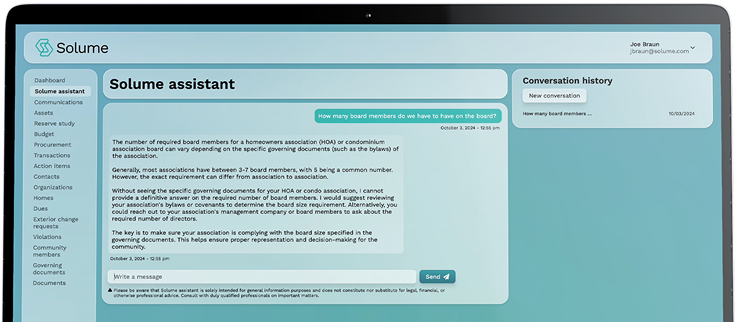
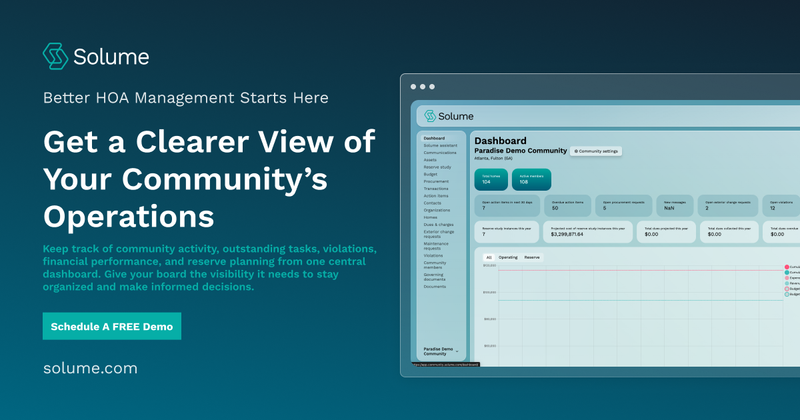
Many boards assume this requires a management company. In reality, the work is manageable with the right systems. Platforms built for self-managed communities centralize governing documents, log architectural review requests, and keep financial records ready for any records request.
When those tracking gaps are the real problem, Solume's automated reserve study tools and compliance tracking help volunteer board members stay ahead of reserve funding obligations and documentation requirements without an accounting background. Running a self-managed HOA well means keeping decisions and dollars inside the community, and the right tools make that practical instead of overwhelming. Because Florida HOA laws vary by community and shift with new legislation, boards should confirm interpretation with a qualified attorney for their specific situation.

Florida HOA laws reward boards that stay organized and penalize the ones that improvise. If your board wants a clearer way to manage reserve planning, records, and compliance tracking without a management company, you can talk to the Solume team about your community in a 15-minute call to see whether it's a good fit.
Frequently Asked Questions
Can homeowners actually dissolve or get rid of an HOA in Florida?
It's legally possible but difficult, since dissolving an HOA in Florida typically requires a supermajority vote of members (often 100% or as specified in the governing documents) plus formal termination of the declaration with the county. Most attempts stall because reaching unanimous or near-unanimous consent among homeowners is rare.
What does the 80/20 rule mean for Florida HOAs?
The 80/20 rule generally refers to the idea that associations must focus most enforcement and operations on maintaining common standards while allowing reasonable flexibility for individual homeowner circumstances. It's not a formal statute under Chapter 720, so boards should check their own governing documents rather than assume a specific percentage applies statewide.
Can a Florida HOA force a homeowner to get rid of a pet?
Yes, if the governing documents contain enforceable pet restrictions (breed, size, or number limits) and the homeowner violated them, the HOA can require compliance through fines or legal action. Exceptions apply for documented service animals and emotional support animals under the Fair Housing Act, which HOAs cannot override.
Are there statewide parking rules HOAs in Florida must follow?
Florida law doesn't set one statewide parking standard; each HOA enforces parking rules through its own declaration and rules, covering things like guest spots, commercial vehicles, and street parking. Boards still need to follow Chapter 720's fining procedures (notice and hearing) before penalizing a homeowner for a parking violation.
Is it worth hiring a lawyer to interpret Florida HOA laws instead of relying on board volunteers?
For routine matters like fines or record requests, boards can often follow Chapter 720 directly since it spells out specific procedures and dollar limits. Legal counsel becomes worthwhile for disputes, recall elections, or amendments to governing documents, where mistakes can expose the board to liability.
What happens if a Florida HOA ignores the new HB 797 governance requirements?
Since HB 797 rewrote Chapter 617 as of July 1, 2026, HOAs that skip the new 'qualified director' standards or conflict-of-interest disclosures risk director liability and challenges to board decisions. Noncompliance doesn't dissolve the HOA, but it weakens the legal protections officers and directors would otherwise have under the revised standard of care.
How much can a Florida HOA actually fine a homeowner?
Under Chapter 720, fines are capped at $100 per violation unless the governing documents allow more, and continuing violations can accrue daily fines up to a $1,000 aggregate cap. Associations must also follow proper notice-and-hearing procedures before any fine becomes collectible.
Do Florida condo associations follow the same laws as HOAs?
No, condominiums are governed by Chapter 718 (the Condominium Act), while homeowners' associations fall under Chapter 720, and the two statutes differ on issues like reserve funding, record access, and board elections. Communities transitioning between structures, such as developers handing over control, need to confirm which chapter actually applies to their declaration.