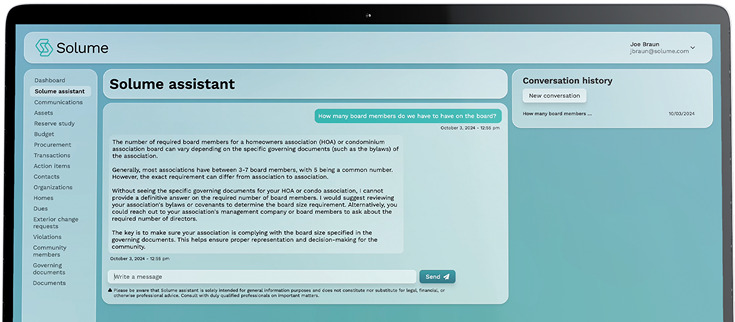

Florida HOA management | HOA financial transparency | HOA fraud prevention | HOA board member fraud | self-managed HOA Florida
The invoice looked completely routine. A vendor payment, logged in the ledger, signed off. Nobody looked twice.
That is how it usually starts.
In Martin County, Florida, investigators say a property manager named Alexandra Delacaridad Gonzalez did exactly that — writing checks to herself from the HOA accounts she managed, concealing the withdrawals with fictitious invoices and forged signatures, then spending the stolen funds on plastic surgery, vacations, and personal shopping. Warrants have been issued for fraud, embezzlement, and grand theft. Her bond was set at $1,350,000. NewsNation first reported the case.
But here is the part that often goes unsaid when stories like this surface: a dishonest property manager is not the only person who can drain an HOA's accounts. A board treasurer with unchecked access and no oversight can do the same thing — and sometimes does. The name and the title change. The structural vulnerability is identical.
This story is not really about one bad actor. It is about what becomes possible when financial visibility is concentrated in a single set of hands — whether those hands belong to a management company employee or a volunteer board member who has been trusted with the checkbook for years.
If your HOA or condo association in Florida cannot answer, in real time, who has access to your accounts and what they have done with that access, you are not running oversight. You are running on hope.
Key Takeaways
- A Florida property manager is facing charges for allegedly stealing hundreds of thousands of dollars from HOA accounts she managed.
- The alleged fraud was concealed through fake invoices, manipulated ledgers, and forged signatures — undetected until investigators got involved.
- Property managers are not the only risk. Board members with unchecked access to association accounts can commit the same fraud — and the structural vulnerability is identical.
- Even if a manager or board member is prosecuted, recovery of stolen HOA funds is rarely complete. Homeowners ultimately pay the price.
- The fix is not finding more trustworthy people. It is building a system where multiple people have eyes on the money at all times — and where no single person can initiate, record, and report on transactions without oversight.
- Most HOA financial systems give boards delayed, summarized reports — not real-time visibility into actual transactions.
- Florida law requires specific financial reporting and reserve fund management for HOAs and condo associations — gaps in compliance create both legal and financial risk.
The Florida HOA Fraud Case: What Investigators Found
Who Was Involved and Where It Happened
Alexandra Delacaridad Gonzalez, 46, worked for Avant-Garde Property Management in Florida. According to the Martin County Sheriff's Office, she had access to the HOA bank accounts of the communities she managed — and she used that access to pay herself.
Investigators say the alleged theft ran into the hundreds of thousands of dollars. Gonzalez is currently wanted on warrants for fraud, embezzlement, and grand theft. Deputies believe she may be in the Miramar or Vero Beach area. Her bond has been set at $1,350,000.
How the Alleged Fraud Was Carried Out
The method was not sophisticated. It did not have to be. According to investigators, Gonzalez:
- Wrote checks directly to herself from HOA accounts
- Created fictitious invoices to make the payments appear legitimate
- Entered false records into the financial ledger
- Forged the signatures of authorized account holders
She then reportedly used the stolen funds for plastic surgery, travel, and personal shopping.
The mechanism was simple because the opportunity was simple: one person controlled the payments, the records, and the reporting. No one in a position of oversight could see behind the summary.
The Real Cost: Why Homeowners End Up Paying
Stolen Money Rarely Comes Back Whole
An arrest warrant is not a refund. Even when HOA fraud cases result in conviction, restitution is partial at best. Assets may have already been spent. Recovery takes years. Legal fees accumulate. And in the meantime, the association still has obligations — maintenance, insurance, reserve contributions — that do not pause while the process plays out.
HOA Fees Rise to Cover the Gap
When reserve funds are depleted or operating accounts are drained, the math eventually lands on homeowners. Special assessments. Increased dues. Deferred maintenance that compounds into larger repairs. The residents of these Florida communities did not write those checks to Gonzalez — but they may end up paying for them anyway.
Trust Inside the Community Breaks Down
Fraud cases do not stay contained to the financials. They corrode the entire fabric of community governance. Board members face scrutiny they did not invite. Residents lose confidence in the association itself. Future volunteers become harder to find. And the time that should go toward running the community goes instead toward damage control.
How HOA Financial Fraud Happens — And Why It Keeps Happening
The Gonzalez case is not a story about one unusually bold criminal. It is a story about a structural vulnerability that exists in thousands of Florida HOAs and condo associations right now — and it applies equally whether the person exploiting that vulnerability works for a management company or sits on the board.
Too Much Control in Too Few Hands
In the traditional property management model, a single manager or bookkeeper handles payments, maintains records, and produces the reports the board reviews. That concentration of control is the vulnerability. When one person can initiate a transaction, record it, and summarize it for the board — all without independent verification — the system depends entirely on that person's honesty.
Boards Reviewing Summaries, Not Data
Most HOA boards receive monthly financial reports — PDFs prepared by the management company, summarizing what happened. By the time a board reviews those reports, the transactions are weeks old. If those reports have been manipulated, the board has no independent way to verify what they are reading. They are not seeing the bank. They are seeing a curated version of the bank.
Systems Without Audit Trails or Alerts
Spreadsheets and disconnected accounting tools do not flag suspicious behavior. They do not alert a board member when an unusual vendor payment is made. They do not cross-reference invoices against prior transactions. They record what they are told to record. That is not oversight — that is a ledger.
The Threat Nobody Talks About: Board Members Who Steal
When HOA financial fraud makes the news, the story almost always involves a management company. That framing is understandable — there is a clear outside villain, and the board is cast as the victim. But it is incomplete. And for self-managed communities in particular, it creates a dangerous blind spot.
Board members — usually volunteers, often longtime residents, frequently trusted friends of their neighbors — can steal from their associations just as easily as any property manager. The mechanism is the same: access to accounts, control over record keeping, and an absence of independent oversight. The only difference is that board member fraud tends to go undetected even longer, because no one thinks to look.
How Board Member Fraud Typically Happens
The patterns are consistent. A board treasurer is given sole signing authority on the association's bank account. Dues are collected into an account only they can access. Vendor payments go through them without a second approval. Monthly financial reports are prepared by — and reviewed by — the same person. The rest of the board sees a summary and moves on.
In that environment, diverting funds is not especially difficult. Checks written to cash. Personal expenses run through a vendor account. Payments made to a business the treasurer controls. Reserve funds drawn down gradually, a little at a time, to avoid triggering a hard number that someone might question.
It is the same playbook Gonzalez allegedly used — just executed from inside the board rather than from inside the management company.
Why Self-Managed Communities Are Particularly Vulnerable
Self-management is the right choice for a lot of Florida communities. It keeps costs down, gives the board direct control, and removes the management company as a financial intermediary. But it also means the safeguards that a reputable management company might provide — however imperfect — are gone.
In a self-managed HOA, the board is both the decision-maker and the financial custodian. If the financial custodian is also the only person who can see the accounts, the association has no independent check on its own governance. That is not a personnel problem. That is a design problem.
The Only Real Protection: Multiple Eyes on the Money
The principle is simple. No single person — not a property manager, not a board treasurer, not a bookkeeper, not a volunteer who has served the community for fifteen years — should be the sole witness to the association's financial activity.
That means:
- More than one board member has direct visibility into account activity — not just the treasurer.
- Payments above a defined threshold require dual authorization before they can be executed.
- Financial records are accessible to all board members in the same system, not maintained privately by one person.
- Transactions are logged automatically, not entered manually by the same person who initiates them.
- Homeowners retain the right — and the practical ability — to inspect financial records at any time.
None of this requires suspecting anyone. It requires acknowledging that good people, under financial pressure or given too much unchecked access for too long, sometimes make choices they would not otherwise make. Structural controls protect against that. They also protect the honest board member who gets accused of something they did not do, because the records are clear.
Florida Law and What It Actually Requires of HOAs and Condo Associations
Florida has some of the most specific HOA and condo association governance requirements in the country. Under Florida Statute 720 (HOAs) and Florida Statute 718 (condominiums), associations have defined obligations around financial reporting, reserve fund management, and board transparency.
Key requirements include:
- Reserve fund tracking: Florida condominiums are required to maintain reserve accounts for specific components (roof, painting, paving, and any item over $10,000) unless owners vote to waive reserves. HOAs have similar obligations. These reserves must be tracked separately and cannot be commingled with operating funds.
- Annual financial reporting: Associations above certain size thresholds are required to have annual financial statements reviewed or audited by a CPA. Smaller associations must maintain records that are accessible to members.
- Record access: Florida law gives unit owners and homeowners the right to inspect association financial records. If those records have been manipulated — or simply do not exist in a reviewable format — the association is already out of compliance.
- Board member obligations: Florida boards operate under a fiduciary duty. Ignorance of financial mismanagement is not a legal shield — board members who fail to implement reasonable financial controls can face personal liability.
The Gonzalez case illustrates what happens when a management company becomes the single point of financial truth. The board trusted the reports. The reports were fabricated. By the time anyone looked at the actual bank, the money was gone.
What Actual Financial Transparency Looks Like
Transparency is not a document. It is not a monthly report. It is the ability for the right people — the board — to see what is happening with their association's money at any point in time, without waiting for someone else to summarize it for them.
Real-Time Access to Financial Activity
When a payment is made, the board should be able to see it. Not in a report four weeks later — now. Real-time visibility makes manipulation dramatically harder, because the window between action and detection collapses.
Clear Audit Trails for Every Transaction
Every dollar that moves through an association's accounts should be traceable: who initiated the transaction, when it happened, what it was for, and what documentation supports it. An audit trail is not just good practice — in Florida, it is a compliance requirement.
Separation of Financial Control
No single person should be able to initiate a payment, record it, and report on it without independent verification. When those functions are separated — or when the system itself creates that separation automatically — fraud becomes exponentially harder to execute and sustain.
How Solume Was Built for This Problem
Solume is an HOA and condo association management platform built specifically for self-managed Florida communities. Transparency is not a feature we added. It is the premise the platform was built on.
Here is what that means in practice.
Money Moves Directly to the Association — Not Through Us
When a homeowner pays dues through Solume, that payment goes directly into the association's own bank account through our ACH or credit card processor. It does not pass through a Solume account - ever. It does not pool with funds from other communities. There is no middle layer between the homeowner and the HOA.
This is a structural choice. The cases that end up in criminal investigations — including the one described above — often involve a management company that controlled pooled accounts on behalf of multiple communities. When one person controls the inflow and the recordkeeping, the opportunity for theft is built into the model. We removed that layer entirely.
Full Financial Visibility for the Board
Every transaction is visible to board members in real time. There is no waiting for a monthly summary. There is no reliance on reports prepared by someone else. Boards see what is happening with their money when it happens — which is the only version of oversight that actually works.
Reserve Fund Tracking Built In
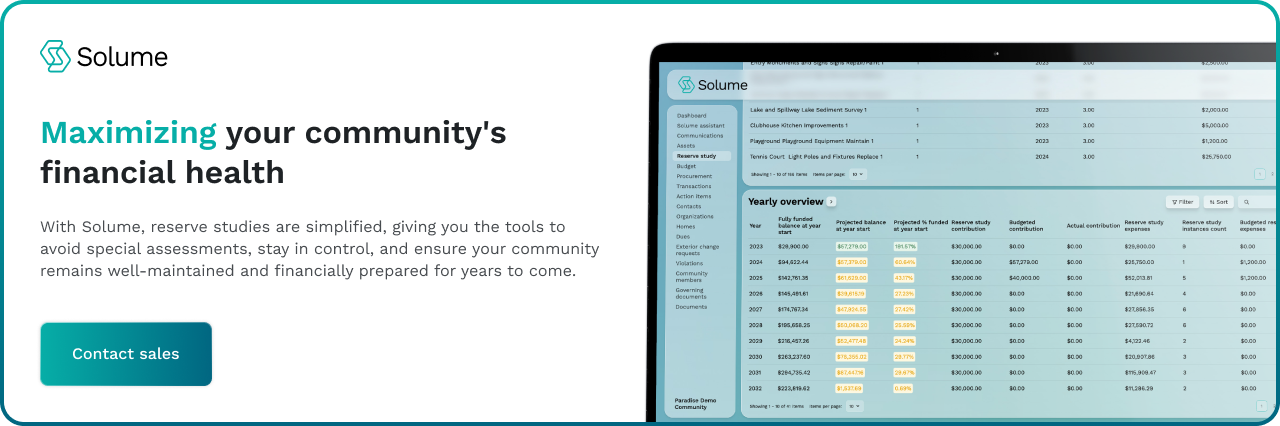
Florida law requires HOAs and condo associations to maintain reserve funds for major capital components. Solume includes reserve fund tracking directly in the platform — so boards can see reserve balances, contributions, and projected needs without maintaining a separate spreadsheet or relying on a management company to report them accurately.
When reserves are managed inside the same system as dues collection, budgeting, and financial reporting, the whole picture is visible. There are no disconnected tools. There is no information that lives only with the manager.
Florida Compliance, Without the Manual Work
Between Chapter 720, Chapter 718, and local county requirements, staying compliant as a Florida HOA board is genuinely complex. Solume's platform is built to help boards meet their reporting and reserve obligations — not by doing it for them through a management layer, but by giving them the tools and visibility to do it themselves, correctly.
Questions Every Florida HOA Board Should Be Asking Right Now
You do not need to suspect fraud to ask these questions. These are the questions of a board doing its job.
- Who has access to our association's bank accounts, and what controls exist on that access?
- Does more than one board member have independent visibility into account transactions — or does everything run through one person?
- When a homeowner pays dues, exactly where does that money go — and who can touch it before it reaches our account?
- Can any board member see a live transaction record right now, without requesting a report?
- Are our reserve funds being tracked separately from operating funds, as required by Florida law?
- If something went wrong last week, how quickly would we know?
- Are we reviewing actual financial data — or summaries prepared by the same party that controls the money?
If you cannot answer these questions confidently, the issue is not your board. It is the system you are working in.
The Bottom Line: The Risk Is Not Fraud — It Is Invisibility
The Martin County case — reported by NewsNation — will be processed through the courts. Gonzalez will face consequences. And somewhere in Florida, the homeowners whose dues funded those vacations and surgeries will figure out what comes next.
But the next version of this story is already in motion. In some communities, it will involve a management company employee. In others, it will involve a board treasurer who has had sole access to the accounts for years. In both cases, the enabling condition is the same: one person, one set of eyes, no independent check.
Fraud is the event. Invisibility is the condition that makes it possible.
The solution is not finding more trustworthy people. The solution is building a system where a single person's trustworthiness is never the only thing standing between your association and financial disaster. Multiple people with eyes on the money. Real-time visibility. No single point of control. That is what oversight actually looks like.
Frequently Asked Questions
Can a Florida HOA property manager steal association funds?
Yes. If a property manager has unsupervised access to HOA bank accounts and the board relies on manager-prepared reports for financial oversight, the conditions for embezzlement exist. The Martin County case reported by NewsNation is not an isolated event — it is a recurring pattern tied to a structural vulnerability in traditional HOA management. Florida law places fiduciary obligations on board members, which includes implementing reasonable financial controls to prevent this from happening.
Can a Florida HOA board member steal association funds?
Yes, and it happens more often than most communities realize. A board treasurer with sole signing authority, access to accounts other board members cannot see, and control over financial reporting is in a structurally identical position to the property manager in the Martin County case. The title is different. The opportunity is the same. Board members in Florida operate under a fiduciary duty and can face criminal charges for misappropriation of association funds — but the more effective protection is structural: ensure that no single board member has unchecked, unsupervised access to association finances.
Who is responsible if HOA funds are stolen in Florida?
The association itself bears the financial liability — which ultimately falls on homeowners. Even if a manager is convicted and ordered to pay restitution, recovery is rarely complete or timely. Board members who failed to implement adequate controls may also face personal liability under Florida law, particularly if they had reason to be concerned and did not act.
How can Florida HOAs prevent financial fraud?
The most effective prevention is structural, not personnel-based. The core principle is simple: multiple people must have independent visibility into the association's financial activity at all times. In practice, that means ensuring dues payments go directly to the association's account rather than through a management company; requiring more than one board member to authorize payments above a defined threshold; giving all board members — not just the treasurer — real-time access to financial transactions; separating the functions of initiating payments, recording them, and reporting on them; and using a platform that creates a transparent, auditable record of every financial activity that no single person can alter after the fact.
Does Florida law require HOAs to maintain reserve funds?
Yes. Under Florida Statute 718 (condominiums), associations are required to maintain reserve accounts for specific components unless owners vote to waive or reduce reserves. Florida Statute 720 includes similar provisions for HOAs. Reserves must be tracked separately from operating funds and cannot be used for general expenses. Failure to comply exposes the association to legal risk and leaves communities vulnerable to major capital shortfalls.
Should HOA dues payments go through a management company?
It depends on the setup — but the risk increases significantly when dues pass through a management company's accounts before reaching the association. The safest model is one where homeowner payments go directly into the association's own bank account, with no intermediate layer that a third party controls. This is the model Solume is built on.
What financial records are Florida HOAs required to keep?
Florida HOAs are required to maintain itemized records of receipts and expenditures, current account balances, and reserve fund records, among other items. These records must be accessible to members upon request. The specific requirements vary based on association size and whether the community is governed under Chapter 718 or Chapter 720. Associations that cannot produce clean, complete records on request are already out of compliance.
Self-Managed in Florida? See How Solume Works.
Solume is built for Florida HOAs and condo associations that want to manage their own communities without handing over financial control to a third party. Our platform gives boards real-time visibility into association finances, handles dues collection with direct-to-account transfers, includes reserve fund tracking to help meet Florida's statutory requirements, and keeps everything in one place — not scattered across disconnected tools and management company portals.
Transparency is not a promise we make. It is how the system works.
Learn more or schedule a demo.