
A homeowner installs a satellite dish on their balcony. The board sends a fine notice. Three months later, the association defends itself in small claims court because nobody followed the hearing procedure written into its own condo bylaws. That scenario plays out constantly. It usually traces back to a board that never understood where its condo association rules come from or how far they reach. This article walks through the layers of authority behind those rules, what makes them enforceable, how to change them, and the compliance duties that most often trip up boards.
Key Takeaways
- Condo association rules come from a three-tier structure of CC&Rs, bylaws, and board-adopted regulations, each with different authority and different amendment procedures.
- The board enforces rules through notices, fines, and liens, but must follow the notice-and-hearing steps required by state law and the governing documents.
- Rules and regulations are the easiest layer to change: often a single board vote, while amending CC&Rs or bylaws usually requires an owner supermajority.
- Any condo rule that conflicts with state or federal law, including fair housing protections, is unenforceable regardless of what the documents say.
- Before buying, reviewing rental caps, pet policies, reserve funding, and pending special assessments matters as much as reading the rules themselves.

What are condo association rules?
Condo association rules are the written restrictions and standards that govern how owners use their units and the shared property around them. They exist because condominiums involve collective ownership. You own your unit outright, but the hallways, roof, parking lot, and pool belong to everyone. Rules keep that shared arrangement from turning into chaos.
Most boards lump everything under one label. In reality, the term covers several tiers of authority. The recorded declaration sets the foundation. The condo bylaws describe how the condominium association runs. Board-adopted rules and regulations handle day-to-day matters. Each layer carries different weight and follows a different process for change. If you're still mapping out the role a condo association plays, that broader picture makes these tiers easier to follow.
The Community Associations Institute, the main trade body for this field, publishes plain-language guidance on how these documents interact. Their governing documents overview is a useful starting point for board members who inherited a binder they've never read. Many communities don't realize these documents bind every owner automatically at closing, with no signature required. That automatic transfer makes the whole system work: because the restrictions run with the property itself, they don't depend on any single owner agreeing to them.

How rules fit within governing documents (CC&Rs, bylaws, declaration)
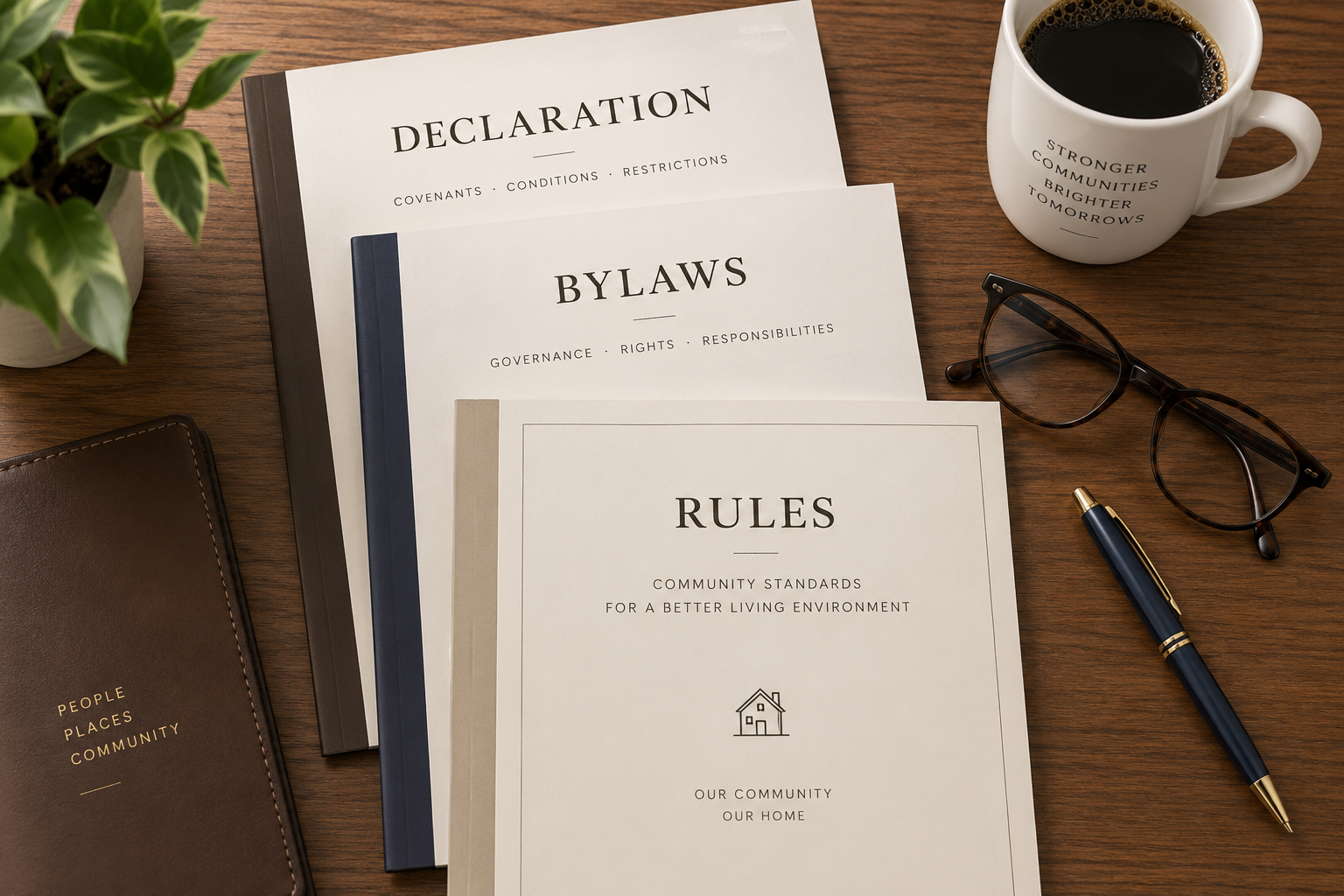
Think of your governing documents as a hierarchy. At the top sits the declaration of condominium, sometimes called the master deed. The county records this document. It contains the CC&Rs, the covenants, conditions, and restrictions that "run with the land." Below that come the condo bylaws, which cover elections, meeting procedures, and the powers of the condominium association board of directors. At the bottom sit the rules and regulations the board adopts.
The order matters because a lower document can never contradict a higher one. A board rule that clashes with the CC&Rs is void. A bylaw that violates the declaration of condominium loses. The hierarchy holds because the declaration is recorded against the land, while board rules are internal decisions, so a court defers to the recorded document when the two conflict. Most enforcement disputes start with a board treating all three as interchangeable.
Many boards assume rules and CC&Rs carry the same weight. In reality, a rule sits at the bottom of the stack and gives way to everything above it, so a poorly grounded rule collapses the moment an owner challenges it.
The U.S. Department of Housing and Urban Development explains how fair housing law overrides any association document. That is another reason the hierarchy runs even higher than your own paperwork. Knowing which tier a restriction falls under tells you exactly how hard it will be to change.
Are condo rules legally binding and enforceable?
Yes, condo association rules are generally legally binding, which can catch new owners off guard. When you buy a unit, you agree to the entire framework whether you read it or not. The CC&Rs are recorded against the property, so they transfer to you the moment you close, the same way a lien or easement would.
But binding is not the same as bulletproof. To count as binding, a rule generally has to pass three tests. It must be authorized by the governing documents, adopted through the proper procedure, and consistent with state and federal law. Fail any one, and you may end up with an unenforceable condo rule. If you're unsure which rules are actually enforceable, audit your documents before your next hearing.
Here's the hard truth many boards miss. A rule can be reasonable and still be unenforceable if the board skipped the vote or notice its condo bylaws require. Courts routinely toss fines levied without a hearing because the procedural step gives the owner a chance to respond, and a fine issued without it denies that basic right. Enforcing condo rules is as much about process as the rule itself, and condo owner rights are often protected precisely at that procedural level.
Common issues condo rules typically address (noise, pets, parking, trash, common areas)
Most condo rules and regulations cluster around a predictable set of friction points because shared living creates the most conflict there. Noise rules usually set quiet hours, often 10 p.m. to 8 a.m., and address flooring in upper units where footfall carries. Pet restrictions cap the number of animals and sometimes limit weight or breed, though breed bans are increasingly challenged under disability accommodation law.
Parking rules assign spaces, restrict guest parking, and prohibit boats or RVs. Trash rules dictate where bins go, when they're set out, and how bulk items are handled. Common areas add another layer: pool hours, gym use, grilling limits, and hallway decorations. Well-drafted pet restrictions, parking rules, and noise rules head off most neighbor disputes before they start.
Consider a condo owner who runs a home daycare out of their unit despite a rule limiting units to residential-only use. The condominium association issues escalating penalties and fines, and the owner faces a lien within months. These restrictions feel petty until you see what happens when one owner's use degrades everyone else's property value.

How boards create and amend condo association rules
Understanding how to create condo rules starts with the source of authority. The board can only adopt rules the governing documents empower it to adopt, and only for subjects the declaration reserves to board discretion. A self-managed board that invents a rule outside that grant is on shaky ground the moment an owner pushes back.
Creating condo rules at the bottom tier is usually straightforward. Rules and regulations typically require a properly noticed board meeting, discussion, and a majority vote of the directors. The change is recorded in the minutes and distributed to owners. That's it. That's why this layer is the go-to for adjusting pool hours or move-in windows. Exterior changes are another matter, so it helps to manage architectural review requests in one place rather than tracking approvals across scattered emails.
Amending association rules at the higher tiers is a different animal. Changing the CC&Rs or condo bylaws almost always demands an owner vote, frequently a supermajority of 67% or more, plus recording the amendment. The supermajority exists for a reason: the declaration defines the property rights every owner bought into, so the law makes it hard to rewrite those rights out from under everyone. When amending association rules at this level, most boards assume they can quietly rewrite the declaration. In reality, they can't touch it without the members.
State law variations governing condo associations (FL, IL, CT, OH examples)
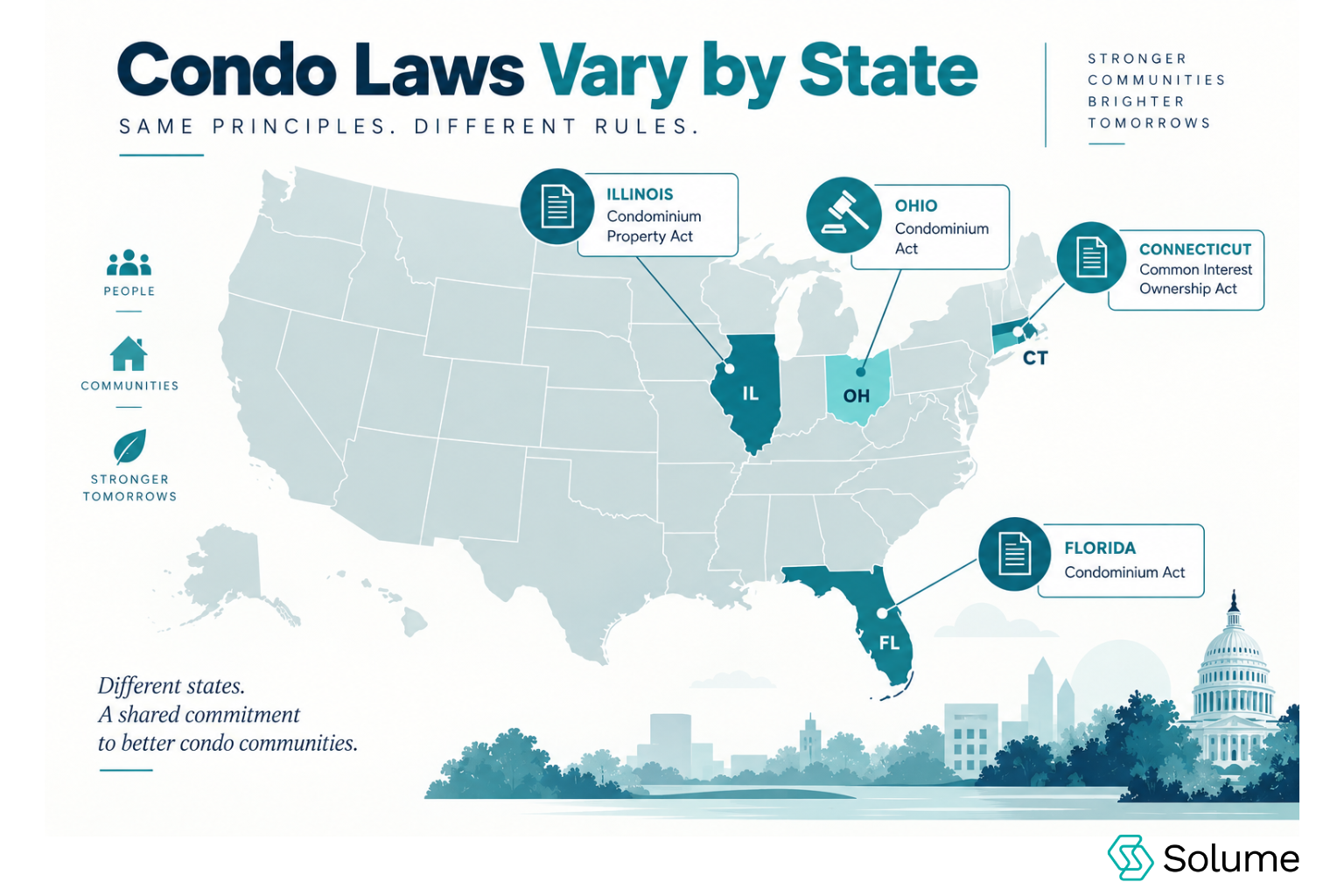
State condo laws set the floor beneath every association, and they vary more than boards expect. Florida condo laws are among the strictest. The Florida Condominium Act, Chapter 718, was tightened after the Surfside collapse to mandate structural inspections and reserve funding requirements for older buildings, with hard deadlines. Under Florida condo laws, a self-managed board that ignores its reserve study now risks statutory penalties, not just angry owners. That shift reflects a broader trend in condo association rules toward mandatory reserve planning rather than leaving long-term funding to board discretion.
Illinois operates under its own Condominium Property Act, which gives owners broad rights to inspect records and challenge assessments. That same Condominium Property Act shapes how notice must be given. Connecticut and Ohio follow versions of the Uniform Common Interest Ownership Act, each with distinct notice periods and fine caps. State condo laws that permit a fine in one place may make it overreach in another.
The lesson: never copy another community's condo rules and regulations without checking them against your own state condo laws. State law almost always overrides a conflicting rule. Because these statutes vary widely, boards should consult their attorney for legal interpretation before relying on any single provision.
Enforcing rules and applying penalties fairly
Enforcing condo rules fairly is where volunteer board members get sued, and almost always for the same reason: inconsistency. If you fine one owner for a balcony grill and wave off another, the second violation becomes evidence that your enforcement is arbitrary. For volunteer board members, selective enforcement is one of the fastest ways to lose in court.
This matters because penalties and fines only stick when they follow due process. Most governing documents and state statutes require written notice of the violation, a chance to cure it, and a hearing before an impartial panel before any fine attaches. Skip a step, and the fine is voidable.
Picture a board that fines three units for storing bikes in a shared hallway, then quietly lets a director's family member off the hook for the same thing. When one of the fined owners contests it, the inconsistency becomes the whole case, and the board spends more defending the fine than it ever would have collected. Keep the escalation ladder predictable: courtesy notice, formal violation letter, hearing, fine, and only then a suspension or lien. Document each step with dates. Board responsibility here isn't about being tough. It's about being uniform, and that board responsibility protects everyone. Transparency in how you apply penalties, backed by open resident communication, protects the association more than fine revenue ever will and keeps enforcement from curdling into resentment.
Compliance and record-keeping duties for self-managed boards
Compliance is not a one-time event. It's an ongoing set of association responsibilities that a self-managed board carries entirely on its own. Those association responsibilities include maintaining current governing documents, filing annual state reports, holding required meetings with proper notice, and producing estoppel certificates when a unit sells. Miss the estoppel deadline in a state like Florida and you delay a closing and expose the association to liability. These are just a few of the common challenges self-managed boards face once the administrative work piles up.
Record-keeping is the backbone of it all. Boards must retain meeting minutes, financial statements, reserve studies, vote records, and violation histories, often for several years under state law. The reason this matters is straightforward: when an owner requests records or a dispute lands in court, the association that can produce a clean, dated paper trail wins, and the one relying on memory loses. Sloppy record-keeping is what sinks self-managed boards more often than bad rules do.
This is a heavy administrative load for people with day jobs, and it is exactly the gap where self-managed boards fall behind. Solume centralizes member and home records, tracks architectural review requests, and automates reserve study compliance so volunteer boards aren't reconstructing history from email threads. Because rule enforcement software timestamps notices and hearings, you end up with the exact documentation a court wants to see when you enforce condo rules under pressure.
Getting condo association rules right depends less on writing perfect rules and more on the discipline behind them: consistent enforcement, clean records, transparency with owners, and reserve planning that keeps the community stable for the long term. If your board wants a clearer way to handle compliance, reserve planning, and consistent rule enforcement software without leaning on a management company, you can book a 15-minute fit call to explore your options with the Solume team and see whether it matches how your community operates. No pressure, just a straight look at whether the tools solve the problems your board is losing sleep over.
Frequently Asked Questions
Where do condo association rules actually come from?
They flow from three layers of governing documents: the CC&Rs (also called the declaration or master deed) recorded with the county, the bylaws that govern how the association operates, and the day-to-day rules and regulations set by the board. All three bind current and future owners because they legally 'run with the land' the moment you buy the unit.
What are the most common condo association rules I'll run into?
The typical set covers quiet hours (often 10 p.m. to 8 a.m.), pet limits on breed, size, and number, parking and guest restrictions, architectural approval for exterior changes, and rental or leasing caps. Most of these trace directly back to the CC&Rs and the board's adopted regulations.
Who enforces condo association rules, and what happens if I ignore them?
The board of directors enforces the rules, usually through written notices, fines, and, in serious cases, suspension of privileges or a lien on the unit. Enforcement authority comes from the recorded governing documents, but it must follow the notice and hearing procedures your state law and bylaws require.
What's the difference between CC&Rs, bylaws, and rules?
CC&Rs are recorded property-use restrictions like architectural standards and assessment obligations, while bylaws are the internal document covering elections, meetings, and board powers. Rules and regulations are the most granular layer: things like grill use or move-in hours, and they're the easiest to change, often needing only a board vote.
Can residents actually change or challenge a rule they disagree with?
Yes, but the path depends on the document type: rules and regulations often require only a board vote to amend, while CC&Rs and bylaws typically need a supermajority of owners. Any rule that conflicts with state or federal law, such as fair housing protections, is unenforceable and can be challenged on that basis.
Why does my condo association have so many restrictions?
Restrictions exist to protect shared property value, maintain consistent standards, and keep the association financially and legally stable. In reality, some rules are outdated or overly broad, but any rule the board can't tie to a legitimate governance or financial purpose, or that violates state law, may not hold up if challenged.
Is it worth reviewing the rules before I buy, or can I sort it out later?
Review them before you commit, because the CC&Rs, bylaws, rules, and financial disclosures bind you the day you close. Pay close attention to rental restrictions, pet policies, reserve funding, and pending special assessments: the risk most buyers overlook is inheriting an underfunded community with rules they can't easily change.
What if a board tries to enforce a rule that wasn't in place when I bought?
Boards can adopt new rules after your purchase, but the change must follow the amendment procedures in your governing documents and can't override rights protected by state law. If a new rule wasn't properly adopted or conflicts with the CC&Rs or statute, you can dispute its enforcement.