
Key Takeaways
- Most community association software wasn’t built for Condos and HOAs. It was adapted from apartment or portfolio tools, and it shows in day-to-day frustration.
- The right platform should take work off the board’s plate, make life easier for residents, and support volunteers who are already stretched thin, not bury them in more complexity.
- Community association software works best when short-term operations and long-term financial planning live side by side, with reserve study management, financial management, communication tools, and day-to-day operations all in one place.
- Solume is designed specifically for self-managed boards and smaller management firms that want modern systems without enterprise-level complexity.
- We start with a free demo so you can see if Solume even makes sense for your community. If it does, we follow that with a 30-day onboarding period where your board actually uses the system before any payment is required. No pressure, no sales pitch, just real use in your day-to-day work.
What Is Community Association Software?
Community association software is supposed to make life easier for Condo and HOA board members and anyone else trying to keep the place running without losing their evenings and weekends. It should support a board of directors that’s volunteering nights and weekends, and it should work whether you’re a self-managed HOA or you’re one of the Community Association Management Companies juggling multiple communities. In practice, many platforms do the opposite. They promise efficiency, but once you log in, you realize the system was never designed for how associations actually operate.
At a very basic level, it should be the one place people go when they need answers. Money, documents, messages, and maintenance. All of it. It should help homeowners associations move away from spreadsheets, email chains, and paper folders, and into something that works in real time.
The problem is that much of the market is dominated by legacy software. These tools often look modern on the surface, but underneath, they still behave like apartment rental systems or large portfolio platforms that were retrofitted for Condos and HOAs. Boards end up feeling like they put lipstick on a pig.
Key Features of HOA Management Software
Here’s a gut check most boards recognize immediately. Good HOA software isn’t exciting, and that’s the point. It quietly takes work off your plate, cuts down the administrative tasks no one volunteered for, and gives management teams and association members one place to look instead of five. No buzzwords. Just fewer things blowing up at once.
When software is actually built for Condo and HOA use, the difference is obvious almost immediately. It feels lighter. You stop wondering where things live. You stop double-checking whether someone else already handled an issue. And you stop relying on one board member to be the human filing cabinet.
The features that matter most are not flashy. They are practical, connected, and easy to understand.
- Resident portals that centralize resident communication and Member Communication so announcements, notices, and updates live in one place instead of scattered email threads
- A Member Database that keeps association members, units, and contact information organized as real community information, not a half-broken spreadsheet
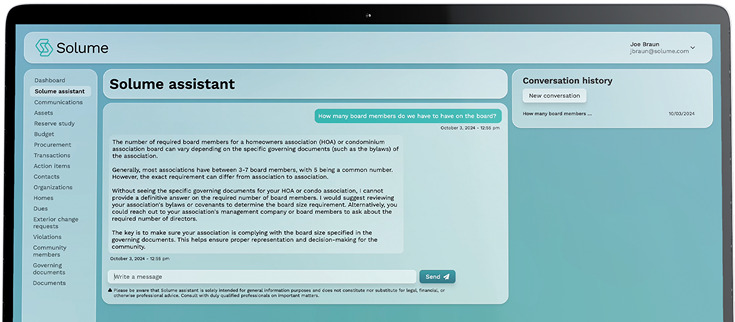
- Document Management paired with an AI assistant that lets board members and homeowners ask simple questions like "What are the parking rules?" or "When was the roof last replaced?" and get instant answers without digging through folders
- Online payments with clear payment options that reduce paper checks, personal payment apps, and manual tracking
- Maintenance and work order management that logs issues, assigns responsibility, tracks progress, and closes the loop with a visible record
- Violation Tracking and Risk Management that documents enforcement consistently, so boards are protected when issues escalate
- Financial tools for financial management that show dues, transactions, and balances in real-time, with financial reporting and financial reports you can actually read
- A clean bridge between accounting software and the rest of operations so you’re not running one tool for accounting systems and another for everything else
- A transparent payment system and Payment Processing that supports online payments and payment options without the paper checks drama
Each of these features works best when they are connected. When communication, finances, maintenance, and records live in separate systems, boards lose time and confidence. When they live together, decisions get easier.
How It Supports Community Association Managers
Good community association software reduces friction for management teams and volunteers alike. More and more boards and smaller firms are looking for ways to co-manage their communities. Technology makes it possible for boards to stay actively involved without being buried in administrative work, while still having the confidence that a professional manager is guiding the process. At the same time, HOA and Condo managers can support more communities because the same tools reduce repetitive tasks and administrative drag.
This matters whether you’re a self-managed HOA or a small management firm. When systems are disjointed, community managers spend more time chasing information than actually managing the community.
Benefits for Community Association Management Companies
Financial Management and Accounting Software
Financial management is where most associations feel the pain first. Boards are juggling day-to-day operations while also being responsible for long-term financial planning, often without a financial background. Deferred maintenance turns into special assessments, not because boards don’t care, but because there hasn’t been a good solution that shows operations and reserve study planning together. Solume is built to give boards insight into both, so today’s decisions don’t quietly become tomorrow’s financial emergencies.
Good community management software doesn’t try to turn your association into a Small Business. It handles the money the way boards actually deal with it, as a shared responsibility connected to common areas, reserve planning, and the real decisions people have to make.
The right community management software simplifies:
- Financial reporting with clear financial reports
- Replacement of separate accounting systems with Bank Integrations and cleaner property management software style workflows, without forcing you into a corporate accounting stack
- Payment Processing that supports online payments instead of Venmo and checks, needing to be tracked in a spreadsheet
- Transparent dues collection that homeowners can understand
When financial management tools are stitched together from different systems, mistakes happen. When they live on one platform, boards regain confidence.
Enhancing Operational Efficiency
Operational efficiency is not about doing more. It’s about finally getting rid of the little stuff that keeps stealing your nights and weekends. It’s the constant back and forth, the follow-ups, the "did anyone pay this," the "where is that document," the vendor who says they never got the request, and the homeowner who swears they were never notified. Board members already have full-time jobs. They’re volunteering, trying to do the right thing, and still getting blamed when something slips. When the system is unclear, everything becomes personal. When the system is simple, you can run day-to-day operations without losing sight of long-term financial planning and reserve study management. That’s the difference between feeling like you’re always behind, and feeling like you actually have control.
Modern community association software enables:
- Real-time updates for community managers so nothing gets lost between emails, texts, and "I thought someone else handled that." Everyone sees the same information at the same time, which cuts down confusion and finger-pointing.
- Streamlined architectural requests and service requests that move through a clear process instead of sitting in someone’s inbox. Requests are submitted, tracked, approved, or denied with a record that protects both the board and the homeowner.
- Better resident engagement through intuitive tools that people actually understand. When residents know where to go and what to expect, complaints drop, and participation improves.
- Push notifications and Online Voting that actually get used because they are simple, timely, and don’t require residents to log into a confusing system or remember another password.
This is how boards save time and reduce burnout. When software feels heavy, people stop using it. When it feels simple, it becomes part of daily tasks.
How Solume Provides a Comprehensive HOA Solution
One Platform for Every HOA Task
This is the part most platforms miss. Boards are stuck balancing daily tasks and business operations with long-term financial planning. When those two worlds live in different tools, deferred maintenance turns into special assessments, and everyone acts surprised.
Solume is built to keep short-term operations and long-term planning side by side, so you can see the tradeoffs before they become expensive.
Solume was built around a reality most boards don’t talk about much. Board members carry real responsibility, often without training or backup. The software is there to support their decisions and reduce the weight of that responsibility, not add to it.
Solume brings together management features that cover specific needs without making you feel like you need training to click a button. It is designed for the real day-to-day work of a homeowner association, whether that work is handled by a self-managed board or supported by an HOA Manager:
- Reserve study management so your long-term plan lives alongside your annual budget, not buried in a PDF
- Budget and transactions so boards can see where the money is going and what is actually happening against the plan
- Dues collection and tracking with clear visibility into who has paid, who is late, and what follow-up is needed
- Vendor procurement and vendor management, so that quotes, invoices, contracts, and vendor history are organized in one place
- Maintenance management and work orders so maintenance requests get logged, assigned, tracked, and actually closed out across common areas and shared assets
- Maintenance request tracking that gives resident support a clear record, and gives the board cover when something gets disputed later
- ARC requests so architectural approvals don’t disappear into email threads
- Violation communication and tracking, so enforcement stays consistent and documented
- Communications, such as dues notices, updates, and announcements, live in one timeline instead of personal inboxes
- Members and homes so you always know who lives where, supported by a full member database that ties history, homeowner dues, and community information to each address, plus Asset Management for common areas and long-term facility management
- Solume Assistant so boards can ask plain-English questions and get fast answers tied to your community’s documents and rules
This is the difference between software you tolerate and software that actually helps. It supports business operations, improves resident satisfaction, and creates real cost savings by reducing duplicated effort and missed follow-ups.
A community in Eugene, Oregon, came to Solume after years of managing a 1970s condo association with spreadsheets that only an economics professor could decipher. They knew they needed systems, but they also knew volunteers shouldn’t need professional training to use them. Solume gave them structure without complexity.
Exceptional Customer Service, Professional Services, and Support
Solume is designed for self-managed HOAs and smaller management firms who want responsive, US-based customer support from people who understand both the technology and the realities of running a community. Our team includes product specialists and experienced property managers who can guide best practices, not just troubleshoot software.
That includes a support model designed around real boards and real people:
- US-based customer service that is patient, responsive, and not outsourced, focused on resident support and board confidence
- Professional Services that help you implement best practices and support management services without overwhelming volunteers
- Support for Small Business operators and management firms
- Patient, hands-on onboarding for the board of directors, HOA Managers, and community association managers. We take the time each board needs, knowing not everyone is tech savvy, even though the software is intuitive and built for ease of use.
- An emphasis on ease of use across all management features
Good software should feel like it’s on your side.
Use Cases of Community Association Software
Success Stories of HOA Management
When community association software works, a few things become obvious quickly. Communication tightens up. Maintenance stops falling through the cracks. Board members spend less time chasing information and more time making decisions.
A condo community in Eugene, Oregon, found this out the hard way. They had been managing a 1970s-era property with a web of spreadsheets that only made sense to the one person who built them. Everyone else felt one step behind. They knew they needed structure, especially as the building aged, but they also knew volunteers shouldn’t need an accounting degree to run a community.
What changed wasn’t just new software. It had one place where financials, maintenance, documents, and reserve planning lived together. Requests stopped disappearing. Questions stopped bottlenecking with one person. The board finally had shared visibility.
That’s what effective community association software does. It doesn’t add rules. It removes guesswork. And that’s how resident trust and community engagement actually improve.
Why Choose Solume
Most HOA software options promise everything. Few deliver it in a way that respects how Condos and HOAs actually function.
Solume focuses on:
- Ease of use for volunteers, without stripping out the power that managers need
- Real-time visibility that improves resident experience, homeowner experience, and resident satisfaction
- Cost savings that come from fewer mistakes, fewer missed handoffs, and better community engagement
- A workflow that supports co-managing, whether you’re a board or a manager supporting multiple communities
- Real-time visibility for community association managers
- A payment system that supports online payments and flexible payment options
- Management software options that grow with your community
- A free demo to confirm Solume is the right fit, followed by a free 30 day free trial onboarding period that lets boards fully use the system before any payment is made, with clear pricing plans and no pressure
The real question isn’t whether software can manage your association. The question is whether your current system is quietly holding you back.
Transform Your HOA and Condo Community with Modern Community Association Software
Most community operations don’t fail because people don’t care. Most boards care a lot. Things break down because the systems everyone relies on stop scaling, with the responsibility being placed on volunteers.
If your board is still stitching together tools, relying on spreadsheets, or hoping social media posts reach homeowners instead of using direct resident portals and push notifications, it is worth asking a simple question:
What would actually change if your systems worked together instead of fighting you every step of the way?
Solume does not promise perfection. It gives boards, management firms, and community managers the structure they need to handle administrative tasks, facility management, financial management, and long-term reserve planning with confidence and control.
Sometimes the right software doesn’t just make things easier. It changes how the board shows up, how residents engage, and how problems get handled before they turn into messes.
Community Association Software FAQs
Is community association software really necessary for small Condos and HOAs?
It depends on how much strain you’re willing to put on volunteers. Small associations often assume software is overkill until spreadsheets break, emails get missed, or financial questions pile up. The size of the community matters less than the complexity of what you manage.
Why do so many boards abandon their current HOA software?
Most platforms weren’t designed for Condos and HOAs from the ground up. They’re often apartment or portfolio systems that were adapted later. Boards log in expecting relief and instead inherit new workarounds. That frustration adds up.
Can community association software really replace spreadsheets?
Yes, and that’s usually the first win boards feel. Software replaces fragile spreadsheets with real-time data, shared visibility, and fewer single points of failure. No more one person holding everything together.
How does software improve resident communication?
It centralizes communication. Instead of announcements scattered across email, text messages, and bulletin boards, residents know where to go for updates, documents, and requests. That clarity alone reduces conflict.
What features matter most for self-managed HOAs?
Ease of use, financial visibility, resident portals, and reliable payment processing. Self-managed boards don’t need complexity. They need tools that respect their time and make daily tasks predictable.
Is community association software only for professional managers?
No. In fact, many professional tools overwhelm volunteer boards. The best platforms work just as well for self-managed communities as they do for small management firms.
How does software help with financial oversight?
It gives boards one place to review financial reports, track dues collection, and see what’s happening without waiting for monthly emails or manual exports. Transparency becomes the default.
What role does mobile access really play?
It removes friction. When board members and residents can handle tasks from a phone, things get done faster and with fewer reminders.
How long does it take to transition to a new platform?
Less time than most boards expect. The bigger shift isn’t technical. It’s mental. Once people trust the system, they stop clinging to old processes.
How do you know when it’s time to change software?
If your board spends more time explaining the system than using it, or if only one person understands how everything works, that’s usually the signal. Software should reduce dependency, not create it.
Expert Takeaway
Good community association software doesn’t make decisions for the board. It creates the conditions for better ones. When information is clear, accessible, and shared, boards stop reacting and start leading.