
Key Takeaways
- A reserve study is a long-term financial planning tool, not a maintenance checklist, and the distinction matters enormously for how it gets done and who does it.
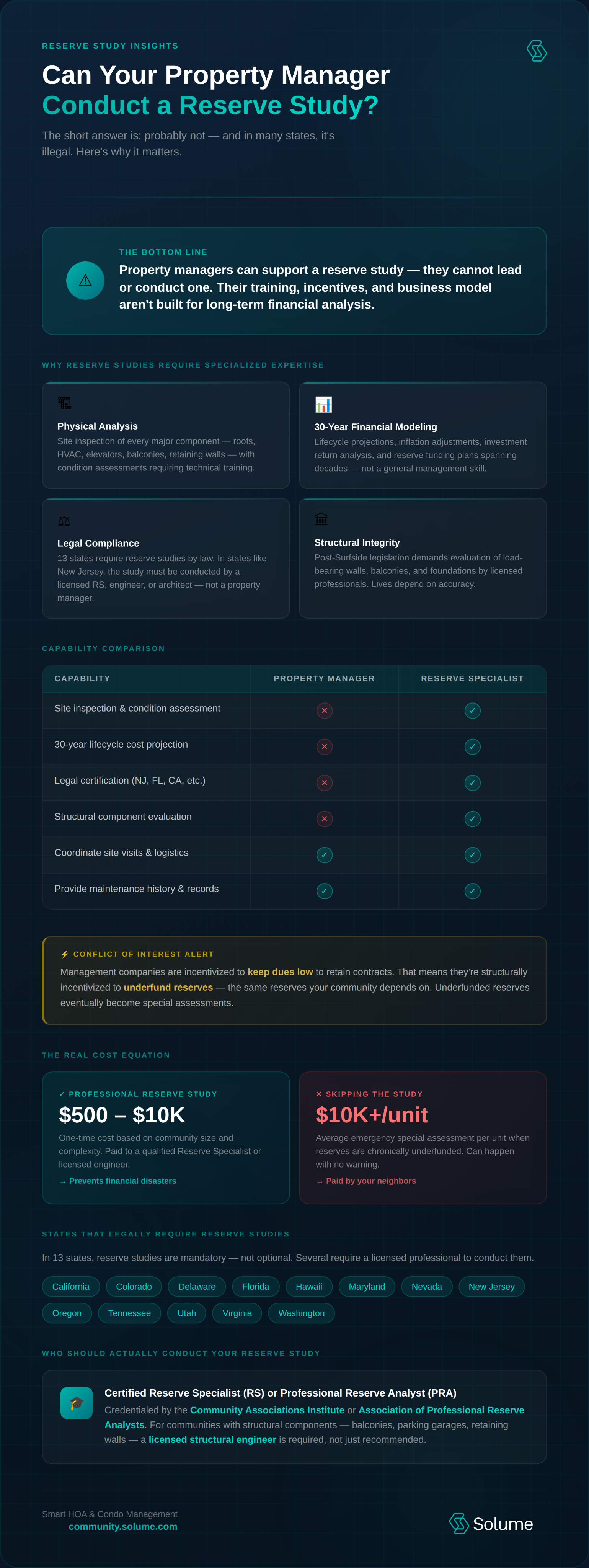
- In 13 states, reserve studies are legally required for condo associations. In states like New Jersey (as of 2024), the study must be conducted by a licensed Reserve Specialist, engineer, or architect, not a property manager.
- Property management companies can play a supporting role in a reserve study process, but they should not lead it. Their incentives, their training, and their business model aren’t built for long-term financial analysis.
- The conflict of interest is real: management companies are often incentivized to keep dues low, which means they’re incentivized to underfund reserves, and underfunded reserves eventually become special assessments.
- Some boards in states with looser requirements choose to build their own reserve study using a platform like Solume. That’s a legitimate option, but complex assets like parking garages, retention ponds, and balconies should still involve a licensed professional.
- The Surfside condo collapse in 2021 changed the legislative landscape permanently. If your community hasn’t revisited its reserve funding strategy since then, it’s overdue.
I want to tell you about a community I worked with directly.
They had been under management by one of the largest property management companies in America for nearly 20 years. Two decades of the same management, the same processes, the same annual budgets — and by all appearances, things were running fine. Until they weren’t.
Out of nowhere (or at least what felt like out of nowhere), the board was informed that the community needed significant emergency repairs. Repairs that had apparently been building up quietly for years. The special assessment that followed came out to approximately $13,500 per unit. For a community of any size, that number is devastating. For homeowners on fixed incomes, it’s a crisis.
What made it worse: the property management company, which had overseen this community’s finances for 20 years and presumably had visibility into the deteriorating condition of these assets, happened to have a lending arm. And that lending arm stepped right in to present the community with a loan (with interest, of course) to cover the cost of repairs that arguably should have been planned for all along.
I’m not here to accuse anyone of fraud. But I am here to name a conflict of interest when I see one. And I am absolutely here to tell every HOA and condo board reading this: a property management company handling your reserve study is not just a bad idea in most cases — in some states, it’s not even legal.
The Role of a Property Management Company in Reserve Studies
What Is a Reserve Study and Its Purpose?
Before we get into who should conduct a reserve study, it’s worth being clear on what one actually is, because it’s frequently misunderstood, even by experienced board members.
A reserve study is a long-term financial planning document. It has two components: a physical analysis and a financial analysis. The physical analysis involves a site inspection of the community’s major components, like roofs, parking lots, HVAC systems, plumbing systems, pavement, common areas, pool equipment, elevators, retaining walls, balconies, and anything else the association is responsible for maintaining. A qualified reserve specialist or engineer evaluates each component’s current condition, estimates its remaining useful life, and projects when it will need to be repaired or replaced.
The financial analysis takes that physical data and builds a funding plan around it. How much money does the community need in its reserve account to cover those future costs? How much should it be contributing to reserves each year? Is the current reserve balance on track, or is the community heading toward a funding shortfall that will eventually require emergency repairs and a special assessment?
A comprehensive funding plan isn’t just a spreadsheet. It factors in inflation, investment returns on reserve contributions held in savings accounts, certificates of deposit, or treasury bills, and the lifecycle of every major component of the property. A full reserve study done correctly tells a board not just where they are today, but where they’ll be in 5, 10, and 30 years, and what it will cost if they fall behind.
That is not a task for a generalist. It requires specialized training, independent judgment, and, in a growing number of states, a professional license.
How Property Management Companies Contribute
To be fair, property management companies do play a legitimate supporting role in the reserve study process. They have boots on the ground. They know the community’s history, they have records of past repair work and maintenance expenses, and they can coordinate a site visit efficiently. A good property manager can pull together the documentation a reserve specialist needs to do their job, such as maintenance logs, prior repair costs, vendor invoices, and a current inventory of common elements like parking lots, signage, and community amenities.
They can also help translate reserve study findings into the annual budget process, ensuring that the reserve contributions recommended in the study are reflected in the operating budget the board approves each year.
What they should not be doing is conducting the study itself, making the financial determinations about replacement costs and funding levels, or recommending that the community defer reserve contributions to keep dues low. That last one is where boards need to pay close attention.
How HOA Boards and Property Managers Work Together
Supporting Financial Planning and Reserve Contributions
The relationship between an HOA board and a property management company works best when roles are clearly defined. The board governs. The management company executes. And for something as consequential as a reserve study, the board needs to be driving the process, not delegating it entirely.
In practical terms, this means the board is responsible for hiring the reserve specialist, reviewing the study’s findings, making decisions about funding levels, and communicating the results to homeowners. Monitoring cash flow and reserve fund status is an ongoing responsibility that property managers can assist with, but the board members bear the fiduciary duty. If reserves are underfunded and a special assessment hits, it’s the board that answers for it, not the management company.
Good property managers understand this and respect the boundary. They help prepare for future costs like roof replacement and concrete replacement by keeping accurate maintenance records and flagging emerging issues early. They assist with funding requirements by making sure the annual budget reflects what the reserve study recommends. But they aren’t the ones determining what those requirements should be.
Site Inspections and Component Condition Analysis
A proper site visit for a reserve study isn’t a walkthrough. It’s a systematic condition assessment of every major component the association maintains, and for complex communities, that list can be substantial.
Tracking wear and tear on major components requires trained eyes. Evaluating the useful life of HVAC systems, plumbing systems, and structural elements involves technical knowledge that most property managers simply don’t have, and aren’t expected to have. Identifying repair needs for amenities like golf courses, retention ponds, or parking garages requires professionals who have seen those specific components fail and know what early-stage deterioration looks like.
This is the part of the reserve study conversation that tends to get glossed over. A management company sending a staff member to walk the property and note “roof looks okay” is not a component condition analysis. It’s an impression. And basing a 30-year funding plan on impressions is exactly how a community ends up with $13,500 special assessments.
Benefits of Professional Support in Reserve Studies
When a community invests in a professional reserve study conducted by a qualified reserve specialist affiliated with the Association of Professional Reserve Analysts or certified by the Community Associations Institute, the benefits compound over time.
Expertise in assessing replacement costs and future expenses means the numbers in the funding plan are grounded in actual market data, not estimates based on what repairs cost a decade ago. A professional knows that pavement resurfacing costs more now than it did five years ago. They know what roof replacement costs per square foot in your market. They know what a water heater replacement costs for a 200-unit condo association versus a 40-unit one. That precision matters when you’re building a 30-year financial model.
Improved planning for unexpected costs and emergency repairs is one of the most underappreciated outcomes of a well-executed reserve study. Communities with adequate reserves don’t experience true “emergency” repairs in the same way underfunded communities do, because the reserve study identified the repairs coming years in advance and the community saved for it. The emergency isn’t an emergency anymore. It’s a line item.
Better funding levels also protect resale potential. Mortgage lenders, including those underwriting FHA and VA loans, scrutinize reserve fund status as part of the approval process for condo sales. A community with chronically underfunded reserves can effectively make individual units harder to sell and finance. Potential buyers increasingly review reserve balance and funding levels before making offers. Condo owners in well-funded communities have a real financial advantage at resale time, even if they never think about reserves until the moment they’re trying to sell.
Challenges in Relying on Property Management Companies
Here’s the blunt version of what I’ve observed: property management companies are generally not in the business of long-term financial planning. They’re in the business of managing day-to-day operations, handling vendor relationships, collecting dues, responding to maintenance requests, and keeping boards and homeowners from being too unhappy with each other.
That last part is the problem.
When dues go up, homeowners complain. When homeowners complain, they sometimes blame the management company. So a management company that is responsible for recommending reserve contributions — which require raising dues to fund adequately — faces a structural incentive to keep those contributions low. Not because they’re dishonest. Because keeping people happy in the short term is how they keep the contract.
The result is predictable: chronically underfunded reserves, deferred maintenance, deteriorating common areas, declining property values — and eventually, a special assessment that blindsides everyone except the people who were paying attention to the numbers.
Specialized Knowledge for Reserve Studies
The importance of reserve study specialists and reserve analysts isn’t just a professional preference — it’s increasingly a legal requirement. In New Jersey, Senate Bill S2760 (signed into law in 2024) requires that reserve studies be completed or overseen by a licensed Reserve Specialist, a New Jersey-licensed engineer, or a New Jersey-licensed architect. A property manager doesn’t qualify.
Reserve studies or a reserve schedule for condo associations are legally required in 13 states: California, Colorado, Delaware, Florida, Hawaii, Maryland, New Jersey, Nevada, Oregon, Tennessee, Utah, Virginia, and Washington. In states like Florida, the post-Surfside legislation goes further — requiring structural integrity reserve studies for condominiums three stories or taller, conducted every 10 years, with findings that directly determine reserve funding requirements. As of 2025, condominium associations in Florida can no longer waive reserves for structural components.
The Association of Professional Reserve Analysts and the Community Associations Institute both maintain standards for who is qualified to conduct a professional reserve study. These organizations exist for a reason. The technical demands of a full reserve study — physical analysis of major components, lifecycle projections, financial analysis of funding needs — require training and credentials that go well beyond general property management.
Utilizing reserve funds wisely — whether held in savings accounts, certificates of deposit, or treasury bills — also requires an investment strategy aligned with the funding plan’s timeline. A reserve specialist understands how to structure reserve contributions for both liquidity and returns. A property manager managing a reserve account without that framework is essentially guessing.
Balancing Financial Health and Maintenance Costs
This is where the tension lives for most boards. Maintaining adequate reserves for major repairs and capital improvements requires dues that reflect the actual long-term cost of the community. But homeowners push back on dues increases. Boards face re-election. Management companies face contract renewal. Everyone has a short-term incentive to underfund.
The communities that figure this out — that treat reserves as the nest egg that protects everyone’s investment rather than a discretionary savings account that can be raided or ignored — are the ones that don’t hit their residents with surprise assessments. They plan for pavement resurfacing years before the parking lot deteriorates. They budget for water heater replacement across a condo building before the failures start. They track the useful life of every major component and fund for its replacement on schedule.
Financial health for a homeowners’ association is not measured quarter to quarter. It’s measured over decades. And the financial analysis in a reserve study is the only tool that gives a board a realistic view of where they’re headed.
Actionable Insights for Homeowners’ Associations
Partnering with property management companies can absolutely streamline the reserve study update process — gathering site visit documentation, coordinating with vendors, and providing maintenance history. That’s a legitimate and valuable contribution. But the strategic direction of the reserve study, the funding plan it produces, and the decisions about reserve contributions should remain with the board and a qualified professional.
Leveraging professional reserve study companies ensures accurate cost estimates, defensible funding levels, and long-term financial health that protects property owners, condo owners, and the community as a whole. In states where professional qualifications are legally required, there’s no choice. In states where the law is looser, there’s still a fiduciary responsibility — and that responsibility runs to every homeowner in the community, not just the ones who show up to board meetings.
Some states do allow volunteers or unlicensed individuals to conduct reserve studies, and Solume has worked directly with communities that chose to build their own reserve study using our platform rather than hire outside professionals. That’s a legitimate path for some communities — particularly smaller ones with straightforward common elements and boards that are genuinely engaged in the process. For those boards, Solume provides the tools to organize the data, track component conditions, document reserve balances, and build a funding plan that’s transparent to everyone in the community.
But if your community has a parking garage, a retention pond, load-bearing balconies, retaining walls, or any structural component that affects the safety of residents, please don’t rely on a volunteer or a property manager for that assessment. Hire a licensed engineer or a certified reserve specialist. The cost of a professional reserve study ranges from roughly $500 to $10,000, depending on community size and complexity. That cost is a rounding error compared to the cost of getting it wrong.
Where Solume Fits In
Whether your community hires a professional reserve study company or builds the study internally, the work doesn’t end when the report is delivered. The reserve study needs to be a living document reviewed annually, updated as conditions change, and integrated into the community’s financial planning and annual budget process year after year.
That’s what Solume is built for. Our platform gives HOA and condo boards a single place to manage their reserve study data, track component conditions over time, monitor their reserve account balance against the funding plan, and keep the entire financial picture organized and transparent. If you work with a professional reserve study company, Solume helps you manage and act on what they deliver. If your board is self-managing and wants to build the reserve study internally, Solume gives you the structure to do it in a way that holds up.
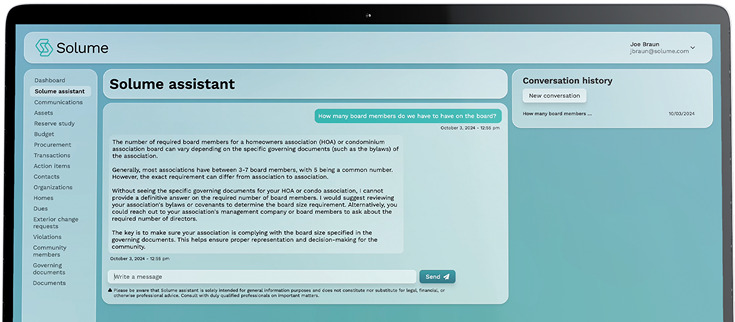
And if you have questions about what your governing documents say about reserve funding requirements or what your state law requires, Solume Assistant can pull answers directly from your CC&Rs, bylaws, and applicable state statutes in seconds.
The community that got hit with a $13,500 per unit special assessment didn’t lack the ability to plan. They lacked the tools, the incentives, and the independent oversight to see the problem coming. That’s exactly the gap Solume exists to close.
Request a free 15-minute call to find out if Solume is a good fit for your community. No pressure — just an honest conversation about where your community is and whether the tools can help.
FAQs
1. What Is a Reserve Study and Why Does It Matter?
A reserve study is a 10-30-year financial model that tells your community what its major assets will cost to replace — and whether you're saving enough to cover it. It has two parts: a physical analysis of your common areas and major components, and a financial analysis that builds a funding plan around what that physical analysis finds. Most boards treat it like a maintenance checklist. It isn't. When it's done right, nothing catches you off guard. When it's skipped, the first sign that something went wrong is usually a special assessment.
2. Can a Property Management Company Legally Conduct a Reserve Study?
In some states, no — it's illegal. In others, it's technically permitted but still a bad idea. At least 13 states require reserve studies, and several — including New Jersey — require the study to be conducted by a licensed Reserve Specialist, engineer, or architect. A property manager doesn't qualify. Even where it's legal, the conflict of interest is real: management companies are incentivized to keep dues low, which means they're incentivized to underfund reserves. I worked with a community managed by one of the largest property management companies in America for nearly 20 years. The special assessment that eventually hit came to approximately $13,500 per unit — and the same management company's lending arm was right there with a loan offer. With interest.
3. What Is the Difference Between a Reserve Study and a Reserve Fund?
The reserve study is the plan. The reserve fund is the money. Having a reserve fund without a current reserve study is like having a savings account with no idea what you're saving for — the balance might feel fine and still be dangerously inadequate. You need both.
4. How Often Should a Reserve Study Be Updated?
Every 3 to 5 years at minimum — sooner if something significant changes. A major repair, a new state law, storm damage, or a change in the community's physical condition all warrant an earlier reserve study update. A study from 2018 does not tell you what your community needs in 2025. Treat it as a living document, not a one-time task.
5. What Happens If an HOA or Condo Doesn't Have a Reserve Study?
Nothing bad happens immediately — and that's exactly the problem. The assets are still deteriorating. The funding gap is still growing. The board just doesn't know it yet. Eventually, it shows up as deferred maintenance, emergency repairs, special assessments, and declining property values. In states where a reserve study is legally required, the board also faces potential legal liability. Mortgage lenders — including FHA and VA — review reserve adequacy for condo financing. An underfunded community makes individual units harder to sell.
6. Who Is Qualified to Conduct a Reserve Study?
A certified Reserve Specialist (RS), a Professional Reserve Analyst (PRA), or a licensed structural engineer. Not a property manager. Not a volunteer with a clipboard. For communities with structural components — balconies, parking garages, retaining walls — a licensed engineer isn't optional. The Surfside collapse in 2021 killed 98 people and permanently changed how states think about who should be assessing structural reserve components.
7. How Much Does a Reserve Study Cost?
Between $500 and $10,000, depending on community size and complexity. A mid-sized condo association typically runs $2,000 to $5,000 for a professional reserve study. Compare that to a special assessment on an underfunded community, which can run $10,000 per unit or more — assessed all at once, with no warning. The reserve study that could have prevented it cost less than one month of management fees.
8. Can an HOA Board Conduct Its Own Reserve Study?
In many states, yes — there's no law against it. For a small community with simple common elements and an engaged board, a self-managed reserve study using the right tools is a legitimate path. Solume has worked directly with communities that built their own reserve study on our platform. But the moment your community has structural components — balconies, parking decks, retention ponds — you need licensed eyes. Know where your qualifications end.
9. What Assets Should Be Included in a Reserve Study?
Everything the association is responsible for maintaining — especially the items most communities underestimate. The standard list includes roofs, parking lots, HVAC systems, plumbing systems, pools, elevators, and building exteriors. The components that tend to get missed — retention ponds, retaining walls, parking garages, balconies — are often the most expensive and the most dangerous when they fail. If it's structural, safety-related, or expensive to replace, it belongs in the reserve study.
10. What Is the Difference Between Fully Funded and Threshold Funded Reserves?
Fully funded means your reserve balance matches the theoretical depreciated value of all components. Threshold funding sets a minimum floor that your reserves won't fall below. Both are legitimate approaches with different implications for dues levels and special assessment risk. Most boards have never heard either term, which says everything about how seriously the industry takes long-term financial planning. A board that doesn't know which method they're using is making financial decisions they don't fully understand.
This guide is for educational purposes only and does not constitute legal or financial advice. Reserve study requirements vary by state. Consult a licensed reserve specialist or attorney for guidance specific to your community.
This article is intended for educational purposes only and does not constitute legal or financial advice. Reserve study requirements vary by state and change frequently. For guidance specific to your community, consult a licensed reserve specialist, engineer, or attorney with experience in community association law.