A self-managed board in Spokane sends out a special assessment notice. It follows the process spelled out in its declaration. Two weeks later, a homeowner's attorney sends a letter. The problem wasn't the amount. The board followed RCW 64.38, even though WUCIOA notice provisions already applied to them. Washington HOA laws currently run on two parallel tracks, and the gap between them is exactly where volunteer board members get caught. This article walks through what the statutes generally require, where boards slip up, and how to stay on the right side of the law before the 2028 transition closes the gap for good.
Key Takeaways
- Washington HOA laws currently operate on two tracks: RCW 64.38 for pre-2018 communities and RCW 64.90 (WUCIOA) for newer ones, with full consolidation set for January 1, 2028.
- Homeowners are automatically bound as HOA members when they purchase property in a covenant-restricted community, making opt-out effectively impossible without selling.
- RCW 64.38.045 gives homeowners enforceable rights to inspect association financial records and meeting minutes, a tool often underused in accountability disputes.
- Washington courts can award attorney fees to homeowners who successfully challenge board noncompliance, raising the financial stakes of ignoring statutory requirements.
- Self-managed boards face a narrow compliance window right now, since WUCIOA provisions already apply in part to older associations before the 2028 full transition.

What Washington HOA laws are (overview of governing statutes like WUCIOA)
Washington HOA laws aren't one book. They're a stack of overlapping statutes, and which one controls your association depends on when your community was created. Older associations fall under the Washington Homeowners' Association Act (RCW 64.38). Condominiums formed before 1990 or between 1990 and 2018 fall under separate condo acts. Anything created on or after July 1, 2018 falls under the Washington Uniform Common Interest Ownership Act (RCW 64.90), better known as WUCIOA.
WUCIOA was designed to unify these scattered rules. By January 1, 2028, it will replace the older statutes entirely, pulling HOA communities, condo associations, and cooperatives under one framework. The overlap exists because the legislature phased WUCIOA in gradually to avoid forcing thousands of existing associations to rewrite their documents overnight. What many communities don't realize is that WUCIOA already applies certain provisions to pre-2018 associations, including rules on meetings, budgets, and dispute resolution. Many of these same communities are self-managed, and understanding the common challenges self-managed boards face makes it easier to see why statute confusion is such a frequent trap.
The Washington State Legislature publishes the full text, and boards should read the source rather than rely on summaries. You can review the statute directly at the Washington State Legislature's RCW 64.90 page. Knowing which statute governs your community is part of board responsibility, and boards should confirm the current classification with their attorney since statutory references can change over time.
How state law interacts with HOA governing documents, bylaws, and CC&Rs
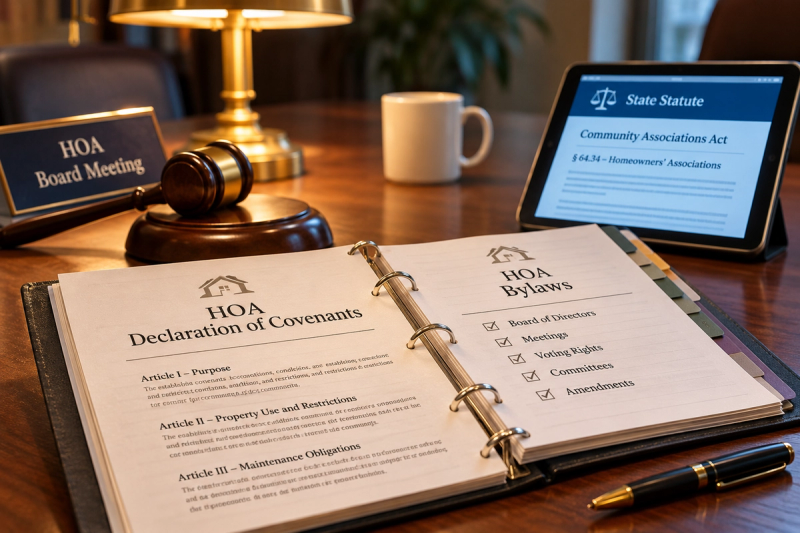
Here's the hard truth most boards assume backward: your governing documents don't override Washington state law. State law sets the floor. Your declaration, HOA bylaws, and covenants and rules can be stricter in some areas, but they cannot grant your board powers the statute withholds or strip rights the statute guarantees.
What actually happens is a conflict hierarchy. Washington statute sits on top, then your recorded CC&Rs, then your HOA bylaws, then board-adopted rules. The statute wins every time because your association exists only because state law authorizes it, so no document it produces can override the authority under which it was created. If a bylaw contradicts RCW 64.90, the statute generally controls, and any action the board took under that bylaw can be challenged. Boards enforcing an old parking covenant or fine schedule written before WUCIOA took effect face real legal compliance risk, and some end up enforcing rules that boards can't legally enforce without realizing it.
Most volunteer board members inherited their governing documents from a developer and never cross-checked them against current law. The Washington State Chapter of the Community Associations Institute offers education on reconciling these layers; you can find resources through WSCAI. Because interpretation gets technical and this article is not legal advice, boards should consult their attorney before enforcing any provision they're unsure about.
Homeowner rights under Washington HOA law
Buy a home in a covenant-restricted community, and you automatically become a member, whether you ever set foot in the clubhouse or not. That membership comes with assessment obligations. The legal rights that come with it are enforceable too, and boards sometimes forget they exist.
The most practical one is access to records. Under RCW 64.38.045, owners can inspect association financial records, budgets, reserve account statements, and meeting minutes on request. WUCIOA extends similar disclosure requirements to associations under its reach. This is the single most underused tool homeowners have, and it's often the first move in any accountability dispute. Communities that ignore these obligations eventually learn what happens when HOA transparency fails, usually the hard way.
Owners also have the right to proper notice of board meetings, the right to attend most of them, and the right to vote on matters the governing documents reserve to the membership. Washington courts can award attorney fees to homeowners who successfully challenge board noncompliance in some circumstances. That fee-shifting matters because it can remove the usual barrier that stops an owner from suing over a few hundred dollars: the cost of the lawsuit can land on the association instead. Ignoring these rights isn't a small procedural slip; it's a financial exposure. Boards that treat financial transparency as optional often learn otherwise in mediation or court.
House Bill 1110 and zoning changes affecting associations
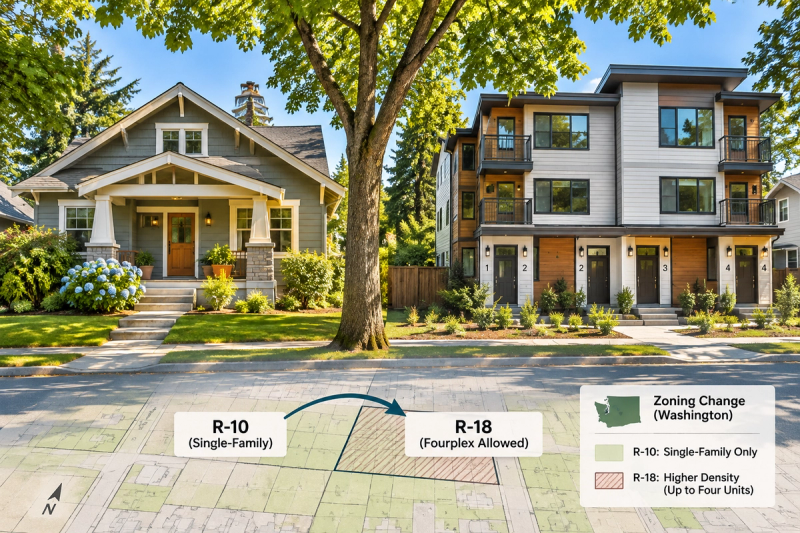
House Bill 1110, passed in 2023, reshaped land zoning across Washington cities by requiring most of them to allow duplexes and fourplexes on lots previously reserved for single-family homes. The goal was community stability through more housing supply. The effect on HOA communities is messier than lawmakers framed it.
House Bill 1110 targets municipal zoning, not private covenants. A city may now permit a fourplex where single-family zoning once stood, but your recorded CC&Rs can still restrict lots to single-family use. Many assume HB 1110 automatically voids those covenants. In reality, it generally doesn't, at least not directly. Private land use restrictions in governing documents generally survive the end of municipal single-family zoning, because zoning sets what a government will allow while a covenant is a private contract between owners that the city has no power to cancel.
That tension is where disputes brew. A homeowner points to the new state allowance; the board points to the declaration. Boards should not assume HB 1110 either frees them or binds them without a legal read of their specific covenants against the statute. This is an area where Washington state law and HOA documents actively collide, and it is squarely one of the Washington HOA laws boards misread most often.
Exemptions and which communities the laws apply to
Not every neighborhood with a shared road is a regulated HOA. Washington's statutes draw lines, and the exemptions matter because a board operating under rules that don't apply wastes effort and credibility.
WUCIOA generally applies to common interest communities created on or after July 1, 2018, and partially to older ones. But smaller communities get breaks. Associations with very few units or very low annual assessments can be exempt from some WUCIOA requirements, including certain budget and reserve-study mandates. The thresholds are specific, so check the statute rather than assume your size exempts you.
Pre-2018 homeowners associations still answer to RCW 64.38, and older condo associations answer to the condominium acts that predated WUCIOA. A condo association built in 1995 isn't governed by the same reserve rules as a 2020 HOA community. These distinctions turn on recording dates, unit counts, and assessment levels. Boards in self-managed communities should confirm their exact classification with a qualified attorney before adopting policies, and watch for exemption status to shift as the 2028 consolidation approaches.
Common rule enforcement areas boards get wrong (parking, fines, meetings)
Rules enforcement is where good boards generate bad lawsuits. The pattern is almost always the same: the board enforces a rule it never properly adopted, or skips a step the statute requires before penalizing an owner.
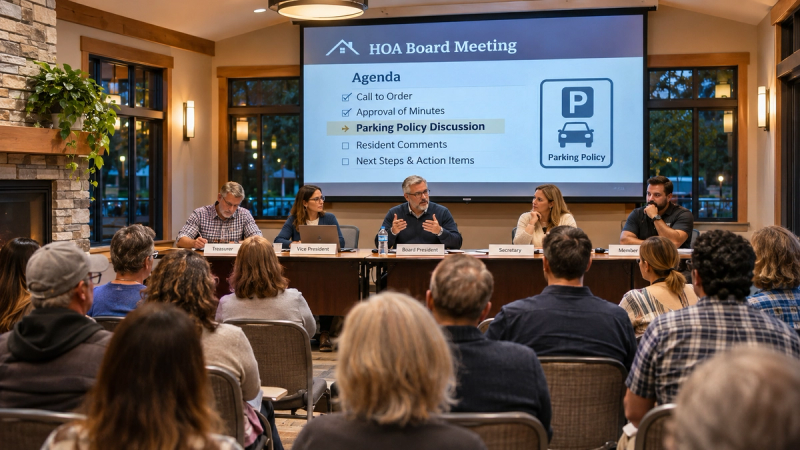
HOA parking rules top the list. Boards tow vehicles or impose restrictions based on an informal policy that was never recorded or ratified. If the HOA parking rules aren't anchored in the governing documents and adopted through proper procedure, enforcement can collapse when challenged.
HOA fines are the second trap. Washington law and WUCIOA generally require notice and an opportunity to be heard before an association imposes fines. Picture a self-managed board that fines an owner $500 for an unapproved fence, skips the hearing, and ends up paying the owner's attorney fees after the fine is voided. The fine was sound in concept; the process wasn't. The step boards skip here exists for a reason: the hearing is the owner's chance to contest the facts, so a fine imposed without one is often procedurally defective no matter how clear the violation seems.
Board meetings are the quiet third failure. Decisions made without proper notice, or in a closed session that should have been open, can be invalidated. Consistent rules enforcement depends on following procedure every single time, not just on being right.
Financial transparency and reserve/disclosure requirements under Washington law
The risk most boards overlook is financial. Underfunded reserves don't announce themselves until a roof fails and the only option left is a crushing special assessment. Washington law tries to force the conversation earlier.
Under WUCIOA, many associations must prepare budgets, maintain reserve accounts, and in many cases commission reserve studies with regular updates. The statute ties this to disclosure: owners are entitled to see the numbers. Boards unsure of their exact obligations should review Washington's reserve study requirements directly, since the rules differ depending on when the association was formed. This is financial transparency written into law, not just good practice. The Florida Surfside collapse in 2021, which killed 98 people after years of deferred maintenance and reserve shortfalls, is often cited as a reason states keep tightening these rules.
Deferred maintenance plus thin reserves equals special assessments, and special assessments are what fracture community stability faster than almost anything. A fiduciary duty runs to every board member here: managing association money prudently and reporting it honestly isn't optional. Boards that treat reserve planning as a line item to minimize are deferring both maintenance and legal compliance risk. Honest reserve planning now is generally cheaper than an emergency assessment later.
How can self-managed boards stay compliant with practical tools?
Volunteer board members didn't sign up to become compliance officers. Treasurers with full-time jobs and presidents who are retirees are expected to track two statutes, maintain reserves, run proper board meetings, and produce records on demand. That's a lot to carry on a spreadsheet and a shared email inbox, and the gaps that open under that load are exactly what turn into disputes.
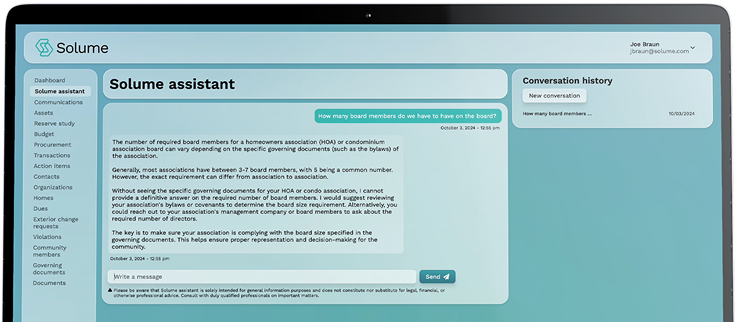
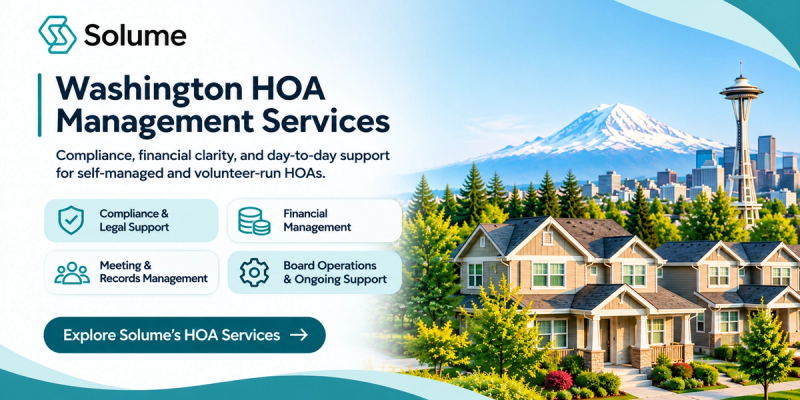
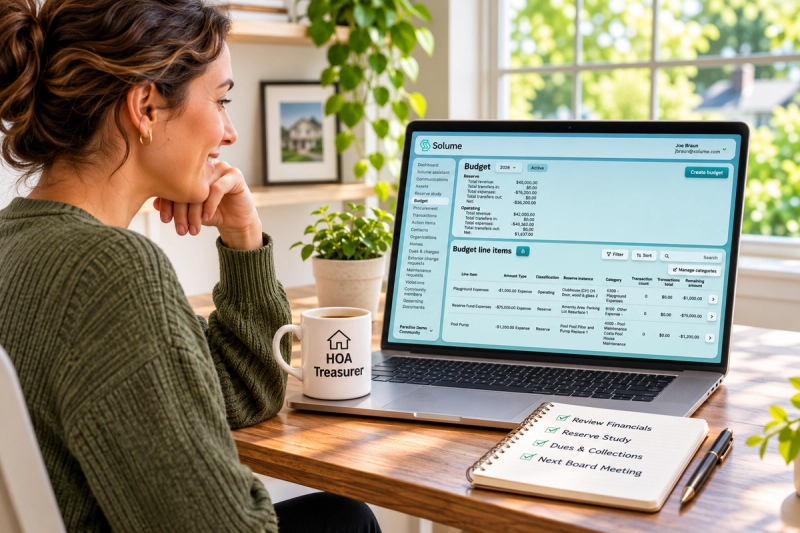
The practical fix is a system that enforces the process so the board doesn't have to remember every rule. That means centralized financial records any owner can be shown, documented meeting notices, organized ARC requests, and reserve data that updates instead of gathering dust. Solume was built specifically for self-managed HOA communities, pairing financial management and automated reserve study tools with compliance tracking so boards can meet Washington's disclosure requirements without a management company. Its AI assistant also helps boards organize governing documents and flag potential compliance gaps for review, though it does not substitute for legal counsel.
Here's the honest limit: software doesn't practice law, and this article isn't a substitute for legal advice. Practical tools reduce the odds of missing a statutory step and keep financial transparency built into daily operations, but boards should still consult their attorney for legal interpretation. Compliance is a habit the right tools make easier to keep.
Washington HOA laws will keep shifting until the 2028 consolidation settles them, and the boards that stay out of trouble treat compliance as an ongoing habit rather than a once-a-year scramble. If your board wants a clearer way to manage reserve planning, financial transparency, and compliance across Washington's two statutes, book a 15-minute call to see whether Solume fits your community. No pressure, just a straight look at whether it solves the problems your board is actually facing.
Frequently Asked Questions
Which law actually governs my HOA, RCW 64.38 or RCW 64.90?
If your community's CC&Rs were recorded before July 1, 2018, RCW 64.38 (the Homeowners' Associations Act) generally applies. Communities formed after that date fall under RCW 64.90 (WUCIOA), which will replace the older statutes entirely by January 1, 2028. Check your declaration's recording date to know which track applies to you.
What rights do I have as a condo or HOA owner in Washington?
Under RCW 64.38.045, you can inspect your association's financial records, meeting minutes, and annual statements on request. You're also automatically bound as a member once you own property in the HOA's jurisdiction, including vacant lots, so those same inspection rights apply to you from day one.
Can a homeowner legally opt out of an HOA in Washington state?
No. If your property deed references recorded CC&Rs that create the HOA, membership and assessments are mandatory regardless of whether you use shared amenities. The only realistic exit is selling the property or, in rare cases, a legal challenge to the covenant's validity itself.
How can homeowners hold their HOA board accountable?
Start by requesting records under RCW 64.38.045 to check budgets, reserve contributions, and meeting minutes against what the board reports. If discrepancies or governance failures continue, homeowners can raise the issue at an owners' meeting, request mediation through resources like WSCAI, or pursue legal remedies under RCW 64.38 or RCW 64.90.685.
Do Washington's bathroom access laws apply to HOA common areas?
Washington's bathroom access laws primarily govern public accommodations and employers, not private HOA-owned facilities like clubhouse restrooms. However, associations should still align restroom and facility policies with state nondiscrimination law to avoid liability, since common areas can be treated as quasi-public spaces in some disputes.
Is it worth tracking two separate HOA statutes instead of waiting for WUCIOA to fully apply in 2028?
Yes, because boards operating under the wrong statute risk invalid assessments, improper meeting notices, or unenforceable rule changes right now, not in 2028. Since WUCIOA already partially applies to older communities for certain provisions, boards need to track both RCW 64.38 and RCW 64.90 today, not treat the transition as a future problem.
What happens if a Washington HOA board just ignores RCW 64.38 requirements?
Noncompliance exposes the board to legal challenges from homeowners, including suits to invalidate assessments or force record disclosure under RCW 64.38.045. Washington courts have also awarded attorney fees to prevailing homeowners in governance disputes, making ignored compliance an expensive gamble rather than a shortcut.
How do Washington HOA laws differ from states like Florida or California on fee authority?
Washington HOAs derive assessment authority from both statute and governing documents, similar to California, but lack Florida's more rigid reserve-funding mandates tied to structural inspections. RCW 64.90 does strengthen financial disclosure requirements compared to the older RCW 64.38, narrowing that gap as the 2028 transition completes.