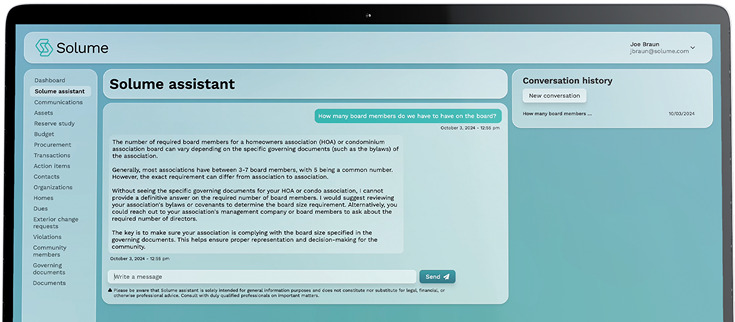
A landscaper stops showing up in July. The pool contractor's insurance quietly expired in April. Nobody on the board can find the original contract. This is how vendor management falls apart in a self-managed community: not through one big failure, but through a dozen small gaps nobody owned. Here's the hard truth: most boards don't have a vendor problem; they have a tracking problem. This article walks through what vendor oversight really involves, why it goes sideways, and how to build a system that outlasts any single volunteer.
Key Takeaways
- Vendor management for a self-managed HOA covers sourcing, contracting, monitoring, and renewal, not just hiring a landscaper.
- Lapsed vendor insurance is one of the most overlooked liability risks volunteer boards carry without realizing it.
- Vendor-related disorganization, not the vendors themselves, is a leading cause of board member burnout.
- Vendor oversight often falls to a single treasurer, creating gaps whenever that person rotates off the board.
- A documented vendor reference history protects future boards from inheriting above-market contracts or unreliable service providers.

What vendor management actually means for an HOA board
Most boards assume vendor management means "hiring a landscaper." In reality, it's the full cycle of sourcing, vetting, contracting, monitoring, and eventually renewing or replacing every provider a community pays: landscapers, roofers, pool crews, pest control, accountants, and attorneys. A sound vendor management process turns a pile of phone numbers and handshake deals into something a new board member can pick up and run, and boards that struggle with this often see the same self-managed HOA challenges show up again and again.
Here's why this matters: an HOA is a legal entity spending other people's money. The board has a fiduciary duty to ensure those dollars buy real value and that every vendor working on common property is properly insured and licensed. The Federal Trade Commission's guidance on vetting contractors and service providers outlines the same basic due diligence any buyer should apply: verify licensing, references, and written terms before money changes hands.
In self-managed communities, nobody handles this quietly in the background. No management company files certificates or chases vendor bids. The board becomes the vendor management function, so having a real process can be the difference between control and chaos.
Why vendor management matters for community stability and finances
Vendor spending is usually the largest line item in an HOA budget after reserves. Poorly managed, it quietly drains the money residents expect will protect their property values. What many communities don't realize is that vendor disorganization and underfunded reserves feed each other: when maintenance requests pile up and vendors aren't tracked, small repairs become deferred maintenance, and deferred maintenance becomes one of those special assessments nobody saw coming.
The stakes aren't theoretical. The 2021 Surfside condo collapse in Florida, which killed 98 people, was tied in part to years of postponed structural work and reserve shortfalls, as documented in reporting on the National Institute of Standards and Technology investigation. That tragedy reshaped reserve laws across several states and underlined what deferred vendor work can eventually cost.
Vendor management also improves financial transparency and supports fraud prevention. When every bid, contract, and payment is documented, homeowners can see where their dues go. That transparency builds trust, and trust keeps communities stable through budget votes, reserve planning, and tough dues decisions.
Why most HOA boards lose control of their vendors (common chaos signals)
Vendor management challenges rarely announce themselves. They creep in, and tracking down vendor data is one of the more persistent vendor management challenges boards face once things unravel. Here are the signals a board has already lost the thread: nobody can produce the current contract for a service the HOA pays monthly. Vendor bids live in three different inboxes. Insurance certificates are either missing or expired. The same vendor has been "handled" by whoever happened to answer the phone.
The root cause is almost always that vendor oversight sits with one person, usually the treasurer, and lives in their personal email. When that volunteer rotates off the board, the institutional memory walks out with them, and the new treasurer inherits a mystery.
Another chaos signal: maintenance requests get texted directly to vendors with no record on the board's side. A homeowner reports a broken gate, someone calls a repair crew, the work gets done, and no one documents what was authorized or paid. Multiply that across a year, and the budget stops matching reality. These gaps aren't signs of a lazy board. They're the predictable result of volunteer board members managing vendors from memory and goodwill instead of a system.

The vendor management lifecycle: from planning to offboarding
The vendor lifecycle gives a board a repeatable path instead of a scramble. It runs in five stages. First, planning and vendor selection: identify the need, request multiple vendor bids, and compare on scope and price, not just the lowest number. Second, vendor qualification and due diligence: confirm licensing, insurance, and references before signing anything.
Third, contracting and vendor onboarding: put the scope, price, term, and expectations in writing, and collect the documents you'll need to track. Fourth, performance monitoring: log service visits, maintenance requests, and complaints so you have evidence when renewal comes up. Fifth, vendor renewal or vendor offboarding: decide whether to keep, renegotiate, or replace based on the record you built.
Treating this as a vendor lifecycle instead of a series of one-off decisions makes vendor management survivable for volunteers, and it aligns closely with broader property management best practices across the industry. Each stage produces a document, and those documents become the handoff file for the next board. A community that follows this loop stops reinventing its vendor relationship every election cycle. Instead, it builds a reference history that protects everyone who serves after.
Contracts, scope, and onboarding vendors the right way
A vague contract is a future dispute. The most common mistake boards make during contract negotiation is accepting a vendor's one-page proposal as the agreement. That proposal protects the vendor, not the community. A usable contract spells out the exact scope of work, schedule, price and payment terms, term length, how either side can cancel, and proof of current insurance and licensing. Boards should also know that state HOA regulations on vendor contracts can affect notice periods, bidding requirements, and disclosure obligations, so it's worth reviewing the contract with the association's attorney before finalizing terms.
Vendor onboarding is where you collect and file the paperwork that protects the HOA later: the signed contract, a certificate of insurance naming the association as an additional insured, the business license, and a primary point of contact. Skip this step, and you're trusting that everything is fine without any evidence.
During contract negotiation, don't hesitate to ask for references from similar-sized communities. A reputable service provider will have them, and checking is part of sound vendor management. Here's why this matters: once a vendor is on your property and you rely on them, your bargaining power drops. Scope boundaries, response times, and insurance obligations are far easier to lock in before the first invoice than after a problem.
Ongoing performance monitoring and maintenance tracking
Signing a good contract is step one. Performance monitoring tells you whether the vendor is actually delivering. This is the stage where most HOA chaos lives, because it requires consistent effort rather than a single decision. The fix is a shared record every board member can see, which is why many boards turn to vendor review and rating tools to keep performance feedback consistent rather than anecdotal.
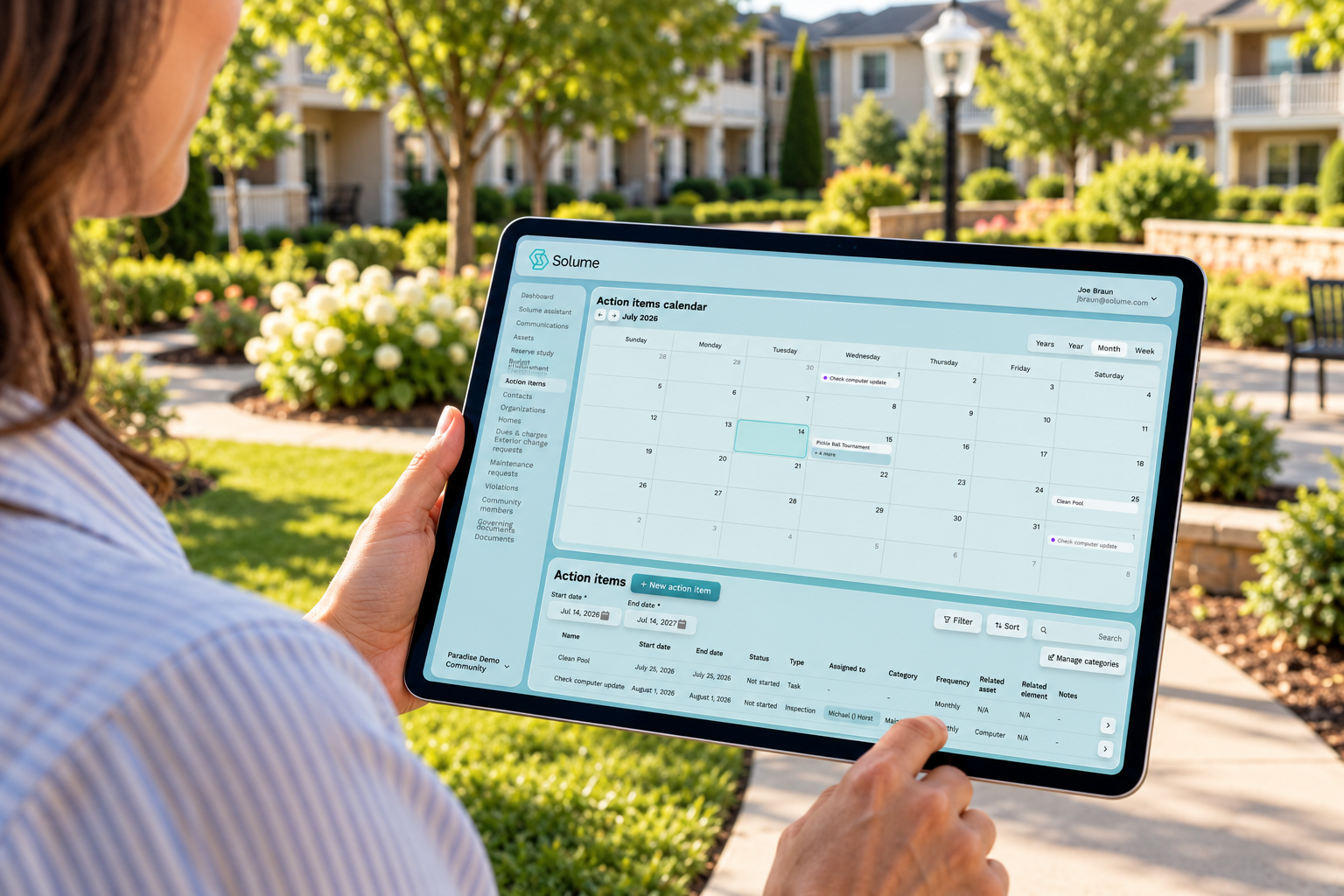
Good maintenance tracking means logging each request when it comes in, noting which vendor was assigned, recording when the work was completed, and flagging any complaint or missed visit. Over a year, that log becomes your evidence. Picture a community that trusts a landscaper's claim of weekly mowing with no log to check it against: when the grass is knee-high by August and dues are questioned, the board has nothing but memory to argue with, and the renewal conversation turns into a he-said-she-said. With a record showing three skipped weeks, that same conversation is settled in a sentence.
Centralizing this is where software earns its keep. Solume's maintenance tracking tools let a self-managed board log requests, assign vendors, and keep a visible history that any member can review instead of relying on one person's inbox. The benefit isn't just vendor accountability. The next treasurer inherits a complete picture instead of a shrug, and homeowners can see that reported problems actually got handled.
Vendor risk, compliance, and due diligence
The risk most boards overlook is the vendor whose insurance lapsed without anyone noticing. If an uninsured contractor falls off a roof on common property or damages a unit, the association may be left holding liability. Understanding the insurance and liability risks of uninsured vendors is part of the board's fiduciary duty, not an optional extra, since this is third-party risk management at its core.
Due diligence doesn't stop at vendor selection. Insurance expires, licenses lapse, and vendors change their coverage. Risk management and compliance require tracking renewal dates on every certificate, not just filing the original and forgetting it. This compliance risk is exactly why so many boards get caught off guard. Many assume a vendor's proof of insurance is checked once and then kept on file. In reality, that certificate has an expiration date, and an expired one offers zero protection.
Vendor rules also vary by location. Several states now impose specific requirements on reserve studies, structural inspections, and vendor qualifications, and those rules differ significantly from Florida to California to Nevada. Boards should confirm their obligations by reviewing their state's current HOA statute and consulting their association attorney for legal interpretation, rather than relying on general summaries. Documented due diligence protects against loss and shows the board took oversight seriously.
Vendor renewal, offboarding, and when to replace a vendor
A vendor renewal shouldn't be automatic. Too many boards re-sign by default because switching feels like work, and that's how a community ends up paying above-market rates for mediocre service year after year. Renewal season is a decision point: pull the performance record, compare current pricing against fresh vendor bids, and decide whether this one still serves the community.
Know when to replace. Repeated missed service, slow responses to maintenance requests, lapsed insurance, or pricing that has drifted above market are all signals. If you're renegotiating the same complaints every quarter, the vendor relationship has run its course.
Vendor offboarding deserves as much care as onboarding. Collect any keys, access codes, or association property. Confirm final invoices are correct, and nothing is double-billed. Document why the vendor was replaced so the next board understands the history and doesn't accidentally rehire a problem. A clean offboarding record, paired with notes on why a vendor was kept or dropped, is exactly the reference history that spares future volunteer board members from repeating a predecessor's mistakes.
What a vendor management system (VMS) is and how software helps
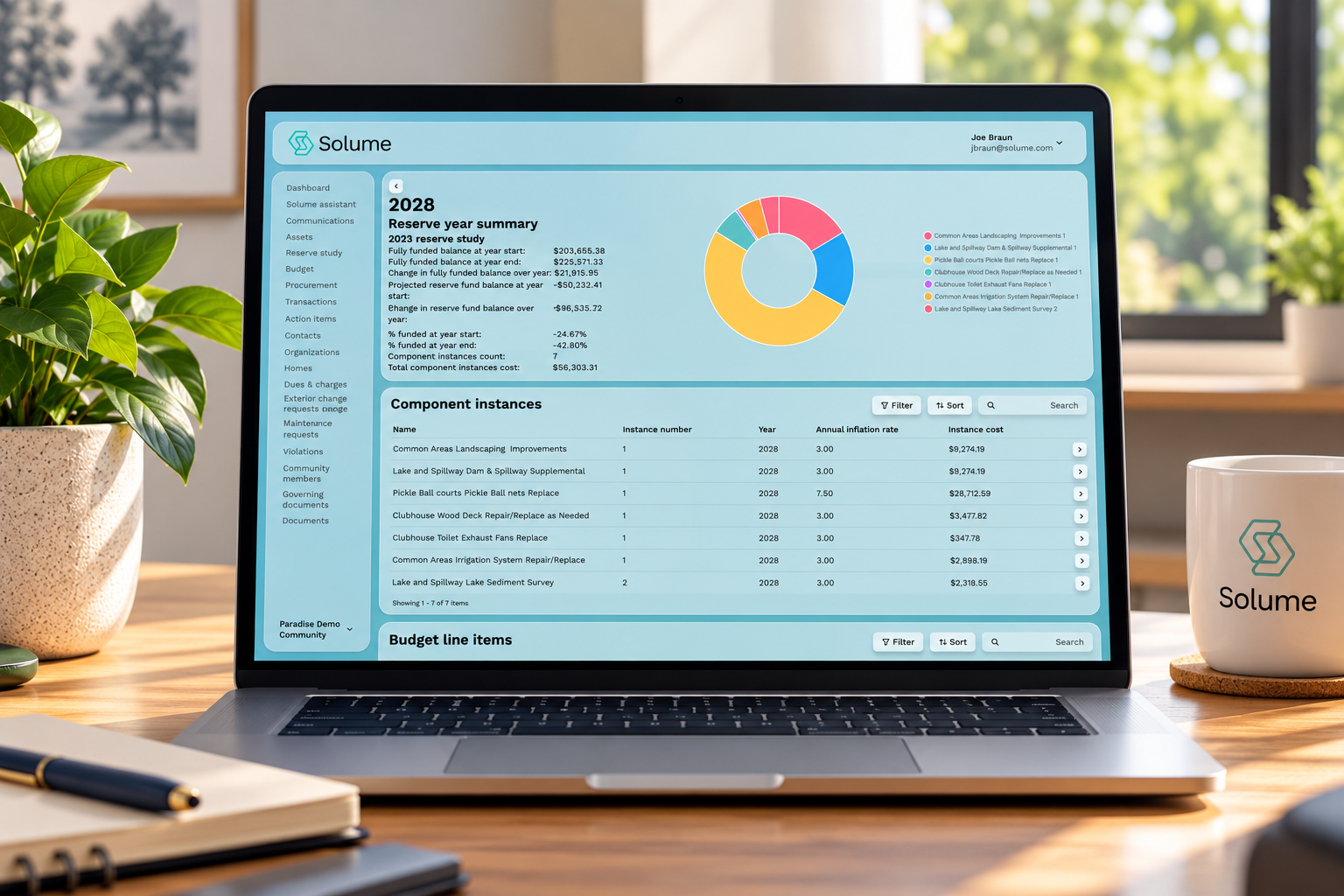
A vendor management system is a central place to store and track everything about every vendor: contracts, insurance certificates, bids, contact info, service history, and renewal dates. Instead of living in one volunteer's email, the vendor data lives in a shared system the whole board can access. That single change solves most of the chaos signals described earlier.
A vendor management system doesn't make judgment calls for you. It removes the memory burden. It flags an insurance certificate expiring next month. It shows which contracts come up for renewal this quarter. It keeps every maintenance request tied to the vendor who handled it. The board still decides; the software just makes sure nothing falls through the cracks.
In self-managed communities, HOA management software replaces the filing function a management company used to perform, without the monthly fee. Solume's vendor management and reference program centralizes vendor data and maintenance planning so boards keep oversight in-house, and participating in a shared vendor reference program means your community isn't starting its vetting from zero every time a new need comes up. A vendor management system isn't technology for its own sake. It's continuity, so the community's vendor knowledge survives every board turnover.
Vendor management best practices for volunteer boards
Start with the vendor management best practices that cost nothing but discipline. Require at least three vendor bids for any significant job, and never choose on price alone. Put every agreement in writing. Collect a certificate of insurance before a vendor sets foot on the property, and track its expiration.
Spread the responsibility. This responsibility should never rest on a single treasurer's memory, since volunteer board members rotate out and take their knowledge with them. Assign a backup, and keep all vendor data somewhere the whole board can reach, since continuity is the first thing to break when knowledge lives in one head.
More vendor management best practices to build into your routine: review vendor performance before every renewal, keep a running log of maintenance requests and outcomes, and document why you hired, kept, or replaced each vendor. These habits support financial transparency by making spending explainable to homeowners, and they support fraud prevention because clear records make it much harder for payments to go anywhere they shouldn't. None of this requires professional training, just a system and the consistency to use it. Good vendor management isn't about doing more work; it's about making sure the work already being done survives the next board turnover.
If your board wants a clearer way to manage vendor oversight, maintenance tracking, and financial transparency without a management company, you can see how Solume fits your community on a short 15-minute call. It's an honest conversation about whether a self-managed system makes sense for your situation, not a sales pitch.
Frequently Asked Questions
What does vendor management actually mean for an HOA?
It's the process of finding, vetting, contracting, and tracking the landscapers, repair crews, and service providers a community relies on. For a self-managed board, that means keeping bids, insurance certificates, contracts, and performance history organized without a management company doing it behind the scenes.
What are the four stages most boards use to manage vendors?
They generally break down into sourcing and vetting, contracting and onboarding, performance monitoring, and renewal or termination. Most HOA chaos happens in the monitoring stage, where boards lose track of expiring contracts or vendors that missed a service call three months ago.
Who handles vendor management if we don't have a management company?
In a self-managed HOA, this usually falls to the board treasurer or a designated committee member, which is exactly where burnout starts. Without a shared system, that responsibility often lives in one volunteer's inbox and disappears when they rotate off the board.
What happens if a vendor's insurance lapses and nobody catches it?
The HOA can be held liable if that vendor causes property damage or injury while working on-site without active coverage. This is one of the most common fiduciary risks volunteer boards face, since insurance renewal dates rarely get tracked consistently in spreadsheets.
Is poor vendor management a real stress point for board members?
Yes, board members consistently cite disorganized vendor bids, missed service calls, and unclear contract terms as a top source of frustration. Much of that stress comes from chasing paperwork rather than managing vendor relationships.
Can software actually replace the vendor vetting a management company used to do?
Software won't negotiate contracts for you, but it can centralize bids, store compliance documents, and automatically flag expiring insurance or contract renewal dates. The vetting judgment still belongs to the board, but the tracking burden shifts from a volunteer's memory to a system.