
A $40,000 special assessment lands in every owner's mailbox because the roof failed and the reserve fund held $12,000. Nobody planned for it. Now half the building is angry at a volunteer board that was just trying to keep dues low. This is exactly what a reserve study for a condo association is built to prevent. This article breaks down what a reserve study is, what it covers, who performs it, how it becomes a funding plan, and why skipping one puts both your money and your board's legal standing at risk.
Key Takeaways
- A reserve study for a condo association pairs a physical inspection of shared components with a 20 to 30-year financial projection to fund future repairs and replacements.
- Update frequency is dictated by state law; every three years in California, annually in Washington, and at least every 10 years for Florida's SIRS.
- Florida condo buildings three stories or taller must complete a Structural Integrity Reserve Study, with the first deadline set for December 31, 2025.
- Study costs scale with size and complexity, ranging from roughly $1,500 for small associations to $15,000 or more for amenity-heavy high-rises.
- Skipping or underfunding a reserve study shifts the risk to owners through surprise special assessments and can create fiduciary and compliance liability for the board.
What a reserve study is (definition for beginners)
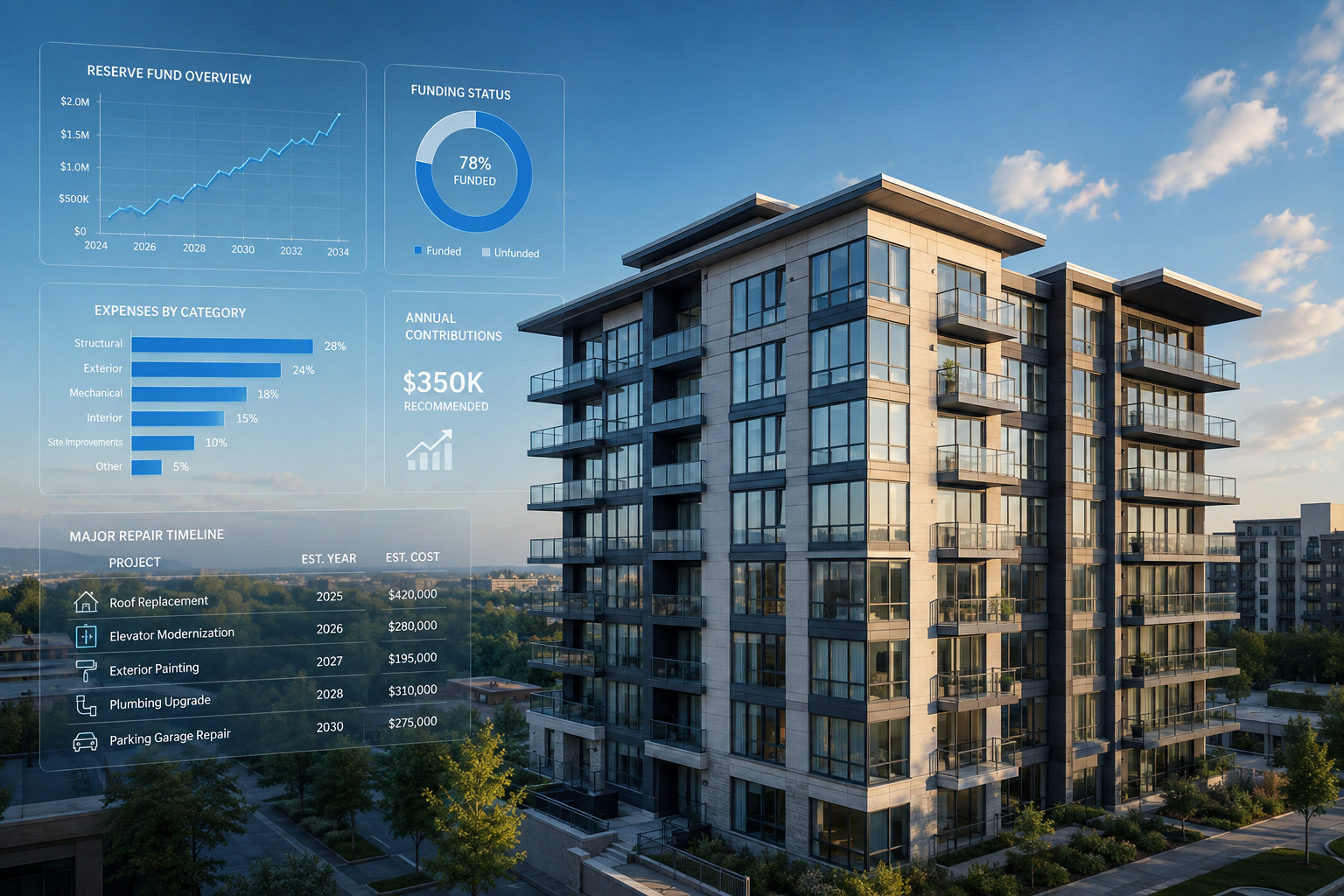
A reserve study is a report that answers two simple questions. What shared components will your community need to repair or replace over the next few decades? And how much money should you set aside each year to pay for it? Think of it as a capital planning tool that connects your building's physical reality to your condo association reserves.
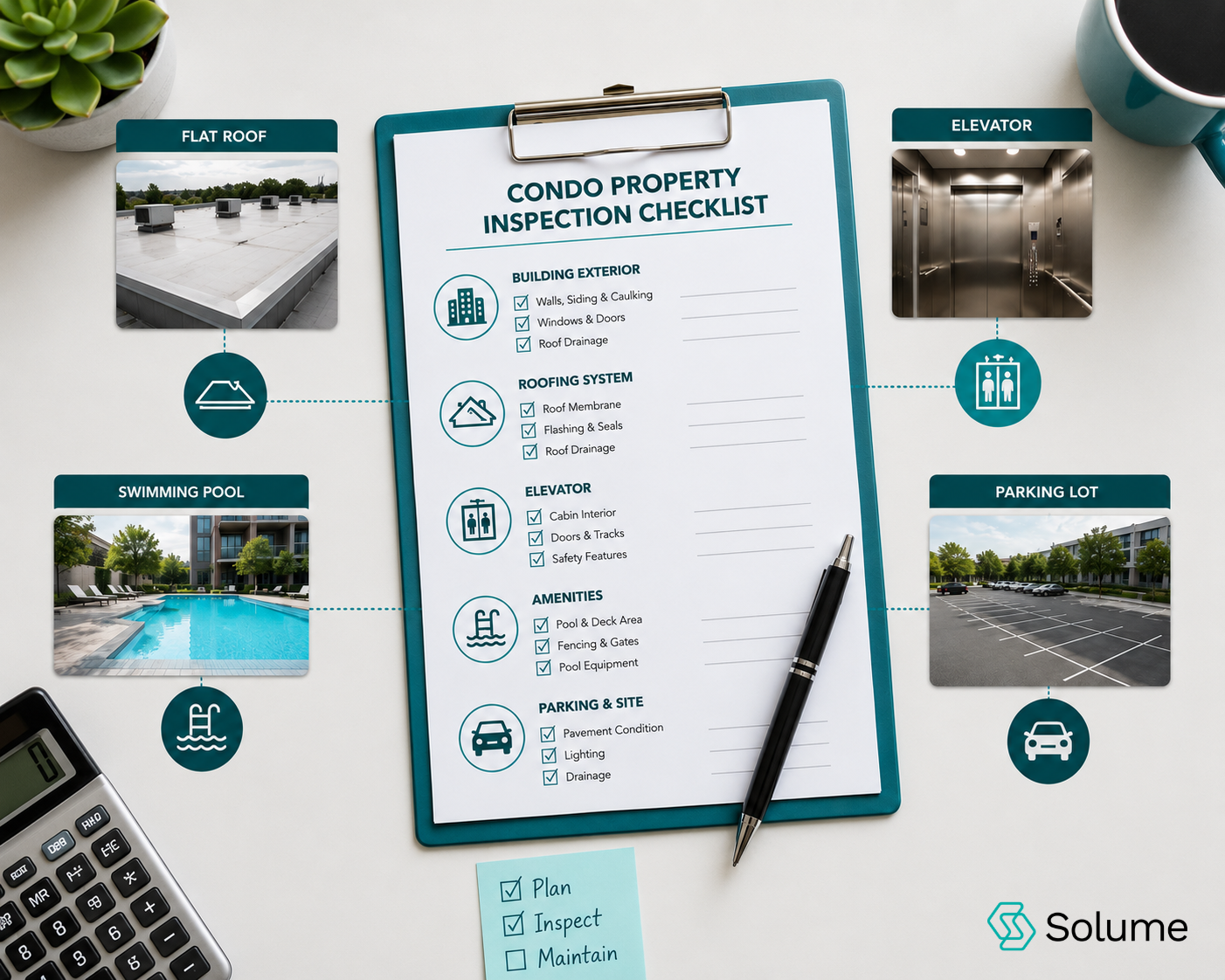
The study looks at the common elements a condo association owns collectively: the roof, the elevators, the pool, the parking lot, the exterior paint. It estimates when each one wears out and its replacement cost. Then it builds a plan so the reserve fund is ready when the bill for major repair and replacement arrives. Modern automated reserve study tools can help boards keep this data organized as conditions change.
Most boards assume this is a technical document only accountants care about. In reality, it's the backbone of long-term planning for a condominium association. The Community Associations Institute, the main trade body for community associations, publishes national reserve study standards that most professionals follow. You can review their reserve study standards through CAI. A reserve study for a condo association is not a suggestion box. It's the financial map for the next 30 years.
Which common components a reserve study covers (roofs, elevators, pools, etc.)
A reserve study covers the common assets the condominium association maintains, not the interior of anyone's unit. The general rule: if a shared component has a limited lifespan and a meaningful replacement cost, it belongs in the study.
Typical items include:
- Roofing and gutters, often the single largest reserve expense
- Elevators, where modernization can run six figures in a high-rise
- Pools, spas, and pool decking
- Asphalt and parking lot resurfacing
- Exterior painting and siding
- HVAC and boiler systems serving common areas
- Fencing, gates, and access control
- Clubhouse interiors, furniture, and fitness equipment
What gets included depends on your documents and state law. Florida's Structural Integrity Reserve Study, for example, generally requires structural common elements like the roof, load-bearing walls, and waterproofing to be funded, and generally restricts waiving reserves for them; you can read more about Florida's strict condo reserve study rules to see how they differ from other states. The Florida Department of Business and Professional Regulation publishes the condominium requirements and statutes here. Small stuff like light bulbs stays in the operating budget. The reserve study focuses on major projects, the ones big enough to sink a budget if nobody planned ahead.
The two parts of a reserve study: physical analysis and financial analysis
Every reserve study is built on two halves that depend on each other. Remove one and the report is useless.
The first half is the physical analysis. A qualified professional inventories every reserve component, inspects its condition, and estimates its remaining useful life and replacement cost. A 25-year roof that's 18 years old has about 7 years left, and that timing drives everything downstream. This is where the onsite inspection matters. You can't judge the wear on a boiler or a parking deck from a spreadsheet.
The second half is the financial analysis. This takes the physical data and models it against your reserve fund balance, projected inflation, and expected interest earnings to produce a funding plan. It tells the board how much annual funding is needed to stay solvent when replacements come due. This connects directly to building your community's annual budget, since the reserve contribution is a core line item that shapes everything else.
Here's why this matters. Because the funding plan is only as accurate as the component data feeding it, a beautiful physical inventory paired with weak financial modeling still leaves you with underfunded reserves. And a rosy financial plan built on bad component data will fail the moment reality hits. The strength of a reserve study for a condo association comes from both parts working together.

Types and levels of reserve studies (full, update with/without site visit)
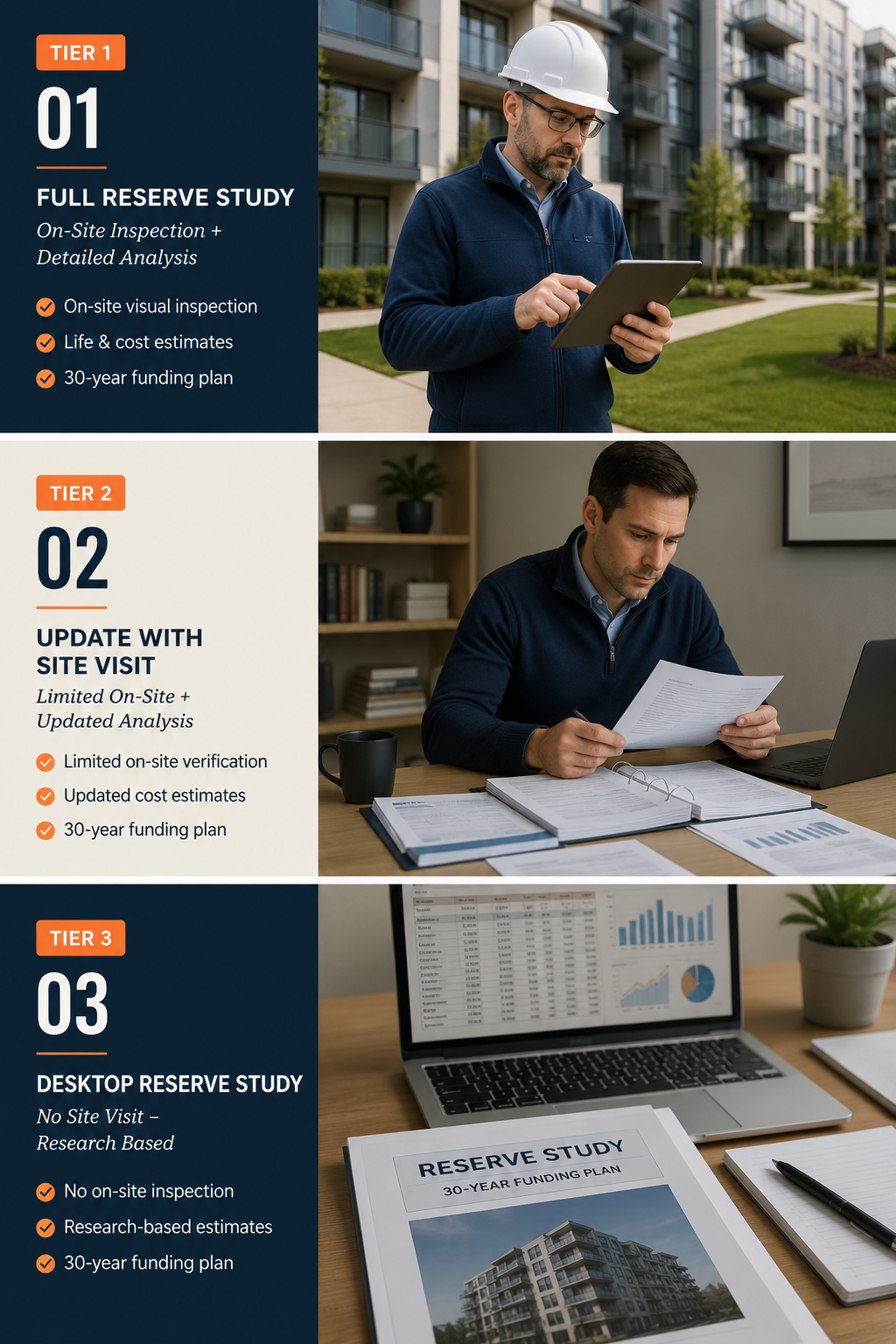
There are three standard types of reserve studies. Knowing which one you need saves money without cutting corners.
A Full Reserve Study is the deepest level. The specialist visits the property, builds the entire component inventory from scratch, measures and inspects everything, and establishes the baseline funding plan. Associations getting their first study, or those with outdated records, need this one.
An Update With Site Visit keeps the existing inventory but adds a fresh onsite inspection to re-check conditions and update remaining useful life. Component ages, costs, and reserve balances all get refreshed. Most associations do this every few years.
An Update Without Site Visit is a desk review. The professional updates the numbers, inflation, interest, and current reserve balance, without physically inspecting the property. It's cheapest and works well between site visits.
A common pattern: a full study to start, an update with a site visit every three years, and a no-site-visit reserve study update in between. Matching the study level to your point in that cycle keeps data accurate without inspecting every year. Because the right cadence often depends on where you're located, it's worth checking the reserve study requirements by state before settling on a schedule.
How a reserve study builds a funding plan and 30-year forecast
Once the physical and financial data come together, the study produces a 30-year forecast. That's the part board members actually use to make decisions. As a capital planning tool, this forecast lays out, year by year, which components need replacing, what each capital expenditure will cost in future dollars, and whether your reserve fund can cover it.
From that forecast, the study recommends a funding plan. Most reserve studies present a few approaches, from baseline funding that keeps you barely above zero to fully funded models that track the aging of your components dollar for dollar. The board picks the annual funding level that fits the community's tolerance for risk and dues increases.
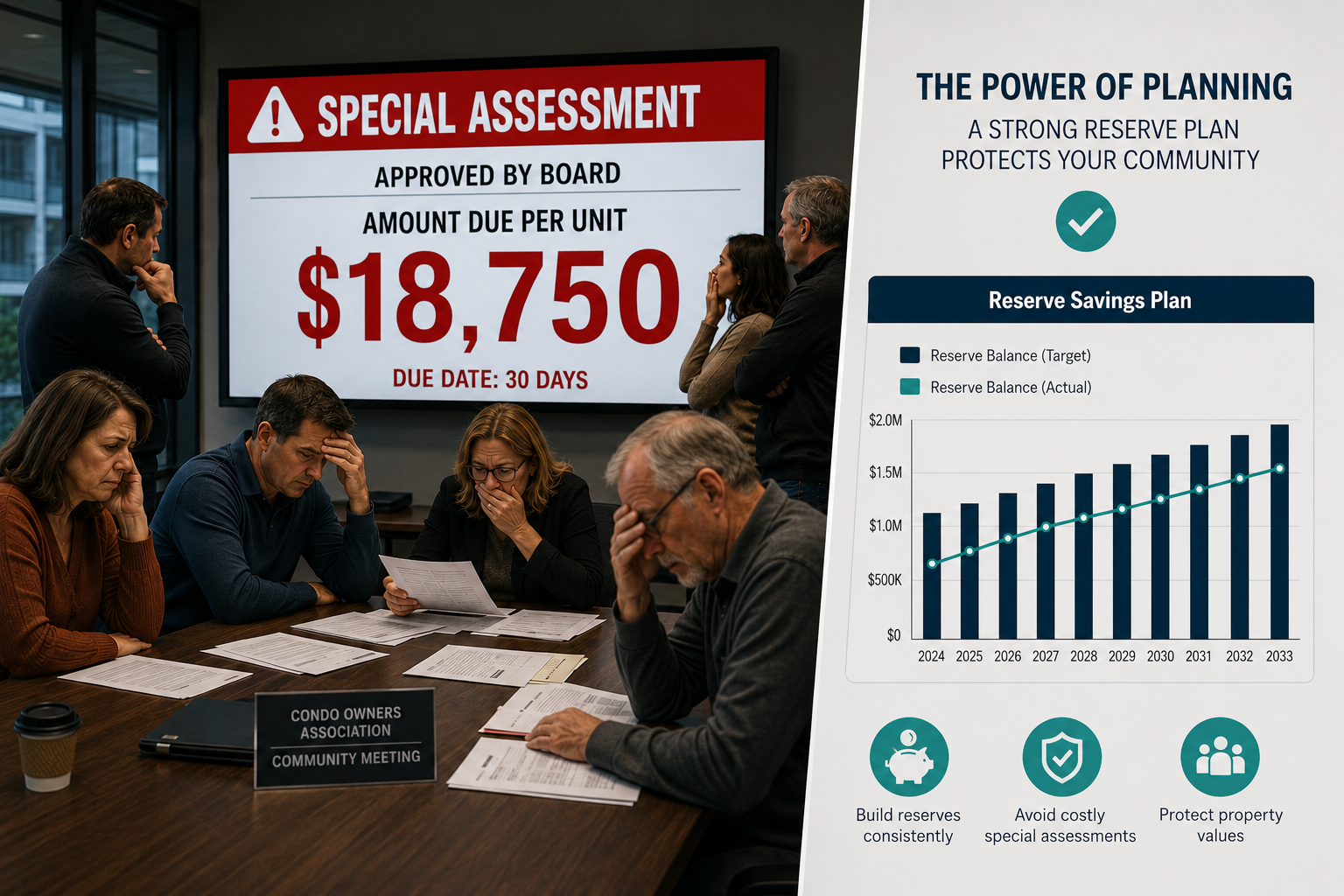
Here's the hard truth: a 30-year forecast isn't a prediction; it's a discipline. Prices shift, roofs fail early, interest rates move. What the forecast does is force steady, predictable contributions instead of panic funding. Consider a 40-unit building that funds its reserve account gradually and spreads a $500,000 roof over 25 years of small dues increases. A comparable community that ignores the forecast pays for that same roof in one brutal special assessment. This budget planning tool turns a scary future number into a manageable monthly line item.
Why a reserve study matters: avoiding special assessments and underfunding risks
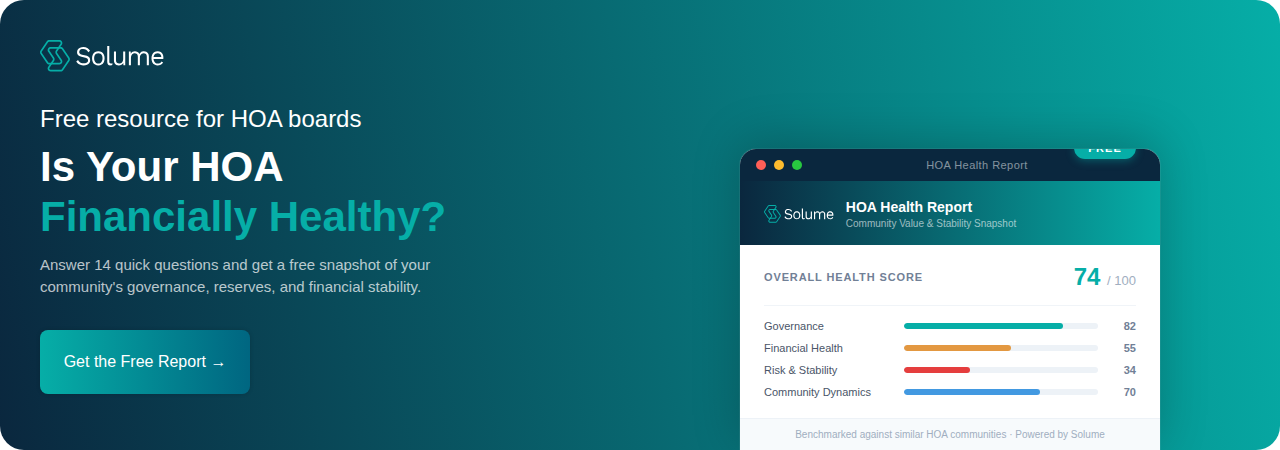
The risk most boards overlook is that underfunded reserves don't stay hidden. They surface as a special assessment, usually at the worst possible time, when a major repair and replacement is needed, and there's no money to fix it.
The risks of underfunding go beyond an angry membership. Deferred maintenance compounds because a small roof repair delayed lets water reach the units below, turning a patch job into a full replacement plus interior damage. Property values drop when buyers see thin reserves and looming assessments on the resale disclosure. Lenders increasingly scrutinize condo association reserves before approving mortgages, which shrinks your buyer pool.
The 2021 Surfside collapse in Florida, which killed 98 people, put a national spotlight on years of deferred maintenance and unfunded structural repairs in condo buildings. That tragedy prompted federal condo safety and reserve legislation and is a large part of why Florida now mandates a reserve study for a condo association at risk. The lesson for every board: reserves aren't a cushion, they're a liability you owe your future owners. Left unchecked, deferred maintenance keeps that liability hidden until it becomes a crisis.
Who conducts a reserve study (engineers, architects, reserve specialists)
A reserve study is only as trustworthy as the person who prepares it. This is not a job for the board treasurer with a spreadsheet.
The most recognized credential is the Reserve Specialist (RS) designation from the Community Associations Institute. A certified reserve specialist has met experience and education requirements for reserve planning and follows national standards for the physical and financial analysis. Many are also licensed engineers or architects, which matters when structural components are involved.
State law sometimes dictates who qualifies. Florida's SIRS generally must be prepared or verified by a licensed engineer or architect, not just any reserve specialist. Other states are less specific but still expect a credentialed professional.
Many assume any handyman or contractor can eyeball the building and produce a study. In reality, a contractor has an incentive to sell you work, while an independent reserve specialist has no stake in the repairs. That independence is the whole point. When you hire someone to conduct your reserve study, ask about their credentials, their standards compliance, and whether they carry professional liability insurance.
Transparency and fiduciary duty in reserve planning for board members
Board members owe the community a fiduciary duty. That means acting in the association's financial interest, not just keeping dues comfortable during your term. Reserve planning is where that duty gets tested most, and it works hand in hand with sound bookkeeping practices that keep every dollar accounted for.
A reserve study creates transparency. It gives owners a documented basis for why dues are set where they are and what the money protecting the common assets is meant to cover. When owners can see the funding plan and the 30-year forecast, trust replaces suspicion, and budget votes get less contentious.
Reserve study laws and compliance requirements vary significantly by state, so check your condominium association statute and confirm with your attorney what applies. In California, for instance, the California Civil Code Section 5550 reserve study requirements generally direct boards to conduct a visual reserve study inspection at least every three years and review it annually. Skipping a study required under those reserve study laws isn't a paperwork oversight. In compliance states it can be a breach that puts individual board members and their financial responsibility in question.
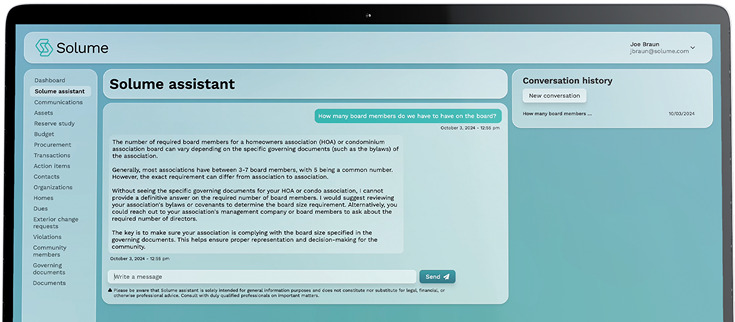
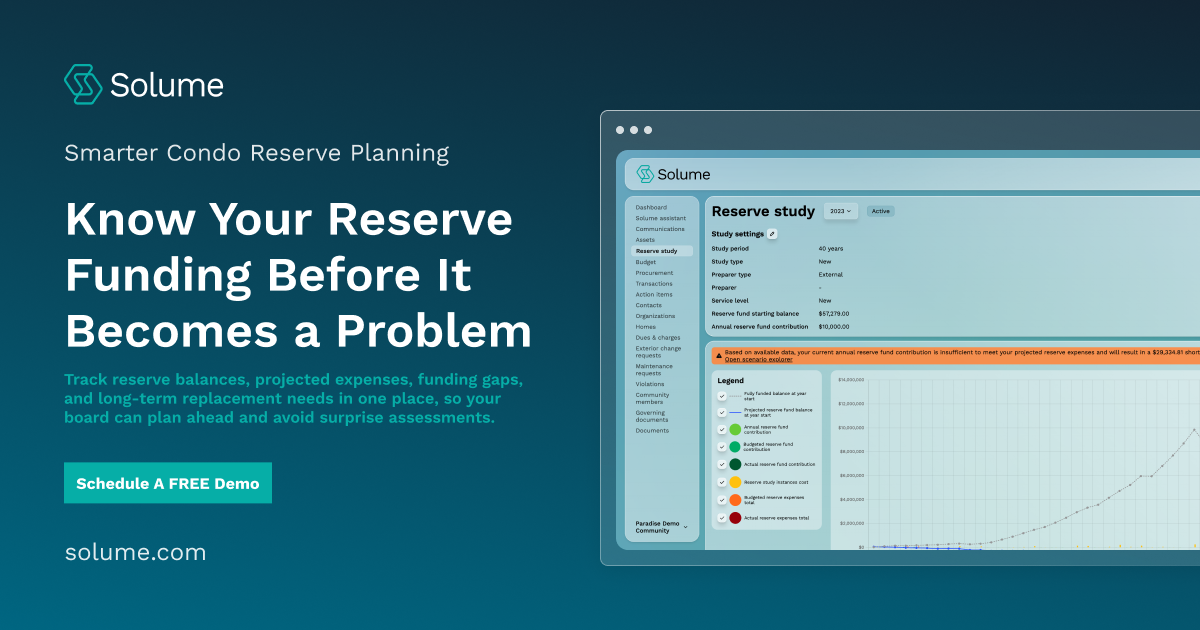
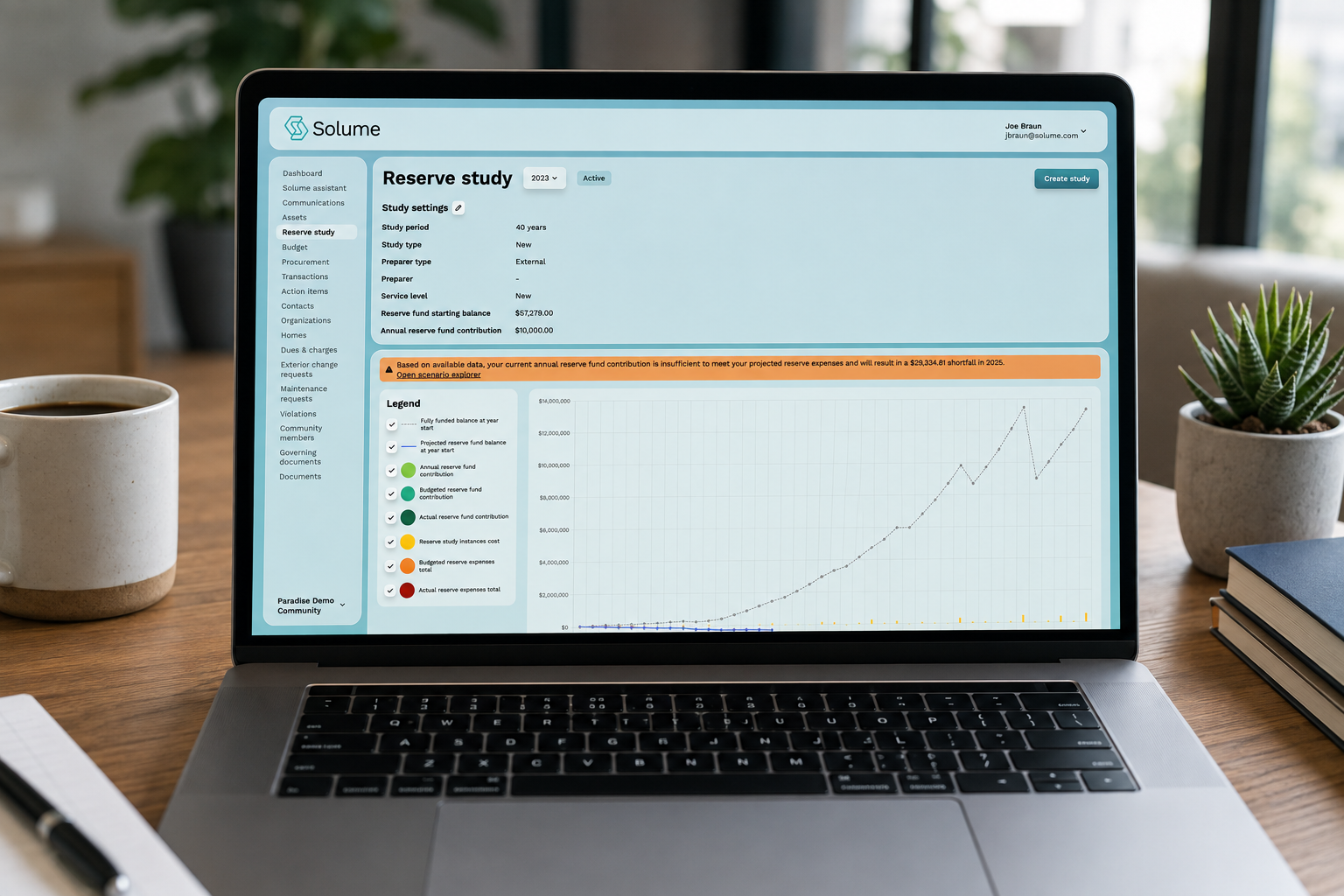
For self-managed communities and volunteer boards without a management company, keeping data, deadlines, and reporting organized is genuinely hard. Solume's automated tools and compliance tracking help self-managed communities keep their reserve funding plan current and their reporting transparent without hiring a firm. Pairing that as a budget planning tool with dedicated financial management tools for boards makes it easier to stay on top of both reserves and day-to-day finances. That openness is what separates a stable homeowners association from one lurching between assessments, and it protects the financial responsibility every board carries.
If your board wants a clearer way to manage reserve planning, compliance deadlines, and financial reporting without leaning on an expensive management company, you can book a 15-minute call to see if Solume fits your community. It's a short conversation, not a pitch, and it starts with your actual reserve situation.
Frequently Asked Questions
What exactly is a reserve study for a condo association?
It's a financial planning tool with two parts: a physical analysis that inspects shared components like roofs, elevators, and parking lots to estimate their remaining useful life, and a financial analysis that projects replacement costs over a 20- to 30-year period. The goal is a funding plan that prevents surprise special assessments.
Who is qualified to conduct a reserve study for our association?
Reserve studies are typically performed by credentialed reserve specialists, often engineers or professionals holding the Reserve Specialist (RS) designation recognized by the Community Associations Institute (CAI). Some states, like Florida, require SIRS reports to be prepared or verified by licensed engineers or architects.
How often does a condo association need to update its reserve study?
The Community Associations Institute recommends updating at least every three years, though requirements vary by state. California mandates a study every three years with annual reviews under Civil Code § 5550, Washington requires annual updates with a site inspection every three years, and Florida's SIRS must be updated at least every 10 years.
How much should we expect to pay for a condo reserve study?
Cost depends on your community's size, location, and complexity. Smaller associations under 50 units typically pay $1,500 to $4,000, mid-sized communities of 50 to 150 units run $2,000 to $5,000, and high-rises with elevators and extensive amenities can reach $5,000 to $15,000 or more.
What's the difference between a full reserve study and an update?
A full study includes a detailed on-site inspection to identify every component, assess conditions, and establish a baseline funding plan: usually done when an association has never had one or its data is outdated. An update refreshes that data periodically, either with a new site visit or as a no-site-visit review of existing figures.
What happens if our association skips or ignores its reserve study?
Underfunding usually surfaces as sudden special assessments or emergency loans when a major component fails, straining owners financially and lowering property values. In compliance states like Florida and California, skipping required studies can also expose the board to legal liability and fiduciary claims.