A board secretary resigns mid-term and takes six years of meeting discussion history with her, locked inside a personal Gmail account nobody else can touch. That single scenario has sunk more self-managed HOA boards than any budget shortfall. The communication tools most volunteer boards rely on- group texts, forwarded emails, a shared spreadsheet- were never built to hold institutional memory or stand up to a legal challenge. This article walks through what self-managed communities actually need to communicate well, stay compliant, and protect themselves when a decision gets contested, drawing on solutions built for self-managed communities that handle these exact problems.
Key Takeaways
- Communication tools become a legal necessity, not just a convenience, once an association faces a compliance dispute or contested vote.
- Group texts and personal email lose institutional knowledge the moment a volunteer board member resigns or turns over.
- State statutes in places like Florida and California can require associations to retain communication records, which free tools rarely support well.
- Centralizing resident requests into one hub cuts down the after-hours calls and texts that drive volunteer board burnout.
- A documented, timestamped communication trail is often the deciding factor when a board's decision is challenged in court or by homeowners.

Why self-managed HOA boards need dedicated communication tools (the chaos of email threads, missed notices, and transparency gaps)
Here's the hard truth: most disputes between boards and homeowners don't start over money. They start over who knew what, and when. A meeting notice sent to the wrong address list. An architectural approval nobody can find. A budget vote that half the community swears never happened. When communication lives in personal inboxes and text threads, there's no single record anyone can point to, and no proof a required notice actually went out. These breakdowns are among the common challenges self-managed boards face, and they tend to compound year over year without a system to catch them.
The mechanism behind this is simple: email and text were designed for private, one-to-one exchanges, so they scatter information by default instead of collecting it. A board inherits no shared memory from that structure, which is why every volunteer turnover feels like starting over. Dedicated communication tools reverse that default by storing every message and notice in one place the association controls.
Transparency gaps erode trust faster than any assessment. The Federal Trade Commission's guidance on record-keeping and consumer notices reflects a broader principle: if you can't document notification, in a regulator's eyes you often didn't. A self-managed HOA board faces that same standard without a management company's filing system behind it. Communities that have lived through a public breakdown in trust often turn to transparency solutions that rebuild resident trust only after the damage is already done.
Dedicated communication tools close that gap. They give volunteer board members a central place where every notice, vote, and resident message gets captured and stays searchable. The right communication tools, paired with solid internal communication tools for board-only discussion, make that record keep itself.
Types of communication tools every HOA board should have (broadcast announcements, two-way resident messaging, document/reference hub)
Not every message needs the same channel, and mixing them up is how boards lose track. There are three core types of communication tools a self-managed community should run. First, broadcast messaging for one-to-many announcements: pool closures, assessment reminders, meeting notices. Second, two-way resident communication so homeowners can submit questions, maintenance requests, and ARC items without flooding a personal cell phone. Third, a document and knowledge base where governing documents, budgets, and minutes live permanently.
Email and newsletters still handle the broadcast layer well, but they fail as a system of record because sent mail scatters across individual accounts. The Community Associations Institute publishes guidance on association governance and operations that repeatedly points to documentation as a board responsibility, not an optional nicety.
Separating these channels matters for a practical reason: when a two-way request lands in the same inbox as a broadcast blast, urgent homeowner issues get buried under routine announcements, and something falls through. Keeping them distinct means a leaking roof report doesn't sit unread behind a pool-closure notice.
Proper document management turns scattered files into an actual reference hub. When all three types of communication tools work together, residents stop asking the same questions and board members stop reinventing answers from memory.
Centralized communication hub vs. scattered tools: how an all-in-one platform replaces email, texts, and spreadsheets
Most boards assume stitching together Mailchimp, a Facebook group, Dropbox, and a dues spreadsheet is "good enough." In reality, every extra app is another place a record can disappear and another login a departing volunteer takes with them. A centralized communication hub solves this by keeping resident communication, document management, and announcements in one system the association owns, not an individual.
The move from spreadsheets to software usually happens the hard way. Picture a 90-unit condo association tracking dues in a shared spreadsheet and sending meeting notices by group text. A board member leaves, the spreadsheet link breaks, and the association spends three weeks reconstructing who paid what before an audit. All while a contested special assessment vote sits in limbo.
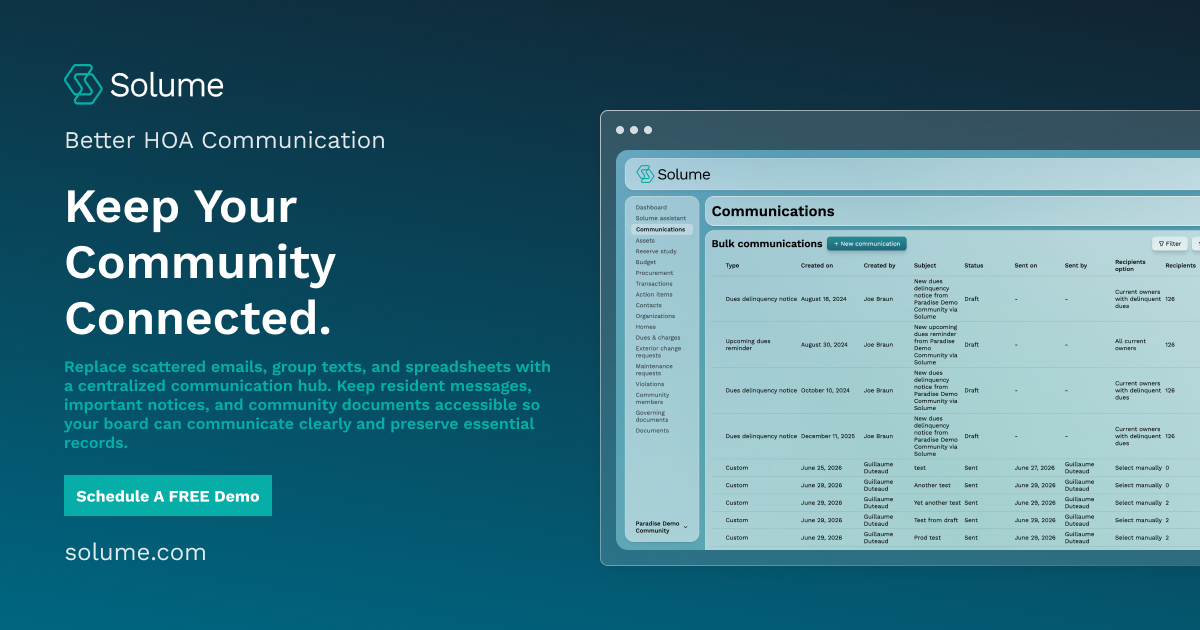
An all-in-one platform prevents that failure. Solume gives self-managed boards a single centralized communication hub tied to member records, so resident messages, notices, and documents stay with the community permanently rather than in a volunteer's inbox. The difference isn't convenience. It's continuity.

Must-have features to look for when choosing HOA communication tools
Choosing communication tools means skipping feature lists and starting with what fails your board today. A few must-have features separate real communication tools from repackaged email apps. Automated notices with delivery tracking let you document that a meeting notice went out and to whom. Broadcast messaging should reach every owner across email, text, and portal at once. A searchable document library should hold governing docs and minutes. Request tracking for maintenance and ARC request management matters too, plus vendor management so contractor work and invoices stay tied to the same record. And a mobile app matters, since most homeowners check their phone long before they'd log into a desktop portal, a reality borne out by mobile technology adoption trends tracked by Pew Research Center showing how dominant phones have become for everyday communication.
Record-keeping deserves its own line. The feature that matters most is often invisible until you need it: timestamped logs of who received each notice. Many boards assume any messaging tool documents itself. It doesn't. Consumer apps delete, forward, and lose messages with no audit trail.
Delivery tracking matters for a concrete reason: many state notice requirements hinge on documented notification, not just the act of sending, so a tool that logs delivery helps build a stronger record than an unverified one. That single mechanism is why delivery proof outranks nearly every flashier feature.
Surveys and polls are a useful bonus for gauging resident sentiment before a vote, and video meetings keep hybrid board meetings accessible. But documentation and delivery records are the non-negotiable must-have features for a self-managed HOA board.
How a resident communication hub supports transparency and board responsibility
Transparency isn't a slogan in self-managed communities. It's a defense. When homeowners can log in and see the same budget, minutes, and notices the board sees, the "what are they hiding" tension that fuels most HOA conflicts drops sharply. A resident communication hub makes board responsibility visible: decisions get documented, notices get logged, and the trail sits there for anyone who asks.
The root cause of most transparency complaints is asymmetry. The board has information homeowners can't easily access, so homeowners assume the worst. A centralized communication hub removes that asymmetry by publishing records once and making them available to everyone, which also supports volunteer board members personally. If a decision gets challenged, the trail helps show the board acted properly and on time.
Consider a board that approves a special assessment for a roof replacement and posts the bids, the vote tally, and the reserve shortfall that drove the decision to a shared hub the same week. When a handful of owners later claim the board acted in secret, the record answers them before the complaint gains traction. Without that trail, the same board spends months defending a decision it actually made correctly.
Solume's centralized communication hub ties resident messaging and document access together so owners see decisions as they happen. That turns transparency from a promise into a feature that lifts resident engagement and supports long-term community stability as trust in the process grows.
Communication tools and compliance: meeting notice, voting, and record-keeping requirements by state
This is where free tools quietly expose boards. Compliance requirements for meeting notices, voting procedures, and record retention vary significantly by state, and the penalties for getting them wrong are real. Florida's statutes impose specific notice and record-keeping obligations on associations, and California's Davis-Stirling Act sets its own rules for open meetings and member access to records. Boards should consult their attorney for legal interpretation, and the practical takeaway holds everywhere: having the ability to show owners were notified correctly and that the record was retained matters.
What actually happens in a dispute is that an attorney requests the notice and the documentation that it was sent. A text thread often can't produce that. Tools built for HOAs log automated notices with timestamps and keep voting records intact, which supports what compliance generally requires.
Because rules differ by state, boards should verify their specific obligations with their state's HOA statute or a qualified attorney before relying on any tool. The goal isn't to guarantee compliance, no software can, but to help your board manage compliance and reduce administrative risk.

How to get started: switching from email and spreadsheets to an HOA communication platform (step-by-step)
Switching from spreadsheets to software is less work than most boards fear, and the move usually takes a weekend, not a quarter. Step one: export your current member list and contact details into one clean file. Step two: gather your governing documents, recent minutes, and the current budget so they're ready to upload into a document library. Step three: import members and set communication preferences, email, text, or both. Step four: send a single welcome broadcast so residents know where official notices will now live.
The piece boards overlook is the cutover date. Pick one day after which all official resident communication runs through the new platform, and stop using the old group text entirely. Internal communication tools for the board, votes, discussion, shared files, should move at the same time so nothing stays stranded in a personal inbox. The reason a hard cutover matters is that two parallel systems guarantee a record ends up in the wrong one, which defeats the entire point of centralizing. Most platforms, including Solume, offer a free 30-day trial, so run a real meeting cycle through it before committing.
AI-powered communication: using an AI assistant for 24/7 resident questions and automated notices
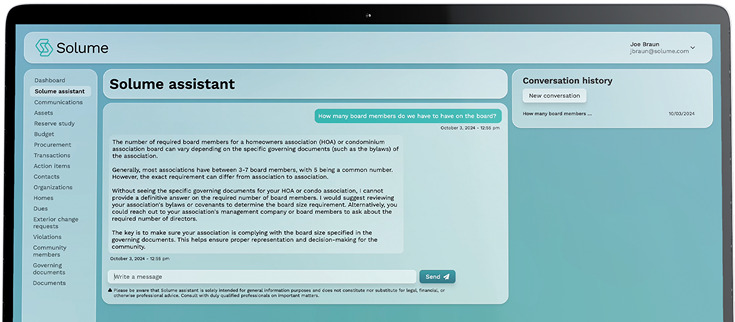
Volunteer board members don't have time to answer the same five questions every week. "When's the next meeting?" "Where do I pay dues?" "What's the pet policy?" An AI assistant handles those around the clock, pulling answers from your governing documents and knowledge base so residents get accurate responses at 11 p.m. without a board member touching their phone. This is one of the clearest examples of software designed for volunteer board members earning its keep, since it removes work rather than adding another system to manage.
The practical win is twofold. First, an AI assistant reduces the repetitive load that drives board burnout, because routine resident communication no longer interrupts dinner. Second, it improves accuracy. Instead of one board member guessing at a bylaw, the AI assistant answers from the actual document, which keeps the board consistent.
Solume's AI Assistant pairs that 24/7 support with team chat and instant messaging for the board itself, and can trigger automated notices for dues reminders and meeting announcements. Many assume an AI tool just deflects questions. In reality, a good one also surfaces when a question needs a human, routing genuine disputes to the board instead of improvising on matters it isn't equipped to decide.
The ROI of better communication for volunteer boards (less burnout, fewer disputes, higher dues compliance)
Boards rarely calculate what bad communication costs them, but the bill is real. Three returns show up consistently. Less board burnout, because volunteer board members stop fielding duplicate calls and texts once questions route through one hub. Fewer disputes, because a documented trail ends most "you never told me" arguments before they escalate. And higher dues collection, because automated notices and clear payment options remove the "I forgot" excuse that stretches delinquencies for months.
Consider the math on dues collection alone. An association carrying even a handful of chronically late accounts loses working capital it needs for maintenance and reserves, and chasing those payments eats volunteer hours. Automated reminders through proper communication tools recover both, supporting the community stability that keeps a self-managed board functional year over year. The subscription cost of HOA communication tools is usually a fraction of what one contested assessment or one emergency management-company contract would run.
The reason this ROI holds up is that most board costs are hidden in volunteer time and avoidable conflict, neither of which shows on an invoice. Better communication tools convert that invisible drain into a fixed, predictable subscription, which is why boards that make the switch rarely go back.
If your board is ready to replace scattered email threads and spreadsheets with one system built for self-managed communities, you can see how it works for your community on a short 15-minute call to find out whether Solume fits how your board already operates.
Frequently Asked Questions
What types of communication tools do HOA boards actually need?
Most boards need a mix of a centralized message hub, email or text alerts, document sharing, and a request-tracking system for maintenance and ARC items. Spreadsheets and group texts don't hold up once a community passes 50-75 homes, because messages get lost and there's no audit trail for disputes.
What communication skills matter most for board members using these tools?
Clarity, timeliness, documentation, consistency, and tone management matter most because boards are communicating decisions that affect homeowner finances and property rights. A board president who documents every vote and notice inside a shared platform protects the association legally if a decision is ever challenged.
What platforms do self-managed communities typically use for communication?
Many associations start with Facebook groups, Mailchimp, or basic email lists, then move to purpose-built HOA platforms once compliance and record-keeping become a concern. The shift usually happens after a board gets burned by a lost notice or an undocumented vote during an audit or legal dispute.
What are the 5 C's of effective communication in an HOA context?
Clear, Concise, Correct, Complete, and Courteous, these matter because HOA notices (special assessments, violation letters, meeting minutes) can become legal evidence. A violation notice missing required details under state statute can be thrown out, so completeness and correctness aren't optional for boards.
Is paying for dedicated communication tools worth it for a small volunteer board?
For associations under roughly 30 units with low conflict, free tools may suffice for a while. But the moment a board faces a special assessment, a compliance dispute, or turnover in volunteers, having a documented communication trail becomes worth far more than the subscription cost.
What happens if a board relies only on email and text for official communication?
Email and texts get deleted, forwarded incorrectly, or lost when a board member resigns, leaving no institutional record. Several state statutes (including Florida and California) require associations to maintain communication records, and gaps here create real exposure during audits or legal challenges.
Can communication tools reduce board burnout?
Centralizing resident questions, maintenance requests, and announcements into one system reduces the constant stream of individual calls and texts volunteer board members otherwise absorb. Boards using a single hub instead of juggling five apps report fewer after-hours interruptions, though the tool alone doesn't fix understaffed boards.
Do communication tools help with legal compliance, or just convenience?
Both, timestamped, searchable records of notices and votes are often the first thing requested in a compliance dispute or lawsuit. A platform that logs who received what notice and when gives boards something a text thread never can: a defensible paper trail.