Picture a volunteer treasurer in Mesa who raises dues 25% to cover a roof replacement and skips the membership vote. Six months later, the increase proves unenforceable. That mistake cost the association legal fees and a credibility hit it didn't need. Arizona HOA rules and regulations are more restrictive than most boards assume. The gap between what boards think the statute says and what it actually requires is where HOA disputes get expensive. This article covers the rules that trip up community associations most often, why they matter, and where HOA education tends to fall short, including the common challenges self-managed boards face when no one on the board has a legal background.
Key Takeaways
- Arizona HOA laws are built primarily on Title 33 of the Arizona Revised Statutes, split between the Condominium Act and the Planned Communities Act.
- Assessment increases in Arizona are capped at 20% per year without a membership vote, limiting how much a board can raise dues unilaterally.
- When CC&Rs and Arizona statute conflict, the statute overrides the governing document.
- Arizona has no single state agency enforcing HOA compliance, so most disputes route through ADRE's dispute process or the courts.
- Open meeting rules in Arizona restrict board decision-making to noticed sessions, limiting the use of informal or email-based consensus.

What Arizona HOA laws actually govern (overview of statutes and governing documents)
Most boards assume their CC&Rs are the final word. They aren't. HOA rules and regulations Arizona enforces live primarily in Title 33 of the Arizona Revised Statutes, split into two tracks: Chapter 9, the Condominium Act, for condo associations, and Chapter 16, the Planned Communities Act, for everything else. These statutes set the floor for how a homeowners association operates, covering assessment limits, access to records, and open meetings. Boards that want the full picture should read Arizona Revised Statutes Title 33 (Property) directly, rather than relying on a summary someone forwarded.
Here's the part that catches people: when your governing documents conflict with the statute, the statute wins. That hierarchy exists because the legislature wrote owner protections into the law that a private document can't bargain away. CC&Rs, bylaws, and board rules can be stricter in some areas, but they cannot strip owner protections the legislature wrote in. That hierarchy applies equally to HOAs and condos operating under the same roof of Title 33.
The state publishes the actual text, and reading it beats relying on secondhand summaries. Pull the Planned Communities Act directly from the Arizona State Legislature's statute database. Boards that build their rules around the statute itself, not a management company's take on it, make fewer costly mistakes.

Open meeting and recording requirements boards misunderstand
Board meetings in Arizona are, with narrow exceptions, open to members. That single rule dismantles a lot of common practice. Arizona treats the decision-making process as a transparency obligation, not an internal convenience, because members can't hold a board accountable for a decision they never saw made. A board that reaches consensus through a chain of emails, then "ratifies" it at a quick public meeting, has already made the decision in the dark.
Many assume a quorum of board members texting about a vendor bid is harmless. In reality, that can count as an unnoticed meeting. Decisions belong in noticed board meetings where members can attend; executive sessions exist only for narrow matters like litigation, personnel, attorney-client discussions, and member payment issues, not routine business.
Recordings are another gray zone. Arizona statute permits members to record open board meetings, and boards cannot flatly prohibit it, though reasonable rules on method are allowed. Some associations now archive meeting recordings alongside minutes, so owners who missed a session can review what happened, a step that doubles as HOA education for newer members. The National Conference of State Legislatures provides useful background on state-level common-interest community governance, which helps boards see how Arizona's rules fit a broader pattern.

2025 legislative changes affecting Arizona HOAs and condos
Arizona's legislative session produces a steady stream of changes to Title 33, and boards that don't track them inherit the risk. The 2025 legislation summary that matters most to community association boards centered on owner rights: tightening requirements around notice, fines, and how associations handle flags, political signs, and certain exterior features. Any bill signed by the governor becomes binding once it reaches its effective date, whether or not your board read it. For a reliable way to stay current, Community Associations Institute's Arizona legislative updates track these changes as they move through the legislature.
Many communities don't realize that new laws rarely arrive with a courtesy notice in your mailbox. A statute can change in spring, take effect months later, and leave your governing documents technically out of step, and that lag is where enforcement issues start.
Boards should also watch pending legislation each year, since proposals that stall in one session often return in the next. Reviewing the 2025 legislation summary alongside pending legislation gives boards time to update policies before the effective date, not after. For precise bill language, check the Legislature's bill tracker rather than news recaps, which often compress or misstate what the statute requires.
Common compliance mistakes and how disputes arise
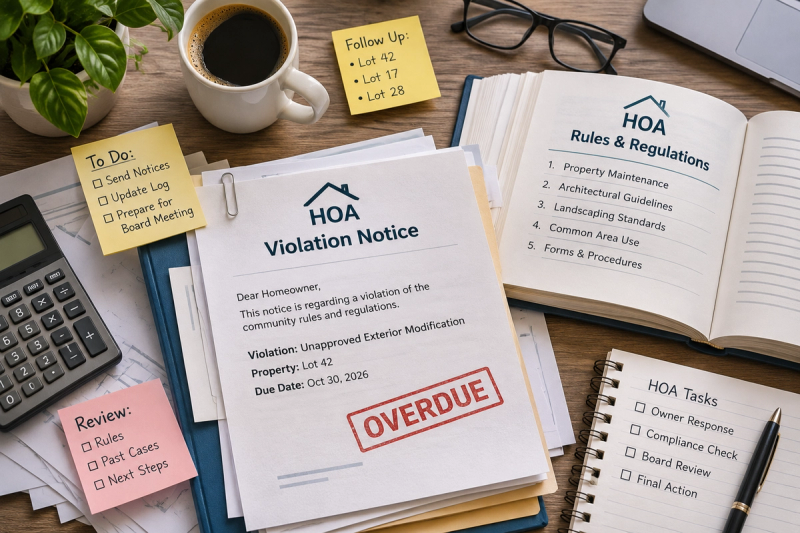
Most HOA disputes don't start with bad intentions. They start with a procedural shortcut. Picture a self-managed community that fines an owner for an unapproved fence without sending the required notice or offering a hearing. The fine may not hold up on process grounds alone, leaving the association defending a mistake it didn't need to make.
The recurring errors are predictable: raising assessments past the 20% cap without a vote, denying homeowners access to records, skipping proper meeting notice, and enforcing rules your HOA may not actually be able to enforce. Selective enforcement is another trap. Fining one owner for a violation the board ignored next door invites a discrimination or fairness challenge.
The root cause is usually documentation, or the lack of it. When a board can't show it followed notice, hearing, and voting procedures, it weakens its position even when it was right on the merits. Compliance tracking that logs each step- the notice date, the hearing offer, the vote- turns a he-said-she-said HOA dispute into a defensible record. Arizona community managers should confirm which chapter, condo, or planned community actually governs the association they're running, and consult an attorney when questions of interpretation arise.
Board responsibilities and fiduciary duty under Arizona law
Serving on a board is not an honorary title. Board members in Arizona owe a fiduciary duty to the association, meaning they must act in good faith, in the community's interest, and with reasonable care. Volunteer board members are held to the same standard as paid members for financial stewardship and compliance, since that duty doesn't disappear just because someone serves unpaid.
Board responsibility covers the unglamorous work: maintaining adequate reserves, approving realistic budgets, and handling special assessments through the proper process. This kind of board responsibility is central to Arizona's reserve study requirements, since deferring maintenance to keep dues low often sets up a far larger special assessment later, which can itself raise questions about the duty to plan ahead.
The risk most boards overlook is personal exposure. When a board ignores its own governing documents or Arizona statute, individual members can face claims the association's insurance may not fully cover. Fiduciary duty also demands transparency. Members have a right to understand how their money is spent, which is exactly why accurate homeowner records and open financial reporting aren't optional niceties.
Enforcement, fines, and homeowner records access rights
Arizona caps HOA fines more tightly than many boards realize. Late fees on unpaid assessments are limited to the greater of $15 or 10% of the overdue amount, and only after the payment is 15 or more days late. Violation fines must follow a notice-and-hearing process; skip it, and the fine is vulnerable to challenge.
Records access is where owners most often catch a board off guard. Under HOA regulations Arizona sets by statute, homeowners association members have broad access to financial statements, meeting minutes, contracts, and reserve information, usually within 10 business days of a written request. A board can charge reasonable copying costs but cannot simply refuse. Denying homeowner records is one of the fastest ways to end up in the state's dispute process.
Because Arizona has no single agency policing day-to-day HOA conduct, enforcement issues flow through the Arizona Department of Real Estate's dispute process or the courts. HOA managers and the property management firms that support them should treat records requests and fine procedures as compliance priorities, not clerical afterthoughts. The practical fix is organized homeowner records and a documented fine history any board member can produce on request.

Why self-managed and volunteer boards get Arizona laws wrong
Self-managed communities don't get Arizona laws wrong because they're careless. They get them wrong because nobody handed them the statute or any real HOA education. A retiree who volunteers as treasurer is suddenly responsible for interpreting Title 33, tracking a legislative session, and running meetings by the book, often with zero legal or accounting background.
The structural problem is turnover and institutional memory. Volunteer board members rotate every year or two. The person who understood the assessment cap leaves, notice procedures drift, and the next board inherits practices that quietly fell out of compliance. Without steady education, each board relearns the same lessons, sometimes through a dispute.
Self-managed communities also tend to assume their governing documents are complete and current. In reality, CC&Rs written decades ago may conflict with newer statutes, and the board won't know until an owner points it out. This is exactly where HOA software built for Arizona communities helps: platforms like Solume centralize governing documents, records access, and compliance tracking so knowledge doesn't walk out the door when a term ends. That discipline isn't only for communities that hire a property management company; self-managed boards need the same structure.

Using compliance tracking and software to stay current with changing laws
Keeping up with HOA rules and regulations in Arizona, which change each session, is a losing game without the right tools. Your governing documents sit in a filing cabinet, and the one spreadsheet tracking violations lives on a former treasurer's laptop. Compliance tracking fixes the mechanism behind most failures: lost documentation and missed procedural steps.
Good software turns compliance from memory into a system. It timestamps meeting notices, logs the hearing offered before a fine, stores homeowner records and meeting recordings where any authorized board member can retrieve them, and keeps reserve planning numbers current so special assessments don't arrive as surprises. That record is what helps a board when an owner challenges a decision.
Solume was built specifically for self-managed communities, automating dues collection, centralizing communication, and integrating reserve study tools and compliance tracking that most legacy HOA software ignores. For a community association juggling meetings, enforcement, and new laws, that structure can be the difference between a documented process and a vulnerable one. Software won't interpret the law for you; boards should still consult their attorney for legal questions, but it keeps the transparency and documentation Arizona expects within reach.
If your board wants a clearer way to manage finances, reserve planning, and compliance under Arizona HOA laws, book a 15-minute call to see whether Solume fits your community. No pressure, just a straight look at whether the system solves the problems your board is actually dealing with.
Frequently Asked Questions
What laws actually govern HOAs in Arizona?
Arizona HOAs operate under Title 33 of the Arizona Revised Statutes: Chapter 16 covers planned communities (ARS § 33-1801 et seq.) and Chapter 9 covers condominiums. No state agency directly regulates HOA operations, but the Arizona Department of Real Estate runs a dispute resolution process for owner-board conflicts.
Can my HOA raise my dues as much as it wants?
No. Regular assessment increases are capped at 20% per fiscal year without a vote from the membership. Late fees are also capped at the greater of $15 or 10% of the unpaid balance, and only after the payment is 15+ days late.
If my CC&Rs conflict with Arizona law, which one wins?
State statute wins. Arizona law sets mandatory minimums and owner protections that CC&Rs, bylaws, or board rules cannot override, even if the governing documents were recorded first.
Are HOA board members allowed to discuss business outside of meetings?
Arizona's open meeting requirements mean most board decisions must happen in noticed meetings, not in informal side conversations or email chains used to reach consensus. Boards can hold executive sessions only for narrow matters like pending litigation or personnel issues, not routine business.
Does Arizona require HOAs to get regular financial audits?
Arizona law doesn't impose a blanket audit mandate on every HOA; requirements typically come from the association's own governing documents or bylaws. Boards should check their CC&Rs directly, since assuming 'the state requires it' can leave a real compliance gap unaddressed.
Is it even worth learning Arizona HOA law if my board already has a management company?
Yes, because management companies execute decisions, but the board still holds fiduciary and legal responsibility under ARS Title 33. Boards that don't understand the statute often rubber-stamp vendor recommendations they can't actually evaluate.
What happens if my Arizona HOA board breaks these laws?
Owners can use the ADRE's HOA Dispute Process (under Title 32, Chapter 20, Article 11) for violations like denied records access or improper meeting notice, which is faster and cheaper than litigation. For larger disputes, Arizona courts have ruled against HOAs that overstepped statutory authority, as seen in cases like Mason v. La Glorieta.
Do Arizona HOA laws cover things like air conditioning units or exterior rules?
Arizona law doesn't set statewide technical standards for AC units; local building codes and the HOA's architectural guidelines handle that. State law does govern whether the HOA's enforcement process for these rules follows required notice and hearing procedures.